Using Royalty-Free Music On YouTube Without Collecting Copyright Claims
For a long time I believed that crediting the artist in the description was enough. Name the track, link the source, done. It felt like the honest thing to do, and honest felt like it should be sufficient.
Then one of the best-performing videos I had at the time picked up a claim within minutes of going live. The revenue on it went to almost nothing. Worse, that video was the one pulling recommendations toward the rest of the channel, so the damage was not contained to a single upload.
That was the week I stopped treating music as the last thing you drop in before exporting.
First, know which thing you are looking at
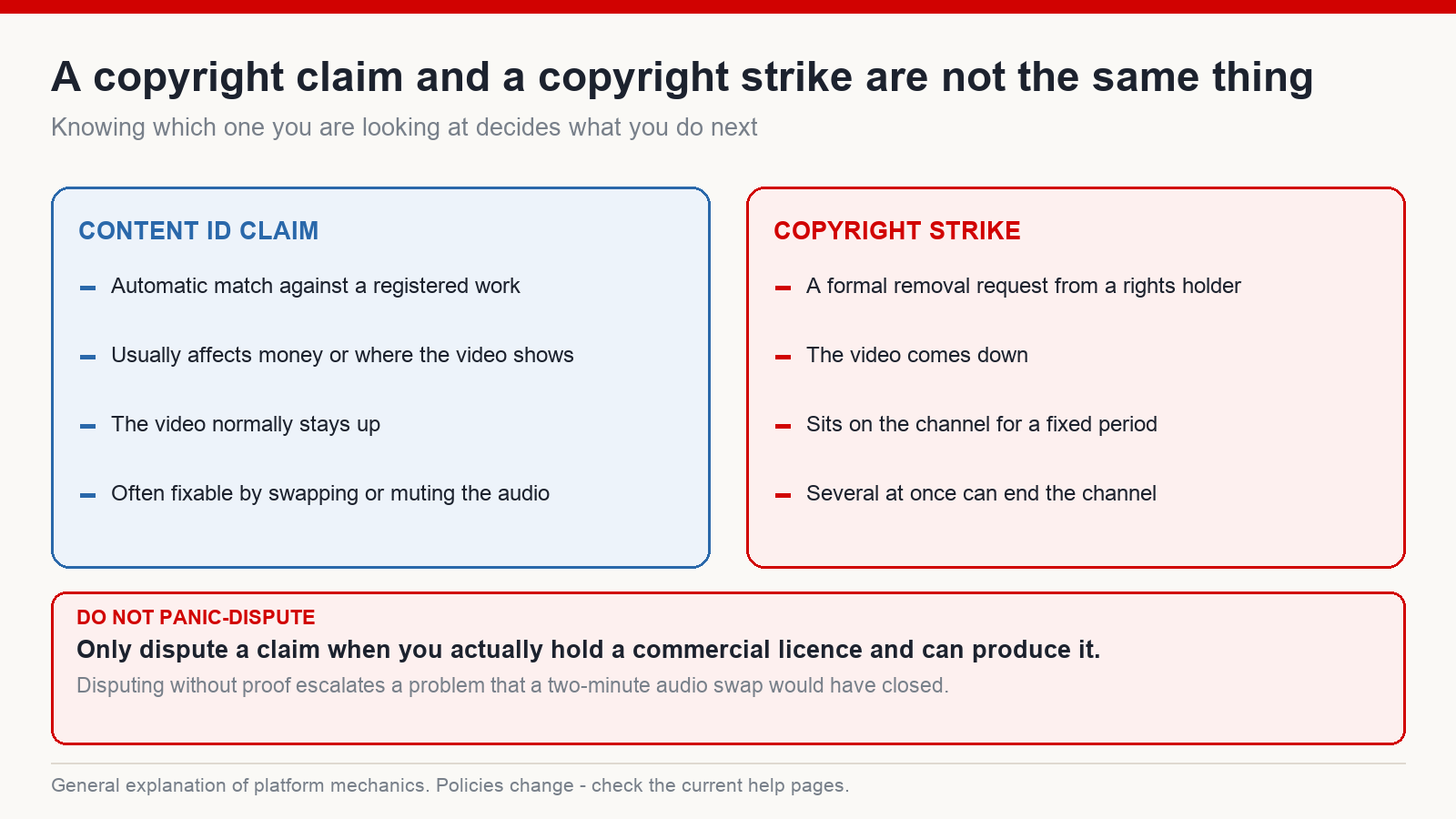
A claim and a strike are different animals, and people conflate them constantly.
A claim is automatic. A fingerprinting system matched something in your video against a registered work. Usually it affects monetisation or where the video can be shown; the video normally stays up. In many cases you can resolve it in a few minutes by muting or replacing the offending audio in the studio interface.
A strike is a formal removal request from a rights holder. The video comes down. It sits on the channel for a fixed period, and accumulating several is how channels end.
The practical consequence: do not panic-dispute. Disputing is for when you genuinely hold a commercial licence and can produce it. Filing a dispute you cannot back up turns a two-minute audio swap into a real problem.
Why “free” music keeps causing claims
The word free is doing a lot of unearned work on the internet. Most of what is described that way is free to listen to, free for personal projects, or free on condition of an attribution format that almost nobody follows exactly.
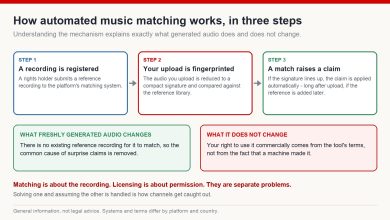
None of that is the same as a licence covering commercial use on a monetised channel. And fingerprinting does not care about your intentions – it matches audio. Remixes, slowed versions, sped-up versions and small pitch shifts are all still detectable.
The specific sources that cause the most trouble, in my experience: tracks trending on short-form platforms, files pulled from random uploads, MP3s from sites with no licence page, and audio baked into editing templates. That last one catches a lot of people, because the template feels like it came with permission attached. It did not.
Three sources that actually hold up
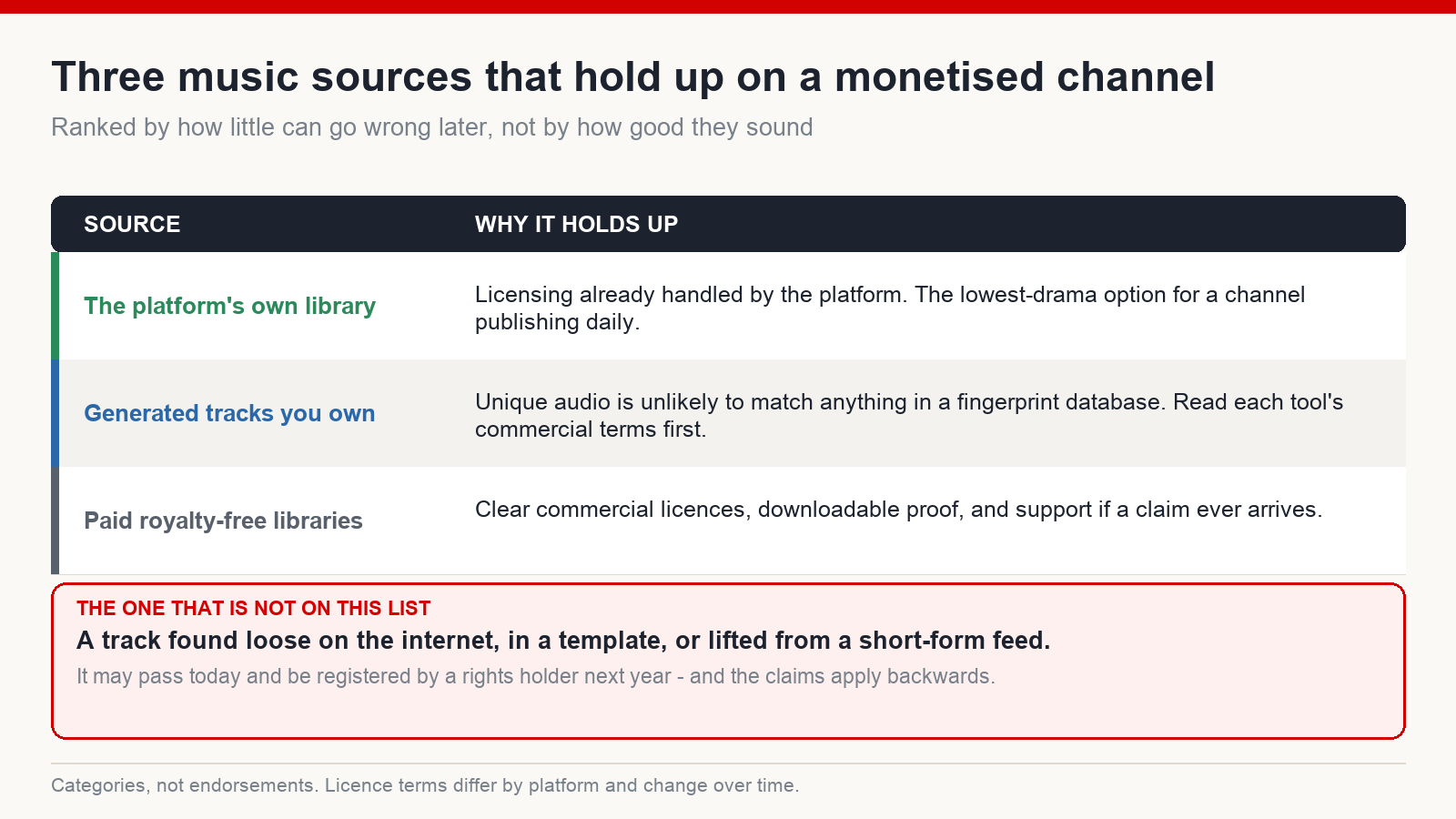
Ranked by how little can go wrong later rather than by how good they sound:
The platform’s own audio library
If you are publishing regularly and want the fewest possible surprises, start here. The licensing is handled by the platform itself, so you are not exposed to a third party registering the work later, or to ownership changing hands. It is filterable by mood and length, and it is free. The trade-off is that a lot of channels use it, so the well-known tracks are recognisable.
Tracks you generate yourself
Generation tools have changed this category considerably. A track produced for your video is unlikely to match anything in a fingerprint database, which removes the retroactive-claim risk almost entirely, and it lets a channel develop an audio identity of its own.
The caveat is real though: read the commercial terms of whichever tool you use. Not every service grants unrestricted commercial rights on every tier, and the terms change. Screenshot the terms page on the day you generate. That takes ten seconds and it is the whole of your evidence if anyone ever asks.
Paid royalty-free libraries
If you want a more cinematic sound, subscription libraries are worth the money. What you are really buying is not the audio – it is the clear commercial licence, the downloadable proof of it, and in some cases active support if a claim arrives anyway. If you run more than one channel or produce for clients, that support is the thing that justifies the cost.
Credit is not a licence
Worth saying plainly, because it was my own mistake: writing “I do not own this music” or “credit to the owner” in a description grants you nothing. It is not a legal instrument. It does not create permission that did not exist.
Attribution matters only when a licence specifically requires it – some open licences do, and they usually specify the exact format: artist name, source link, licence name. Get that format wrong and you are outside the licence terms anyway. Attribution is a condition of some licences. It is never a substitute for one.
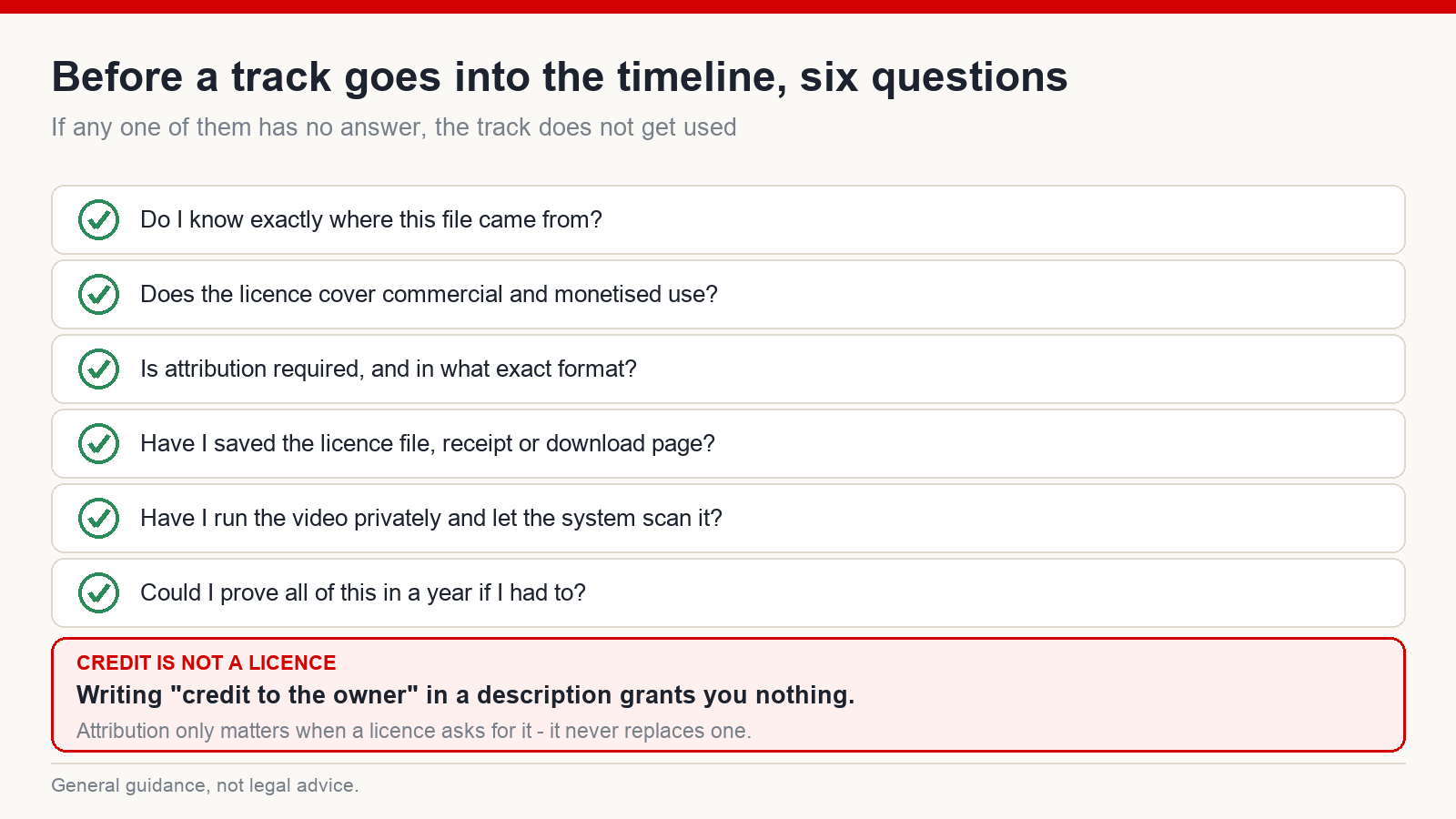
The five-minute check before anything goes public
This is the routine that has saved me the most trouble, and it is embarrassingly simple.
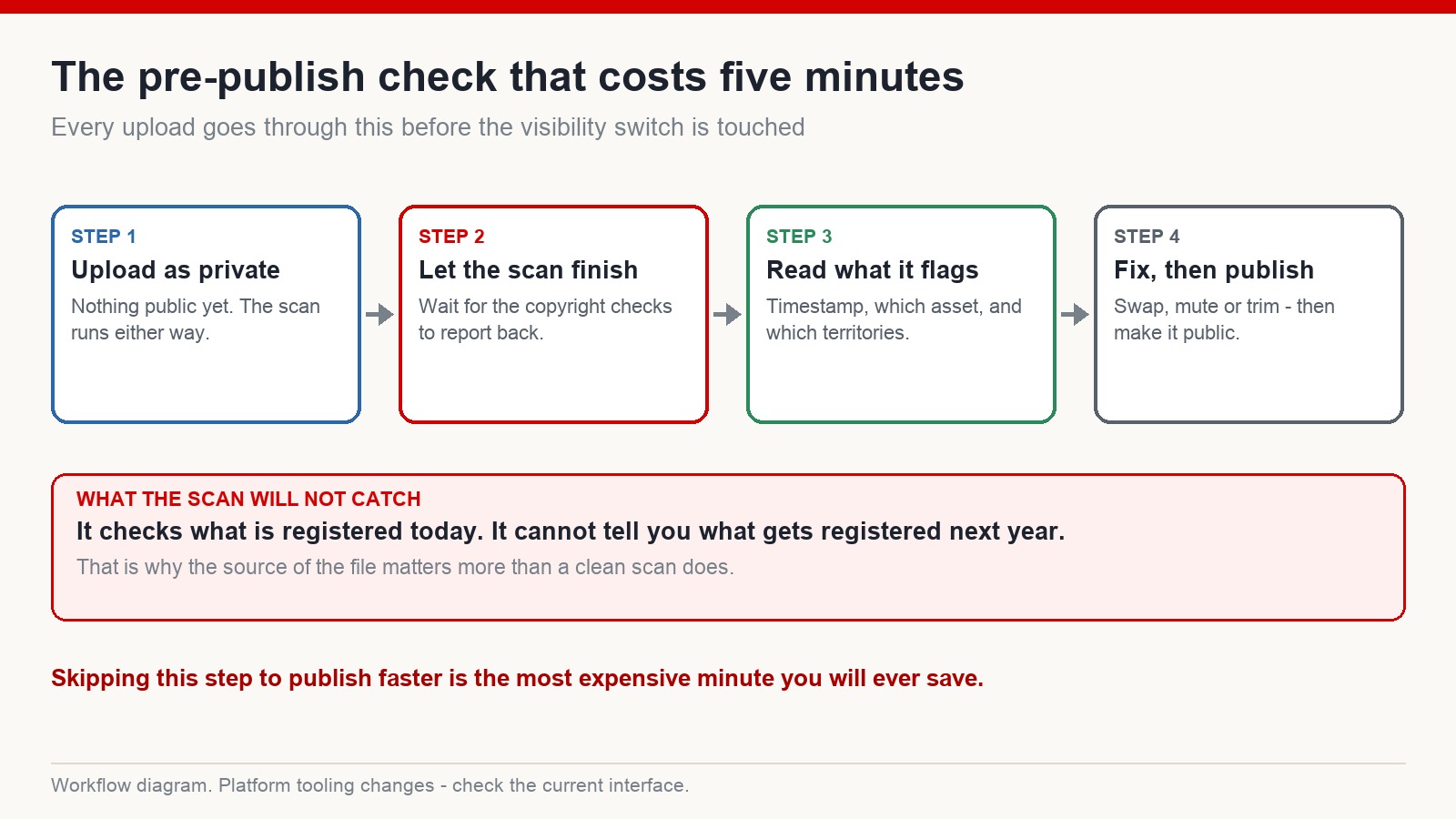
Upload the finished video as private or unlisted first. Do not set it public. The scanning runs either way, so let it finish. If something matches, you get told which timestamp, which asset, what kind of claim, and which territories are affected – before a single viewer has seen the video.
Then use the copyright checks panel in the studio interface, which will flag music, images and video segments ahead of publication. Plenty of creators skip this because they are in a hurry to publish. Five minutes is a cheap insurance premium against losing a video that was going to do well.
If a track came from anywhere with even slight uncertainty attached, run it through a music identification app first. If a consumer app can name the song and the label, the platform’s fingerprinting certainly can. It is not a complete test – plenty of registered works are not in consumer databases – but it catches obvious problems in seconds.
If a claim lands anyway
First: do not panic and delete the video. A claim on a video that is performing is usually a revenue and visibility issue, not an existential one.
You have three sensible options. Swap or mute the audio inside the studio, which is normally fastest and closes the matter. Dispute, but only if you hold and can produce a commercial licence. Or, in some cases, simply accept it – if a video is drawing significant traffic and the claim is not restricting where it can be shown, some creators keep the traffic rather than disturbing a video that is working.
What matters is choosing deliberately instead of reacting.
The risk nobody plans for
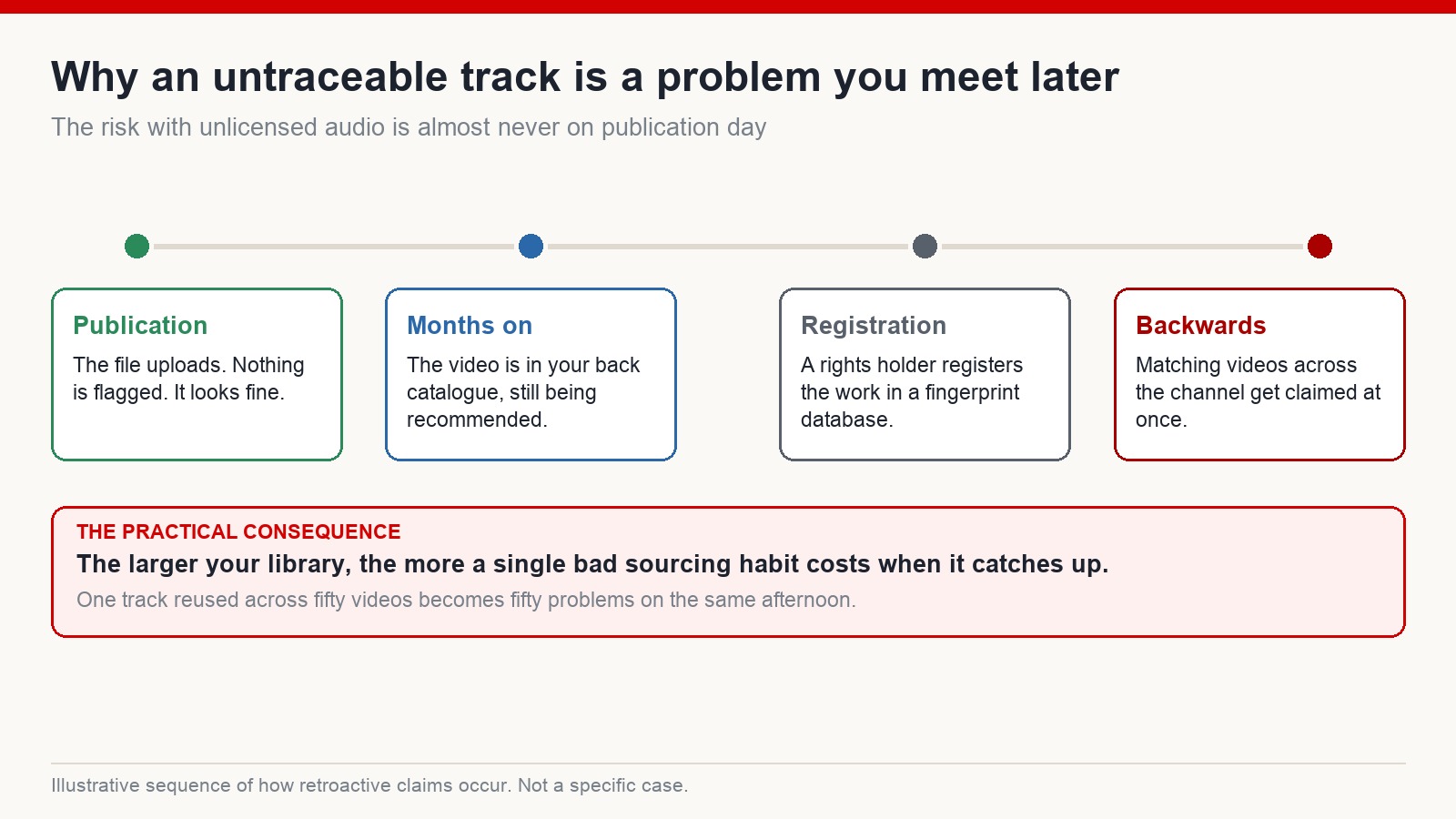
Here is the part that makes untraceable audio genuinely dangerous rather than merely untidy.
You publish. Nothing is flagged. Months pass and the video is sitting in your back catalogue, still being recommended. Then a rights holder registers the work in a fingerprinting database – and matching gets applied backwards, across everything.
If you reused one convenient track across fifty videos, that is fifty claims on the same afternoon. The bigger your library, the more a single sourcing habit costs you when it eventually catches up. Which is exactly backwards from how it feels at the time, when the library is small and skipping the paperwork seems harmless.
Frequently asked questions
Can I monetise a video using royalty-free music?
Yes, provided the licence explicitly covers commercial use. Free to download is not the same as free to monetise – check the terms rather than the headline on the page.
Does crediting the artist prevent a claim?
No. Attribution satisfies a condition of certain licences. It does not create a licence, and it will not stop automated matching.
Will a copyright claim get my channel deleted?
A claim on its own generally does not. It typically affects revenue and where the video is available. Strikes are the ones that put a channel at risk, and they work differently.
Is music from short-form platforms safe to reuse?
Usually not, especially on a monetised video. Music licensed for use inside one platform’s app is not automatically licensed for your upload elsewhere.
Can generated music still be claimed?
The risk is much lower when the track is unique to you, but read each tool’s commercial terms – they vary by service and by subscription tier, and they change.
Treat it as part of the content system
The upload-and-hope era is over, particularly for channels publishing at volume. The more you scale, the cleaner the underlying system has to be, because every sloppy decision gets multiplied by the number of videos it touches.
One badly sourced track can cost revenue on a video, damage its distribution, and in the worst case affect how the whole channel is treated. That makes rights management part of content strategy, not an administrative afterthought.
If you are building an English-language channel and want the rest of the production system laid out in order, that is what mmoyoutube.com covers. Nothing here is legal advice, platform policies change, and you should read the current terms of any library you use rather than trusting a summary.