Why AI Text-To-Speech Narration Sounds Robotic (And How To Fix It In The Script)
There was a stretch when producing an English-language video without appearing on camera meant hiring people. A native speaker to read the narration. An editor. Sometimes a writer. For anyone starting out with no audience and no revenue, that stack of freelancers was where the project quietly ended.
Synthetic narration removed that barrier almost overnight. A script, a text-to-speech tool and a free editor will now get you a finished faceless video. What it did not remove is the difference between narration a listener stays with and narration they click away from.
That difference is where most beginners get stuck. They assume a better voice tool will fix it. In my experience it almost never does, because the problem is upstream of the tool.
What text-to-speech actually does
The mechanics are trivial: you paste text, choose a voice, adjust a couple of controls, export an audio file. Modern systems produce something close enough to a human read that most viewers never question it.
What people miss is that the system is performing your text, not interpreting it. It has no idea which sentence is the important one, where you meant to leave a gap, or that a particular line was supposed to land heavily. It renders exactly the rhythm you wrote. If the writing has no rhythm, the output has none either.
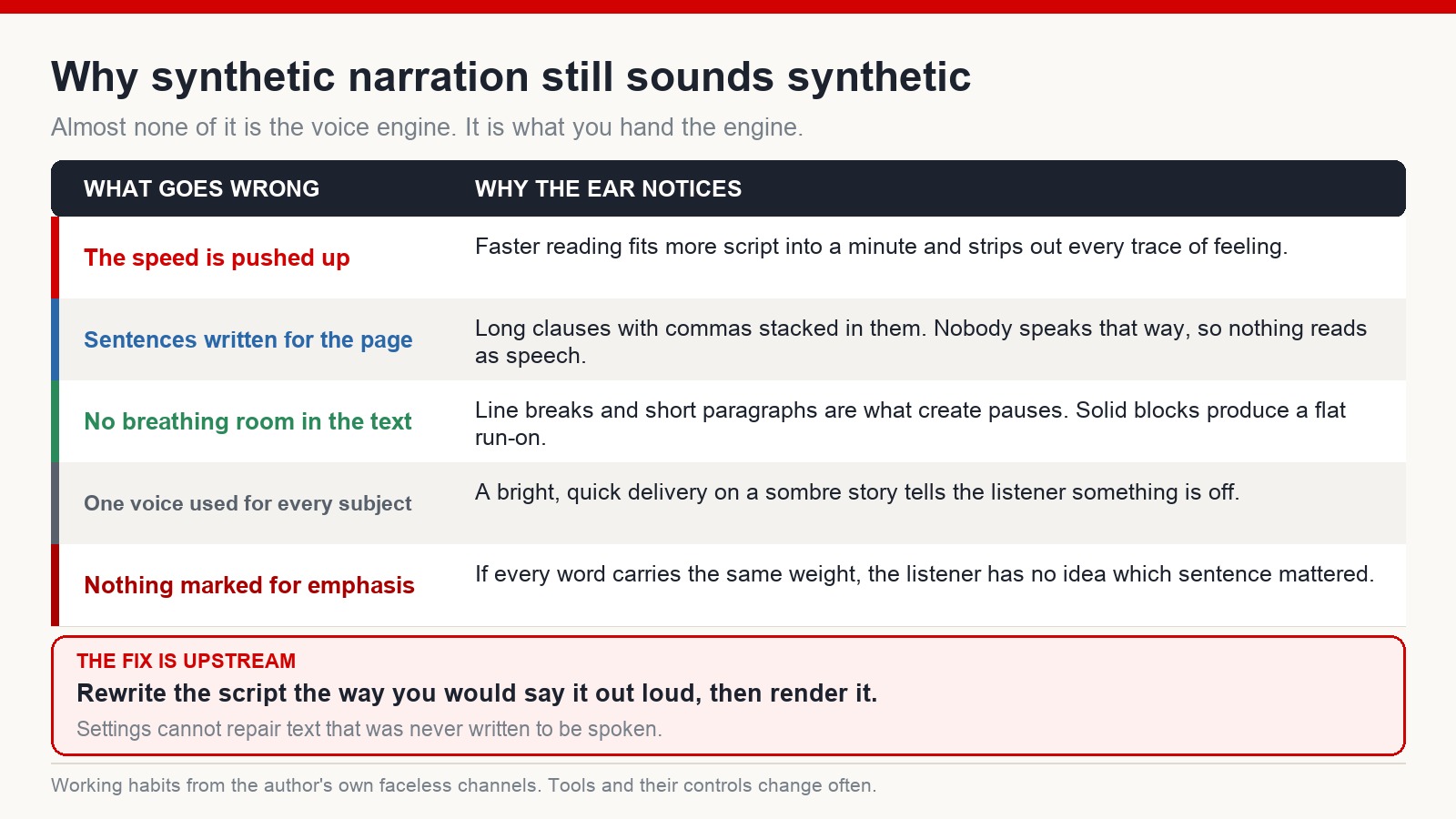
The five things that make narration sound artificial
When somebody sends me a video and says the voice sounds fake, it is nearly always one of the same handful of causes, and only one of them lives in the tool.
The speed is pushed up
New creators raise the reading speed to fit more script into less time. It works, in the sense that the words fit. It also strips out every trace of feeling, and the result is the flat, hurried delivery people describe as robotic. Set the pace slightly slower than feels natural when you are reading along. On playback it will sound normal, because a listener processes speech more slowly than a reader processes text.
The sentences were written for the page
Long clauses stacked with commas, subordinate phrases, formal connectors – fine in an article, unspeakable out loud. Nobody talks in forty-word sentences, so nothing in the output reads as speech. Short sentences. One idea each. It looks unsophisticated on the page and sounds completely natural in a voice track.
There is no breathing room
Pauses are not a setting you enable, they are a thing you write. Line breaks, short paragraphs and full stops instead of commas are what create the gaps. A solid block of text produces a solid block of speech, and there is nowhere for the listener to catch up.
Nothing is marked for emphasis
If every word carries the same weight, the listener never learns which sentence mattered. When I write for narration I decide in advance which line in each section is the one that has to land, and I build the sentences around it so the delivery has somewhere to go.
One voice is used for everything
Which brings up the part almost nobody plans.
Cast the voice to the subject
On a faceless channel there is no presenter, no expression, no body language. The voice is carrying the entire personality of the video. Treating it as a neutral delivery mechanism wastes the one channel of atmosphere you have.
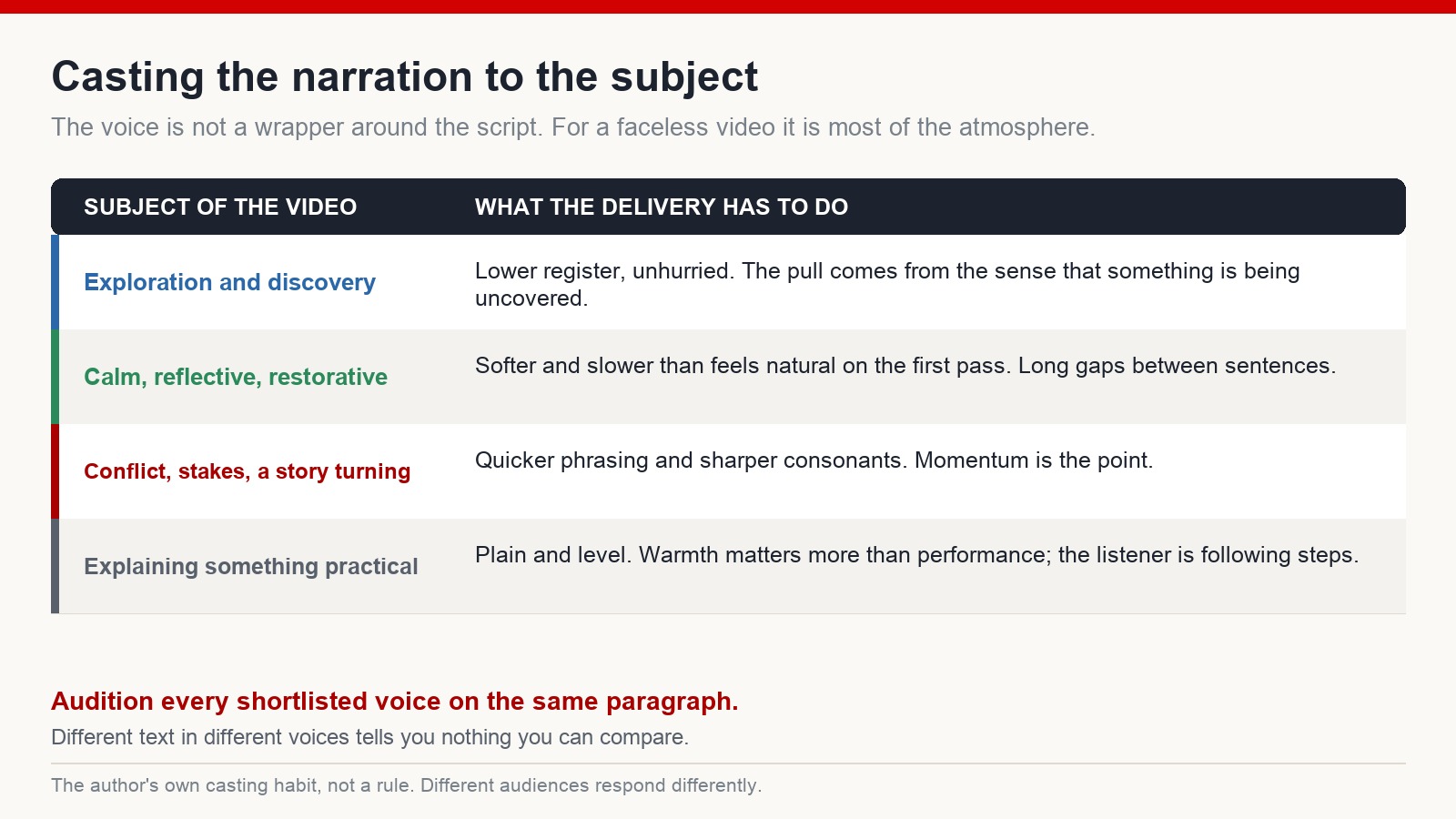
Exploration and discovery pieces tend to work with a lower register and an unhurried pace, because the appeal is the sense that something is being uncovered. Calm, reflective material needs to be softer and slower than feels right on the first attempt, with real gaps between sentences. Stories with conflict in them want quicker phrasing and more attack. Practical explainers want plain and level, because the listener is trying to follow steps rather than be moved.
One habit worth adopting: audition every voice on your shortlist using the same paragraph. Testing different text in different voices tells you nothing you can compare, and it is the reason people spend an hour auditioning and still cannot decide.
The listening pass that catches almost everything
Before the audio goes anywhere near the timeline, listen to the whole export once, on a phone speaker, doing something else. Not on headphones, and not while reading along with the script – that is what hides the problems, because your eyes fill in the delivery your ears are not getting.
Three things show up immediately in that pass. Sentences you cannot follow on one hearing, which means they need splitting. Passages where the voice never changes gear, which means the writing has flattened out. And any place where you lose interest, which is exactly where the audience will leave.
Fix those in the script and render again. Re-rendering costs minutes. Publishing narration that nobody can stay with costs the video.
What synthetic narration does not fix
It is worth being blunt about this, because a lot of material about faceless production implies otherwise. A good voice does not make a video worth watching. It removes an obstacle – it does not supply a reason to keep watching.
Retention comes from the structure of the script: whether the opening makes a promise, whether the middle keeps paying it off, whether the material is arranged so each section creates a reason to hear the next one. Narration quality determines whether that structure survives contact with the listener. It cannot substitute for a structure that was never there.
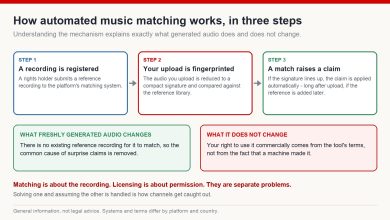
The other thing it does not fix is originality. Reading somebody else’s script aloud in a synthetic voice is still somebody else’s script. Platform rules on reused and mass-produced content apply to what the video contains, not to how it was recorded, and monetisation policies are increasingly explicit about wanting original value. Some platforms also expect creators to disclose realistic synthetic content, so check the current rules on the platform you publish to – they change, and they differ by country.
Where this leaves a beginner
The gap between an amateur-sounding faceless video and a professional one is not the subscription tier of the voice tool. It is a script written to be spoken, a voice chosen deliberately for the subject, a pace set slightly slower than instinct suggests, and one honest listening pass before the edit starts.
All of that is free, and all of it is under your control. Pick one topic, write three hundred words the way you would actually say them, and render it. You will hear the difference on the first attempt – and if you want the full production route for English-language faceless channels, that is what I teach at mmoyoutube.com.
Frequently asked questions
What is text-to-speech in a video workflow?
Software that converts written script into spoken audio. You supply the text, select a voice, and export an audio file that becomes the backbone of the edit.
Why does my AI voice still sound robotic?
Usually the script rather than the engine: sentences too long to be spoken, no line breaks to create pauses, and a reading speed set too high. Rewriting the text the way you would say it out loud fixes more than any setting.
Can videos with synthetic narration be monetised?
Narration method is not what platforms judge. They look at whether the video offers original value and complies with reused-content and disclosure rules. Policies vary by platform and change over time, so check the current terms before you build a channel on any assumption.
Do I need a native-speaker voice for an English-language audience?
You need narration that is clear and comfortable to listen to. Plenty of successful channels use synthetic voices; what puts viewers off is unnatural pacing, not the absence of a hired voice actor.
How long should sentences be for narration?
Short enough to say in one breath. If you run out of air reading a line aloud, split it – that single rule removes a large share of the artificial quality on its own.