The Pre-Upload Check: Sound And Captions On A Faceless Video
The last twenty minutes before publishing are where most faceless videos are decided, and they are the twenty minutes people skip. The edit is done, the enthusiasm has run out, and the file gets uploaded.
What survives that moment is the difference between a video that feels finished and one that feels like it came off a production line. Viewers register that difference within seconds, without being able to name it, and it shows up in how long they stay.
Almost none of it is about pacing, which is where creators usually look. It is about sound and captions – the two layers that get treated as afterthoughts and carry most of the perceived quality.
What “low effort” actually means
Platforms have tightened their treatment of mass-produced and repetitious content, and monetisation policies increasingly ask whether a video offers original value rather than how it was made. The exact wording differs by platform and changes, so it is worth reading the current version rather than a summary of it.
What matters in practice is that the signals people associate with low-effort output are mostly production signals: a still frame held for half a minute, narration dropped over unrelated stock footage, captions that clearly nobody looked at, music fighting the voice. Those are all fixable in the last pass, and fixing them is cheaper than any argument about policy.
The three audio layers, and how they should sit
On a faceless video the audio is not accompaniment. There is no presenter, so sound is carrying the emotional register on its own. Most videos that feel amateur have good material with the layers in the wrong order.
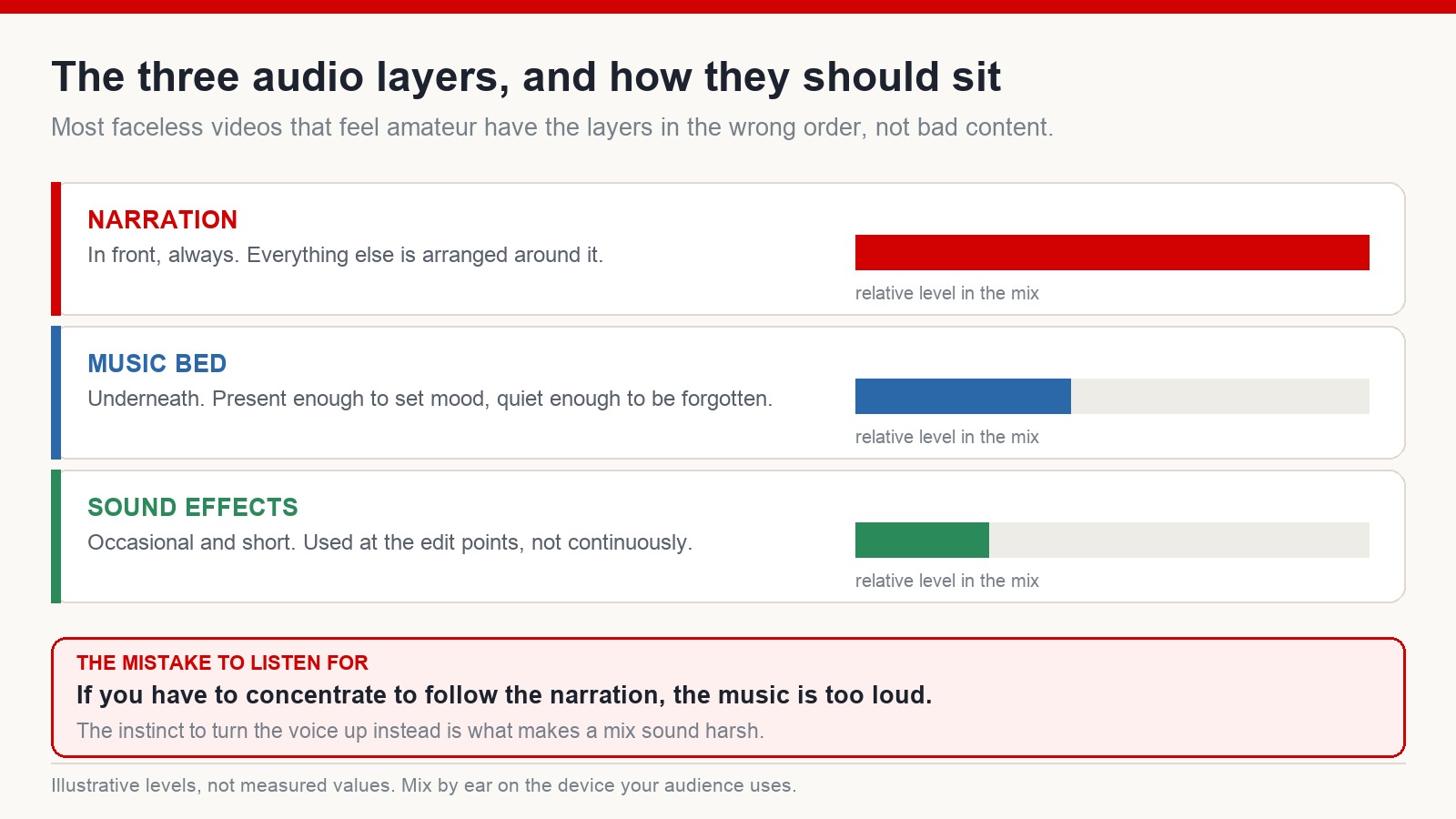
Narration sits in front, always
Everything else is arranged around it. If a choice has to be made between an atmospheric moment and the narration being effortless to follow, the narration wins every time. People forgive plain sound design; they do not forgive having to concentrate to hear the words.
The music bed goes underneath
Present enough to establish mood, quiet enough to be forgotten. The diagnostic is simple: if you find yourself leaning in to follow the voice, the music is too loud. The instinct is to raise the narration instead, which produces a harsh, over-compressed mix – the characteristic sound of a video mixed by somebody in a hurry.
Check the balance on a phone speaker, not on headphones. Headphones separate the layers for you. A phone speaker does not, and that is what most of your audience is using.
Sound effects belong at the edit points
Short, occasional, tied to something happening: a transition, a graphic arriving, a beat of emphasis. Used that way they make an edit feel deliberate. Used continuously they become noise, and they are the fastest route to a video that feels like it is trying too hard.
Captions are not an accessibility afterthought
A large share of viewing happens with the sound off, particularly on phones and particularly in the first few seconds when somebody is deciding whether to commit. Captions are what carries the video through that window, which makes them a retention feature rather than a compliance one.
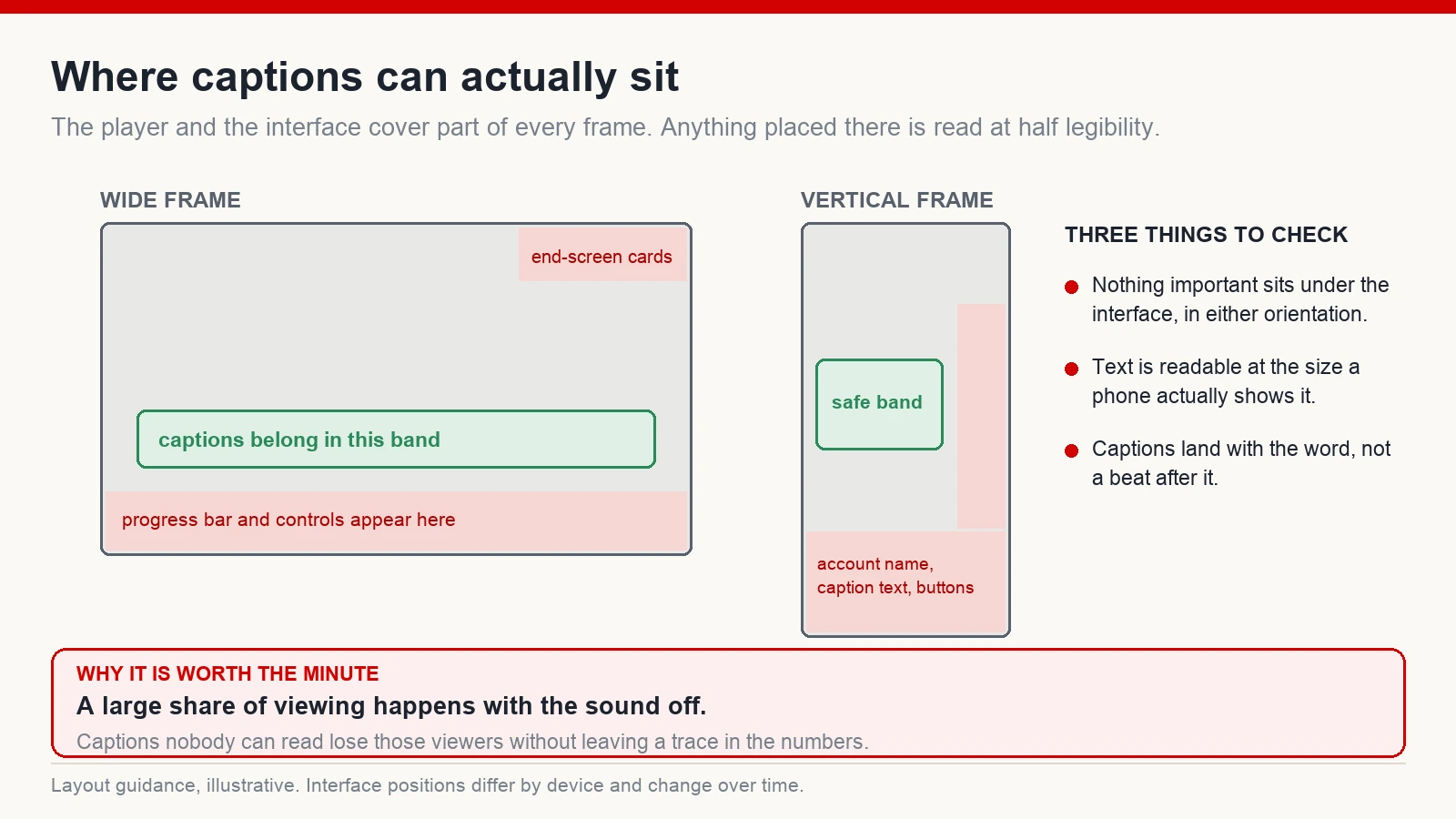
Readable beats decorative
Ornate fonts, saturated colours and heavy animation on every word make captions tiring to read, and tired viewers leave. Clear typeface, strong contrast against whatever is behind it, one or two lines at a time. The goal is text somebody absorbs without noticing they are reading.
Put them where the interface is not
Every frame has areas the player covers. In a wide frame the progress bar and controls take the bottom strip, and end-screen elements occupy a corner near the finish. In a vertical frame the whole right-hand column and a substantial band at the bottom belong to the interface. Captions placed in those areas are read at half legibility on the device that matters most.
Synced to the word, not near it
Automatic captioning is good enough now that this is usually a five-minute correction pass rather than manual timing. It is worth the five minutes: captions arriving a beat after the audio create a low-grade friction that viewers feel without identifying.
If you are publishing for an audience in another language, this pass matters more, not less. Automatic transcription makes characteristic mistakes with names, technical terms and anything spoken quickly, and those are exactly the words a viewer needs to get right.
Restraint with everything else
More effects do not read as more effort. A video where every cut uses a different transition looks unresolved; one that uses two or three consistently looks designed. The same goes for on-screen graphics – arrows, highlights and labels are genuinely useful for directing attention, and stop working the moment there are enough of them to compete with each other.
The thing being optimised is flow. Not demonstrating what the editing software can do.
Disclosure, if the content is synthetic
If a video contains realistic synthetic material – a generated person, a convincing simulation of a real event, an altered recording of somebody real – platforms increasingly require it to be labelled, and there are usually controls in the upload flow for exactly that. Ordinary synthetic narration over stock footage is typically not what these rules target, but the requirements vary and are being revised, so check the current guidance where you publish rather than assuming.
The last pass, in order
- Play the whole video on a phone speaker at moderate volume. Is the narration effortless throughout?
- Is there any point where the music makes you concentrate to follow the words?
- Scan the captions: readable size, clear of the interface areas, landing with the word.
- Is there a stretch where nothing changes for an uncomfortably long time?
- Do the transitions look like two or three deliberate choices, or a sampler?
- Does anything in the video need a synthetic-content label under current platform rules?
Twenty minutes, every video. It will not turn a video nobody wanted into one people watch – nothing in the final pass can do that. What it does is stop a video that deserved an audience being dismissed for reasons that had nothing to do with its content. If you want the full production route for English-language faceless channels, that is what I teach at mmoyoutube.com.
Frequently asked questions
How loud should background music be under narration?
Quiet enough that you never concentrate to follow the words. Judge it on a phone speaker rather than headphones, because headphones separate the layers in a way most viewers’ devices do not.
Do captions actually affect retention?
They carry the video for the substantial share of viewers watching without sound, especially in the opening seconds. Poorly placed or unreadable captions lose those viewers without leaving an obvious trace in the numbers.
Where should captions be positioned?
Clear of the player controls at the bottom of a wide frame, and clear of both the right-hand column and the lower band in a vertical frame. Interface layouts differ by device, so check on a phone before publishing.
Are more transitions and effects better?
No. Consistency reads as intent; variety reads as indecision. Two or three transitions used throughout will look more considered than a different one at every cut.
Do I have to disclose that a video uses synthetic elements?
It depends on what is synthetic and where you publish. Realistic synthetic depictions generally need labelling; requirements differ by platform and change, so check the current rules in your upload settings.