Re-uploading Other People’s Clips: Why That Shortcut Closed
For a while there was a genuinely easy version of faceless video. Find a clip doing well on another platform, download it, swap the music, burn in some captions, upload. No filming, no writing, no editing to speak of. Some channels grew quickly on exactly that.
That window has closed, and the people still working that way tend to discover it the same way: months of steady output, then monetisation declined or a channel removed, usually with the word “reused” somewhere in the explanation.
It is worth understanding precisely what changed, because the lesson is not “never use anyone else’s footage”. Plenty of legitimate channels are built on material they did not shoot.
Two separate rules, constantly confused
Almost every argument about this collapses because two different things get treated as one.
Copyright decides whether you are allowed to use the footage at all. It belongs to whoever created it. Downloading a clip from another platform does not grant a licence, and the fact that it is publicly visible, or credited in your description, or short, changes nothing. A rights holder can issue a takedown regardless of how much you edited it.
Monetisation policy decides whether a channel using permitted material can earn from it. Even with every clip properly licensed, YouTube expects the finished video to include significant original commentary or educational value – and a compilation with music over it generally does not qualify.
You need to clear both. Licensed footage with nothing added fails the second test. Original commentary over footage you had no right to use fails the first. This is why “but I bought a stock subscription” and “but I added my own voiceover” are each only half an answer.
What “adding value” actually means
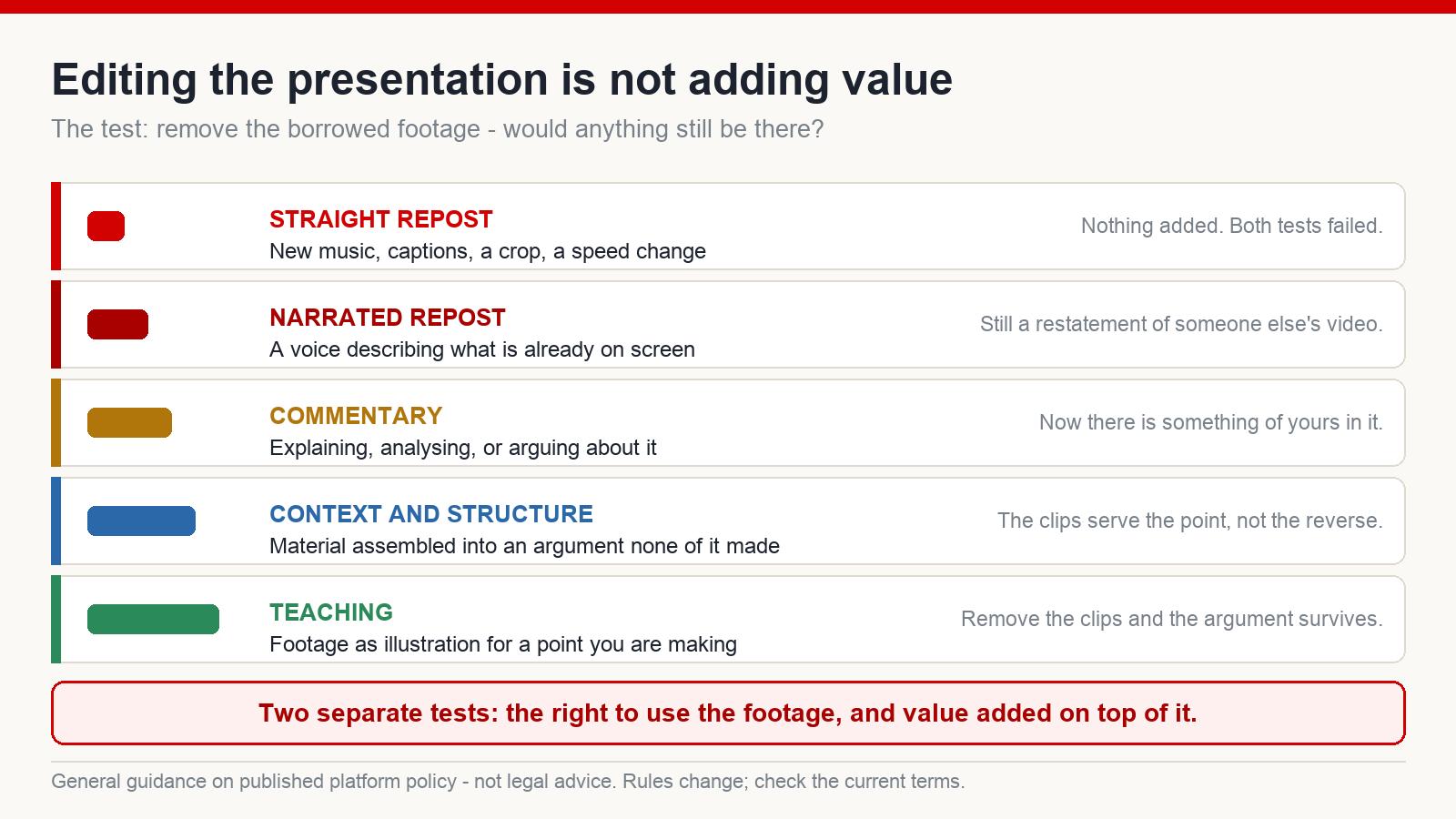
The distinction is not about how much you changed the file. Cropping, speed changes, filters, a different soundtrack and burned-in captions are all edits to the presentation, and none of them make the video yours in any sense that matters.
What counts is whether someone watching gets something they could not get from the original. Concretely, that means one or more of:
- Commentary – you are explaining, analysing, or arguing about what is on screen, not narrating it.
- Context – background the original did not have, why this matters, what it connects to.
- Structure – material assembled into an argument that none of the individual pieces made.
- Teaching – the footage is illustration for a point you are making, the way a diagram illustrates an explanation.
The rough test: if you removed the borrowed footage, would anything remain? If what is left is a real argument with visuals missing, you have a video. If nothing is left, you have a repost with decoration.
Where the mass-render pipeline breaks
A recognisable workflow: pick a competitor’s video, have a model summarise it, generate narration, lay it over stock footage, render, upload, repeat daily.
Every step in that chain is permitted individually, and the combination still fails – because nothing in the sequence adds anything. The script is a restatement of someone else’s video. The narration adds no analysis. The footage is unrelated to the words. The channel is producing derivative work at scale, which is the precise thing the policies on repetitious and mass-produced content describe.
Worth saying clearly: this is not an argument against generation tools. They are permitted and useful. The problem is a pipeline where a human never decides anything.
The percentage myth
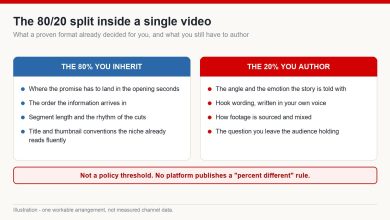
The most persistent piece of bad advice in this area is that some threshold of difference makes a re-upload acceptable – thirty per cent, forty, whatever number is circulating.
No such threshold exists in any policy, and none of the figures being passed around come from anywhere. Copyright asks whether you had the right to use the material and whether the use is transformative in a legal sense; monetisation review asks whether the finished video adds significant original value. Neither is a percentage question, and both are assessed on the video as a whole.
Chasing a number is also the wrong instinct. Anything designed to be different enough to pass review, rather than different enough to be worth watching, is being built for the wrong audience.
Getting footage legitimately
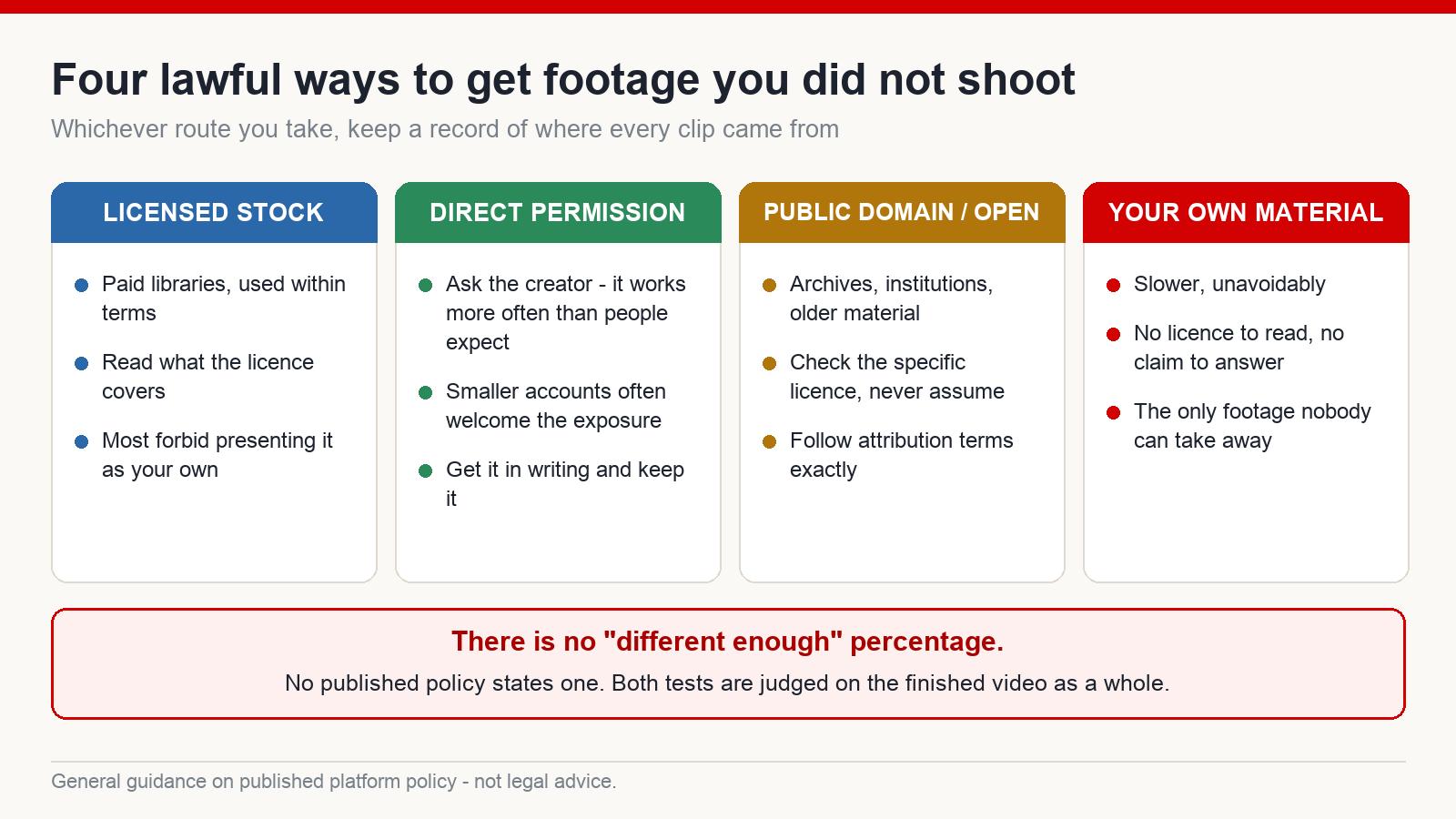
Several routes are genuinely open, and none of them are difficult:
Licensed stock. Paid libraries, used within their terms. Read what the licence covers – some restrict certain uses, and most require you not to present the clip as your own footage.
Direct permission. Contacting a creator and asking is far more effective than people expect, particularly for smaller accounts who benefit from the exposure. Get it in writing and keep it.
Public domain and open licences. Government archives, older material, institutional collections. Check the specific licence rather than assuming, and follow the attribution terms exactly.
Your own material. Slower, unavoidably, and the only footage nobody can take away from you.
Whichever route, keep a record of where each clip came from and what permission covers it. If a claim ever arrives, that record is the entire defence.
A note on running several channels
One thing worth stating plainly, because it circulates as a workaround. When a channel is terminated for policy violations, the account holder is generally not permitted to own or operate other channels, and creating new ones to get around a termination is itself a violation.
Operating several channels is completely legitimate when each one is a real channel with its own purpose and audience, and when none of them exists to work around an enforcement action. Anything sold as a method for keeping a network alive after a strike is describing a policy violation, whatever it is called.
The version that still works
Faceless video built on material you did not shoot remains a viable format. What has to change is the order of operations.
Start from something you want to say – an argument, an explanation, a comparison, a claim. Then find the footage that illustrates it, from a source you are entitled to use. The video exists because of the point; the clips are there to support it.
The failed version runs the other way: start with a clip that performed well elsewhere, then work out what to put over it. That is reposting with production values, and it has been getting steadily harder for several years.
Frequently asked questions
Is re-uploading short-form clips to YouTube safe?
Not without permission. The rights belong to whoever made the clip, and public availability is not a licence. Straight re-uploads also fail the originality expectation for monetisation.
Do new music and captions make it a different video?
No. Those are changes to presentation, not additions of value. The underlying content is still someone else’s.
Does YouTube detect AI-generated content?
The relevant policies are not about how a video was made – they target content that is repetitive, mass-produced, or lacking meaningful original contribution. Assisted production is fine; assembly-line output is the risk. Realistic synthetic media must also be disclosed.
Can I use stock footage for the whole video?
Legally, within licence terms, yes. For monetisation, the question is what you added on top – commentary, teaching, structure. Licensed clips plus generated narration reading a summary is usually not enough.
What if I credit the original creator?
Credit is courteous and it is not permission. Only the rights holder can grant that, and only in advance.
The short version
The shortcut is closed, and what replaced it is ordinary: have something to say, get the footage lawfully, and make sure the video would still be worth something if the borrowed material were removed.
Slower than downloading a clip and swapping the music. Also the only version that is still standing in two years.
If you want a structured way to build a faceless channel on that basis for an English-speaking audience, that is what we work on at mmoyoutube.com.