The Year You Go Home With Nothing to Show Yet
There is a specific kind of dread attached to going home in a year when nothing has landed yet.
You have been working. Videos went out, things were learned, weeks disappeared. But there is no headline. Nothing you can hand over at the door. And somewhere on the journey you start assembling answers to questions nobody has asked you yet.
I have had those years. Most people building anything slow have had several. It is worth saying clearly what is actually going on in them, because the feeling is much worse than the situation.
A family gathering is a terrible scoreboard
The people who see you once or twice a year are, without meaning to be, running an annual sample of a process that changes in small weekly increments.
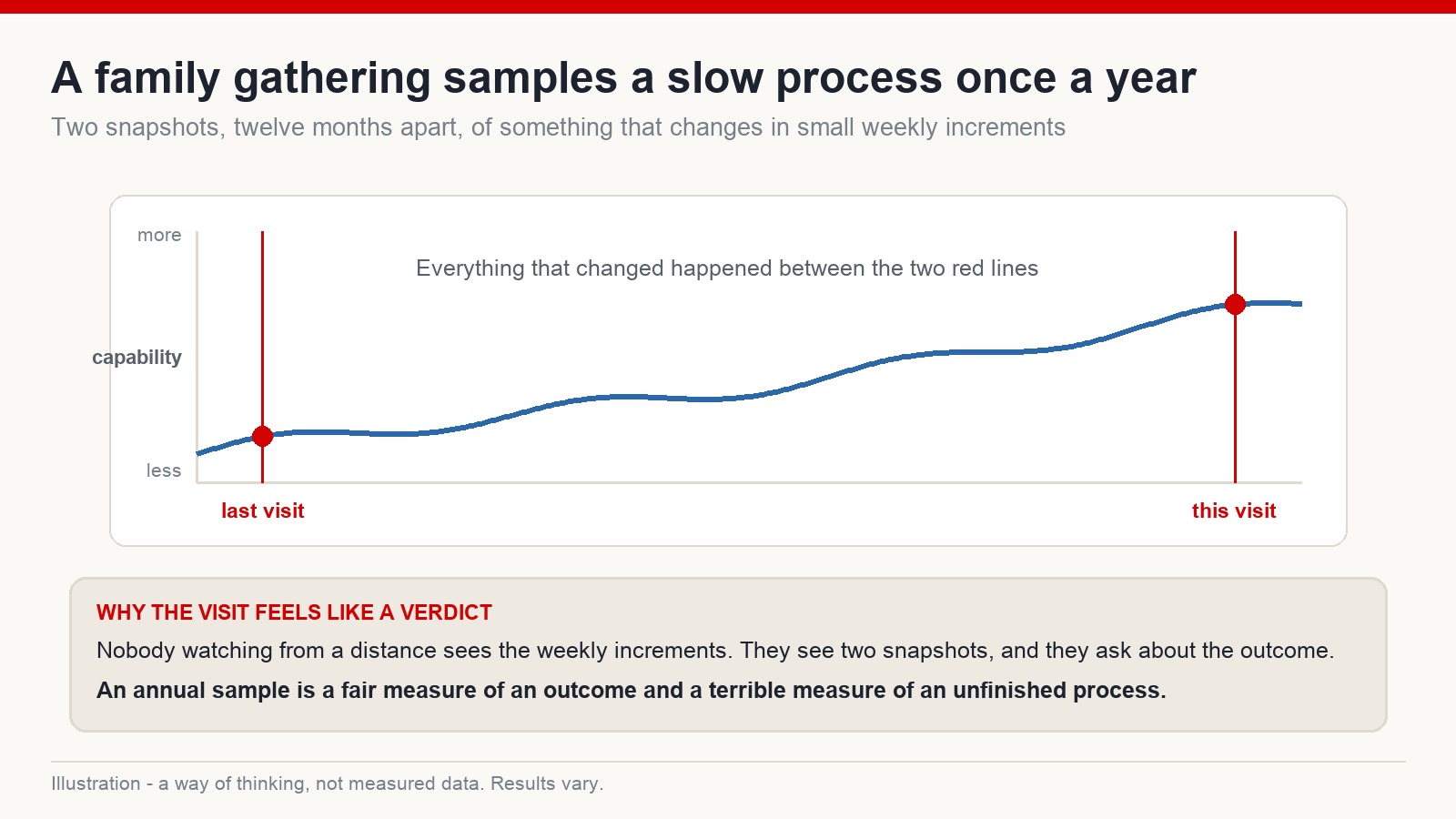
They do not see the forty scripts, the thumbnails you remade, the month you finally worked out why people were leaving in the first minute. They see two snapshots, and the natural question about a snapshot is an outcome question.
That is not unkindness. It is the only information available from a distance. But it means the visit measures the wrong thing, and if you let it act as a verdict you will make bad decisions in January.
The question you are dreading is usually not the one you get
Here is the small, slightly embarrassing pattern I have noticed. The rehearsed answers about income, timelines and whether this is going anywhere mostly go unused.
What people who actually care about you ask is whether you are sleeping, whether you are eating properly, whether the work is making you miserable. The scoreboard is almost always something you brought into the room yourself.
Not always, though. Sometimes the question does arrive, from a cousin or a neighbour or someone quietly enjoying the ask. So it is worth having answers ready that are honest rather than defensive.
Three honest answers to "how is it going?"
The short one, for someone making conversation. "Slowly, but I am better at it than I was last year." Then ask them something. Most people were not looking for a report.
The real one, for someone genuinely interested. Name one concrete thing you can now do that you could not do twelve months ago, and one thing that is still broken. People trust a person who volunteers the broken part. It also, quietly, reminds you that both halves exist.
The flat one, for someone keeping score. "It has not paid off yet. I will know more next year." No detail, no defence, no forecast. The instinct is to argue — to explain the algorithm, the plan, the niche — and it never works, because they are not asking a question. They are making a comment.
One rule underneath all three: do not inflate. An exaggeration told at a family table becomes a debt you have to service at every gathering afterwards, and it will push you into decisions made to protect a story rather than to build the thing.
What actually changed this year
Before you travel, spend twenty minutes filling this in. Not for anyone else — for you.
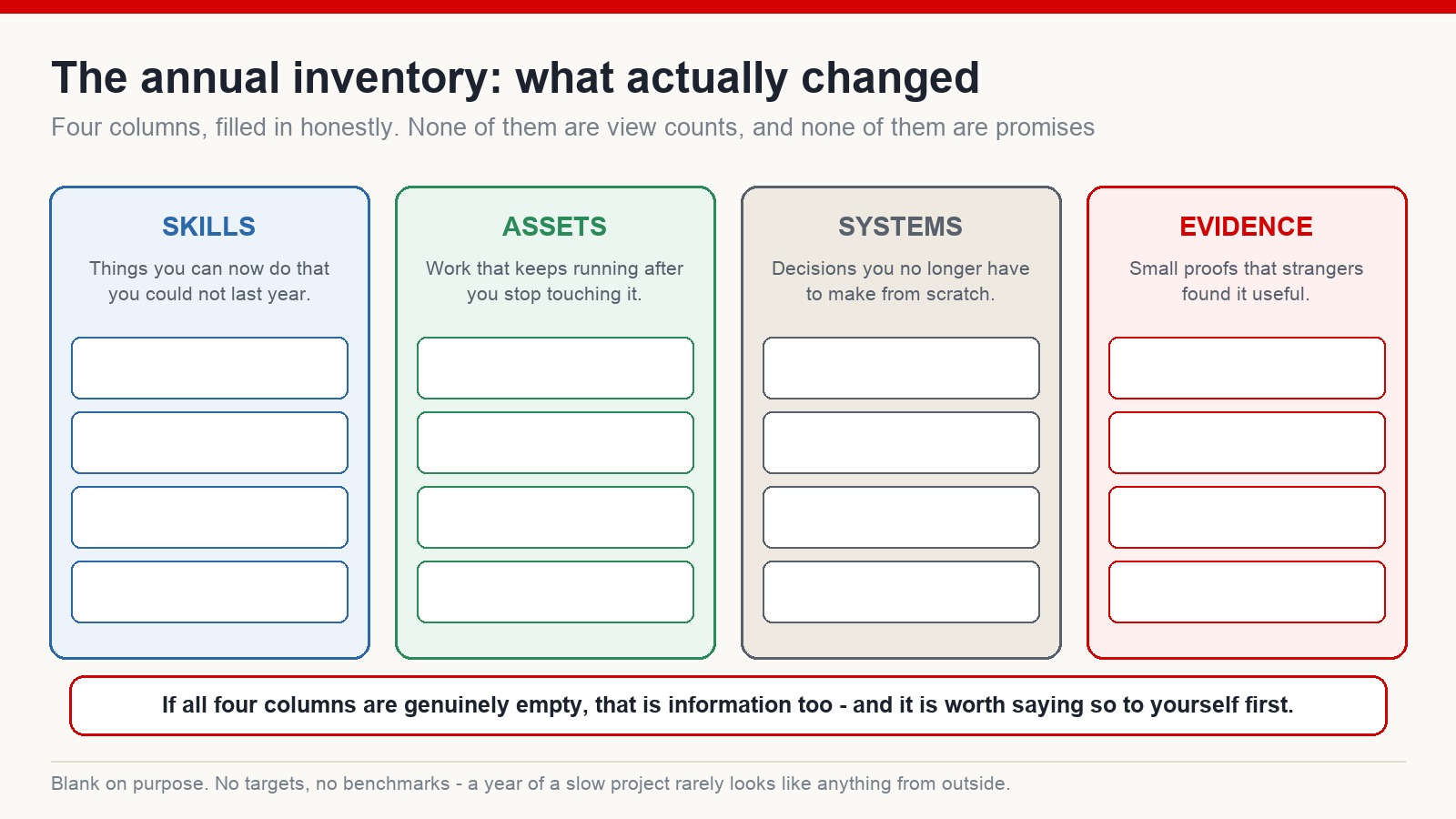
- Skills. Things you can do now that you could not do last year. Writing an opening that starts at the moment. Reading a retention graph and knowing where to look. Finishing a video in half the time.
- Assets. Work that keeps running when you stop touching it. A back catalogue that still gets watched. A thumbnail style you no longer redesign each week. A library of footage or research you can reuse.
- Systems. Decisions you no longer make from scratch: a format, a checklist, a publishing rhythm that survives a bad week.
- Evidence. Small proofs that strangers found it useful — a comment describing exactly the problem you solved, someone who watched to the end, a question that turned into your next three videos.
None of these are numbers you can announce at a table, which is precisely why they get forgotten. They are also the only things that carry into next year.
Sometimes the honest answer is "nothing"
I do not want to write the version of this article where every quiet year is secretly a triumph. Some years genuinely are wasted, and pretending otherwise is how people lose three of them.
Three questions that separate a slow year from a wasted one:
- Did you finish things, or only start them? Unfinished work teaches you almost nothing, because the lesson arrives after publication.
- Did you change anything on purpose? A year of doing the identical thing while hoping for a different result is not patience.
- Can you name what you learned? If nothing comes to mind in five minutes, that is the answer, and it is a fixable one.
If all four inventory columns are empty and all three answers are no, the useful move is not more determination. It is a different approach, or a smaller commitment kept properly, or an honest decision that this is not the thing.
The cost that is not in the inventory
There is one more column nobody writes down: the time this project charges to the people who wait for you.
Slow work has a habit of borrowing against relationships on the promise of a later repayment. "Once this is working, I will be around more." It is a sincere promise and it is very easy to keep rolling forward, because there is always another month that would benefit from more effort.
The correction is not to abandon the work. It is to notice that being present is not a reward you unlock at the end — it is a thing you either do this year or do not. Going home with nothing to show is survivable. Going home rarely, for years, on the theory that the results will justify it, is a worse trade than it looks from inside the project.
And if you still have people to go home to, the year was less empty than it feels.
What do I say when family asks about a project with no results yet?
Say it is slow, name one specific thing you can now do that you could not before, and admit one thing that is not working. Honesty ends the conversation faster than an optimistic forecast, and it costs you nothing later.
How do I stop family gatherings from derailing me?
Decide before you travel what you are measuring the year by, and write it down. Once the criteria exist on paper, a passing comment cannot quietly become your new scoreboard.
How long is too long without visible results?
There is no fixed number, and anyone who gives you one is guessing. The better test is whether your capability is still increasing and whether you are finishing things. Rising capability with no results yet is normal; flat capability after a year is a signal to change something.
If you want a structured route for building an English-language channel rather than improvising one, that is what I put together at mmoyoutube.com.