YouTube Mood Keywords: How the Same Footage Reaches a Completely Different Audience
Two nature videos, almost the same footage, wildly different results
Here is a question I kept coming back to while pulling apart channels aimed at English-speaking audiences. Two videos, near enough identical: same kind of landscape, same kind of animals, same quiet pacing, both competently shot. One sits at a few thousand views. The other has millions.
You can look for the difference in the footage for a long time and not find it. It is not in the footage. It is in the words on the front of the video, and in the assumption those words make about who is watching.
One video was described. The other was positioned. That distinction is what this article is about, and it is one of the few genuinely reusable ideas in keyword work.
People search for a feeling as often as a subject
The default assumption is that a keyword describes what is on screen. There is a deer in the video, so the title should say deer. There is an eagle, so the keyword is eagle.
Reasonable. Also, frequently, wrong about who is actually looking.
A large share of the audience for calm, slow, ambient content is not searching for the animal at all. They are searching for a state they want to be in. They want to wind down after work, or fill a silent room, or stop their attention bouncing while they study, or fall asleep without lying in the dark thinking. What they type reflects that:
- relaxing nature sounds
- rain sounds for sleeping
- forest ambience
- study music
- peaceful piano
None of those name a subject. All of them name an outcome. YouTube mood keywords are simply the vocabulary that group uses, and once you can see it you notice how much of the calm-content shelf is built on it.
Repositioning: the same clip, offered to a different room
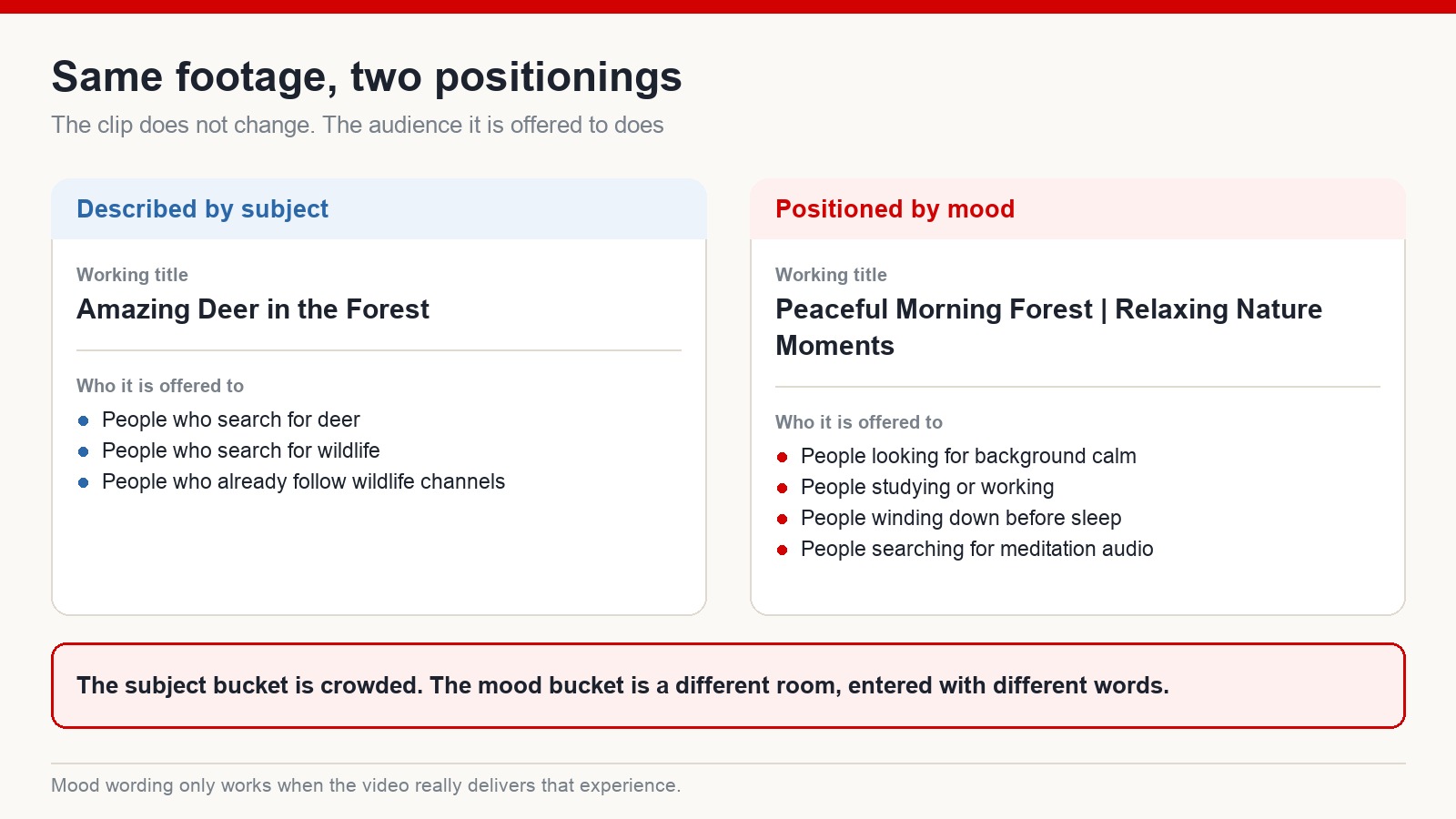
Take a clip of deer moving through a forest at dawn. Two honest ways to present it.
Described by subject: Amazing Deer in the Forest. That is accurate, and it puts the video into the wildlife category, where it competes with everything from documentary channels to people with better lenses than yours. It reaches people who wanted deer.
Positioned by mood: Peaceful Morning Forest | Relaxing Nature Moments. Equally accurate — the footage really is that. But now the video is being offered to people who never typed the word deer: viewers looking for background calm, people working or studying, people winding down before sleep, people who came in through meditation and ambient searches.
The video did not change. The room it is standing in did. That is the whole manoeuvre, and it costs nothing but a rewrite.
It also solves a problem a lot of small channels have without naming it: they are competing in the most crowded possible framing of their own content, when a less crowded framing was available the entire time.
Split a working title into a cluster
Once you accept that mood is a category, finding the vocabulary is mechanical. Take a title that already performs in the space and break it into its parts.
Start with something like Relaxing Nature Sounds for Peaceful Sleep. Split it: relaxing, nature sounds, peaceful, sleep. Four separate handles, each of which has neighbours:
- relaxing — calm, serenity, gentle, soothing
- nature sounds — forest ambience, river sounds, gentle rain, fireplace sounds
- peaceful — quiet forest, stillness, inner peace
- sleep — deep sleep, sleep sounds, study music, stress relief
Within twenty minutes you have not one keyword but a map of how an entire audience talks about one feeling. That is a far more useful object than a single phrase, because it tells you what else to make.
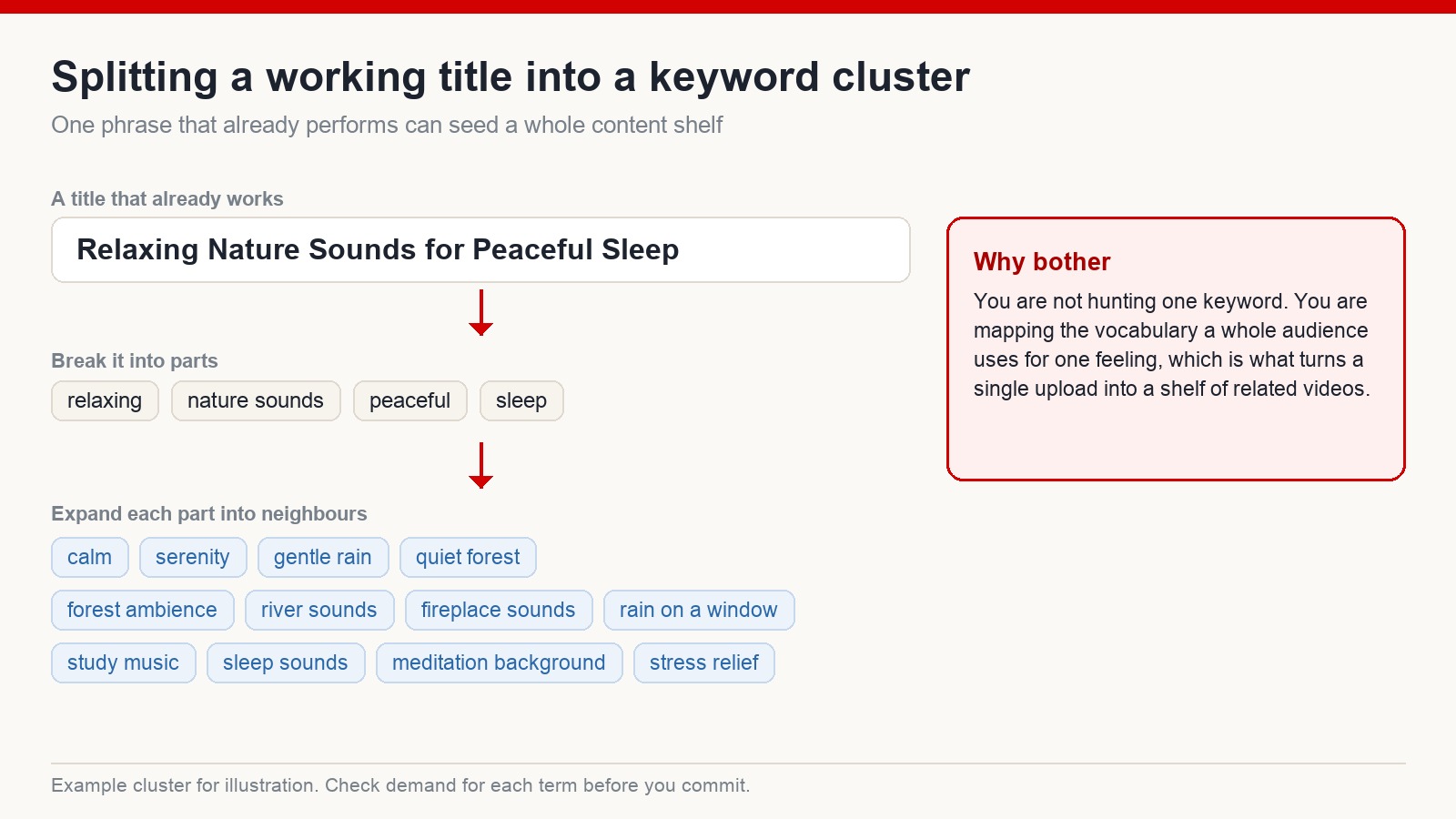
Check each term before you commit to it. Some of these will have real demand and some will be phrases nobody outside your head uses. The split gives you candidates, not conclusions.
Why calm keywords hold up over time
Most content is tied to a moment. A video about a piece of software is obsolete when the interface changes; a video about a trend dies with the trend.
The demand behind mood keywords is not like that. People wanting to sleep, concentrate or decompress is not a trend, and the language they use for it barely shifts from one year to the next. That makes this shelf unusually evergreen: a video published now can still be found in three years, because the search that finds it will still be being typed.
You will also see people claim that English-speaking markets monetise better than others. Advertiser demand does vary by market and by topic, that much is true, but the specific numbers passed around online are unreliable and they change constantly. Treat that as background, not as a plan, and never build a channel on an income figure you read in a comment section.
Build a shelf, not a video
If a mood keyword works for you, the mistake is to make one video and move on. The point of mapping vocabulary is that it hands you a publishing schedule.
From one core feeling you can branch: peaceful forest, peaceful morning, peaceful river, peaceful rain, peaceful mountains. Each is a distinct search, each is a distinct video, and together they read as a coherent channel rather than a pile of uploads. That coherence matters — it is easier for a viewer to subscribe to a channel that is obviously about one thing, and easier for the system to work out who to show it to.
One emotion, split into narrow branches, is usually a more realistic opening for a new channel than one broad category attacked head-on.
The keyword is a promise, and retention collects on it
Here is the part people skip. Words like calm, peaceful and relaxing are not only search terms. They are commitments.
Someone clicking Relaxing Nature Moments has been promised an experience. If the footage is choppy, if there is a jump cut every two seconds, if the audio has a spike in it, if there is a loud intro before the calm starts — the promise breaks in the first fifteen seconds and they leave. Retention falls, and the system stops offering the video to anyone.
Which means mood keywords are not a wrapper you put on existing content. They are a specification for how the content has to be made: long steady shots, gentle transitions, consistent audio levels, nothing that startles.
The thumbnail has to be calm too
A title promising stillness next to a thumbnail with four lines of shouting text and three arrows is an incoherent package, and viewers read incoherence as untrustworthy.
For this kind of content the thumbnail wants to be quiet: few elements, soft colours, one clear focal point, little or no text. The whole chain — thumbnail, title, first thirty seconds, the rest of the video — should feel like it was made by the same person for the same purpose.
Where this stops working
I would rather set the expectation properly than sell you a trick. Mood positioning is not a way to get views out of any video.
It only works when the content genuinely delivers the experience the words promise. Attach calming vocabulary to something that is not calming and you will get clicks followed by immediate exits, which is a worse outcome than not being clicked at all. It also does not replace descriptive keywords — in practice the strongest titles usually carry both, one telling the viewer what is on screen and one telling them how it will feel.
And as always: recommendation behaviour changes, competition in a niche changes, and what works on one channel may not transfer to another. Nothing here is a guarantee of views.
Should I use mood keywords on every video?
No. Use them where the content really does deliver that experience — relaxation, gentle pacing, inspiration, comfort. On a tutorial or a news-style video they are just inaccurate, and inaccuracy costs you retention.
Do mood keywords replace normal descriptive keywords?
No. The reliable pattern is combining them: one part describing what is actually on screen, one part naming the need or feeling the viewer arrived with. That way you can be found by both groups without misleading either.
How do I find more keywords like these?
Take titles that already perform in the space, break them into their component phrases, then expand each phrase into its neighbours. Check demand for the candidates before you build anything, and only then plan a run of videos around the ones that hold up.
Ask what feeling they came for
Modern search work on YouTube is less about satisfying an algorithm than about being honest about who is on the other end of the query. Sometimes a nature video does not need to win the wildlife category at all. It needs to be found in the calm category, where far fewer people are competing and the demand runs all year.
The next time you sit down to title something, it is worth asking the awkward version of the question: is my viewer looking for this subject, or are they looking for a feeling that my footage happens to provide?
If you want the full process for building a faceless channel around an English-speaking audience, that is what I teach at mmoyoutube.com.