What Should You Make Videos About? Start With the Viewer, Not the Idea
Years ago, when I told someone I was going to try making a living from the internet, they laughed. Not cruelly — they were being practical. Their question was: what do you actually have? No relevant skills, no money to invest, no contacts, no English worth mentioning. It was a fair question and I could not answer it.
What eventually changed things was not a tool, a trick or a burst of motivation. It was a boring shift in the question I asked before making anything. I stopped asking what do I want to make and started asking who is this for, and are they already looking for it.
That is not an inspiring sentence. It is, in my experience of nine years of building channels since 2017, the single decision that separates a channel that slowly finds an audience from one that quietly does not.
The most expensive habit in a new channel
"I’ll make what I like" sounds healthy. Enjoying your subject genuinely matters — you will not survive a hundred videos on something that bores you.
But taken alone it produces a particular kind of channel: technically fine videos on topics nobody was looking for, uploaded consistently for eight months, followed by the conclusion that the platform is rigged.
The mistake is a misunderstanding of what the platform does. It is not searching for viewers on behalf of your video. It is choosing, for each individual viewer, the video most likely to satisfy them right now. Those are different jobs. If your video has no particular person it fits, it does not lose the competition — it never enters it.
Describe one viewer, not an audience
"People interested in fitness" is not an audience. It is a category, and categories do not watch anything.
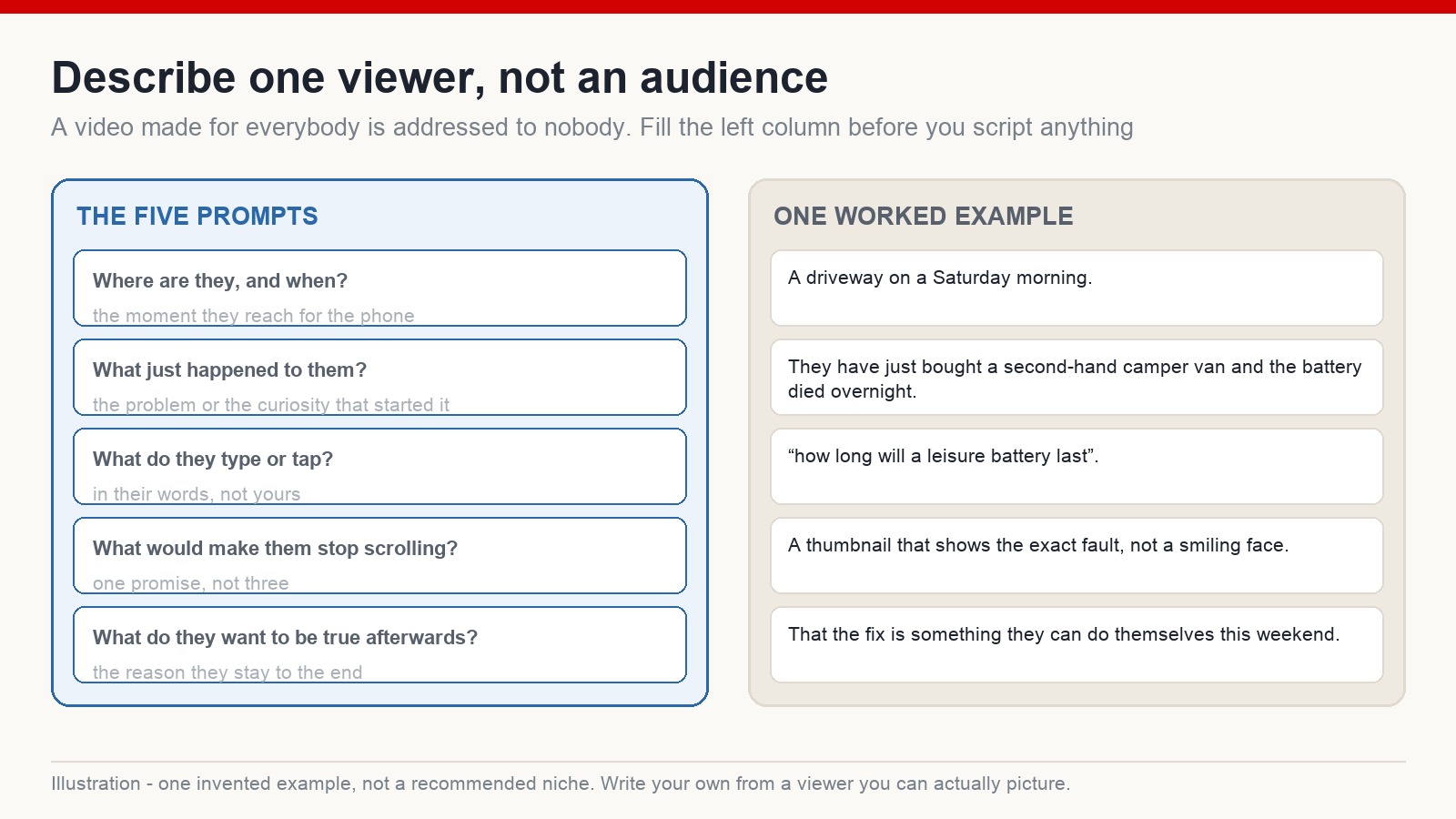
Before scripting anything, write five sentences.
- Where are they and when? The actual moment they pick up the phone.
- What just happened to them? The problem or the curiosity that started this.
- What do they type or tap? In their words. Beginners search in plain, slightly clumsy language; industry vocabulary is a sign you are writing for a colleague, not a viewer.
- What would make them stop scrolling? One promise. Not three.
- What do they want to be true afterwards? That is what keeps them watching past the first minute.
Do this properly once and the next twenty video ideas write themselves, because you are no longer generating topics — you are answering a person.
Four checks before you commit
An interest becomes a subject only when it survives these, in order.
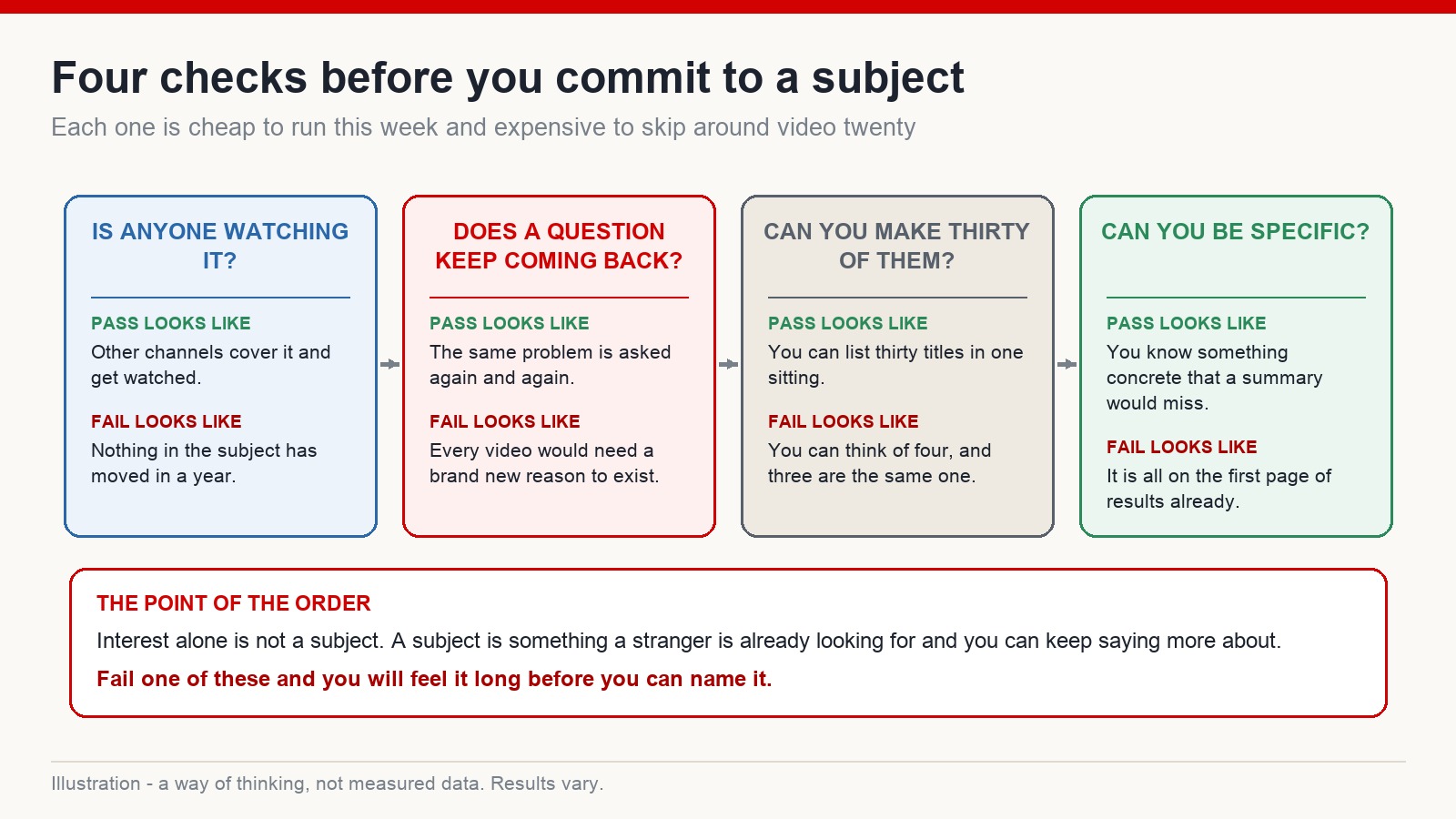
Is anyone watching it? Go and look for channels covering the subject and see whether their recent videos are getting watched. If several are, the subject is alive and any struggle you have will be about your delivery. If nothing has moved in a year, you would be building demand as well as a channel, which is two jobs.
Does a question keep coming back? Recurring problems are the best fuel a channel has, because the same viewer returns with the same need. One-off curiosities produce one-off views.
Can you make thirty of them? Sit down and try to list thirty titles. If you get to four and three are the same video, that is not a subject, it is a video. This check has saved me more months than any other.
Can you be specific? Say something a general summary would miss. Not necessarily expertise — often it is just access, or having recently done the thing badly and worked out why.
Narrower than feels comfortable
New creators reliably choose subjects that are too broad, because broad feels safe. It is the opposite.
A broad subject puts you against channels with years of history and dedicated editors, in a place where your video has to be better than everything else about that topic. A narrow one puts you against a handful of people, several of whom are not really trying.
"Cooking" is a category with an enormous, unwinnable front door. "Meals you can cook in a shared kitchen with one pan" is a subject with a describable viewer, an obvious search phrase and roughly forty videos in it.
The honest limit: narrow can go too far. If you cannot find anyone else making it, cannot list thirty titles, and cannot picture who would type the phrase, you have not found a niche, you have found a gap that exists for a reason. Widen by one step, not five.
The uncomfortable part of working this way
Making videos for a viewer instead of for yourself can feel like a loss. It is worth being straight about the trade.
You will drop ideas you were attached to. You will make videos that are less personally interesting than the ones in your head. And there is a genuine failure mode at the far end: creators who chase whatever is moving, end up with a channel of things they do not care about, and burn out around video forty.
So the boundary is this. The viewer decides the subject and the packaging. You decide whether you can stand to make a hundred of them. If those two never overlap, the honest answer is to keep looking rather than to force it.
What actually changed
The first genuine signal I got was not money and not a large number. It was a video that people watched to the end and asked follow-up questions about. That is a small thing to describe and a large thing to receive, because it was the first proof that the process was learnable rather than lucky.
Everything after that was repetition of the same loop: pick a viewer, check the subject, make it, read what happened, adjust one thing.
I should say plainly that this is my own experience, not a promise. Plenty of people follow a sensible process and grow slowly. Subjects vary, languages vary, platform policies change, and nobody controls the recommendation system. What you can control is whether each video was aimed at somebody in particular.
Should I make videos about what I love or what gets watched?
The overlap. Interest keeps you making videos long enough to get good; demand makes those videos findable. Either one alone runs out — the first in enthusiasm, the second in patience.
How do I know whether a subject has an audience?
Look for other channels serving that viewer whose recent uploads are getting watched. Competition is evidence of demand. An empty subject is more often a warning than an opportunity.
Is it too late to start in a popular subject?
Not usually, but you should enter through a narrow door rather than the main one. Pick a specific version of the subject with a describable viewer, and expand only once that version is working.
If you want a structured route through this for an English-speaking audience, that is what I built at mmoyoutube.com.