AI-Generated Background Music For Faceless Channels: What It Fixes And What It Doesn’t
The version of this problem that hurts is not the claim that appears on upload. It is the one that arrives four months later, on the video that finally started to travel, over a music track that was described as free when you downloaded it.
That experience is why a lot of faceless creators have moved to generating their own background music instead of sourcing it. The move is sensible. The reasoning behind it is often not, and the gap between the two is where people get caught out.
So this is what generating your own music actually solves, what it leaves untouched, and the questions worth settling before any of it goes into a video you intend to monetise.
Why “free” music keeps producing claims
The assumption underneath most music problems is that free means safe. It does not. Free describes what you paid; it says nothing about what you are permitted to do, or about what happens next.
Licences get changed. Rights get sold. A track distributed under generous terms one year can be registered with a rights management system the following year, and the automated match applies to everything already published. There are also tracks that were never the uploader’s to give away in the first place, which nobody discovers until a real rights holder notices.
What all of these have in common is that the trouble surfaces late – typically when a video starts performing, because that is when anybody looks.
How automated matching actually works
Understanding the mechanism explains precisely what generated audio changes, and the explanation is short.
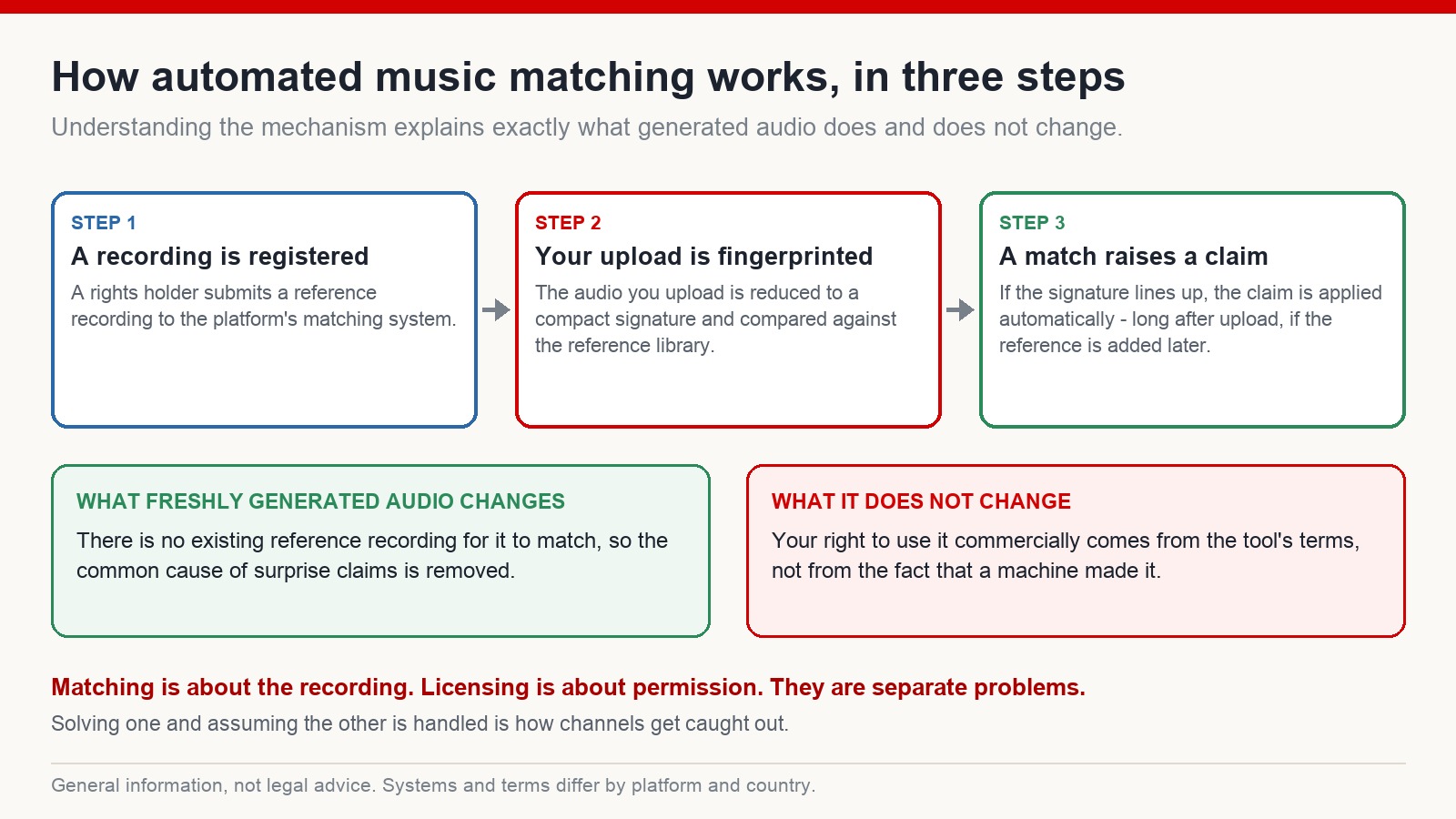
A rights holder submits a reference recording to the platform’s matching system. Your uploaded audio is reduced to a compact signature and compared against that reference library. If the signatures line up, a claim is applied automatically – including on videos that have been public for months, if the reference was added after you published.
The important detail is what is being compared. These systems match the recording, not the mood, the genre or the chord progression. This is why two different recordings of the same public-domain piece behave differently, and why a track that sounds similar to a famous one does not trigger anything on its own.
What generated music genuinely fixes
Follow the mechanism and the benefit is obvious: a piece generated for your video has no existing reference recording anywhere in that library, so the single most common cause of surprise claims is simply absent.
Two practical consequences follow. The first is speed – the hours creators lose hunting for a track, checking its licence and hoping it holds up become a prompt and a render. On a channel publishing regularly, that is a real bottleneck removed.
The second gets mentioned less and matters more over time. When your audio is yours, the channel develops a sound. Viewers start to recognise the mood before they recognise anything else, the same way they recognise a thumbnail style. Using the same widely-shared library tracks as thousands of other channels actively works against that.
What it does not fix
Here is the part that gets skipped. Matching is about the recording. Licensing is about permission. They are separate problems, and solving the first while assuming the second is handled is how channels get into trouble.
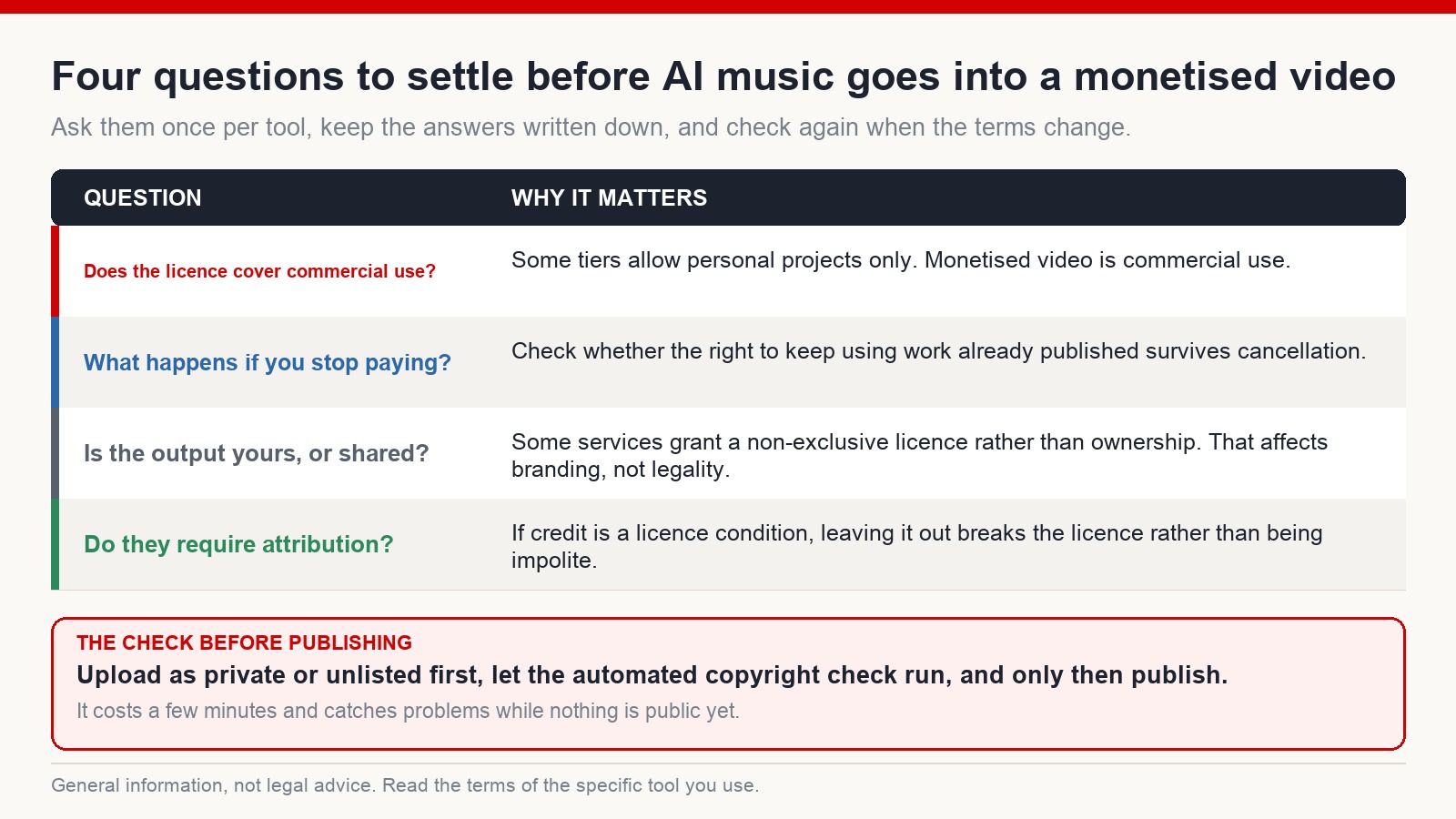
Your right to use generated music commercially comes from the terms of the tool you used, not from the fact that a machine produced it. Four questions are worth settling once per tool, in writing, before anything is published.
Does the licence cover commercial use? Several services allow personal projects on the free or lower tiers, and monetised video is commercial use regardless of how little it earns. What happens if you stop paying – does the right to keep using work you already published survive cancellation, or does it lapse with the subscription? Is the output yours, or are you granted a non-exclusive licence, meaning somebody else may receive something similar? And is attribution a condition rather than a courtesy, because if it is, omitting it breaks the licence.
None of this is exotic. It is the same reading you would do before using any asset commercially, and it takes fifteen minutes per tool.
A note on which tools do what
Worth stating plainly, because a lot of writing on this subject is loose about it: general-purpose assistants and dedicated audio generators are not the same category of tool. Some assistants will help you plan, describe or prompt a piece of music without producing audio at all; others are wired to a generation model and return a file. Capabilities change, and they change quickly.
Before building a workflow on any of it, confirm what the tool you are actually using outputs, in what format, at what quality, and under what terms. Assumptions carried over from an article written six months ago are how people end up with a track they cannot legally publish.
Prompting for the video, not for the track
The prompts that produce usable results describe function rather than musicianship. Mood, intensity, instrumentation family, and crucially the fact that this sits underneath narration – something like calm, sparse, low-intensity ambient bed for a reflective voiceover, no prominent melody.
That last constraint is the one beginners skip. Music generated to be listened to competes with the narration, because it was made to hold attention on its own. Background music has an entirely different job: setting mood while being forgettable. Generate several variations of the same brief and choose the one you notice least on the first listen.
The check that costs five minutes
Whatever the source, publish as private or unlisted first, let the platform’s automated copyright check finish, and only then make the video public. Generated audio should come back clean, and on the occasions when it does not, you would far rather know while nothing is visible.
It is also worth being honest about the limits. Nothing here is absolute, generation tools are new enough that their terms and the legal treatment of their output are still moving, and none of this is legal advice. Compared with a random track described as free by somebody on the internet, though, generating your own with the terms read is a considerably better position to be in. If you want the full production workflow for English-language faceless channels, that is what I teach at mmoyoutube.com.
Frequently asked questions
Can AI-generated music still trigger a copyright claim?
It is far less likely, because matching systems compare against registered recordings and a freshly generated piece is not one. It is not impossible – if generated audio is later registered by somebody, matches can follow.
Do I need to pay to use AI music commercially?
It depends entirely on the tool’s terms. Some restrict commercial use to paid tiers, some place conditions on what happens after cancellation. Read the licence for the specific service rather than relying on general advice.
Is generated music good enough to use as a bed?
For background under narration, generally yes – the job is to support mood without competing. Music intended to be listened to on its own is a different standard entirely.
Does generated music give my channel a recognisable sound?
It can, if you reuse a consistent brief across videos rather than generating something different each time. Consistency is what builds recognition, not novelty.
Should I still run the copyright check if I generated the audio myself?
Yes. It takes minutes, it also covers footage and images, and it catches problems while the video is still private.