Long-Form Or Shorts? Why View Count Is The Wrong Way To Compare Them
You scroll past a short with a couple of million views and something in your head does the arithmetic. That has to be worth a lot of money. It looks like a lot of money.
I made that assumption too, for longer than I would like to admit. It stopped when I sat down and actually looked at how the two formats generate revenue, rather than at how impressive their view counts look side by side.
The comparison people make is wrong at the root, because they are comparing the same number across two systems that do not use it the same way.
View count is not the unit
A view is not a payment. It is not even a consistent measure of attention – a view on a short and a view on a thirty-minute documentary describe completely different events.
What actually feeds ad revenue on a channel is a combination of things: the format, where the audience is in the world, how many minutes each viewer watches, what advertisers are paying to reach that particular audience, and what kind of ad inventory the format supports.
Two videos with identical view counts can produce very different outcomes, and neither number tells you which one it will be. That is the entire reason this question is confusing.
What each format is structurally good at
Both can be monetised. They are distributed differently and they are monetised differently, and it helps to stop thinking of them as competitors.
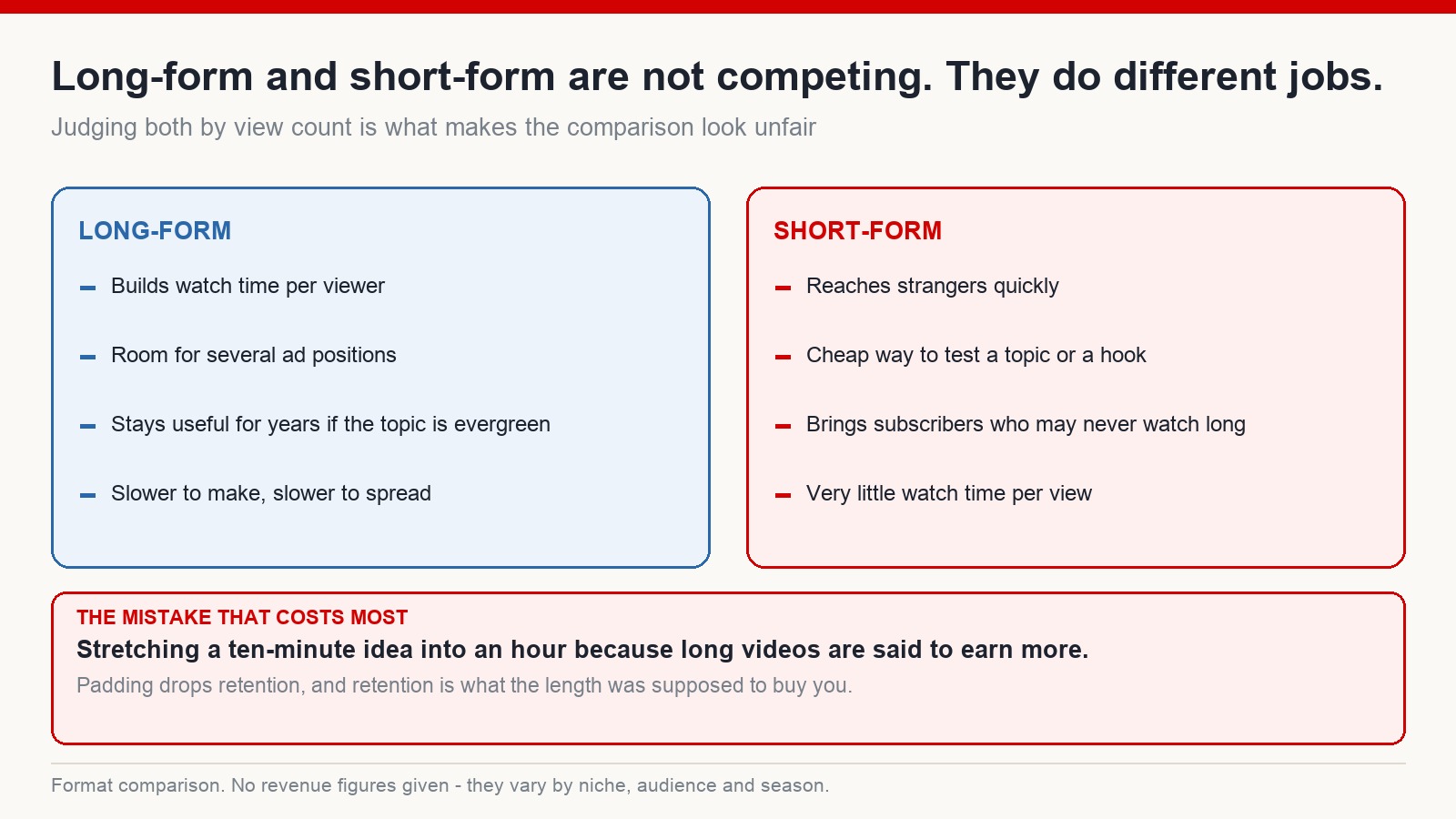
Long-form accumulates watch time per viewer. It supports multiple ad positions across the runtime. If the topic is evergreen, it keeps working for years, because a video that answers a question people keep asking keeps being found. The cost is that it is slower to produce and slower to spread.
Short-form reaches strangers fast. It is the cheapest way to test whether a topic or a hook has any pull at all. It brings subscribers quickly. The cost is that each view carries very little watch time, and its revenue model works on a different basis entirely – a shared pool rather than ads attached to your specific runtime.
Neither of those is better. They are different tools, and the mistake is asking which one wins rather than asking what each one is for.
Why long-form channels dominate certain niches
Something worth noticing about faceless channels aimed at English-speaking audiences: a lot of the established ones are not making five-minute videos. They are making twenty, forty, sixty minutes, and in some categories considerably more.
Documentary, storytelling, relaxation and ambient content, audiobooks, meditation, long-form educational material. Some of these run for hours.
The reason is structural rather than clever. These formats accumulate watch time per viewer in a way short content cannot, and they suit faceless production – no presenter to hold together, footage and narration that can be produced in volume, subjects that do not expire.
They are also, not coincidentally, the categories where a back catalogue keeps earning after the publishing stops. That is the part that makes long-form feel like building something rather than feeding something.
So what is short-form for?
Plenty. Just not the job people assign it.
Short-form is very good at brand recognition, at bringing new subscribers, at testing content ideas cheaply, and at putting your channel in front of people who would never have searched for it. Producing three shorts to find out which of three angles people respond to is far cheaper than finding out across three long videos.
The common pattern is short-form for reach, long-form for depth. Not one instead of the other.
The catch is worth naming: subscribers acquired through short-form do not automatically become people who watch long videos. They subscribed to a thirty-second experience. Converting that habit into a twenty-minute one is real work, and plenty of channels with large short-form subscriber counts get very little long-form viewing from them.
The mistake that costs the most
Here is the one I want to be emphatic about, because it follows directly from hearing “long videos earn more” and acting on it literally.
People take a ten-minute idea and stretch it to sixty minutes. Repetition, padding, filler segments, slow openings, the same point made four times.
What happens is exactly what you would expect. Retention collapses. Viewers leave in the middle. And retention was the entire thing the length was supposed to buy you – so the padding destroys the mechanism it was added to exploit.
Length is not the variable. Holding attention across whatever length you chose is the variable. A tight twelve-minute video that people finish is worth more, by every measure that matters, than a bloated fifty-minute one they abandon at minute six.
Choosing a length when you are new
Some general starting points, offered as ranges rather than rules, and adjusted heavily by niche.
Ten to twenty minutes is a sensible place to begin. Long enough to accumulate meaningful watch time, short enough that you can actually hold a viewer for most of it while you are still learning. Production stays manageable.
Twenty to forty minutes suits narrative and storytelling formats, where the extra time is doing structural work rather than filling space.
Thirty to sixty minutes and beyond tends to belong to documentary, ambient and relaxation content – formats where long duration is the point, not a stretch.
The right length is the length the material genuinely needs. Work out what the video has to say, then let that determine the runtime, rather than picking a number first and finding material to fill it.
An order that works
If I were starting again and running both formats, I would run them in this sequence.
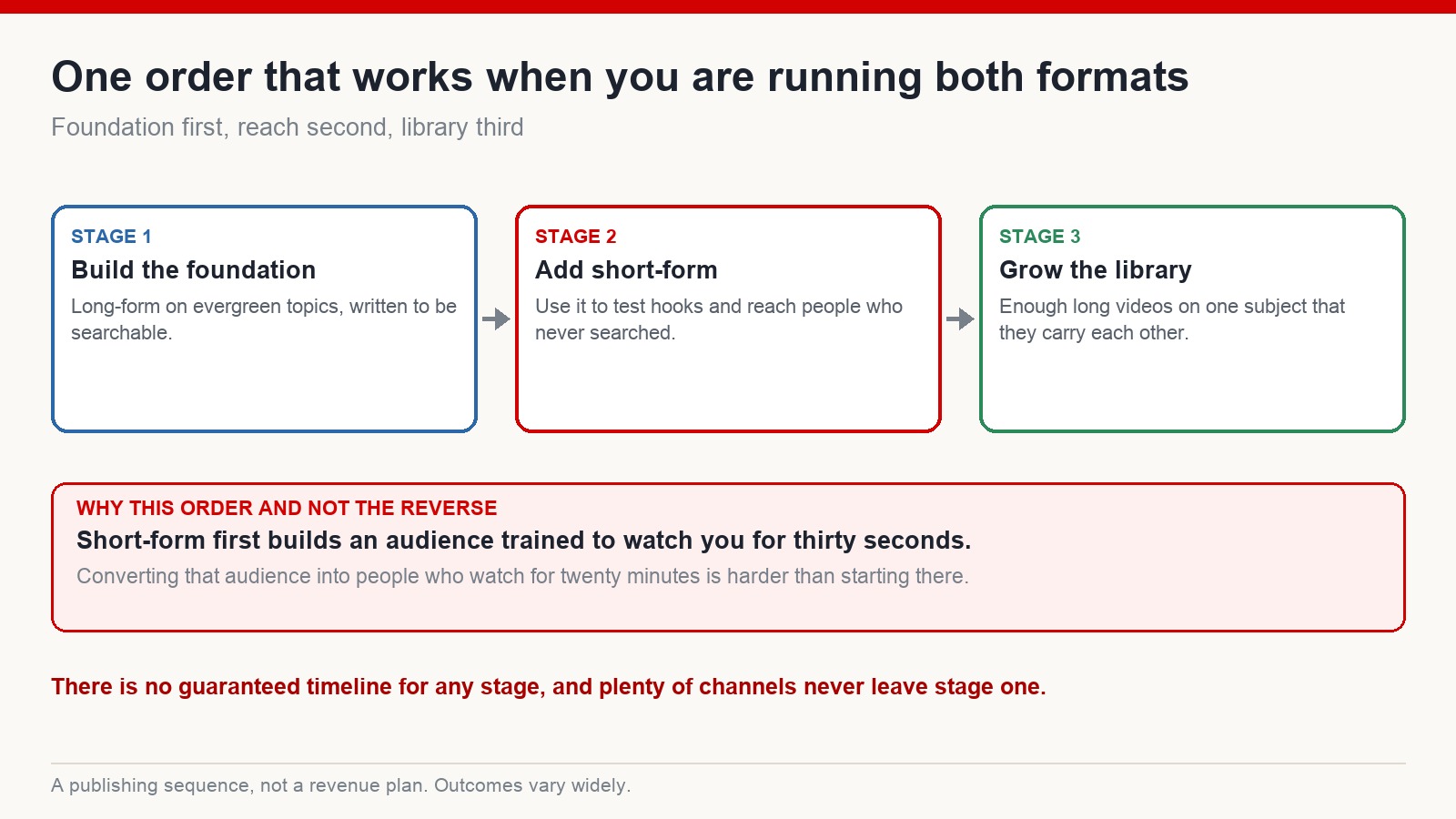
Build the foundation first. Long-form on evergreen topics, written to be findable in search, on a subject narrow enough that the videos reinforce each other.
Add short-form second. Once you know what your channel is about, use short content to test hooks and reach people who would never have searched for you.
Then grow the library. Enough long videos on one subject that they carry each other – a viewer who finishes one has an obvious next one, and the catalogue keeps working while you are making the next thing.
The reason for that order rather than the reverse: starting with short-form builds an audience trained to watch you for thirty seconds. Converting them into people who watch for twenty minutes is harder than building for twenty minutes from the beginning.
There is no guaranteed timeline for any of those stages, and plenty of channels never leave the first one.
What to look at instead of view count
If you want to judge whether a format is working on your channel, the view count is the least useful number available. More informative: how long the average viewer stays, where in the world your audience is, whether people finish, and whether they return for the next video.
Read all of those against your own channel’s recent median rather than against a figure from someone else’s screenshot. What counts as a healthy number varies enormously by niche, format and audience – which is exactly why I am not going to give you one here.
Frequently asked questions
What is the best video length?
There is no fixed answer. Make it as long as the material genuinely supports. Padding to reach a target length reduces retention, which is what you were trying to increase.
Can short-form be monetised?
Yes, though the mechanism differs from long-form and depends on multiple factors. It is a different revenue model, not a smaller version of the same one.
Should I only publish shorts?
If the goal is fast recognition and audience growth, it can work. If the goal is a catalogue that keeps working after you stop publishing, long-form usually needs to be part of it.
Should a new channel start with long-form or short-form?
Many creators build a long-form foundation first and add short content afterwards as a distribution channel. The reverse order tends to produce an audience that does not transfer.
Does a video with more views always earn more?
No. Audience location, watch time per viewer, format and advertiser demand all affect the outcome, and they can move in opposite directions to the view count.
The takeaway
Long-form does not automatically earn more. But a well-made long video with strong retention and a valuable audience will usually do more for a channel than a short with the same production effort behind it.
If you are building something meant to last, look past the view count at watch time, at who your audience is, and at whether the catalogue accumulates. A good long video published today may still be being watched a year from now. That is the property worth optimising for.
Revenue on any platform depends on niche, market, content quality and policies that change without notice, so treat all of this as a way of thinking rather than a formula. For the full build sequence for an English-language faceless channel, see mmoyoutube.com.