Good Script, Falling Retention: Five Places Viewers Still Leave
The worst videos to diagnose are not the bad ones. Bad ones are obvious. The hard case is the video you were proud of — researched properly, written properly, edited properly — that still empties out, and leaves you staring at the analytics wondering what more you were supposed to do.
I have made that video more than once since I started on YouTube in 2017. What eventually helped was giving up the idea that a script is judged as a piece of writing. It is not. It is judged one second at a time by somebody who has an entire app of alternatives and no obligation to be fair.
So when YouTube retention drops on a script you know is good, the problem is usually not the writing. It is one of five things the writing cannot see.
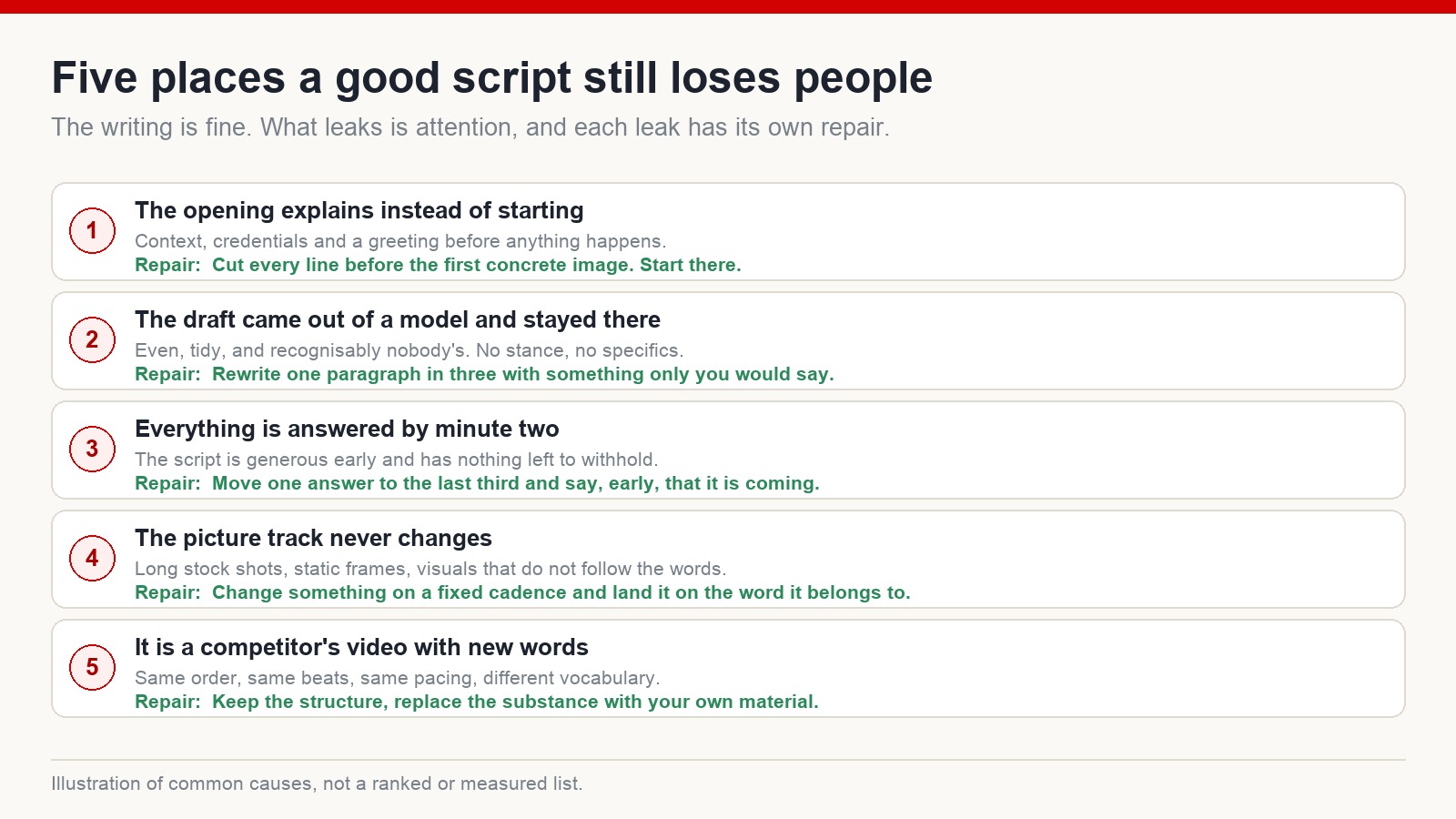
Leak one: the opening explains instead of starting
Read your first forty seconds as a stranger. If what happens is context, background, a greeting and a description of what the video will cover, then nothing has started yet — you have written a preface.
The repair is blunt and it works: find the first sentence in your script where something concrete happens, delete everything above it, and start there. Nine times out of ten the deleted material turns out to be unnecessary altogether. The rest of the time you can reintroduce one line of it later, once the viewer has a reason to want it.
Leak two: the draft came out of a model and stayed there
AI is not the problem. What flattens a script is running a competitor’s video through a model, asking for a rewrite, changing a few words and recording the result. The output is grammatical, even, tidy and recognisably nobody’s.
Audiences read that faster than people expect. Not because they detect the tool, but because they notice the absence: no stance, no specifics, nothing that could only have come from one person. Here is the same point written twice for a wildlife channel:
Flat: “Sharks are often misunderstood animals.”
Rewritten: “I have checked the attack figures for this coastline three times now, and I still find them hard to accept – not because they look wrong, but because they are so much smaller than the fear attached to them.”
The second line is not better written. It is attached to somebody. A useful rule is one paragraph in three: at least a third of the script has to contain something a model could not have produced without you — a mistake you made, a number from your own dashboard, a position somebody could disagree with.
Leak three: everything is answered by minute two
This one hides inside generosity. The script is packed, every question gets a full answer as soon as it comes up, and by the two-minute mark there is nothing left outstanding. The video is still going. The reason to watch it is not.
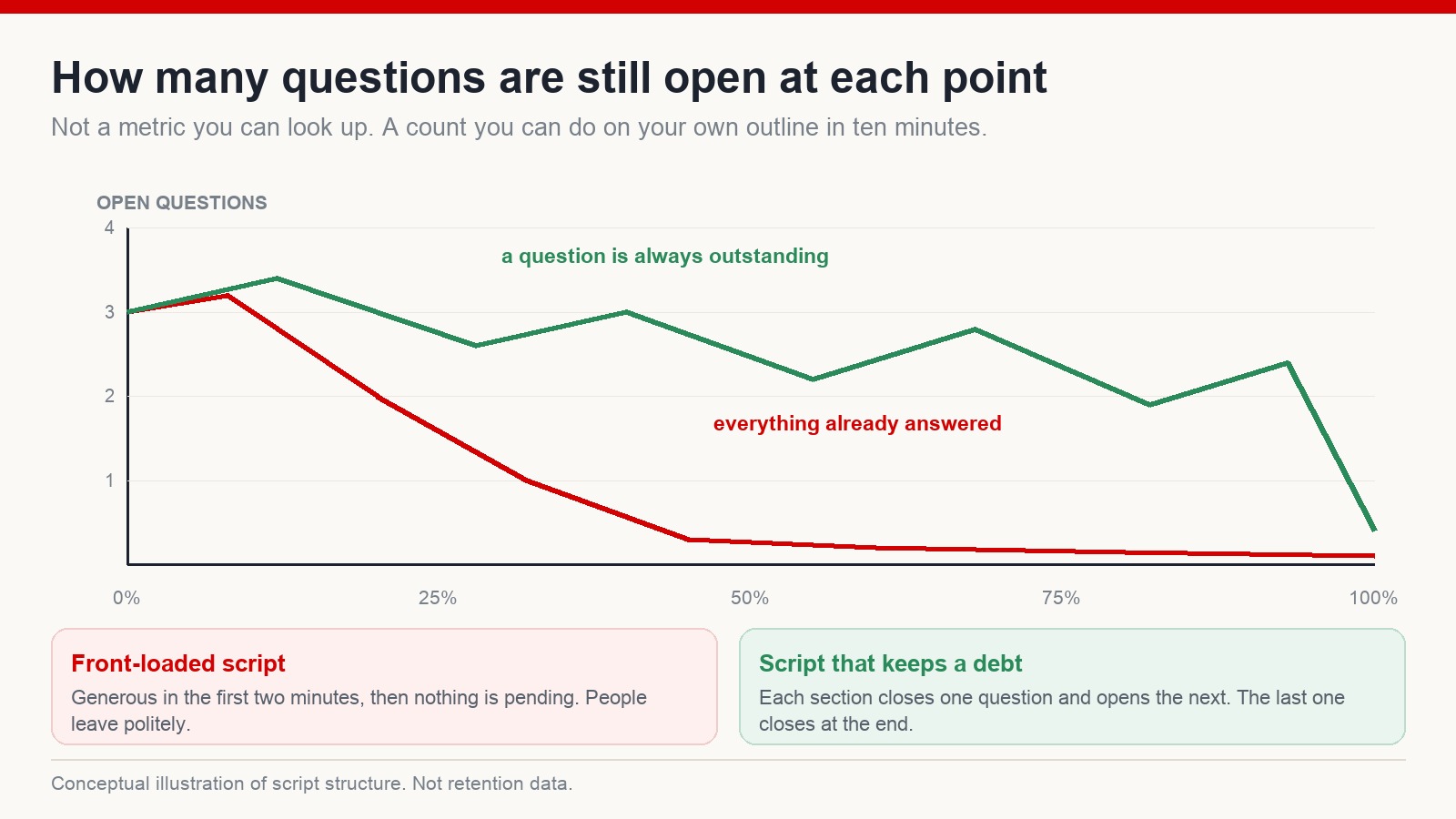
You can count this on your own outline in ten minutes. Walk down the sections and at each one write the number of questions the viewer still has no answer to. If that number reaches zero before the last section, you have found the place people leave.
The repair is not to withhold more. It is to move one answer — usually the most interesting one — into the final third, and to say early that it is coming. Countdown formats do this structurally, which is most of why they work: the strongest item is contractually still ahead of you.
Leak four: the picture track never changes
On faceless channels this is the most common technical cause and the least discussed. The narration is doing everything, the visuals are doing nothing: long stock clips, static frames, the same three shots recycled, images that have no relationship to the sentence being spoken.
Two repairs, and you need both. Change something on a regular cadence — shot, framing, scale, a graphic — often enough that the frame is never inert. And land each change on the word it belongs to: if the line is “and then the whole thing collapses”, the collapse is on screen at “collapses”, not three seconds later while the narrator has moved on.
Stock footage is not the villain here. Stock footage used as wallpaper is. The test is whether a given shot is carrying meaning or just occupying the frame.
Leak five: it is a competitor’s video with new words
Studying a video that worked is how everybody learns. Reproducing it is a different act, and audiences can feel the difference even when they cannot name it — same running order, same beats, same pacing, different vocabulary. It reads as familiar in the flattest possible sense.
Take the structure. Take the pacing. Take the observation that a certain question needs answering before another one can be asked. Do not take the script, the footage, the thumbnail or the sequence of reveals. Beyond taste, this is also where the platform’s reused-content rules live, and a channel built entirely on near-duplicates is fragile in a way that has nothing to do with retention.
A ten-minute audit before you record
Run the draft through five questions. Each one maps to a leak above.
- What is the first concrete thing that happens, and how far in is it?
- Which paragraphs contain something only I could have written?
- At what point in the outline does the number of open questions hit zero?
- How often does the picture change, and does each change land on its word?
- If I put my video next to the one I researched, what is different about mine?
Fixing one of these properly does more than half-fixing all five. If you only have an hour, spend it on the first and third.
What the graph will not tell you
Retention is a measurement, not a diagnosis. It tells you where people left; it never tells you why, and it is easy to over-read. Compare a video against the recent median of your own channel rather than against numbers from somebody else’s niche, format and audience — those comparisons are noise dressed up as a benchmark.
It is also worth saying plainly: some videos underperform for reasons that have nothing to do with the script. Topic demand, thumbnail, timing, what else was on the platform that week. The five leaks are the ones you can actually do something about, which is why they are the ones worth checking first.
Frequently asked questions
Why does retention drop when the content is genuinely good? Usually because value and reasons-to-continue are different things. A script can be full of the first and empty of the second — nothing withheld, nothing changing, nothing at stake.
Does using AI hurt retention? Not by itself. Using AI as a rewriting machine does, because what gets removed in that process is exactly the specificity that makes a video feel like it came from a person.
Is stock footage a problem? Only when it is decoration. Repeating clips, static frames and visuals that do not match the narration all cost attention; the same footage cut to the words does not.
How long should the opening be? Short enough that something concrete has happened before the viewer has to decide whether to stay. Treat that as a description of the job, not as a timer.
Where to start
Open the script of your last underperforming video and do only the third check: mark the point where every question you raised has been answered. If that point is in the first third of the video, you have found something worth fixing, and you can fix it in an afternoon.
If you want the whole process behind this — research, structure, production and the rest of building a faceless channel for an international audience — that is what I teach at mmoyoutube.com. Results vary between channels and niches, and platform behaviour changes.