YouTube Keyword Volume: How to Read the Number Without Being Fooled by It
The number that gets misread more than any other
Someone installs a keyword research extension for the first time, types in the subject they want to make videos about, and sees a figure with five or six digits next to it. Enormous monthly demand. They make the video, and it does nothing.
The conclusion they usually reach is that the tool lied, or that the platform is rigged against small channels. Neither is quite right. What actually happened is that the number answered a question they were not asking.
Search volume tells you roughly how many people look for a phrase. It says nothing about how many good answers already exist, how established those answers are, or whether a channel with no history has any chance of being one of them. Demand is only one side of the equation, and it is the side that is easy to measure — which is exactly why people over-weight it.
What the number actually is
Before using it, be clear about what you are holding.
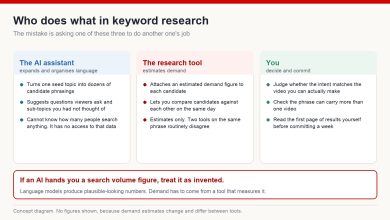
It is an estimate, not a count. Research tools model demand from sampled and inferred data. Two tools looking at the same phrase on the same day routinely disagree, sometimes by a lot, and both revise their figures over time. If you have ever compared two extensions side by side and been unsettled by the gap, that is normal and worth remembering.
It moves. Seasonal subjects swing hard. Anything tied to a product, a release or an event has a lifespan. A figure you noted three months ago is a historical record, not a current reading.
It is language- and region-shaped. A phrase can look substantial worldwide and be thin in the market you actually publish to, and the reverse happens too. If you are making content in English for an international audience, check it as that audience would type it.
None of this makes the number useless. It makes it a rough compass rather than a map.
Three zones, and why the lines move
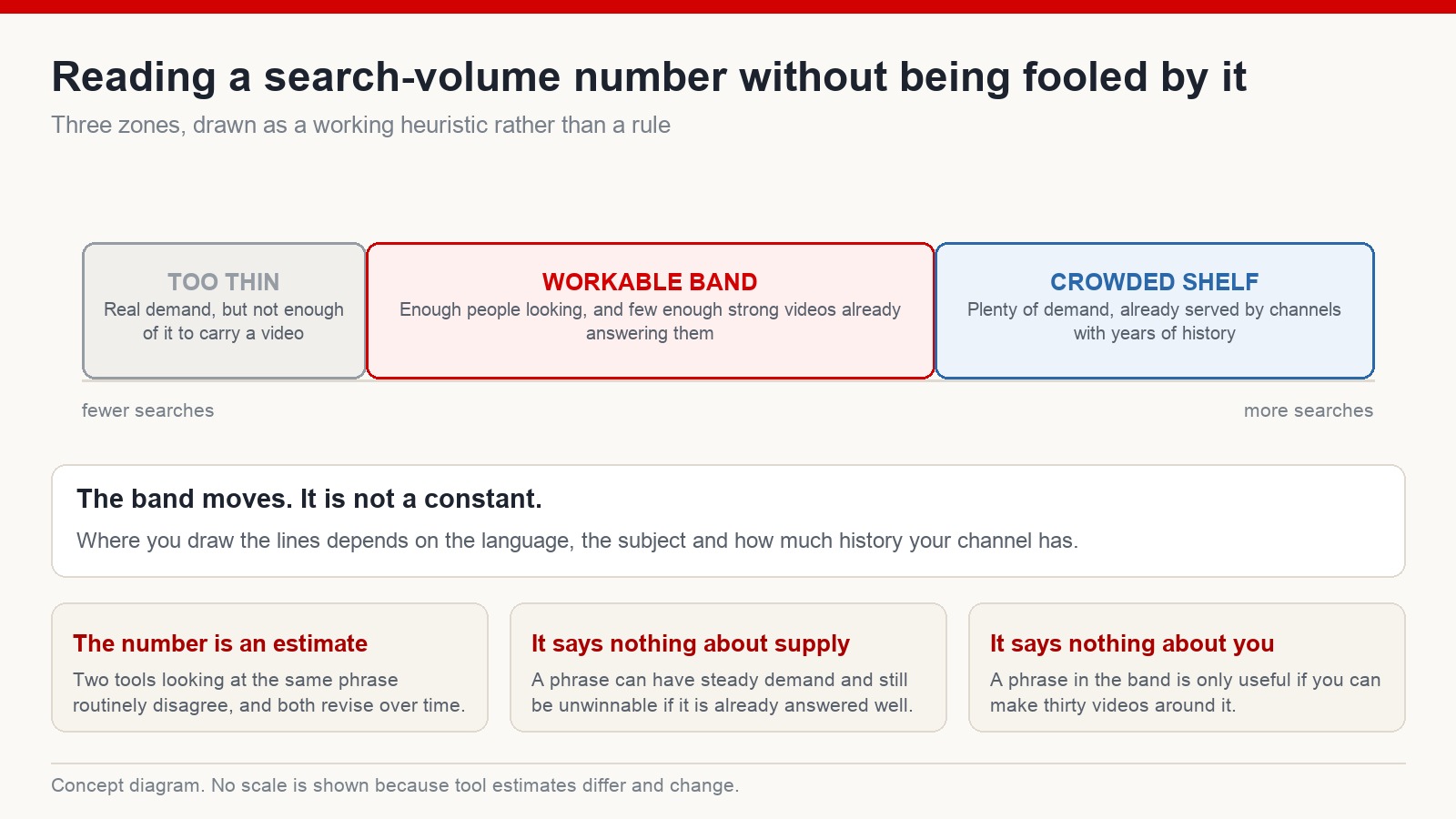
In practice I sort candidate phrases into three rough zones.
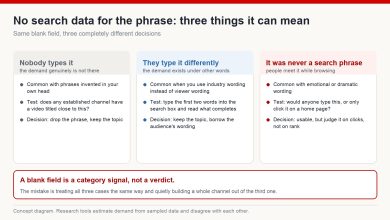
Too thin. The demand is real but there is not enough of it to carry a video. You can rank first for a phrase almost nobody types and it changes nothing. Below roughly a few hundred searches a month, most phrases sit here — and my own experience of building keyword sets in low-demand niches is that a surprising number of “obvious” phrases land in this zone once you actually check them.
Workable. Enough people looking that a video can find an audience, and few enough strong answers that a newer channel is not immediately outclassed. This is where I want most of a publishing schedule to sit.
Crowded. Plenty of demand, being served for years by channels with history, subscribers and back catalogues. Not impossible, but a bad place to spend your first twenty videos.
Here is the part most guides skip: the boundaries between those zones are not constants. You will see one creator recommend a band of roughly one to ten thousand searches a month and another recommend five to fifty thousand, and both can be describing real experience. The right band depends on the language, how mature the subject is, and how much history your channel already has. A channel with two years of consistent uploads can hold ground in territory that would flatten a channel with six videos.
Treat any published range, including mine, as a starting heuristic to calibrate against your own results — not a rule.
Narrowing until the phrase says who it is for
The practical move, when a phrase turns out to be in the crowded zone, is not to abandon the subject. It is to ask the same question more specifically.
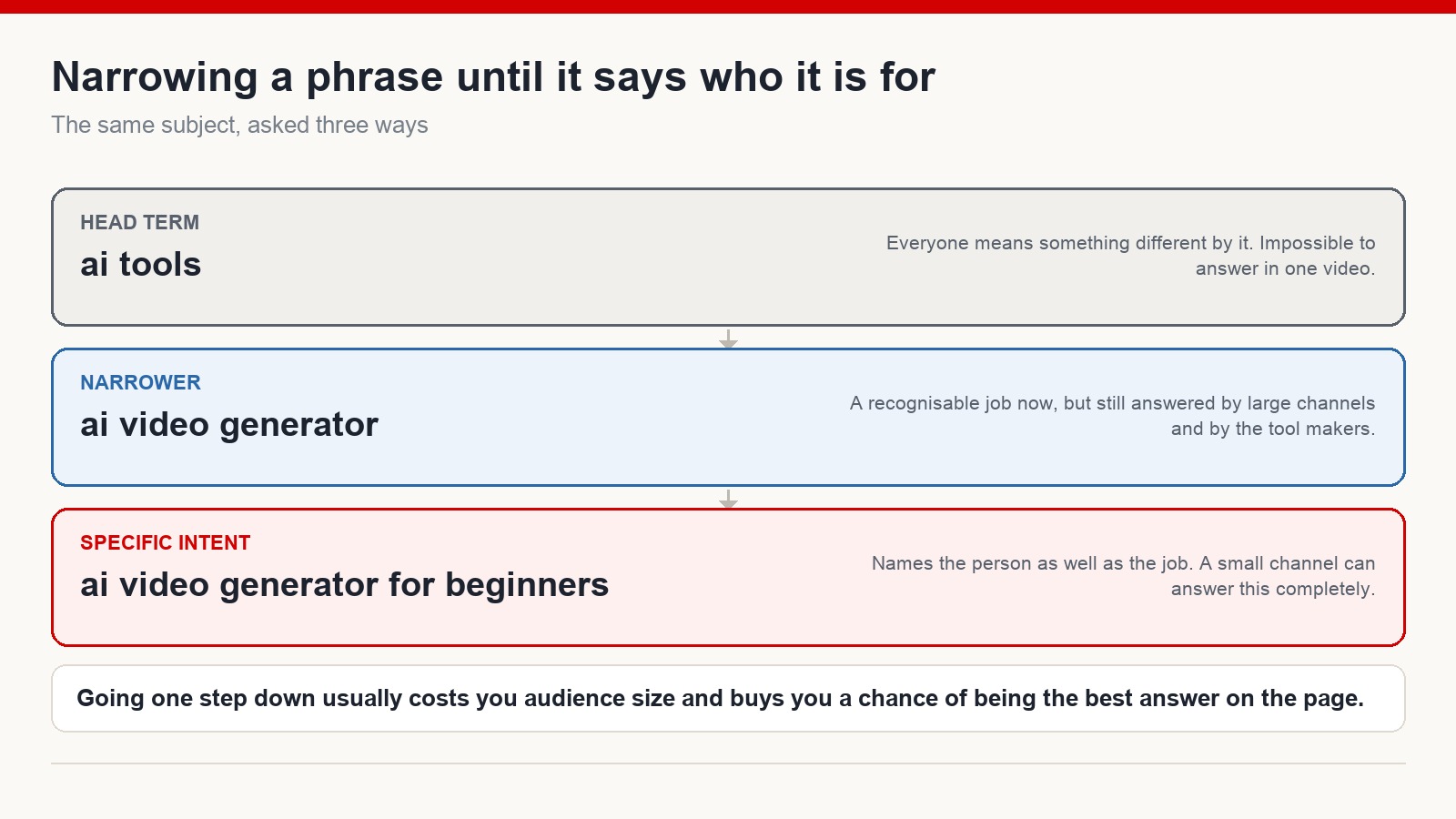
Take ai tools. Huge demand, and useless as a target: everyone typing it means something different, and no single video can answer it. Narrow it to ai video generator and you have a recognisable job, though one the tool makers and large channels are already answering.
Narrow once more to ai video generator for beginners and something changes. The phrase now names the person as well as the job. A small channel can answer it completely, and the audience arriving already knows what they wanted.
The same ladder works in any subject. Meditation music becomes meditation music for deep sleep. Youtube automation becomes youtube automation channel setup. Each step down costs you audience size and buys you a chance of being the best answer on the page. For a channel without history, that trade is almost always worth making.
Once you have one phrase in the workable zone, do not stop. Collect its neighbours — longer variants, near-synonyms, and the question forms people type. That cluster is what tells you the next ten videos, not just this one.
The metrics I ignore at the start
Research tools display a lot of numbers. Competition scores, relevance scores, overall scores. Most are composites the tool has assembled from things it can see, and the weightings are not published.
Early on, I mostly ignore them, for a simple reason: I can check the underlying question myself in two minutes by searching the phrase and reading the first page of results. How many strong channels are already answering it? How old are those videos? Does anything look thin or dated?
That five-minute read tells you more about whether you can compete than a composite score does, because you are looking at the actual competition rather than a summary of it. Composite scores become more useful later, when you are comparing dozens of candidates and need something to sort by.
A workflow that fits in half an hour
- Start with a seed phrase — the plainest description of what your channel is about.
- Read the demand estimate, and treat it as approximate. If it is enormous, you have found a category, not a target.
- Narrow one step, then another, until the phrase names a specific job or a specific person.
- Search the phrase yourself and read the first page. This is the step people skip, and it is the one that saves the week.
- Collect the cluster — variants, question forms, adjacent phrases — and check a few of those too.
- Sanity-check the depth. If the cluster cannot support thirty videos, you have found a video idea, not a shelf.
Then carry the chosen phrase through the title, the description, the tags and the words actually used in the video, without letting it drift into three different wordings along the way.
Why narrower phrases tend to work for new channels
It is not that the platform prefers small phrases. It is that a specific phrase makes you easy to place.
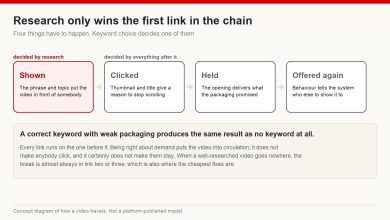
When a video answers a narrow question completely, the audience it reaches is well matched almost by definition. Well-matched audiences click more often and stay longer, and those are the signals that decide whether a video is shown to more people. A broad phrase does the opposite: it collects an audience with a dozen different intentions, most of whom wanted something else, and their leaving is the loudest thing the video says about itself.
So the advantage of a narrow phrase is not a ranking trick. It is that it stops you being shown to people who were never going to stay.
What this cannot do
Choosing a phrase in a sensible band improves your odds. It does not produce views, and I would be careful with anyone who frames it as though it does.
A video can sit in a perfect band and still go nowhere because the packaging was weak, the opening lost people, or the subject was quietly saturated in the months between your research and your upload. Estimates are estimates, platform behaviour changes, and results differ enormously between channels and subjects.
What research reliably prevents is the one failure you cannot fix afterwards: spending a week on a video that nobody was ever looking for. That is a smaller promise than the tools imply, and it is still the most valuable hour in the process.
Frequently asked questions
Are keyword research tools accurate?
They are estimates built from sampled data, and different tools disagree. Use them to compare phrases against each other rather than to trust any single figure as fact.
What volume should a new channel aim for?
There is no universal answer. Aim for phrases with enough demand to be worth answering and few enough strong existing answers that you can compete — then adjust the band based on what actually works for your channel.
Should I care about competition scores?
Less than you would think at the start. Searching the phrase and reading the first page of results tells you the same thing more directly.
How many keywords should one video target?
One main phrase, plus a handful of closely related ones used naturally. Trying to target several unrelated phrases in one video usually means it answers none of them properly.
How often should I recheck a phrase?
Before committing to a run of videos, and periodically after. Demand drifts, competitors publish, and tool estimates get revised.
If you want to see how phrase selection fits into building a faceless channel for English-speaking audiences end to end, the system I teach is at mmoyoutube.com. Outcomes vary by channel, subject and market.