Position 11 Is Where Your Next Win Is
There is a small detail in the first panel of this card that is worth more than the other two panels put together, and it goes past most people in half a second. It is a short list of keywords with numbers beside them: pos 11.4. pos 12.8. pos 14.2.
Position eleven is the first result on page two. Nobody goes to page two. A page sitting at 11.4 has already been written, already been crawled, already been judged good enough by a search engine to beat a few hundred other pages — and it earns almost nothing, because it finished one place outside the only page anybody looks at.
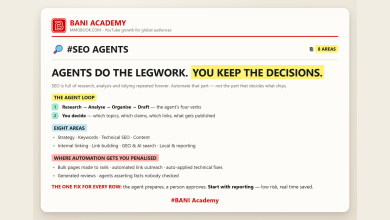
That is the whole argument for doing SEO in the order this card lays it out rather than the order everyone actually does it in. The card presents three free plugins that turn a coding agent into an SEO setup. They are not three tools doing one job. They are three layers, owned by three different parties, and the one most people open first is the slowest of the three.
The footer is honest about what they are — all three are free and open source, checked live before this was posted — and this article is about what that does and does not replace.
Three layers, three different owners
| LAYER 1 · YOUR DATA | LAYER 2 · THE MARKET | LAYER 3 · SOMEONE ELSE’S INDEX |
|---|---|---|
| Search Console, read by the agent | Keyword research, rankings, backlinks, audits | Being cited inside AI answers |
| What is already nearly working on your site | What exists out there and who holds it | Whether an answer engine quotes you or a competitor |
| Fix an existing page. Days to weeks | Write a new page and wait. Months | Change how pages are written. Unclear, and moving |
| Empty if your site has no impressions yet | Never empty — which is why it is seductive | Pointless until something of yours is worth citing |
The three, as the card gives them
| # | Name | How the card labels it | What it is | The four steps it lists |
|---|---|---|---|---|
| 1 | GSC MCP | Plugin — the data layer | Plugs the agent into Search Console to find keywords you almost rank for | Connect it · it studies your analytics · it finds keywords near the top spots · it tells you exactly what to fix |
| 2 | OpenSEO | Plugin — the research layer | One free tool, no monthly bill: research, tracking, backlinks, audits | Run keyword research · track rankings over time · check backlinks · audit the full site for issues |
| 3 | GEO Optimizer | Skill — the AI search layer | Optimises your site so AI engines cite you, not your competitors | Optimise pages for GEO standards · make content easy for AI to cite · target the answer engines · get cited over competitors |
WATCH THE ORIGINAL — 45 SECONDS
All three panels with their steps, the sample keyword list with its positions, and the footer line.
▶ Turn Claude into an SEO expert — 3 free plugins — BANI Academy on Facebook
Why layer one comes first
Open any SEO advice from the last fifteen years and it starts in the same place: keyword research. Find a topic, check the difficulty, write the page. That advice is not wrong — it is just the slowest of the three things you could do today, and the card quietly puts it second.
Layer one does something different. It reads what has already happened on your own site. Somewhere in that data is a page you wrote months ago that ranks at eleven, or twelve, or fourteen for a phrase you were not even aiming at. That page has already done the expensive part. It exists, it is indexed, and a search engine already thinks it is roughly relevant. Moving it three places is a different kind of work from creating something from nothing — it is editing, not writing.
The card’s sample output says it in four words: fix title + add 2 links. That is the shape of a layer-one task. Not a content calendar. A title and two internal links, on a page that already exists, this afternoon.
And this is where an agent genuinely earns its place. The reason most people never do this work is not that it is hard — it is that it means reading a spreadsheet of a few thousand query rows, sorting by position, cross-referencing impressions, and finding the handful worth touching. That is tedious for a person and trivial for a model with access to the data. The card’s second step is exactly that: it studies your analytics data.
So which layer should you open this week?
| Where you are | Open this layer | What to actually do | What wastes the month |
|---|---|---|---|
| Brand new site, no impressions yet | Layer 2 | Research, then write the first ten pages | Checking rankings you do not have |
| Some pages, some impressions, no traffic | Layer 1 | Find everything at position 8 to 20 and fix those pages first | Writing ten more pages that will also land at 15 |
| Steady traffic, want more of it | Layer 1, then 2 | Harvest the near-misses, then research the next cluster | Rebuilding the site design instead |
| Traffic that converts, competitors copying you | Layer 2 | Backlinks and a full site audit | Guessing why a competitor outranks you |
| People already ask AI about your topic | Layer 3 | Make your pages quotable: clear claims, clean structure | Chasing citations before anything of yours is worth citing |
| No site at all, only a channel | None of them | Publish one page that collects emails | A month of SEO tooling for a site that does not exist |
Four honest caveats
Free replaces the bill and the workflow. It does not replace the index. The card describes layer two as a free alternative to the two best-known paid research suites, and for research, tracking and auditing that is a fair claim — those are workflows, and workflows can be rebuilt. Backlink data is different. The expensive suites are expensive largely because they run their own crawlers across the whole web and keep the result. A free tool’s backlink view comes from somewhere narrower, which is fine for spotting patterns and not fine for “nobody links to them”. Use it to find leads, not to settle arguments.
Connecting Search Console is account access, not a file import. Layer one works by giving a program a route into a Google property that knows what every visitor searched for before they reached you. Grant it the narrowest scope that works, prefer read access, and review what you have connected the same way you would review anything with a key to your accounts — the case for that habit is in Read-Only First.
Layer three is marketing, measured somewhere new. Getting cited inside AI answers is a real and growing concern, but it is not a separate discipline you must go and learn. It is clear claims, clean structure, a date, a source and a page that answers the question it promises — which is what good writing for search always was. We made the same point about this category when it appeared on a skills chart last week, in Ten AI Skills, But They Are Not Ten Separate Things. And which engine is doing the citing matters, because they do not all read the same part of the web: The Paid Column And The Free Column Aren’t The Same Product.
Open source is a licence, not a maintenance promise. The card dates its check — checked live before this was posted — which is more than most lists do. Still, before you wire any of the three into your workflow, look at when the project last shipped anything. An abandoned tool keeps working right up until the API it depends on changes. That is one of four distinct ways a free pick quietly dies, which we set out in The Paid Tools Are Fine. It Is the Free Column That Rots.
The one-afternoon version
You do not need all three installed to get the main benefit of this card. You need the first one, and about two hours.
Pull your last three months of search data. Sort it by average position and keep only the rows between eight and twenty — the near misses. Then sort those by impressions, because a near miss nobody searches for is not a near miss, it is a nice fact. The rows at the top of that list are your afternoon.
For each one, open the page that ranks and ask three questions. Does the title actually contain the phrase people typed? Does the page answer that exact question in the first paragraph, or three screens down? Is there any other page on your own site that should be linking to it? That is the whole of fix title + add 2 links, and it is the highest-return hour in search work for a small site.
Then leave it alone for a month. Rankings move slowly and watching them daily teaches you nothing except how to feel anxious.
Questions people ask
Why position 8 to 20 and not 1 to 10? Because a page at three is already doing its job and the work to move it to two is large. A page at twelve is one good edit away from a different amount of traffic entirely.
Does an agent actually help here, or is it a gimmick? It helps with exactly one thing and helps a lot: reading several thousand rows and telling you which twelve matter. The judgement about whether a suggested title is any good is still yours — the thing that proposes the fix cannot also be the thing that approves it, which we argued in The Thing That Makes It Can Never Be The Thing That Grades It.
Can I skip Google entirely and only chase AI citations? Not yet, and probably not soon. Answer engines are mostly reading pages that rank. Being quotable and being findable are currently the same project.
Will this work for a YouTube channel with no blog? Layer one has a cousin that does: the search terms report inside your own channel analytics. Same logic, same near misses, same fix — a title that matches what people actually typed.
Start where the data is already yours
Three free plugins, three layers, three different owners. The market’s data is infinite and slow. Somebody else’s index is interesting and still moving. Your own data is small, finite, boring-looking — and it is the only one of the three that already contains a page sitting one place outside the results, waiting for a better title.
Open that one first.
Learning a lot does not make anyone good. Doing a lot does.
If you want a deadline rather than another saved setup guide, we run a free challenge — there is no barrier to entry, only a commitment fee that is refunded when you finish. It exists because a deadline fixes the title, and a bookmark never does.
What is sitting at position eleven on your site right now? Tell us in the comments under the original reel.
More on building a channel for a global audience at mmoyoutube.com.