This Prompt Produces Exactly Three Combinations. YouTube Tests Exactly Three.
This is the best-engineered prompt card the page has posted in a while, and the thing worth saying about it is not a criticism of how it is written. It is that the prompt stops one step too late, and the step it should not take is the one it ends on.
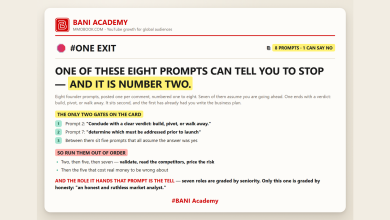
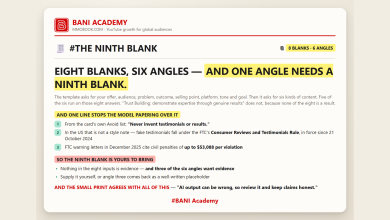
The shape is clean. Eight details about your video go in. Ten title options come out, each with an explanation of the click angle behind it. The three strongest get a thumbnail concept with five components — visual concept, two-to-four-word text, emotion, curiosity element, composition. Then the final instruction: choose the strongest title-thumbnail combination and explain why it has the best potential.
Read that output back. Three titles, each with a matching thumbnail concept. Three complete packaging combinations. That is not an arbitrary number — it is precisely the number YouTube’s own A/B test accepts, and YouTube will decide the winner using your actual audience instead of a model’s opinion.
“A Prompt Template to Create YouTube Titles & Thumbnails People Can’t Ignore” — one fill-in-the-blanks prompt, posted 23 October 2026.
Read the original post on Facebook →
What the prompt actually does, stage by stage
Set out as a pipeline, it is tidy work. The interesting column is the last one.
| Stage | What the prompt asks for | Who is deciding | On what evidence |
|---|---|---|---|
| Input | Eight details: topic, description, audience, problem or desire, key takeaway, most surprising insight, niche, tone | You | What you know about your own video |
| Analyse | Topic, audience, core promise, emotional appeal, strongest curiosity angle | The model | Your eight answers |
| Generate | Ten titles across curiosity, benefit, contrast, transformation, mistake, discovery, controversy, storytelling | The model | General knowledge of what titles look like |
| Explain | The click angle behind each of the ten | The model | — |
| Narrow | Pick the three strongest titles | The model | Titles alone. No thumbnail exists yet |
| Package | A five-part thumbnail concept for each of the three | The model | The chosen title |
| Decide | Choose the strongest combination and justify it | The model | Its own prior two steps |
Three pairs is the exact input YouTube wants
YouTube Studio has a built-in A/B test for packaging. Its help page is specific: creators can test and compare up to three different titles and thumbnails. You choose what varies — the title alone, the thumbnail alone, or the title and thumbnail together as a pair — and the version with the highest watch time is the one shown to everyone.
So the prompt’s own output, three titles with three matching thumbnail concepts, is a filled-in test form. You produce it, and then the last line of the prompt throws two thirds of it away by asking a model with no access to your channel, your audience or your impressions to guess which one would have won.
It will produce a confident answer. It has to; you asked for one. But the thing being predicted — how a particular audience behaves in a feed — is not in the model’s context and never was. Meanwhile the tool that can answer it is free, built into Studio, and takes the three things you just generated.
And the two are optimising different things
This is the part that would be easy to miss, and it is the strongest reason not to trust the model’s pick.
The prompt is built around clicks. Its opening task is titles and thumbnails designed to increase curiosity and clicks. It asks for the click angle behind every title. It asks the thumbnail to add a visual curiosity gap.
YouTube’s test does not measure that. The help page says the feature optimises tests for overall watch time over other metrics, like click-through rate. YouTube explained the reasoning when the feature launched: watch time already contains both halves — whether people clicked, and whether they stayed — so a single number covers what two separate metrics would report.
Which means a title that wins the prompt’s contest can lose YouTube’s. A curiosity gap wide enough to pull a click, and wide enough to disappoint once the video starts, scores exactly as you would expect on a watch-time measure. The card is alert to the honesty half of this — its rules forbid forced clickbait and exaggerated claims, and the task line says without misleading the viewer — but it never connects that principle to the metric that enforces it.
The final step, run both ways
Put the model’s decision next to the platform’s and the trade is clear.
| The prompt’s final step | YouTube’s A/B test | |
|---|---|---|
| Input | Three title-and-thumbnail pairs | Up to three titles and thumbnails |
| Who judges | A language model | Your actual audience |
| Evidence used | The eight details you typed | Real impressions on your channel |
| Metric | Predicted curiosity and clicks | Watch time, explicitly chosen over click-through rate |
| Cost | One more paragraph of output | Free, inside YouTube Studio |
| Time to answer | Instant | A few days, up to two weeks |
| If it cannot decide | It will still pick one | Labelled inconclusive; the first combination you uploaded stays live |
| What you learn | Why a model liked one phrasing | Which packaging your audience actually watches |
Before you rely on that: who can actually run the test
The advice above is only free if the feature is available to you, and for a lot of people reading a prompt card it is not. The eligibility rules are narrower than most posts about A/B testing admit.
| Requirement | Detail | If this is you |
|---|---|---|
| A computer | The feature is only available on computers through YouTube Studio | No phone-only workflow. Draft on mobile, set the test on a desktop |
| Advanced features enabled | Your channel must have them turned on | Verify the channel first; it is a prerequisite, not a formality |
| A long-form video | Shorts are excluded | Shorts creators get no test at all — the model’s pick is the only pick you have |
| Not a scheduled Live or Premiere | Live Archives do qualify, and Premieres qualify once they convert to long-form | Wait for the conversion, then set the test |
| Not made for kids, not mature, not private | These are excluded outright | Kids-content channels are in the same position as Shorts creators |
| Patience | Results take a few days and can take up to two weeks | Not a tool for a video you need to fix tonight |
If you fall outside the rules — and a Shorts-first channel always will — the model’s pick genuinely is the best you have, and the prompt is doing you a service by producing a reasoned one. The argument in this post is narrower than “never trust the model”: it is that when a free test on real data is available, a prediction should not be allowed to replace it.
There is a second, quieter problem in the pipeline worth fixing whichever camp you are in. The prompt narrows ten titles to three before any thumbnail exists. Titles are ranked alone, and only the winners get art. That means a pairing where an average title plus an unusual thumbnail beats a clever title on its own can never surface, because the average title was cut at a stage where nothing visual was being considered. The two layers are doing different jobs, which is exactly why ranking one of them in isolation is the wrong cut.
The fix costs one sentence. Ask for a thumbnail concept for all ten, or at least for five, and choose the three pairs afterwards. Then you are selecting the thing you are actually going to publish.
What the card gets right
Quite a lot, and two lines stand out.
The first is structural: the title and thumbnail must complement each other, not repeat each other — the title carrying enough value to earn the click, the thumbnail adding the visual curiosity gap. That is a genuinely good division of labour, stated more clearly here than in most paid courses, and it is the principle that makes the five-part thumbnail spec worth filling in.
The second is the last rule: if my original topic is weak, improve the angle before generating the titles. That is the only instruction on the card that lets the model push back on the brief rather than decorate it, and it is the right escape hatch to include. Packaging cannot save a video nobody wants; being told so before you spend an afternoon on thumbnails is worth more than ten title options. Drafting against a few fixed title shapes is the natural next step once the angle itself holds up.
And the fine print does its job: replace the brackets with your own details, keep titles honest and not misleading, review the output before publishing. Three sentences, all load-bearing.
Four honest caveats
- Three is a coincidence worth noticing, not evidence of intent. The prompt asks for three thumbnail concepts and YouTube accepts three options. I have no idea whether the author knew that, and the argument does not need them to have known. The point is that the output happens to be the right shape for a tool that exists, so throwing two of the three away is a waste either way.
- Eligibility can change, and so can the metric. Everything about the A/B test here comes from YouTube’s current help pages: up to three options, watch time as the deciding measure, desktop-only, Shorts excluded. YouTube revises these. Open your own Studio and look at the Title or Thumbnail section before planning a workflow around it.
- A test needs traffic to resolve. On a channel with few impressions, a test can finish inconclusive, and YouTube then keeps the first combination you uploaded. So on a small channel the model’s reasoning still matters — not as a verdict, but as the thing that decides which pair you upload first, because that is the one that will quietly become the default.
- I have not run the prompt. Whether it actually produces ten distinct angles rather than eight paraphrases of the same one is an empirical question I did not test. The eight approaches it names are genuinely different in kind, which is a good sign, but a good sign is not a measurement.
The one-line version
Run this prompt exactly as written until the final sentence, then stop: it has just handed you three complete title-and-thumbnail pairs, which is the maximum YouTube’s own A/B test accepts, and that test decides on watch time using your real audience rather than on predicted clicks using none.
The complete prompt, with all eight blanks, the ten-title brief and the five-part thumbnail spec, is in the original post.
Open the original post on Facebook →