Your Research Tool Shows No Data for That Phrase. Three Things It Can Mean
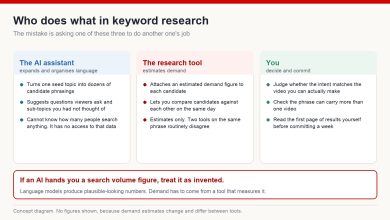
Here is a situation that comes up constantly. You find a video doing enormous numbers in your subject. The title is dramatic, the thumbnail is loud, the comments are full of people saying it changed how they think. You take the title, drop it into a keyword research tool, and the tool comes back with nothing. No demand figure. A dash where the number should be.
Most people react in one of two ways. Either they decide the tool is broken and make the video anyway, or they decide the phrase is worthless and drop the topic. Both reactions skip the interesting part, which is that a blank field is a category signal. It tells you what kind of phrase you are holding — and there are at least three kinds, each requiring a different decision.
Why this matters more than it sounds
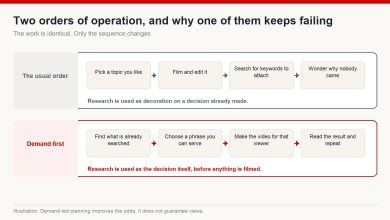
Watching a video succeed and copying its surface is the most reliable way to build a channel that goes nowhere. The dramatic title is visible. The thing that made it work — an existing audience, a moment in the news cycle, a face people already trust, a thumbnail iterated on six times — is not.
When you copy a phrase with no measurable demand, you are also copying a bet you cannot see the odds of. That is worth knowing before you spend a week on it, rather than after.
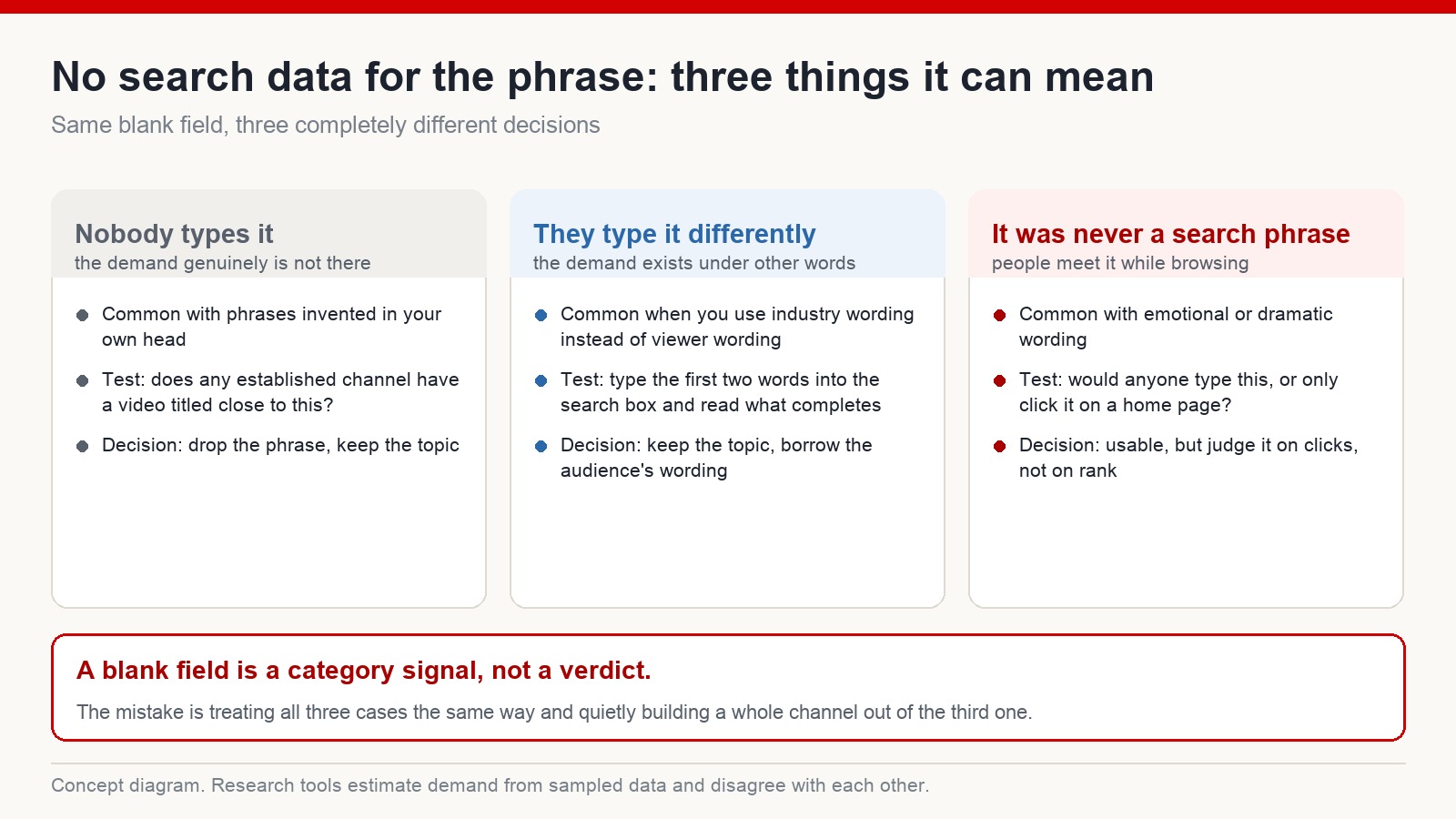
Case one: genuinely nobody types it
The simplest explanation, and the most common when the phrase came out of your own head rather than out of an audience.
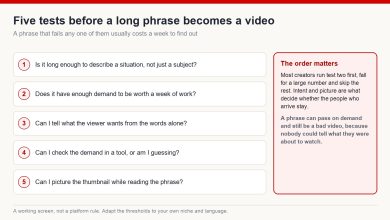
How to tell: search the phrase on the platform and look at what comes back. If the results are only loosely related, and no established channel has a video titled anything close to it, the demand probably is not there.
What to do: drop the phrase, keep the topic. The subject may be perfectly good; you just described it in words nobody uses.
Case two: the demand exists under different words
This one catches people who know their subject well. The longer you spend inside a topic, the more you start using its internal vocabulary, and viewers do not use that vocabulary.
Someone who works in sleep research might reach for sleep onset latency. The people who need that video type why does it take me so long to fall asleep. Same demand, completely different words, and only one of them returns a number.
How to tell: type the first two or three words of your phrase into the platform’s search box and read what it offers to complete. Those completions come from what people actually type. If the suggestions circle your topic in wording you did not use, that is your answer.
What to do: keep the topic and borrow the audience’s wording. This is the case with the highest payoff, because you have found real demand that a lot of people in your niche are describing wrongly.
Case three: it was never a search phrase to begin with
Some phrases were never going to be typed by anybody. Ten dark truths nobody talks about. The most dangerous human behaviour. Nobody sits down and searches those. They get clicked when they appear in front of somebody who was not looking for anything in particular.
These phrases can perform extremely well. They just perform through a different mechanism, and the tool showing no data is not a malfunction — the tool measures search, and this was never search.
How to tell: ask yourself honestly whether any person would type this into a box, or whether it only works as something you stumble across.
What to do: the phrase is usable, but judge it as a click proposition rather than a ranking one. Which means the thumbnail is doing most of the work, timing matters, and you should expect the result to be far less predictable.
Two kinds of phrase, two ways of failing
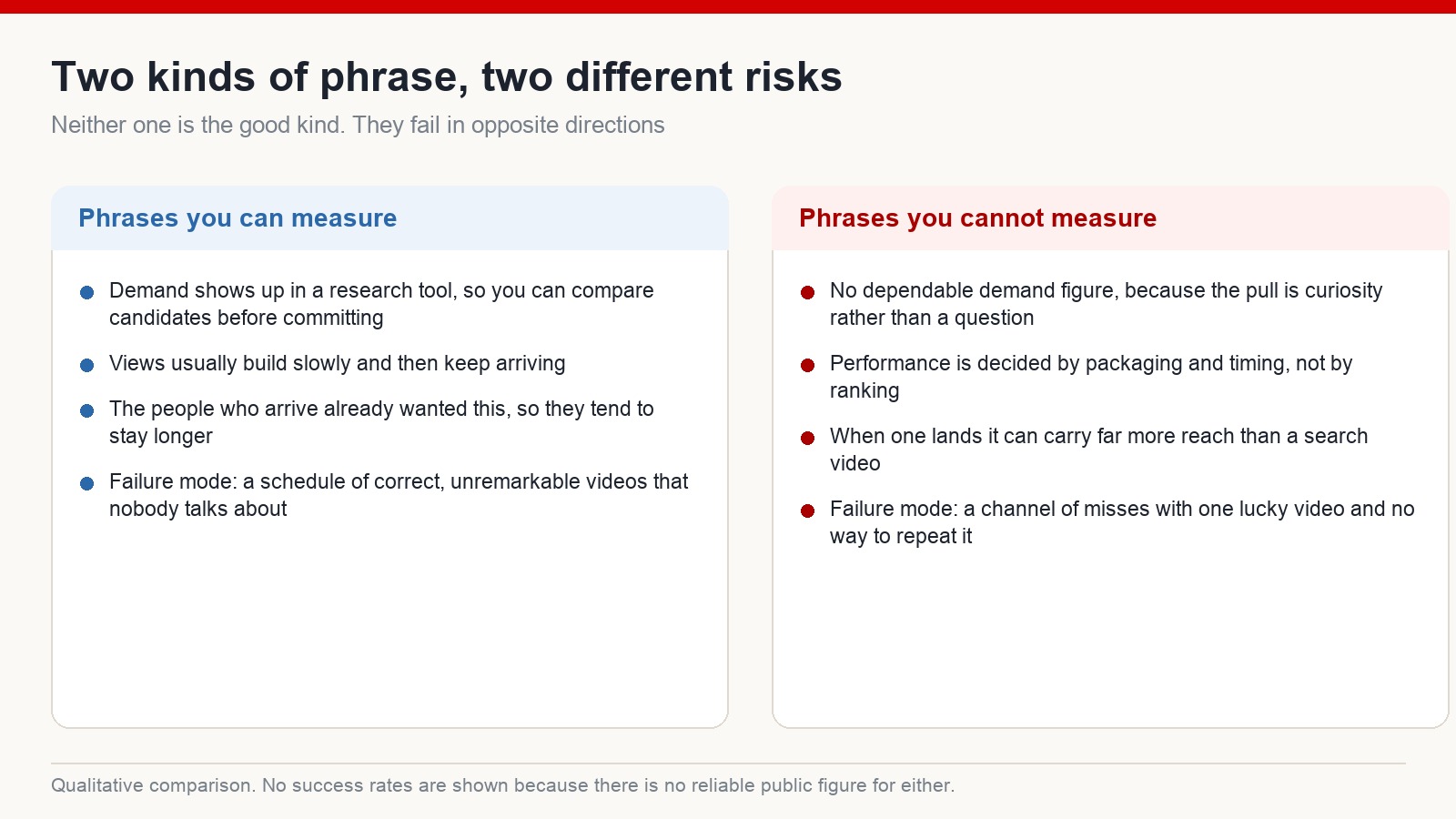
Once you separate the two, their risk profiles look completely different, and neither is the safe option.
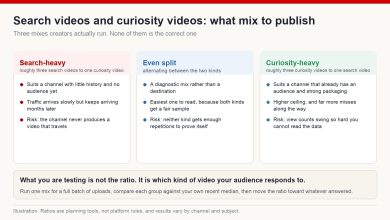
Measurable phrases. Demand shows in a tool, so you can compare candidates before committing. Views build slowly and then keep arriving, because the question keeps being asked. The people who show up already wanted this, so they tend to stay longer. The failure mode is a schedule of correct, unremarkable videos that nobody ever talks about, and a channel that grows in a straight line forever.
Unmeasurable phrases. No dependable demand figure, because the pull is curiosity rather than a question. Performance is decided by packaging and timing rather than by ranking. When one lands it can carry far more reach than a search video would. The failure mode is a run of misses with one lucky hit and no way to work out what made it different.
You will see people quote success rates for these two — so many channels in ten make it with one approach or the other. I would not repeat those numbers, because I have never seen a source for them that stands up. What I am confident about is the shape: the measurable route is slower and more repeatable, the unmeasurable route is faster and far noisier.
The mistake underneath all of this
The real problem is not choosing wrong. It is not noticing you chose.
A creator watches ten viral videos in their niche, absorbs the style, and builds a whole channel out of case three without ever deciding to. Every video is a click bet. Nothing is a search bet. So there is nothing underneath the channel — no video quietly bringing in viewers this month because somebody typed a question — and when a run of uploads misses, the traffic goes to zero rather than to a floor.
The reverse happens too, more quietly. A channel of careful, measurable, correct videos, none of which was ever built to travel, wondering why nothing ever breaks out.
Doing it deliberately
A workable approach, if you are starting without much data:
- Build the base from measurable phrases. These are the videos that keep working after the first week, and the ones that tell the system who your audience is.
- Add the curiosity layer to the packaging, not to the topic. Keep the searched phrase intact in the title and add the reason to click around it: Dark Psychology Tricks Manipulators Use keeps psychology tricks whole while dark and manipulators do the pulling.
- Tag each video before publishing as search-led or click-led, and compare the two groups afterwards against the median of your own recent uploads — not against somebody else’s published benchmark.
- Recheck the phrases you rejected. Demand drifts, tools revise their estimates, and a phrase that returned nothing last year is worth a second look.
Signs you have got the balance about right
You will usually notice it before the view count does. Videos hold attention past the opening rather than emptying out. New uploads land on people who watched the last one. Some traffic arrives from search rather than only from feeds. And older videos keep collecting views weeks after publication instead of flatlining the day the push ends.
That last one is the clearest signal that you have real search demand underneath the channel rather than a series of one-off bets.
An honest limit
None of this makes a video work. Sorting phrases properly means you know which bet you are placing, which is a smaller claim than it sounds and still more than most creators can say. Research tools estimate demand from sampled data and disagree with each other; platform behaviour changes; and two channels running the same approach in the same niche can get very different results.
What it does reliably prevent is building an entire channel on one kind of bet by accident.
Frequently asked questions
Is a phrase with no search data worth using?
Sometimes. It means the video will succeed or fail on packaging rather than on being found, so judge it that way and do not expect it to accumulate traffic later.
Why do dramatic phrases show no volume?
Because nobody types them. They work when they appear in front of someone who was not searching for anything, which is a different mechanism from search demand.
Do measurable keywords grow a channel more slowly?
Usually, yes — and they keep working for longer, because the question that produced the search keeps being asked.
Which should a new channel start with?
Mostly measurable phrases, so the channel has traffic that persists and the system gets a clear picture of who your audience is. Add the click-led videos once you know your packaging works.
Can one video be both?
Yes, and it is usually the strongest option: keep the searched phrase whole in the title and add the curiosity around it rather than instead of it.
If you want the full workflow for building a faceless channel aimed at English-speaking audiences, that is what I teach at mmoyoutube.com. Results vary by channel, subject and market.