Channel Localization: Five Layers Most Creators Skip
I get a version of the same question almost every week. Someone translated their titles into English, translated the descriptions, uploaded, and waited for an international audience to arrive. Months later the views are flat, the revenue per thousand views is nothing like what they were told to expect, and the platform is barely recommending the videos at all.
My answer is usually the same, and it usually annoys people the first time they hear it: you translated the language. You never localized the content. Those are different jobs, and only one of them is the job.
What a localized video feels like from the other side
The test is simple and it happens in a viewer’s head in about two seconds. A localized video makes them think “this was made for me.” A translated video makes them think “this was made somewhere else and converted.”
That is the entire boundary between a channel that reads as international and a channel that reads as a translation project. And viewers detect it faster than any of us would like.
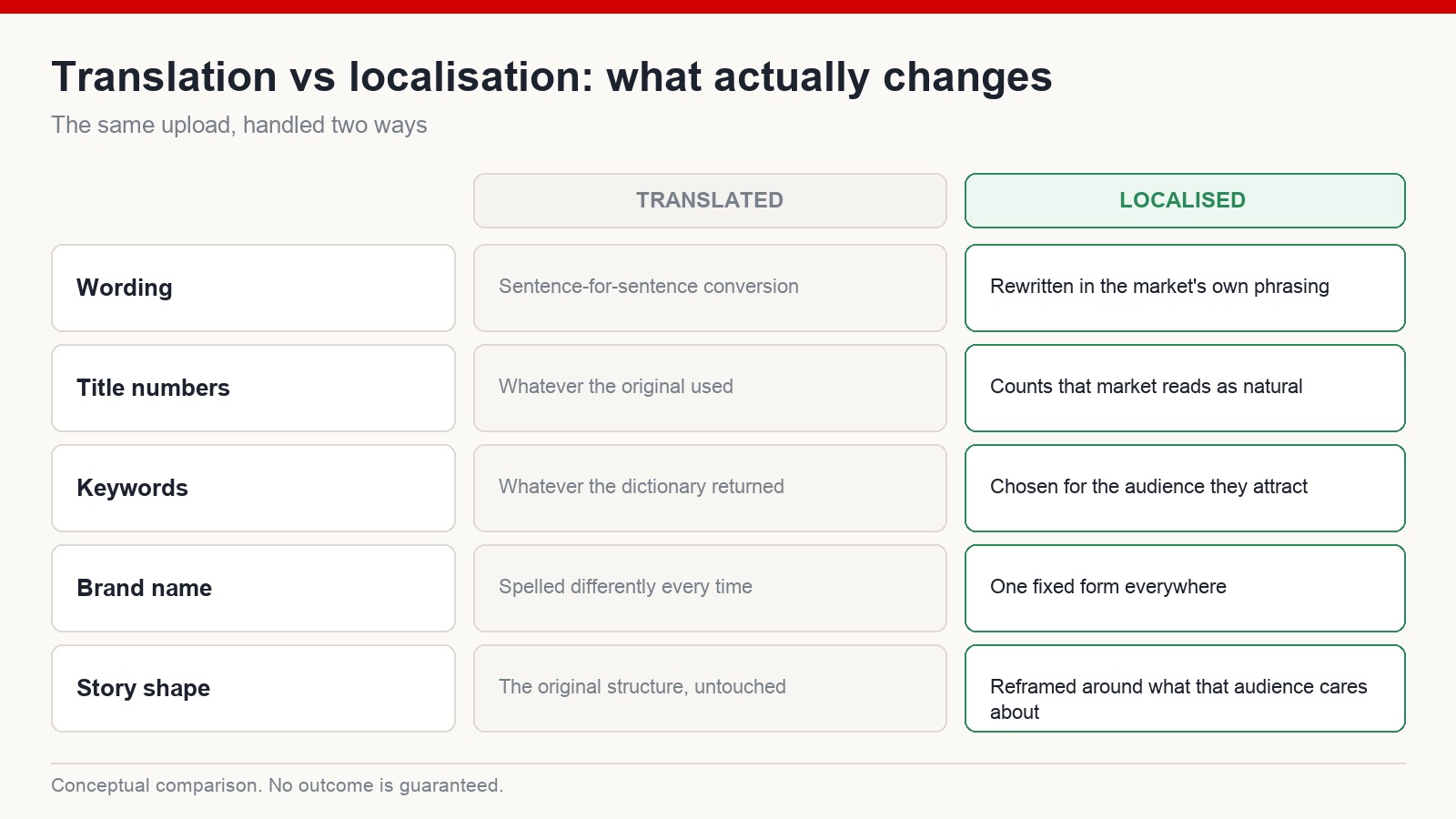
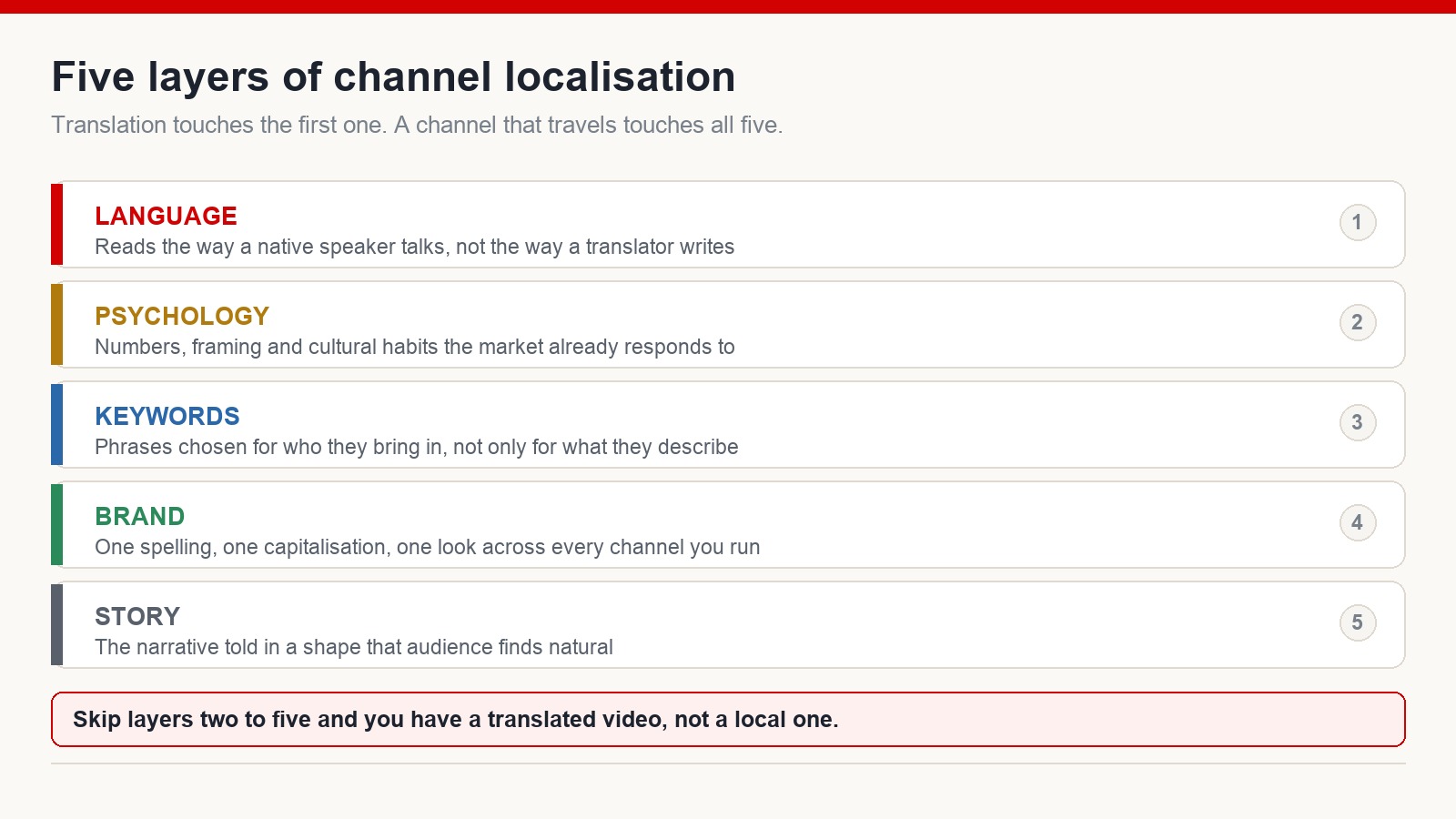
After nine years of building faceless channels for audiences outside my own language, I have come to think of localization as five distinct layers. Translation touches the first one. A channel that actually travels touches all five.
What follows is my working model, not a formula. Results on YouTube depend on far more variables than any single article can control for.
Layer 1. Language: AI is the assistant, not the decision-maker
You do not need to be fluent in English, Japanese, French or Portuguese to build a channel for those markets. That barrier has genuinely collapsed in the last few years, and I think people are still adjusting to how much.
A workable pipeline is unglamorous:
- Write the content in whatever language you think fastest in.
- Sharpen the idea until it is worth publishing at all.
- Move it into the target language with an AI tool.
- Rewrite the output until it sounds like a person from that market wrote it.
The fourth step is the whole game. What you are protecting is not accuracy, it is register – the rhythm and word choice a native speaker would actually use. Audiences spot machine-shaped phrasing in a title almost instantly, and the cost is not a complaint, it is a scroll past.
Layer 2. Psychology: the small cultural details
This layer is made of things too small to argue about individually and large enough to matter in aggregate. The clearest example is the number in a title.
Western audiences respond well to familiar counts: 3, 5, 7, 9, 10, 15, 30, 50, 100. 7 Incredible Wildlife Moments. 10 Amazing Rescue Stories. 50 Peaceful Nature Scenes. A number creates a visual stopping point in a feed that is otherwise a wall of similar promises.
Why I would think twice about 13
In many Western cultures 13 carries an unlucky association that has been sitting there for centuries. I have no data showing it costs you clicks, and I would not pretend otherwise. But avoiding it is free, and I would rather not have any element of the packaging quietly working against the audience I am trying to reach. That is not superstition; it is the same care you would take not to name a product something that reads badly in the market you are selling into.
The broader point of this layer is that cultural habits are part of the packaging. Framing, humour, references, even how direct a claim is allowed to sound – all of it varies by market and none of it survives a translation tool.
Layer 3. Keywords: not just accurate, but aimed
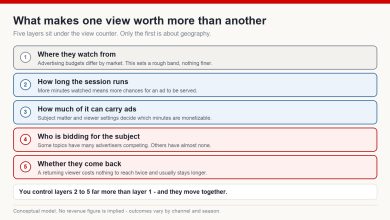
This is the layer with the most direct relationship to what a view is worth.
Stop asking “what is this video about?” and start asking “who will this video bring in?” Those two questions produce very different keyword lists from identical footage.
Take a video of animals in the wild. The obvious packaging is Wild Animal Compilation. Now try:
- Peaceful Wildlife Moments
- Relaxing Nature Journey
- Calm Animal Stories
- Tranquil Forest Life
Same footage, entirely different room. You have moved from people browsing for spectacle to people looking for something to slow down with – an audience that tends to leave content playing rather than bouncing after the highlight. Whether that audience is more valuable on your specific channel is something only your own analytics can tell you, but it is a lever worth knowing exists.
Layer 4. Brand: consistency is what reads as professional
International audiences are unforgiving about presentation, in a way that has nothing to do with production budget.
If your channel mark is written one way, write it that way everywhere – the banner, the titles, the descriptions, the end card, every channel in the network. Not one spelling on the banner and a different capitalisation in the video titles. Nobody consciously notices consistency; everybody unconsciously notices its absence, and it registers as amateur.
This sounds like a small thing until you run more than one channel. At that point a consistent naming structure is what turns three accounts into something a viewer recognises as one operation, which is the difference between a set of uploads and a media brand you could eventually sell.
Layer 5. Story: research the market rather than guessing at it
If you want to know what a market cares about, do not sit and think about it. Go and read it.
The method I use takes about fifteen minutes:
- Find a video with strong traction in the target market.
- Take its title and treat it as data rather than as writing.
- Break it into every smaller phrase it contains.
From Amazing Peaceful Wildlife Moments you get peaceful wildlife, wildlife moments, relaxing animals, calm nature, nature healing. Now you are working with phrasing the market has already validated instead of phrasing you invented.
Then narrow the list. You want the phrases that sit between two dead zones: the ones with no real search demand behind them, and the ones already owned by channels many times your size. The band in between is where a new channel can actually surface.
I deliberately will not give you a search-volume threshold, because the honest answer is that it depends on your niche and your channel, the tools disagree with each other, and the numbers drift month to month. Rank the phrases against each other. Then rank them against what your own channel has managed before. That comparison is real; an absolute benchmark from someone else’s channel is not.
The story layer is the last mile: telling the thing in a shape that audience finds natural. Structure, pacing, how long you take to get to the point – these differ between markets more than most creators expect.
The five layers together
Set out plainly, a channel that reads as local rather than imported is working on all of these at once:
- Language – reads the way a native speaker talks, not the way a translator writes.
- Psychology – uses the numbers, framing and cultural habits the market already responds to.
- Keywords – chosen for the audience they attract, not only for what they describe.
- Brand – one spelling, one look, everywhere.
- Story – told in a shape that audience finds natural.
Skip layers two through five and you have a translated video. Do all five and the video stops being a conversion of something else and starts being a product made for that market.
AI gets you moving. Localization gets you somewhere.
AI can produce a large volume of video in a day. What it cannot do on its own is understand a culture, read the psychology of a specific audience, or decide which viewers are worth building a channel around. That remains the work of whoever is running the system.
The creators I see doing well are not the heaviest AI users. They are the ones who use AI for speed, data for decisions, localization for connection, and brand for the long-term value. That combination is slower to set up and considerably harder to copy.
Frequently asked questions
Is localization the same as translation?
No. Translation converts the language. Localization adjusts the content to fit the culture, psychology and habits of the target audience – the wording, the framing, the references and the structure.
Do I need to speak the language to build a channel for that market?
Not necessarily. AI handles the conversion well. You still need to understand the market and to check that the output reads naturally, which usually means finding someone who can sanity-check the phrasing.
Why does the same content earn differently in different places?
Revenue per thousand views depends on the country, the audience group, the subject and how much advertisers are competing for that attention. It is a variable, not a fixed number, and it moves seasonally as well.
What matters most when working an international audience?
In my experience, not making more videos. Making content that a viewer in that market feels was made specifically for them.
How long does localization take to show results?
There is no reliable answer, and I would treat any specific figure with suspicion. Niches saturate, platform behaviour changes, and outcomes vary widely between channels doing similar work.
A closing note
If your goal is a channel that can hold up for years rather than months, treat localization as a core strategy rather than a translation step at the end of production. When the language, the psychology, the keywords and the culture of the target market all line up, each video has a genuine chance of reaching the audience it was built for.
I say the same thing to everyone I work with: building for an audience in another language is a long project, it carries real risk, and it promises nothing quickly. But if you build it from the foundation up, the system and the skill stay with you long after any individual video has stopped being watched. If you want the full research process behind that, it is what I teach at mmoyoutube.com.