Interest or Demand? How to Decide What Your Channel Is Actually About
The question almost every new channel starts with
Should you make videos about the thing you love, or about the thing people are looking for?
I asked myself that in my first year, and I answered it the way most people do: make what you like, and trust that the enthusiasm will show. It is a nice theory. It survived about a hundred uploads.
What eventually became obvious was less flattering. Nobody watches a video because the person who made it enjoyed making it. They watch because it happens to be the thing they were already interested in at that moment. That is the entire transaction.
Which is why you can find creators pouring real care into a channel — researched, well shot, cut properly — sitting at a few hundred views, while something far simpler on the same platform pulls a hundred times that. The gap is usually not craft. It is whether anybody had a reason to look.
Interest starts a channel. Demand keeps it alive
I want to be careful here, because the advice “ignore what you like and chase the numbers” is how people end up quitting in month four.
Interest matters enormously. A faceless channel aimed at an English-speaking audience is a long job. You will write scripts you are bored of, re-record lines, and rebuild a thumbnail at midnight. If the subject means nothing to you, you will stop, and a channel that stops is worth nothing regardless of how good the research was.
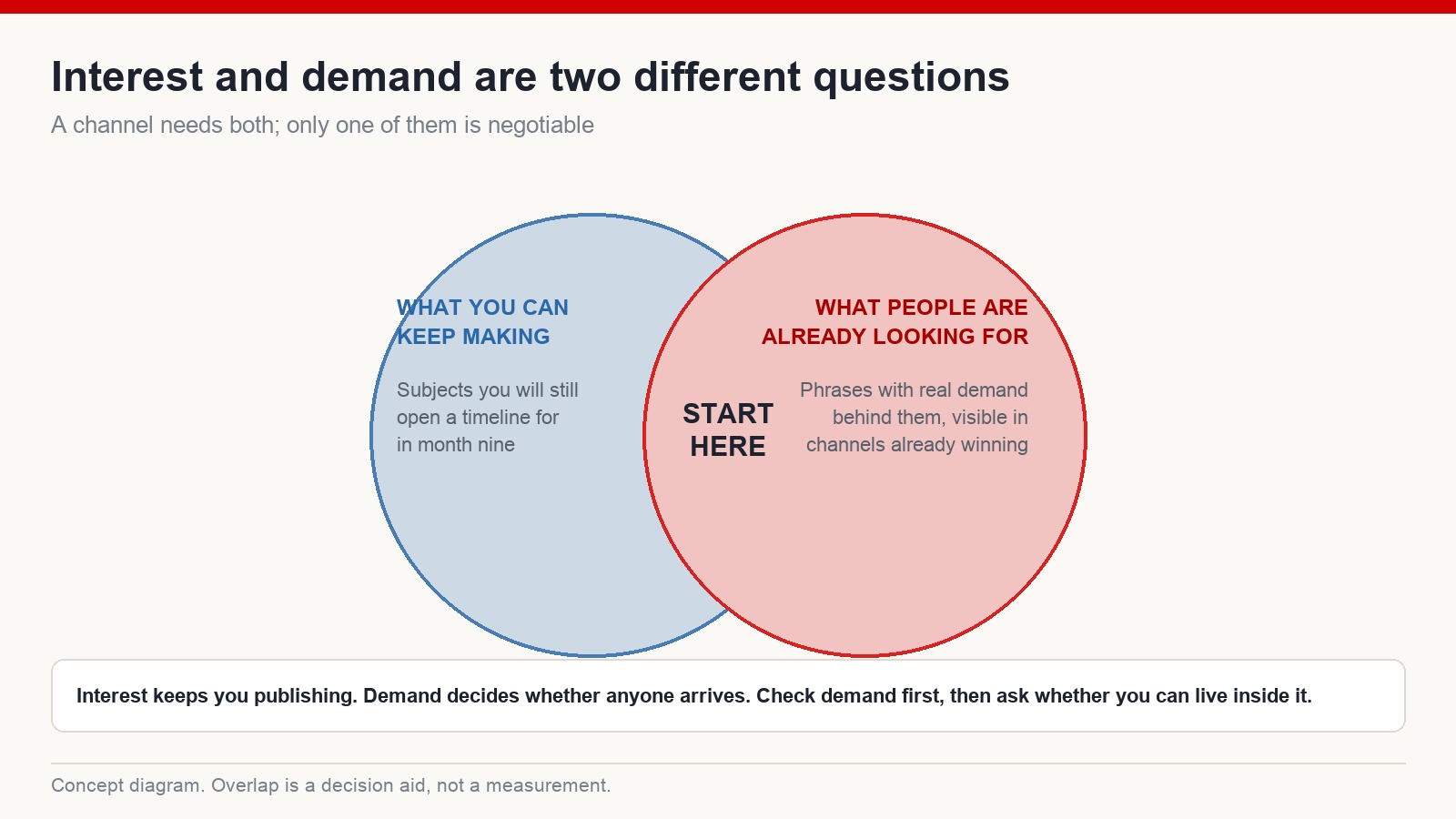
But interest and demand answer different questions:
- Interest answers “will I still be publishing in month nine?”
- Demand answers “will anyone be there when I do?”
Only one of those is negotiable, and it is not the second one. If you build purely on personal taste, you are making content for an audience of one. If you build purely on data, you are making content you will abandon. The order I use now is simple: check demand first, then ask honestly whether I can live inside it for a year.
Better does not mean more complicated
A related misunderstanding is worth naming, because it eats a lot of time.
People assume that if a video underperforms, the fix is production: more effects, tighter cuts, better music, a longer edit. Sometimes that is true. Frequently it is not. A video that nobody was looking for does not become a video people were looking for by being edited harder.
“Good” on this platform is not the same as “impressive”. Good means it matched something a person actually wanted at the moment they were shown it. That match is decided before you open the editor — in the phrase you chose and the way you framed it.
The majority principle: let the shelf answer for you
The most reliable market research I know does not involve guessing what people want. It involves reading what is already working and refusing to argue with it.
Step one: pick channels worth studying
Find several channels serving the audience you want, and be selective. You want channels big enough that a good month is not a coincidence, still publishing, and still growing. A channel that stopped uploading two years ago tells you what worked in a different version of the platform.
Step two: read their strongest uploads, not their newest
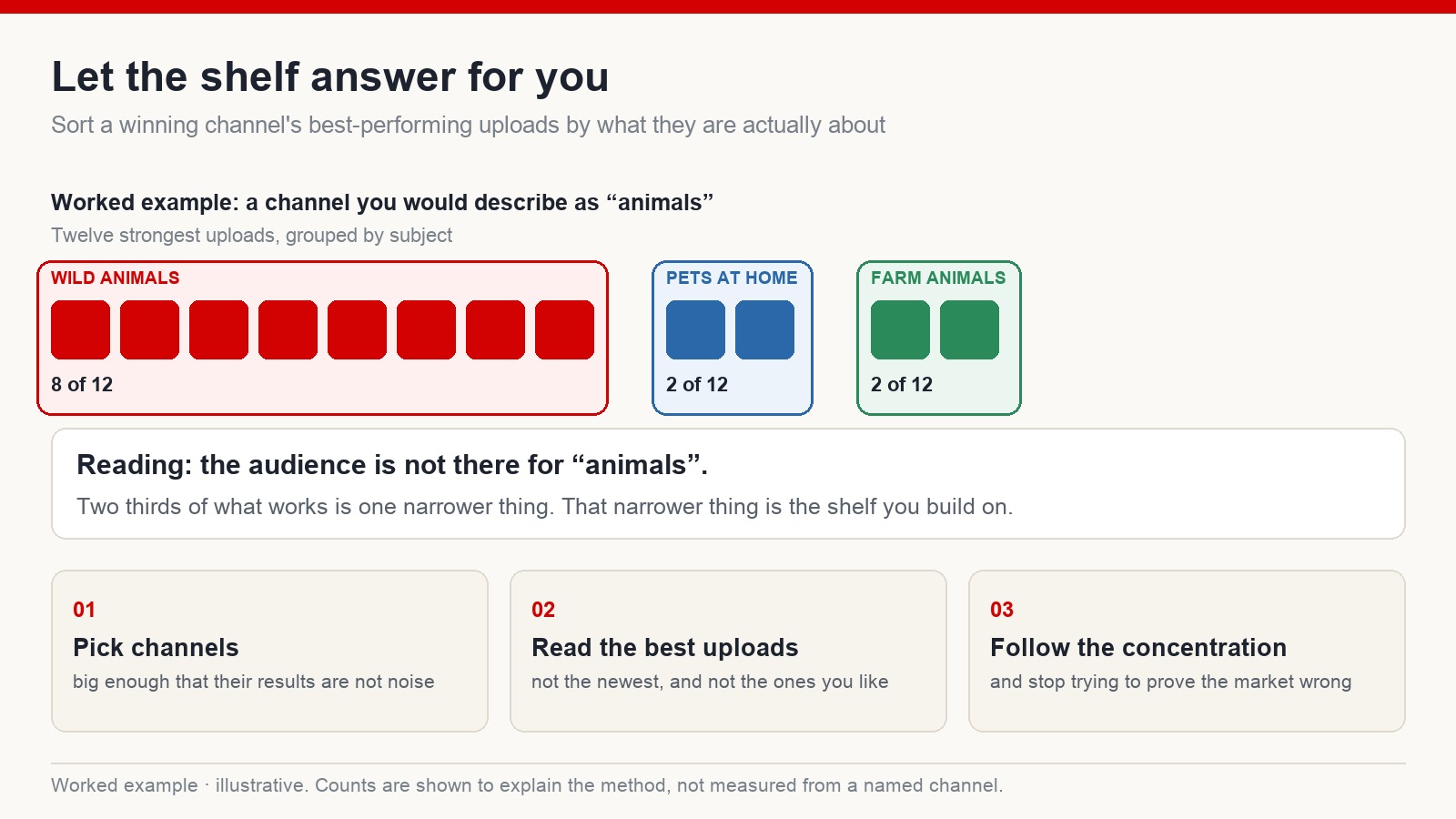
Take roughly a dozen of the best-performing videos on each channel and sort them by what they are genuinely about. Not by the category you would use for the channel — by subject, one video at a time.
This is where the useful surprise usually happens. Say you have a channel you would describe as “animals”. You sort the twelve and find eight are wild animals, two are pets at home, two are farm animals. The channel calls itself one thing; the audience is showing up for something narrower.
You did not have to predict that. It was already on the page.
Step three: follow the concentration
Wherever the results are dense, go deeper. That is the whole rule. Do not spend six months trying to prove that the neglected corner of the topic deserves more attention than it gets. It might. That is an expensive hypothesis to test with your first channel.
One caveat: this reads the past. It tells you what has been working, not what will work forever. Interest in a subject moves, and so does the wording people use for it, which is why this is a check you repeat rather than a decision you make once.
Two kinds of phrase, and a publishing mix
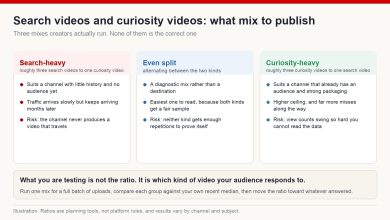
There are broadly two things a title can do, and channels that grow steadily tend to use both.
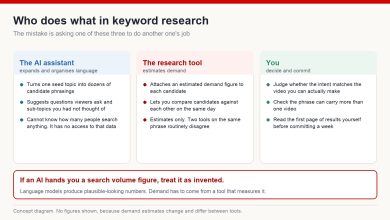
The first is demand-led: phrases people genuinely type, with visible history behind them. sleep music, meditation music, ai video generator, youtube automation. These are slow, dependable and boring in the best sense. They build a base that keeps returning traffic long after publication.
The second is framing-led: wording built for curiosity rather than search. These can travel a long way through recommendations when they land, and go nowhere at all when they do not. They are hard to research in advance because there is often nothing to research.
Rather than choosing, most people I work with run a ratio — something like three demand-led videos to one experiment, or roughly four fifths of the schedule on durable subjects and the rest on trying things. The exact split matters less than having one. It keeps a floor under the channel while leaving room for the occasional video that outperforms everything else you have made.
Where the opportunity usually hides
Most beginners study the biggest channels in a space. Reasonable, and incomplete, because a large channel gets views for reasons you cannot copy: an existing audience, a back catalogue, a name people recognise.
The more informative signal is a small channel with a disproportionately large video. Few uploads, a modest subscriber count, and one video that clearly outran everything the channel had earned the right to.
When that happens, the channel is usually not the explanation. The subject is. Demand outran supply, and the platform handed the overflow to whoever happened to be standing there. That is the shape of an opening: a place where being new is not automatically disqualifying.
Look for the pattern rather than the single case. One outlier can be luck. Three small channels with the same kind of outlier on the same kind of subject is a signal.
The filters I run before committing
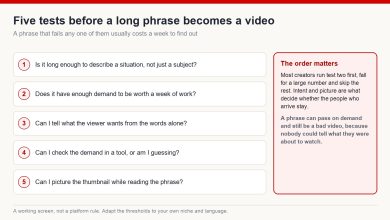
Before I will build a run of videos on a subject, it has to survive five questions in this order:
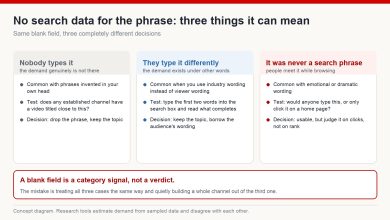
- Is there real search demand? Not a hunch — phrasing people actually use, visible in autocomplete, in competitor titles, and in whatever research tool you use.
- Is more than one channel winning here? A single dominant channel can mean the audience belongs to it. Several suggests room.
- Has a small channel broken through recently? The clearest evidence that arriving late is still viable.
- Can I make thirty videos here? If the subject runs out after eight, it is a video idea, not a channel.
- Does it still make sense in a year? Subjects tied to one product cycle or one moment expire, and so does the work you did on them.
If a subject fails on the fourth question I drop it immediately, because that is the one that costs the most to discover late.
What this does not promise
Choosing by demand improves the odds. It does not produce a result, and anyone telling you otherwise is selling something. Plenty of well-researched videos go nowhere: the packaging was wrong, the opening lost people, the topic was already saturated by the time you published, or the recommendation system simply did not pick it up. Platform behaviour changes too, and what a shelf rewards this year it may not reward next year.
The honest claim is narrower and still worth having. Research does not tell you a video will work. It tells you whether the audience exists at all — and that is the one failure you cannot edit your way out of afterwards.
The one question to change
Before your next video, do not start with “what do I feel like making?”
Start with “what is this audience already looking for, and can I answer it better than what is on the page right now?” Then check whether that answer is something you can stand to make thirty times.
Both questions matter. They just are not equally negotiable, and most people ask them in the wrong order.
Frequently asked questions
Is it wrong to build a channel around something I love?
No — but test whether anyone is searching for it before you commit a year to it. Passion with demand behind it is the best position available. Passion without it is a hobby, which is fine as long as you know that is what you chose.
How do I know demand is real and not something I imagined?
Cross-check. Autocomplete suggestions, phrasing that repeats across competitor titles, and estimates from a research tool should broadly agree. Any one of them on its own can mislead you.
Can a small channel compete with an established one?
On the same broad phrase, rarely. On a narrower phrase the large channel has not bothered to answer properly, often. That is usually where new channels get their first result.
Should I prefer high demand or low competition?
Neither in isolation. High demand with no chance of ranking is a wasted week; no competition usually means no audience. You are looking for the overlap, and it moves.
How often should I redo this research?
Every month or so is a sensible rhythm. Audiences drift, wording changes, and new channels enter. Research treated as a one-off decision quietly goes stale.
If you want the longer version of how I plan and publish faceless channels for English-speaking audiences, the system I teach lives at mmoyoutube.com. Results vary, and nothing on this page is a prediction of what any particular channel will do.