Channels Do Not Die From Using AI. They Die From Not Being Honest.
The question I get asked most often at the moment is some version of “is it still safe to run an AI-assisted channel?”
I understand why people ask it. Every few months a wave of channels loses monetization or disappears entirely, the forums fill up with screenshots, and the explanation that spreads fastest is always the simplest one: the platform is cracking down on AI.
I do not think that is what is happening. When I look closely at channels that got into trouble – including a couple I was asked to review afterwards – the tool almost never turns out to be the problem. What the tool was used to do is the problem. So I think the question is wrong, and the better one is uncomfortable: is my content honest, and is it built to last?
Here are the three patterns I keep seeing behind channels that fall over, none of which are about AI.
1. The majority problem
This is the one newer creators know least about, and it is the one that decides how long a channel survives.
It helps to stop thinking about videos being assessed one at a time. A channel is a body of work, and what that body of work is mostly made of says something about the channel as a whole. One borderline upload sitting among fifty solid ones reads very differently from thirty borderline uploads sitting among fifty.
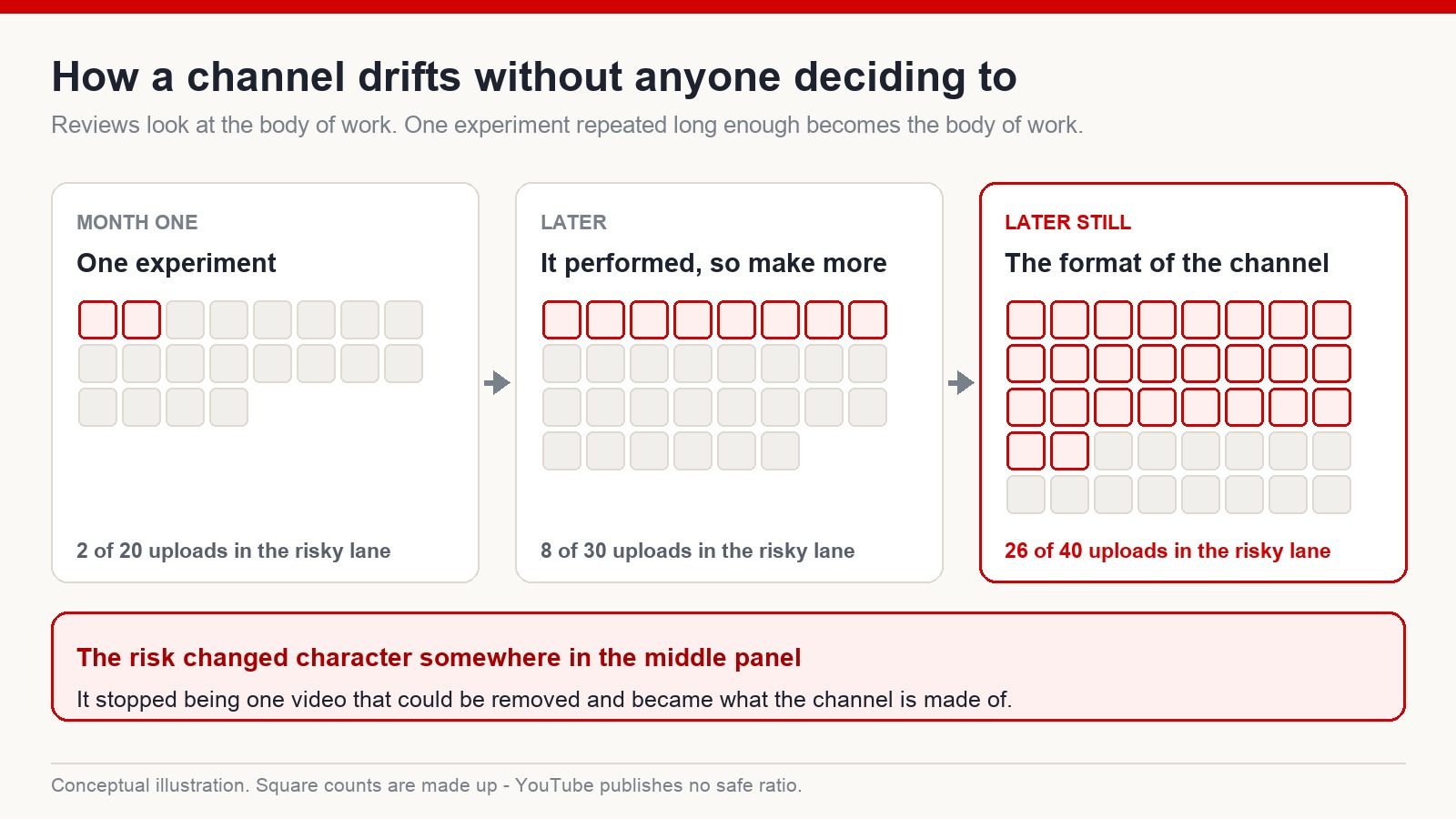
The failure almost never starts as a decision. It starts as an experiment.
Someone publishes a couple of videos that lean on shock, on borrowed footage, on a misleading framing – and they perform. Views arrive faster than they ever have. The obvious next move is to make more of what worked. Five videos become twenty. Twenty become fifty. At some point, without anybody choosing it, the experiment stops being an outlier and becomes what the channel is.
That is the moment the risk changes character. It is no longer one video that could be removed. It is a library whose centre of gravity has moved.
How much is too much?
I want to be careful here, because I have seen a lot of confident numbers passed around in creator communities and none of them come from the platform. YouTube does not publish a ratio, and anyone quoting you one invented it.
What I can tell you is the principle experienced creators actually operate on: keep the clear majority of your library in the lane you would be comfortable defending, and treat experiments as a small, deliberate minority you review afterwards rather than repeat automatically. Not because a magic percentage protects you, but because that habit stops drift from happening while you are not paying attention.
The practical version is a monthly look at your own upload list. Not the analytics – the list. Read the titles as a stranger would, in one sitting. If the pattern that emerges is not the channel you meant to build, you have found the drift before it found you.
2. Using AI without being honest about it
AI-assisted production is not the offence. Deceiving the viewer is.
Those are two different things and they get collapsed together constantly, usually by people who want an excuse for why their channel is not working. There are two specific failures worth naming.
Shipping the raw output
The pattern is familiar: a model writes the script, a second tool reads it aloud, a third generates the visuals, and the result goes up untouched. No editing pass, no point of view, nothing added by the person whose name is on the channel.
The problem is not that a machine helped. The problem is that thousands of people are doing exactly this, with the same tools and the same default settings, which means the output converges. The videos become interchangeable. A viewer clicking one of them has no reason to remember which channel it came from, and a platform assessing it has an increasingly easy time recognising the pattern.
If a human being does not add something between the model’s output and the publish button – judgement, experience, structure, a real opinion – there is nothing on the video that belongs to you.
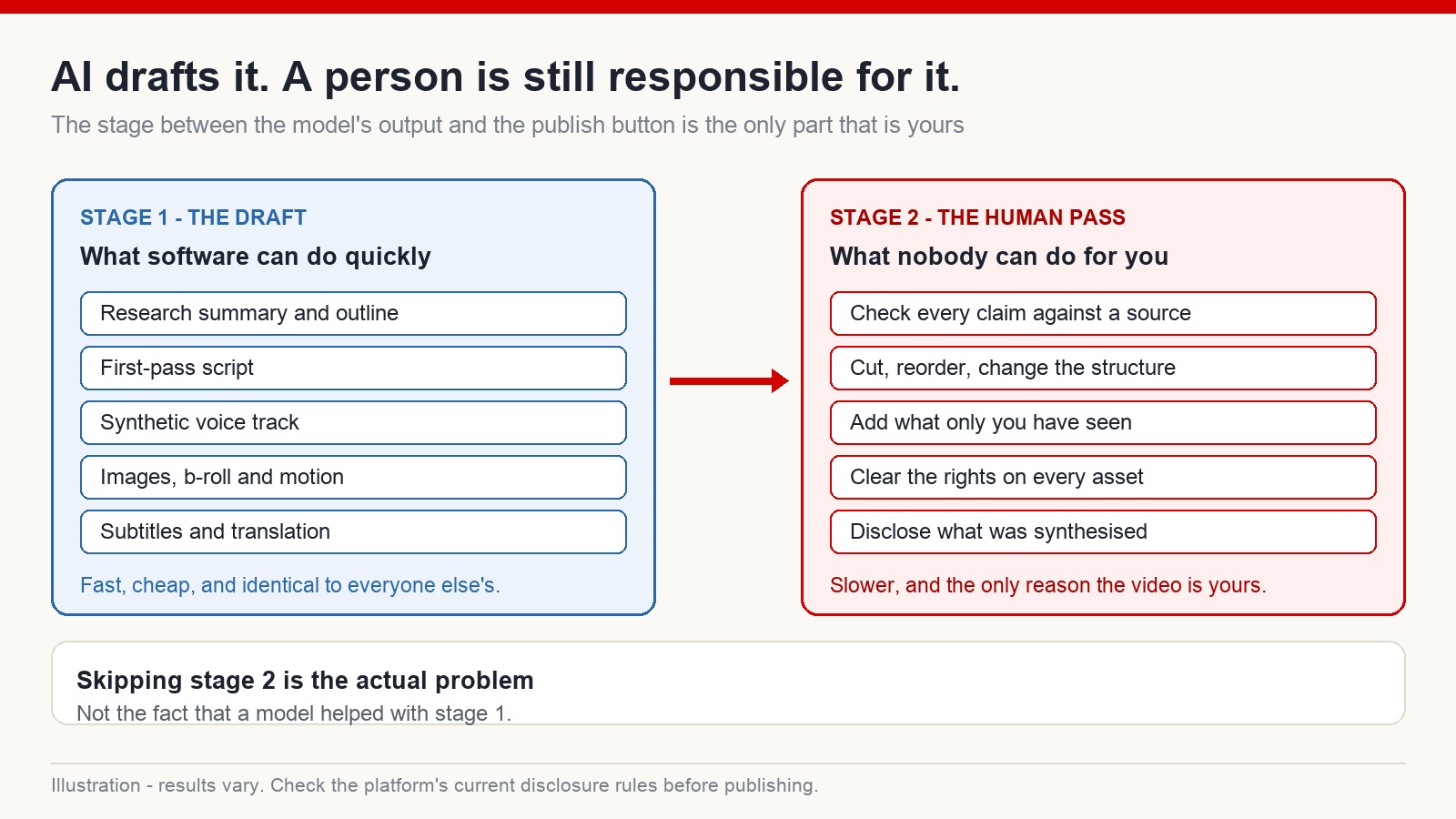
Not disclosing synthetic content
The second failure is sharper. If you generate an image, a character, a moment or an event that a viewer could reasonably mistake for a real recording, and you present it as though it were real, you have moved from production choice to misrepresentation.
The rule I hold myself to is short: say what it is. If a substantial part of what the viewer is looking at was synthesised or significantly altered, tell them. Use the platform’s own disclosure controls where they apply, and check its current guidance rather than relying on what someone wrote about it a year ago, because this area is being actively revised.
Creators worry this weakens the video. My experience has been the opposite. Audiences respond badly to discovering they were misled, and they respond well to being treated as adults. Disclosure costs you a line of text and buys you the ability to keep making things without an unexploded problem sitting in your archive.
3. Trading the channel’s future for this month’s views
This is the trap almost everyone walks into at least once, myself included.
A video takes off. The click-through rate is unusually high, people stay to the end, the revenue for that week looks different from every other week. It feels like a breakthrough. Then you look properly at why it worked, and the honest answer is that it worked because it went somewhere the rest of your library does not – a bit more shocking, a bit more sensational, a bit closer to a line.
What happens next is not really a strategic decision. It is a reflex. A big result makes the brain want the same result again, and repetition is the fastest route there. That is how an exception becomes a template, and how a template becomes the channel’s identity – which takes us straight back to the first problem.
The categories that consistently sit in this risky space are not mysterious: gratuitous violence, imagery of injury, content designed to inflame, systematic use of other people’s material, and claims that mislead people about things that matter to them. Opening a video with the strongest possible version of any of that is a particularly bad idea, because the opening is exactly where automated review looks hardest.
Something more durable to build instead
Retention is the thing shock is being used to buy, and there are slower ways to buy it that do not mortgage the channel: an opening that poses a real question, a story with a reason to stay until the end, a genuine point of view on a subject you know something about, analysis that a viewer cannot get from the first page of search results.
These are harder. They also do not stop working when the platform tightens its review, which is the whole point.
So is AI causing channels to be removed?
Largely, no. AI is a tool, and the questions being asked of your channel are the same ones that were being asked before those tools existed. Does this video offer something of value? Is it transparent about what it is? Does it mislead anyone? Does it respect the platform’s community guidelines and other people’s rights?
A carefully made AI-assisted video, edited by a human, adding real information, honest about how it was produced, sits in a completely different position from a hundred near-identical uploads generated to farm impressions. Same technology. Different intent, and intent is legible in the output.
I should say plainly that nothing here is a guarantee of anything. Platform policies change, enforcement changes, and reviews are made by systems and people I have no visibility into. Treat this as a way of reducing avoidable risk, not as protection – and treat YouTube’s own published policies as the authority over any blog post, including this one.
The question worth asking yourself
If I had to compress all of it into one line: channels do not die from using AI. They die from a library that quietly drifted somewhere the owner would not defend, and from being less than straight with the people watching.
So when you plan the next video, keep asking how to grow the audience – but add a second question underneath it. Would someone reviewing my whole channel, video by video, see something built to last?
That is the question that decides whether you are here in six months or in six years.
Frequently asked questions
Does YouTube ban AI-generated content?
No. The platform’s concern is with content that misleads viewers, adds nothing of value, or breaches its guidelines. How it was produced matters less than what it does.
Should I label videos made with AI?
If AI created or significantly altered something a viewer could mistake for real, disclosing it is the right call – and the platform provides controls for exactly this. Check the current guidance, as it is being updated.
What proportion of risky content is safe?
There is no published figure, and any number you have been given is somebody’s guess. The workable habit is to keep the clear majority of your library in the lane you would defend, and to review experiments rather than repeat them by default.
Are faceless channels inherently risky?
No. Not showing your face says nothing about whether a video is original, useful or honest. Mass-produced repetitive uploads carry risk whether or not a face appears in them.
What protects a channel most?
Originality, transparency and staying inside the community guidelines. There is no technique that substitutes for those three.
If you are building a faceless channel for an English-speaking audience and want to work through this properly, that is what we do at mmoyoutube.com. Nothing on this page is a guarantee – policies change and results differ from channel to channel.