Ten Videos From One Insight: The Difference Between an Angle and a Clone
For a while there was a shortcut that worked. Find a video doing well, run the script through a rewriter, generate a new narration, drop in some stock clips, publish. It was fast, it was cheap, and for a period it produced views.
It stopped working, and the reason it stopped is more interesting than the fact that it did. Platforms did not get better at matching files. They got better at reading patterns – the shape of an opening, the order of the beats, the rhythm of the cuts, the way a thumbnail is composed. A file check can be fooled by re-encoding. A pattern read cannot be fooled by a different voice reading the same structure.
So the useful question is no longer how to make ten videos out of one winner without being noticed. It is how to make ten videos that are actually different. That skill has a name worth using: finding a new angle.
An angle and a clone are not the same object
Both start from the same place – a video that worked. What separates them is how much of the original survives.
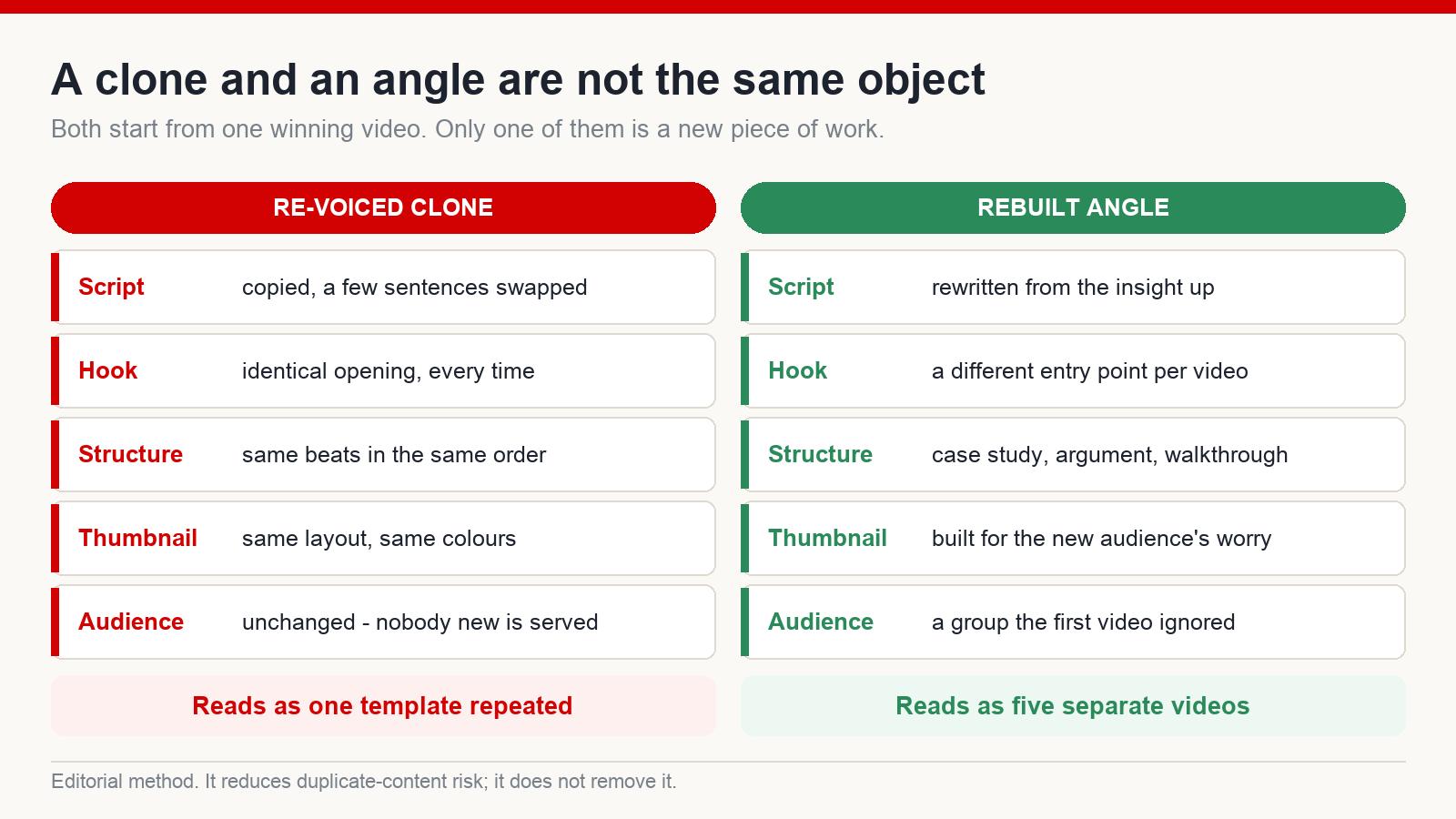
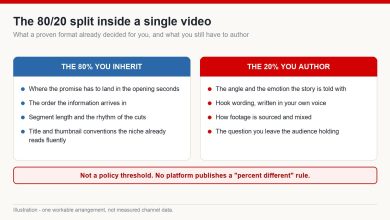
A clone keeps the script and swaps sentences. It keeps the opening, the beats, the thumbnail layout, and above all the audience – nobody new is served. Line up five of them and they read as one template repeated, because that is what they are.
An angle keeps only the underlying insight. The script is rewritten from that insight upward. The way in is different. The structure is different. The thumbnail is built for a different worry, held by a different group of people. Five of those read as five videos, because they are.
Step one: extract the insight, not the content
Most people study a successful video by asking what it said. That produces a summary, and a summary rewritten is a clone.
The better question is why it worked. Take a video that did well on using automation tools to earn a living. What made it travel was probably not the tools. It was more likely a fear of being left behind, or a wish to stop trading hours for money, or the specific hope of doing skilled work without years of training. That is the insight – the thing the audience actually brought to the video.
Once you have that, you are no longer copying a video. You are working from the same raw material the original worked from, which is a completely different starting position.
Step two: give the insight to a different person
The fastest way to turn one insight into several videos is to hold it still and change who it is for. The same insight – that a tool can give back several hours a week – reads very differently to someone with no technical background, someone already running a channel, someone with no budget, someone doing it around a full-time job.
Each group arrives with a different first obstacle and a different definition of success. Written properly, those are separate videos that happen to share a foundation. Written lazily, they are the same video with a different opening line, and everybody can tell.
Step three: change the way in
Openings are where repetition is most visible, to viewers and to the system. If every video begins with a variant of “in today’s video,” the catalogue announces itself as one thing published repeatedly.
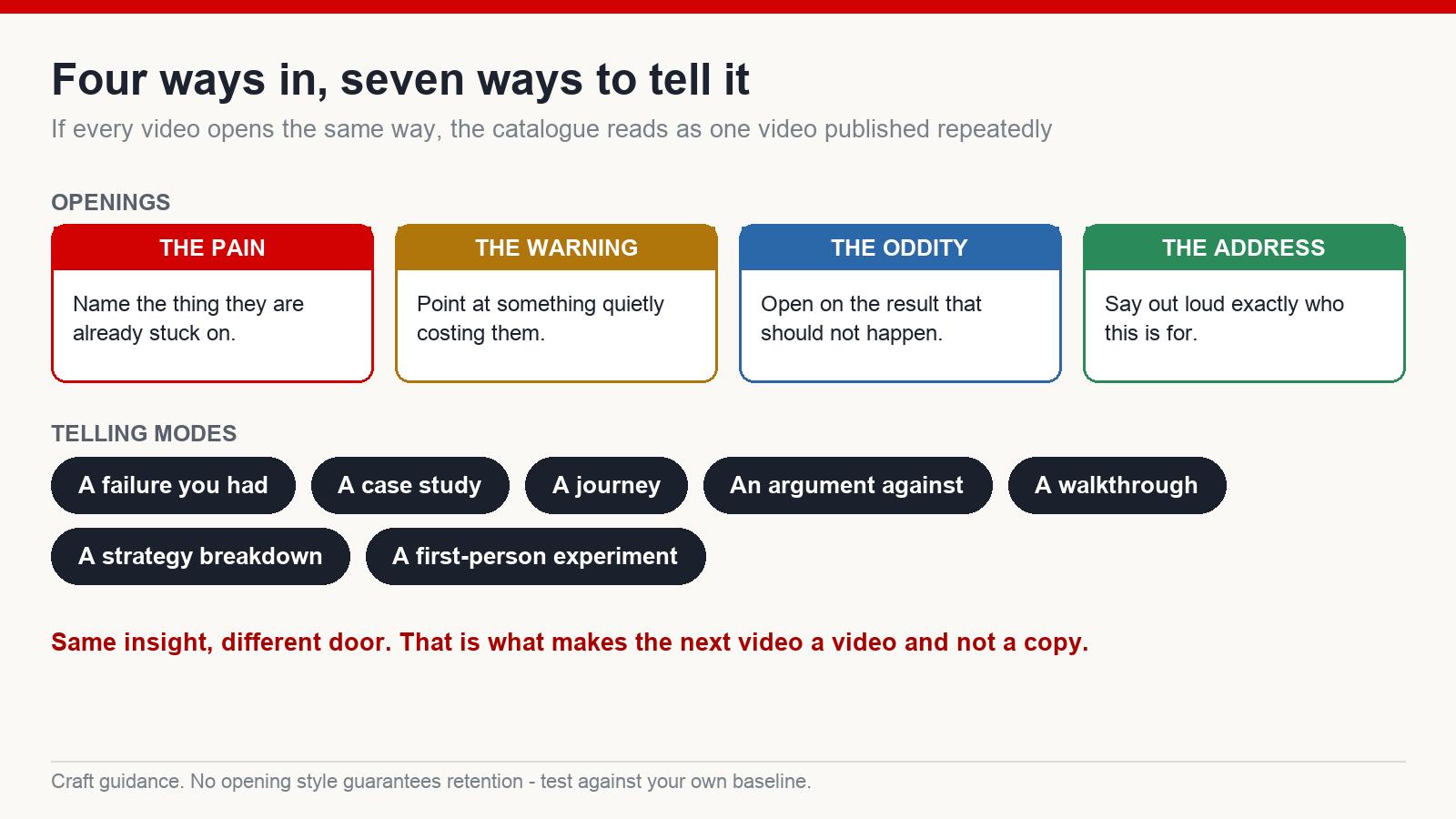
There are more doors than people use. Open on the thing the viewer is already stuck on. Open on something quietly costing them that they have not noticed. Open on a result that should not be possible. Or open by naming exactly who the video is for, which loses everyone else and holds the right people harder.
None of these is inherently better. What matters is that they are not all the same one, and that the door matches the audience the video was written for.
Step four: change the mode of telling
This is the most under-used lever I know. One subject can be told as a failure you had, a case study, a journey, an argument against the received view, a walkthrough, a strategy breakdown, or a first-person experiment.
Those are not stylistic choices. They produce genuinely different videos from the same material, because each one foregrounds different evidence and asks the viewer for a different kind of attention. It is also the thing that stops a catalogue feeling machine-made, which is a judgment viewers make within about fifteen seconds.
Step five: rebuild the thumbnail for the angle
Reusing one thumbnail layout across every angle undoes most of the work. The video is written for a new group and packaged for the old one.
Change what the image is doing, not just its colour: the emotion, the situation, the moment being shown, who is implied to be in it. And keep it honest – a thumbnail that promises something the video does not deliver buys a click and loses the retention that click was supposed to earn.
Stock footage is illustration, not content
A pattern I see constantly: pull a pile of stock clips, cut them together, lay narration over the top, publish. The result feels empty, and it feels empty for a reason. Nothing has been added.
Stock earns its place when it supports a point – cut short, placed where it illustrates something specific, timed against the narration, mixed with other material. When it carries the whole video and nothing else has been contributed, that is the exact shape of upload that reviewers treat as low effort, and they are not wrong to.
Build something recognisable
The end state of doing all this consistently is a fingerprint: your own way of opening, your own pacing, a look to your thumbnails, a manner of telling that someone could identify without seeing the channel name.
That is worth more than any individual optimisation. A recognisable catalogue is one where each new video benefits from every previous one, rather than competing with it for the same slot.
The things that are not angles
There is a genre of advice about defeating pattern detection with overlays, inserted frames and similar manipulation. I am not going to walk through any of it. These are attempts to defeat a review process rather than to add value, they are policy violations in their own right, and the penalty lands on the account rather than the video – normally after you have built something worth losing.
The same goes for copying a competitor’s thumbnail closely enough that it could be mistaken for theirs. It is not a clever growth tactic; it is a rights problem waiting to be reported.
The version worth doing
One winning video should not become ten copies of itself. It should become ten insights pulled out of it, given to ten different audiences, opened ten different ways, told in different modes, packaged separately.
That is slower than the shortcut, and it is the only version that is still working in a year. Nothing here guarantees a result – platforms change, subjects cool off – but it removes the failure mode that kills most volume-driven catalogues.
Frequently asked questions
Is finding a new angle just copying with extra steps?
No. Copying reproduces somebody’s video. An angle takes the insight underneath it – the thing the audience actually wanted – and builds new work from that. The output shares a starting point and nothing else.
How many angles can one video support?
It depends entirely on how strong the insight is. A broad one supports many, because there are many groups who hold it for different reasons. A narrow one supports two or three. Pushing past what the insight can carry is how a catalogue starts repeating itself.
Can I use AI to rewrite the whole thing?
You can use it to draft. What you cannot outsource is the new point of view, the new structure and the new opening – and a draft without those is the kind of output that gets treated as low effort. Read it aloud; the flatness is audible.
Are generated thumbnails a problem?
Not in themselves, provided the image represents what the video contains, it is not a close copy of somebody else’s, and any disclosure requirements for synthetic imagery are met. Those requirements do change, so check the current ones.
Can a video be built entirely from stock footage?
It can be, and it usually should not be. Stock is support. If the footage carries everything and nothing has been added by you, there is not much left to distinguish the upload from any other assembly of the same clips.
I have been building faceless channels for English-speaking audiences since 2017, and the shift from producing more to producing genuinely different work was the change that mattered most. More of how I approach it is at mmoyoutube.com.