Pin, Description Or End Screen: Where Each Thing Belongs
The pinned comment gets discussed as though it were a lever. Pin the right thing and the video does better; pin the wrong thing and you have wasted the best real estate under the player. I do not think that is quite what is going on, and I think most of the arguing about pinned comments is actually an argument about something else.
A video has four surfaces you can put something on. The pin is one of them, and almost every question people ask about it – should the link go here, where do I put the resource, how do I send people to part two – is a placement question that gets easier the moment you can say what each surface is for.
I have been making YouTube content since 2017, mostly faceless channels for viewers in the US, the UK, Germany and Japan. What follows is how I decide, not a set of rules from anywhere official.
Four surfaces, four jobs
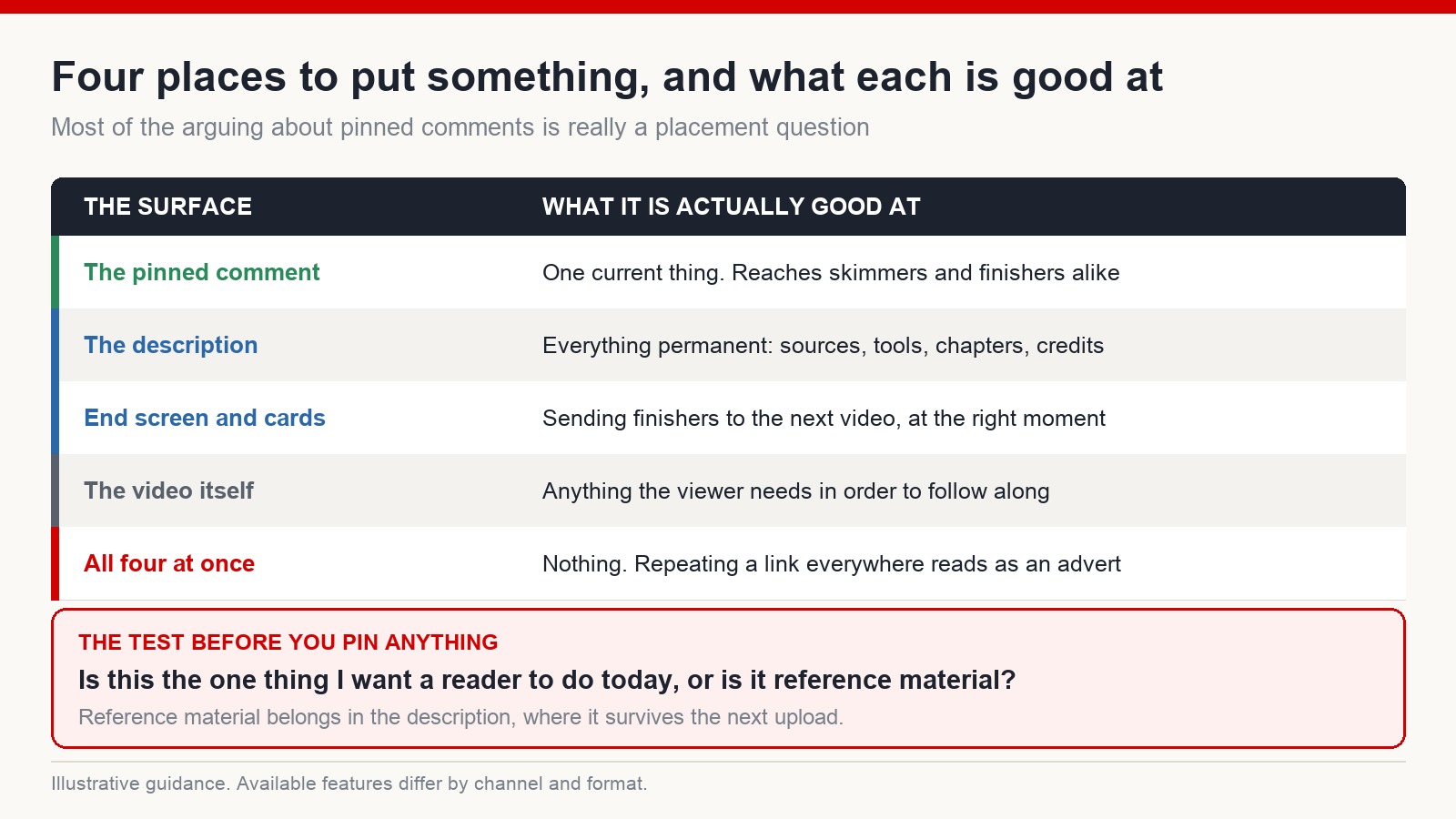
The pinned comment is for one current thing. It sits at the top of the comments, which means it reaches two groups nothing else reaches at once: people who scrolled down before finishing, and people who watched to the end and then scrolled down. It is also the only part of a published video you can rewrite in thirty seconds, which makes it the right home for whatever is true this week.
The description is for everything permanent. Sources, tools mentioned, chapters, credits, the recurring links. It is not read by most viewers and that is fine – it is a reference shelf, not an announcement. Anything that will still be relevant in six months belongs here, because it survives the next upload without you having to do anything.
End screens and cards are for sending people who finished somewhere specific, at the moment they have finished. That timing is the whole value; nothing else on this list can pick its moment.
The video itself is for anything the viewer needs in order to follow along. If someone cannot understand the video without a piece of information, that information cannot live in a comment.
And the fifth option, which is what most channels actually do: put the same link on all four. That is worth naming because it feels thorough and reads as an advert. Repetition across every surface is the single fastest way to teach an audience to ignore all of them.
The test before you pin anything
One question sorts nearly every case. Is this the one thing I want a reader to do today, or is it reference material?
Reference material goes in the description, where it lasts. The one thing goes in the pin, where it is visible and where you can replace it next week without touching anything else. If two things are competing for the pin, one of them is not the one thing, and pinning both halves the attention on each.
A caution on what to expect. You will read confident claims about how much a pinned comment moves watch time or subscriptions. I cannot verify any of them and neither can anyone outside YouTube. What a pin can do is put one message in front of everybody who scrolls down. Whether that changes a number on your channel is something to check against the median of your own last ten uploads, not against a figure in an article.
Handing something out, and the version that goes wrong
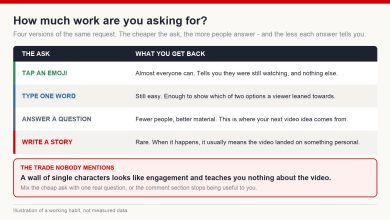
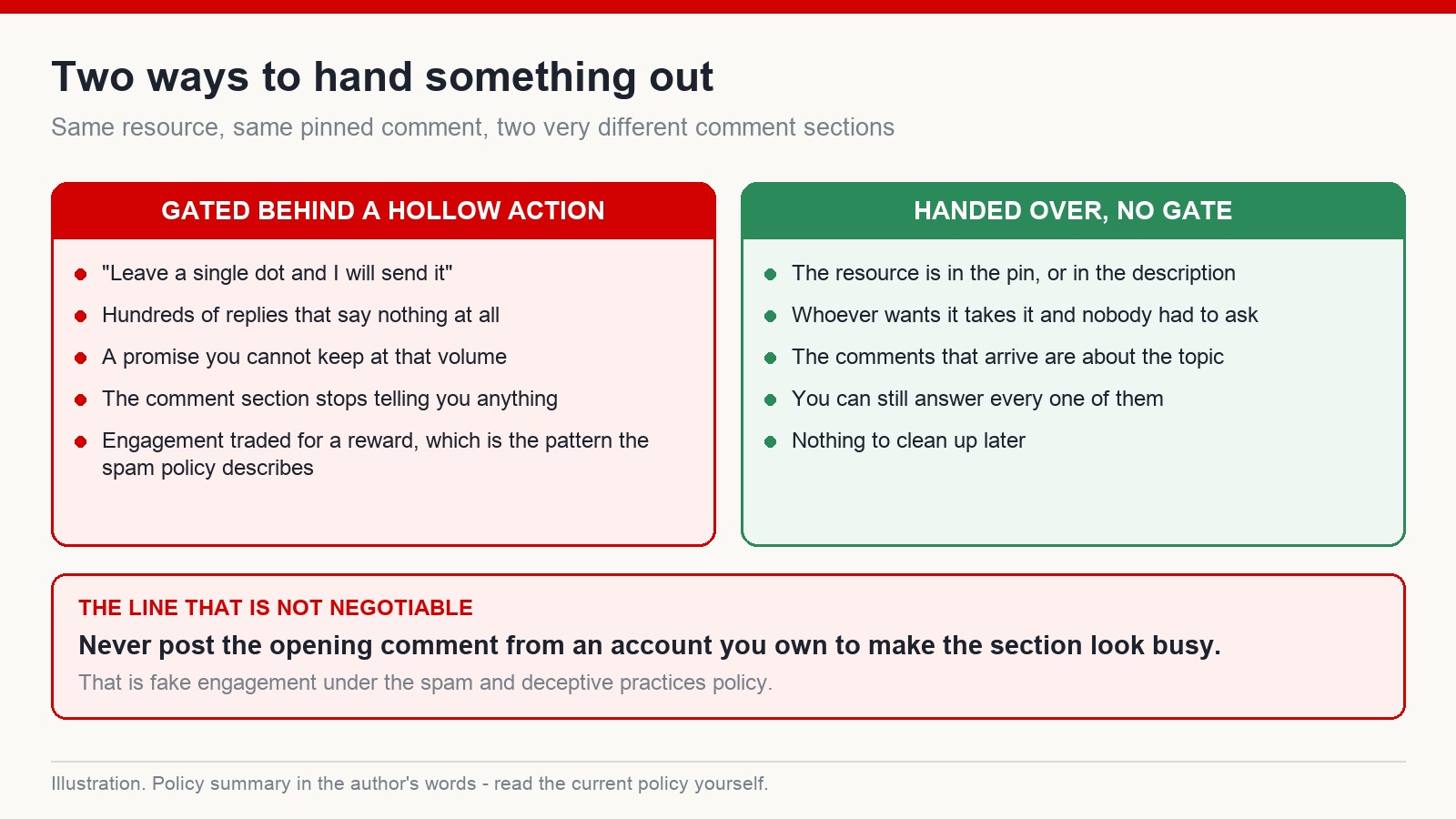
The most-shared pinned comment tactic is a giveaway with a gate on it: ask viewers to leave a single dot, or a single word, and promise to send them the file in return. It is popular because it works at the thing it is aimed at. The barrier is almost zero, the count climbs quickly, and the section looks busy.
I would leave it alone, for three reasons that stack.
The first is that you have to keep the promise, at volume, one message at a time. Four hundred dots is four hundred people you now owe something to, and the usual resolution is either abandoning it – a broken promise sitting in public under your own video – or pasting the same reply four hundred times. Repetitive comments posted at scale sit under YouTube’s spam and deceptive practices policy, and a human pressing the button each time does not change what the pattern looks like.
The second is that you have traded away the only thing the comment section was good for. A comment that consists of a full stop carries no information. Do this for a few months and you have a section that looks active and tells you nothing about what your audience is confused by, disagrees with, or wants next – which was the entire reason to care about comments.
The third is the shape of the thing. You are offering a reward in exchange for an engagement action, and the engagement produced has no relationship to interest in the video. That is the pattern the platform’s spam policy is describing when it talks about engagement produced for reasons other than genuine interest. I am not going to tell you where enforcement draws its line, because I do not know. I am telling you that the tactic is built on manufacturing a metric, and metrics manufactured on purpose are a poor foundation.
The version without the gate is simpler and better. Put the thing in the pin, or in the description, and let whoever wants it take it. The people who then comment are commenting about the topic, you can still answer all of them, and there is nothing to clean up later.
The line that is not a judgement call
One related practice deserves stating plainly, because it gets recommended as a way to make a pinned comment work harder: posting the first comment, or the first few replies, from an account you also own, so the section looks alive and real viewers join in.
Under YouTube’s policy that is fake engagement – engagement that does not come from real people with genuine interest – and the documented consequences run from the metrics being removed to the channel being terminated. Separate emails and isolated browser profiles do not move it into a different category, because the category is about who the account belongs to rather than how well the accounts are separated. It also fails on its own terms, for the same reason the dots do: a conversation you had with yourself teaches you nothing.
Putting a link in the pin without it reading as an advert
Links in pinned comments are fine. What makes them land badly is the order. A pin that opens with a URL is an advert and gets skipped. A pin that gives the reason first and the destination second is a recommendation.
“The full walkthrough of the part I skipped at eight minutes is here” works. “Check out my other stuff” does not, because it names no destination and offers no reason. One link, one reason, and the rest of the links in the description where they belong.
The pin as a route to the next video
The most useful thing I put in pins is a pointer to the specific video that comes next in a sequence – not a playlist, not the channel page, one video, named. Someone who has just finished watching is the most willing they will ever be to watch another one, and the pin catches the ones who never reached the end screen.
This is also what makes going back through older videos worthwhile. When you publish something that follows on from a video you made months ago, rewriting that older video’s pin takes a minute and puts the new thing in front of everyone still arriving at the old one.
Read the replies as research
If your pin ends with a question – a real one, small enough to answer in five words – the replies underneath it are the closest thing to a free survey that this platform offers. Not “what did you think”, which nobody can answer, but “which part are you stuck on” or “what would you want covered next”.
Three people naming the same sticking point is a video. That is worth more than any count of characters underneath it.
Should the same link go in both the pin and the description?
Usually yes for one link, if it is genuinely the thing you want people to have – the description is where they will look for it later. What does not work is putting every link in both places, plus the end screen, plus the video.
How often should I change the pinned comment?
Whenever the one current thing changes. There is no schedule. Publishing something new, or an older video picking up views again, are the two usual triggers.
Is it against the rules to ask people to comment?
Asking a real question that invites a real answer is ordinary and fine. What is worth avoiding is trading a reward for an engagement action, because the responses you get are unrelated to interest in the video.
Can I pin somebody else’s comment instead of my own?
Yes, and it is underused. Pinning a viewer’s genuinely useful question, with your answer underneath it, does more for the next reader than most things you would have written yourself.
Do links in comments hurt a video?
A relevant link with a reason attached is normal. A comment section full of promotional links is the thing to avoid, both because of how it reads and because heavily promotional repetition is what spam filtering is looking for.
The short version
Decide what each surface is for, put one current thing in the pin, and stop asking the comment section to produce numbers. A pin that names a destination and asks a real question will tell you more about your audience in a month than a thousand single-character replies will in a year.
If you want the rest of the process for building a faceless channel for an English-speaking audience, that is what we work through at mmoyoutube.com. Platform policies change – read the current one yourself rather than relying on anybody’s summary, including this one.