The YouTube SEO Process I Use on Faceless Channels
Here is something new creators do not enjoy hearing: a great many videos do not fail on content. They fail because nothing about them told the platform what they were about.
I have been building faceless channels for English-speaking audiences since 2017, and I keep meeting the same scene. Someone spends hours on a script. Days on the edit. Real effort on the thumbnail. Then they upload it into silence, and conclude that the algorithm is against them.
Sometimes it is a content problem. Often it is that the video arrived with no signal attached to it, into a niche where the platform already has a hundred better-labelled alternatives to test first.
Does YouTube SEO still matter?
My answer is yes – but not in the way the phrase is usually sold.
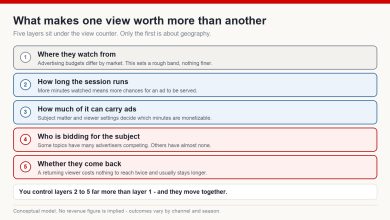
Keywords are no longer the main thing being measured. The platform is watching behaviour:
- Click-through rate – of the people shown this, how many chose it
- Retention – how long they actually stayed
- Satisfaction signals – surveys, likes, dislikes, “not interested”
- What they did next – did the session continue or end
- Engagement – comments, shares, subscriptions
None of that is keyword work. But SEO is still how the system forms an initial hypothesis about your topic, and that hypothesis decides who gets shown the video in the first test. Get it wrong and the behaviour metrics never get a fair reading, because the video was shown to the wrong people.
For a channel aimed at an audience that does not share your first language, “the right people” means the right country and the right phrasing. That is not a small detail. It is most of the difference between traffic that earns and traffic that does not.
Start before the upload: name the file properly
A habit worth adopting is renaming the export before it goes anywhere near the upload page.
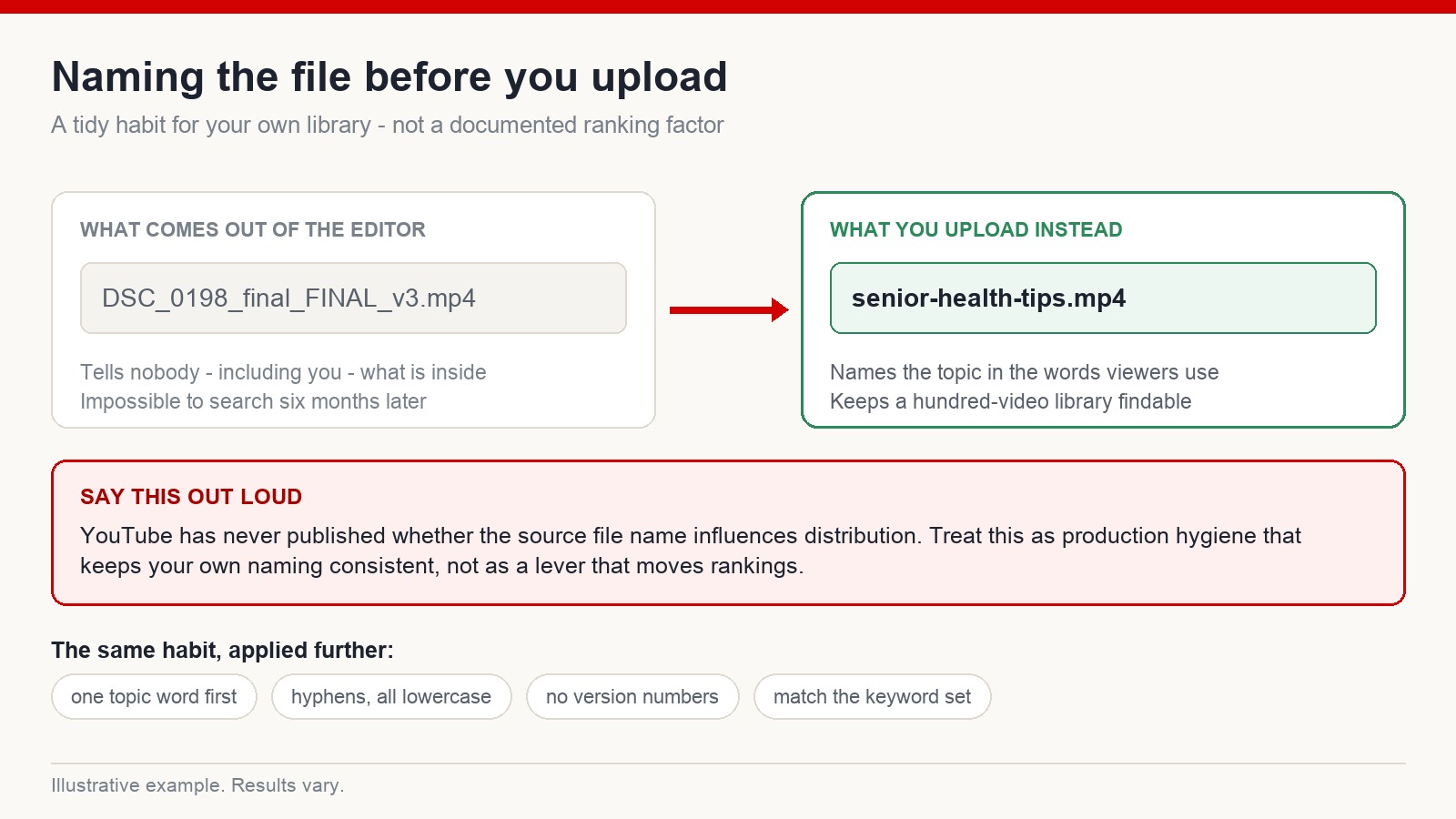
If the video is about senior health, the file leaving your editor should be called something like senior-health-tips.mp4 rather than DSC_0198_final_FINAL_v3.mp4.
I want to be straight with you about this one, because it gets oversold constantly. YouTube has never published whether the source filename influences distribution. I have no evidence that it does. What I can defend is the practical half: a library of a few hundred files named by topic is searchable six months later, and a library named by camera default is not. Treat it as production hygiene, not as a ranking lever.
Build a keyword set, not a keyword
The common mistake is fixating on one exact phrase while your actual audience describes the same need five different ways.
Take senior health as the core idea. Around it sit phrasings like healthy aging, retirement health, senior wellness, healthy lifestyle for seniors, aging tips. Those are not competitors to your main keyword. They are the shape of the demand.
The goal is coverage of an intent, not density of a string. Nobody is rewarded for repeating a phrase; you are rewarded for being unmistakably about a subject that people want.
This is the step I see skipped most often by creators working in a second language, and I understand why – digging into phrasing you are not fluent in feels like work you cannot check. Which brings me to the tool that changed this part of the job.
Reading competitors with AI
The strongest use of a language model in this work is not writing. It is reading – specifically, reading a market in a language you do not command.
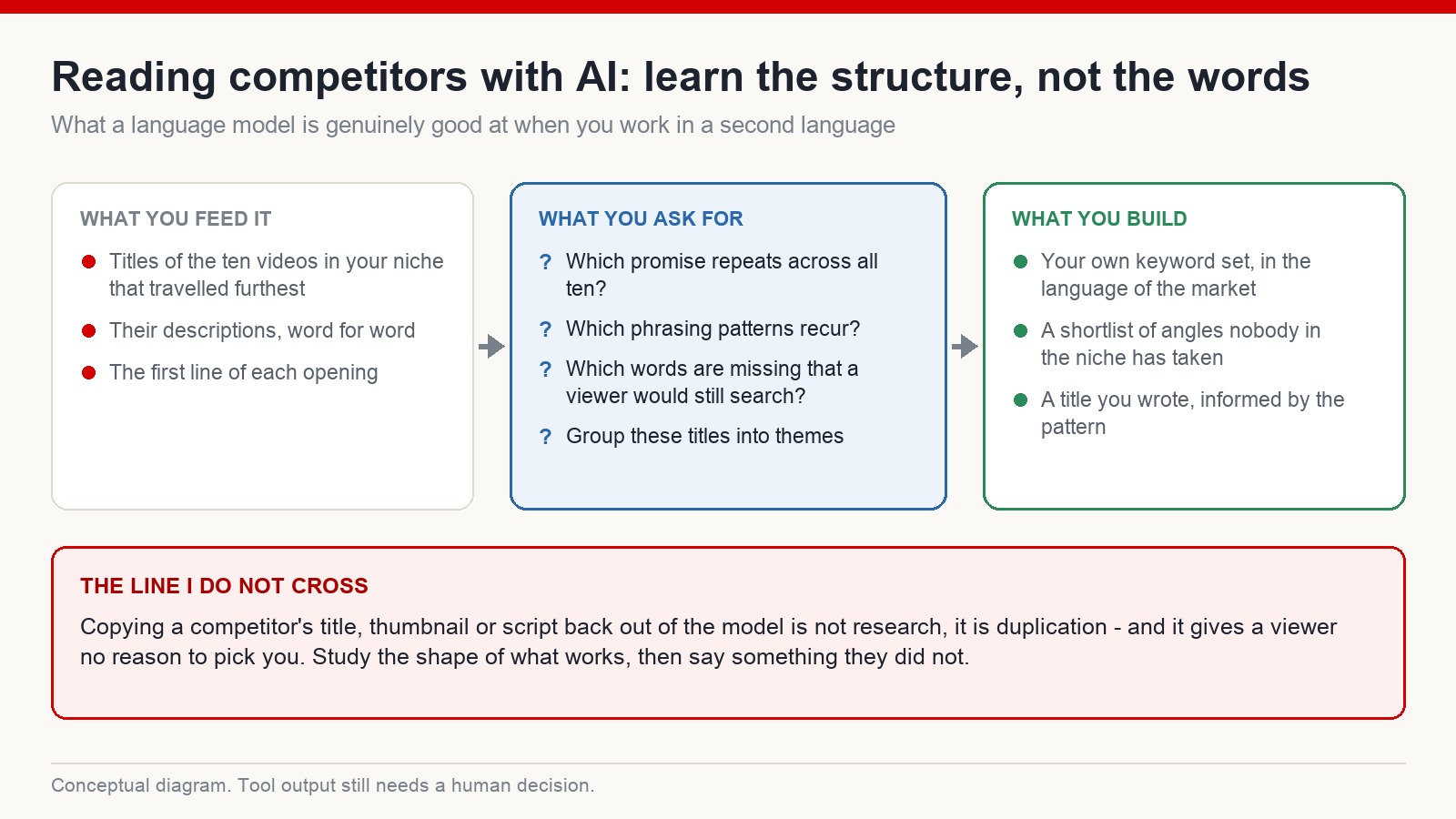
What I feed it: the titles of the ten videos in the niche that travelled furthest, their descriptions word for word, and the first line of each opening.
What I ask for: which promise repeats across all ten, which phrasing patterns recur, which words are missing that a viewer would still search, and how these titles group into themes.
What comes out is a keyword set in the market’s own language, a shortlist of angles nobody in the niche has taken, and enough pattern recognition that I can write my own title with some confidence.
The line I do not cross: copying a competitor’s title, thumbnail or script back out of the model is not research, it is duplication – and it gives a viewer no reason to pick you over the original. Study the shape of what works, then say something they did not.
Write the title in two layers
A title that does its job usually has two things stacked on top of each other.
Layer one: the phrase people search
Retirement health tips. Flat, unexciting, and the reason the platform can categorise the video at all.
Layer two: the reason to click
7 Retirement Health Tips Most Seniors Learn Too Late. Same subject, now with a stake in it.
Layer one is for the system. Layer two is for the human. Drop the first and you are invisible; drop the second and you are visible but ignored. Both layers or neither.
The description is context, not a keyword dump
Most people write the description last, badly, in thirty seconds. It is one of the few places you get to explain the video in plain sentences.
A description that earns its place:
- says what the video actually covers, in the first two lines
- contains the main phrase because it belongs there, not because it was inserted
- includes the related phrasings naturally
- ends with a clear next step for someone who watched it
If the video is about health in later life, the description should be about health in later life. Padding it with unrelated high-volume terms does not broaden your reach; it muddies the only clean signal you had.
The thumbnail is the part they see first
It is easy to spend an afternoon on keywords and forget that nobody reads a title before they have seen an image.
A thumbnail that works is readable on a phone at a glance, has one focal point rather than four, is comprehensible in about a second, and leaves a question open. That last one is the hard part – curiosity without dishonesty.
Same principle as with titles: learn from the leaders in your niche, do not reproduce them. If your thumbnail looks like a slightly worse version of the video above it in the feed, the viewer has no reason to move.
None of this matters if retention collapses
This is the most important paragraph in the article, so I will make it plain.
SEO can bring a viewer to the video. Retention decides whether that visit was worth anything. If people leave in the first fifteen seconds, no amount of keyword work will keep the video in circulation – you have simply proven to the system, at scale, that its recommendation was wrong.
So my order of priority runs:
Content, then retention, then click-through, then SEO.
Beginners tend to run that list backwards, optimising metadata on a video whose opening thirty seconds nobody has ever tested.
Wake the video up with real engagement
Once a video is live, the cheapest thing you can do is turn up in your own comments. Answer people properly. Heart the replies that added something. Pin the comment that answers the question everyone is asking. Update the pinned comment when something changes.
This is not a growth trick and I would not sell it as one. It keeps a community alive around the video, and a live thread is a better thing to hand a returning viewer than a dead one. Anything beyond that – artificial views, reciprocal engagement schemes, comment pods – belongs in a warnings section, not a method. Those tactics violate platform policy and I have watched them cost people entire channels.
SEO as a loop, not a checklist
The version of this that actually holds up is a cycle you run every upload.
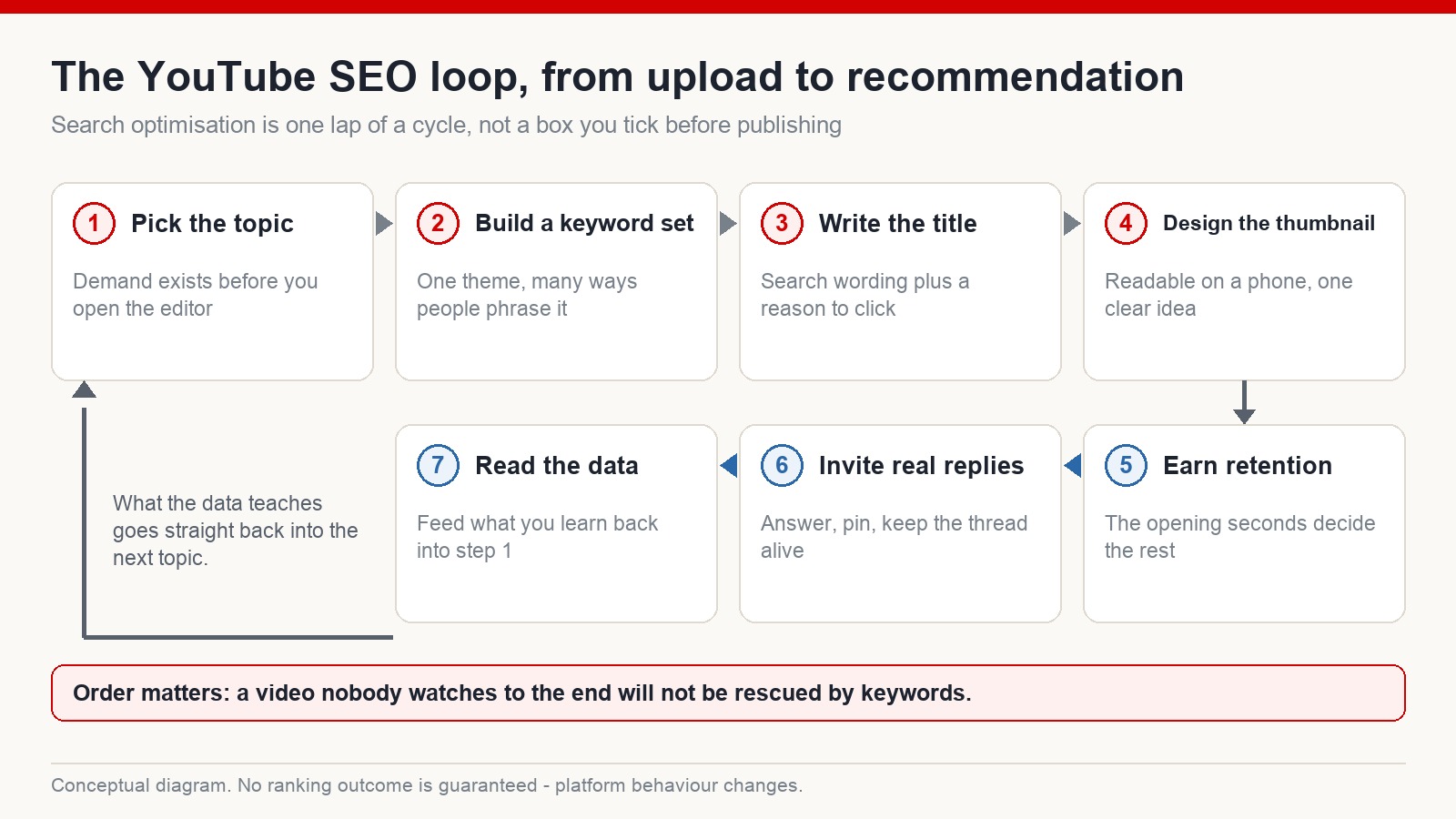
- Pick a topic that already has demand behind it.
- Build the keyword set around it.
- Write the two-layer title.
- Design a thumbnail that survives a phone screen.
- Earn the retention in the opening.
- Invite genuine engagement and answer it.
- Read what the data says, and feed that into the next topic.
Step seven is the one that makes it a loop rather than a list, and it is the step almost everyone drops.
Wrapping up
I have to be honest to be useful here: there is no process that guarantees a video ranks first for anything. Search results move, niches saturate, and platform behaviour changes without notice. Results vary enormously between channels, and anyone telling you otherwise is selling something.
What a process does is raise the probability and remove the avoidable failures. SEO is not a trick. It is how you make sure the platform understands what you made, so it can go and find the people who wanted it. Combined with a thumbnail that earns the click, an opening that earns the minute, and a subject people were already looking for, it turns growth into something you build rather than something you wait for.
Frequently asked questions
Does renaming the video file help SEO?
Many creators do it for consistency and for their own file management. YouTube has never stated that the source filename affects distribution, so treat it as good housekeeping rather than a ranking factor.
Do tags still matter?
They play a supporting role, mainly for terms that are commonly misspelled or for niche subjects where the vocabulary is unusual. They are not where your effort should go.
What influences YouTube rankings most?
Click-through rate, retention, viewer satisfaction, and whether the session continues after your video. Metadata helps the platform categorise you; behaviour decides how far you travel.
Can AI replace keyword research for an international audience?
It removes most of the language barrier, which is enormous. It still cannot tell you which audience is worth having or how your own viewers behaved last month – that comes from search data and your own analytics.
How long before SEO changes show an effect?
There is no fixed answer, and I would be suspicious of anyone who gives you one. Changes to an older video’s metadata can take weeks to register, and some never move at all.
If you want the research side of this in more depth – how to find a market with real demand before you commit months to it – that is the part I teach at mmoyoutube.com.