Should You Change Your YouTube Niche? Usually It Is the Packaging
There was a stretch where I believed one sentence completely: publish consistently and the channel will grow.
So I did exactly that. New idea every day. New video every week. Thumbnails made by hand, titles stuffed with the phrases I thought people searched for, descriptions padded out to the length somebody on the internet had recommended.
Nothing moved. Views stayed flat. People were not clicking, and the ones who did were leaving halfway through. The channel sat there as if the platform had forgotten it existed.
So I did what almost everybody does at that point. I blamed the niche. Then the algorithm. Then my gear, my lack of a team, my lack of budget. It took me an embarrassingly long time to consider the least flattering explanation: I was not failing for lack of opportunity. I was failing because I had been doing the same thing for a year and calling it persistence.
Repetition and iteration look identical from outside
This is the trap that is genuinely hard to see, because from the inside it feels like discipline.
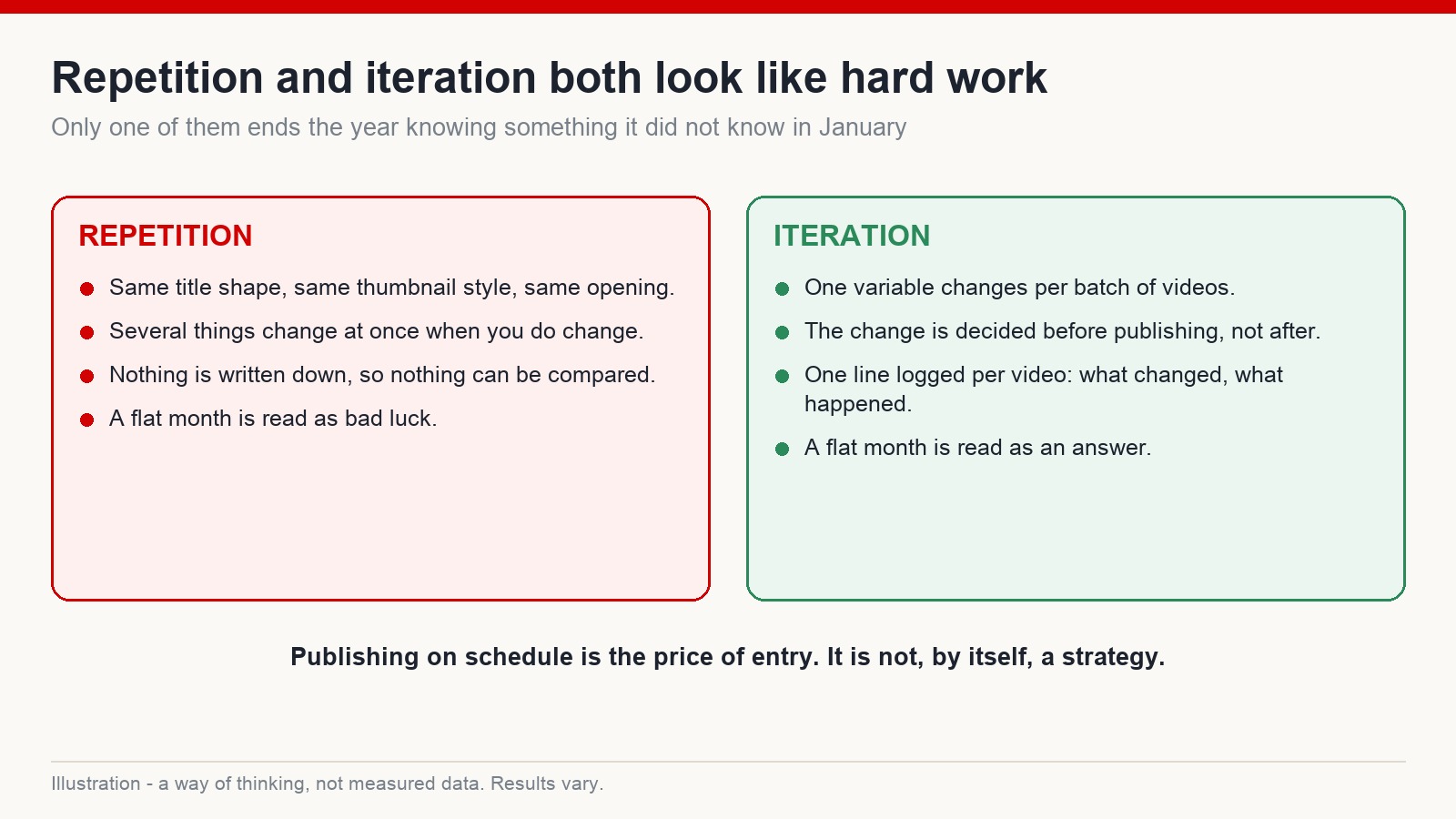
You are working. You are publishing. You are researching, editing, hoping. Anyone watching would call you committed. But look closely at twenty consecutive uploads and you may find the same title shape, the same thumbnail style, the same opening ninety seconds, the same way of choosing subjects, the same underlying assumption about what viewers want.
If that formula has not produced a result in six months, doing it a seventh time is not persistence. It is inertia wearing persistence as a costume.
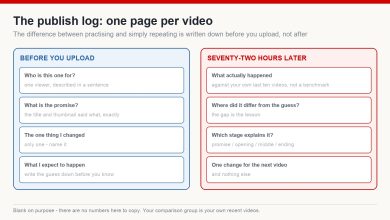
Iteration looks different in one specific way: something is deliberately different in this batch compared to the last, it was decided before publishing rather than rationalised afterwards, and it is written down so the result can be read. Publishing on schedule is the price of entry. It is not, by itself, a strategy.
What the platform actually responds to
Part of why old routines stop working is that the routine was built for an earlier version of the platform.
There was a period when getting the keyword into the title, writing a long description and filling in tags gave a video a reasonable shot at search traffic. That era is over, and its residue is everywhere in the advice people still follow.
What a recommendation system responds to now is behaviour. Did people click the thing when it was put in front of them? Did they stay? Did they watch something else afterwards or leave the platform? None of that is about how hard you worked on the video. All of it is about whether the video was worth a stranger’s next ten minutes.
Which means the honest question is not “why is my channel not being pushed?” but “what did the last person who saw my thumbnail decide, and why?”
A channel that nearly got abandoned
One creator I worked with ran a faceless personal-finance channel. He was, by any normal standard, doing everything right. Four videos a week. Eight to ten minutes each. Clear narration, tidy visuals, genuinely accurate content.
Fifty-odd videos in, the channel was still very small. He asked me the question in the title of this article: is this niche finished?
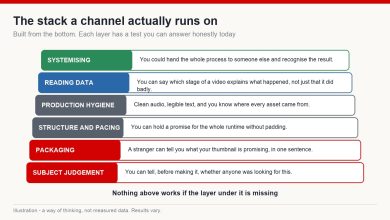
I watched a few videos and the niche was not the problem. The packaging was. His titles were safe to the point of invisibility. His thumbnails looked like lecture slides. Every video opened with a slow run-up before it got to anything. Individually those are small flaws. Together they meant no stranger had a strong enough reason to click, and the few who did had no strong reason to stay.
What he did next is the part worth copying. He did not rebuild the channel. He changed one thing at a time. He rewrote how he framed titles – moving from a neutral list (“five ways to save money”) to the actual tension inside the subject (“it took me three years to work out why saving more was making me poorer”). He cut the first thirty seconds of every video. He rebuilt thumbnails around a single readable idea. He chose subjects closer to what his viewers were privately worried about.
The result was not a straight line and I am not going to dress it up as one. Most videos still performed like most videos. But some began travelling far past anything the channel had done before, and that had nothing to do with luck. It happened because he stopped defending the old formula.
Is it the niche or the packaging? Four checks
Before you throw away a subject you already understand – which is a real asset, and one you cannot rebuild quickly – work down this list in order.
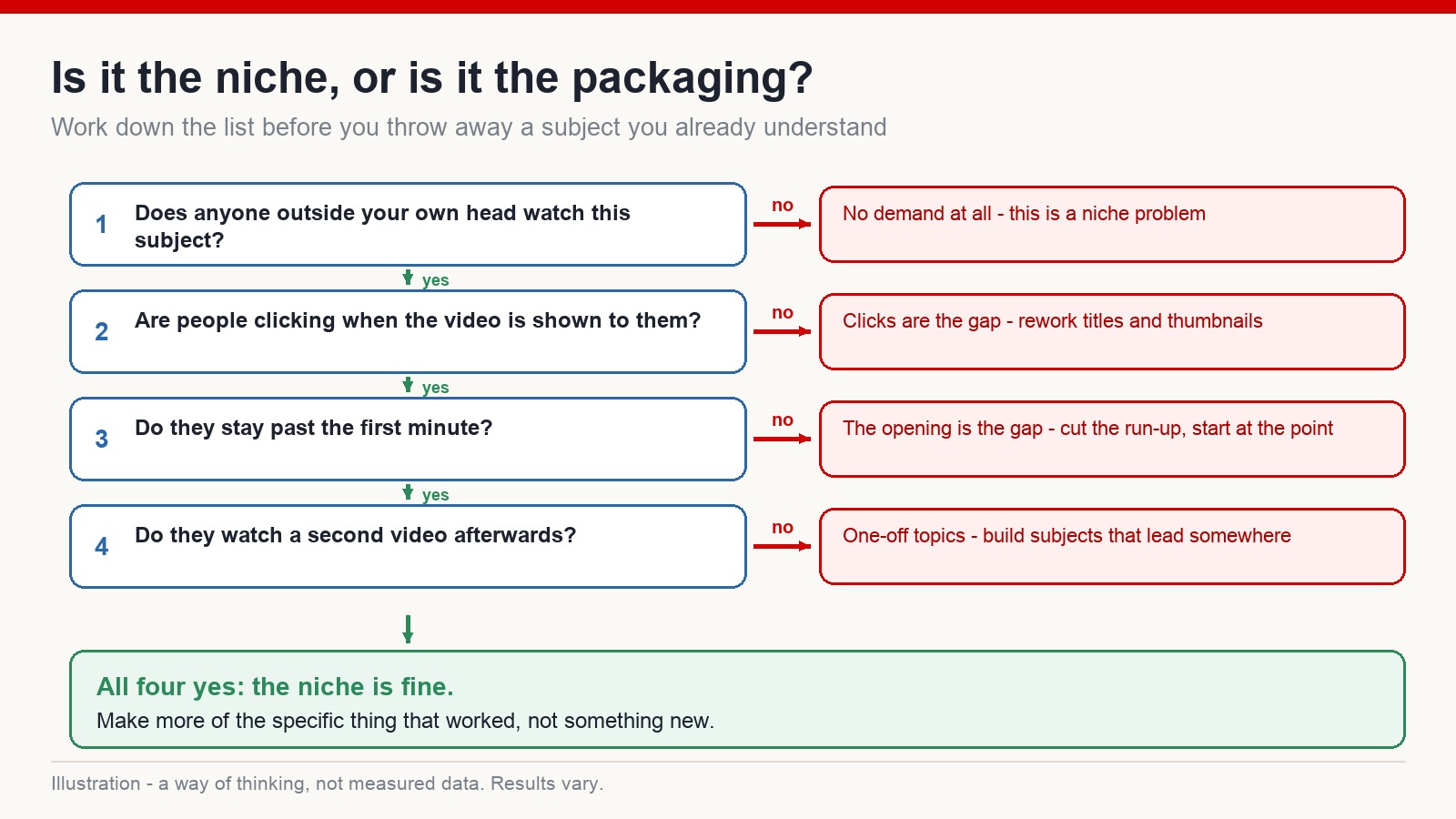
One: does anyone outside your own head watch this subject? Not “could they” – do they. If you cannot find other channels serving this audience at all, you may genuinely have a demand problem, and that is the one case where changing subject is the right answer.
Two: are people clicking when the video is shown to them? If impressions happen and clicks do not follow, the gap is between your title and thumbnail and the promise a stranger is willing to gamble ten minutes on. That is a packaging problem, not a niche problem.
Three: do they stay past the first minute? If people click and then leave immediately, the video is not delivering what the thumbnail promised, or it is taking too long to start. Cut the run-up.
Four: do they watch a second video afterwards? If every video is a self-contained one-off, you are collecting visitors rather than building an audience. That is a structural fix – subjects that lead somewhere – not a reason to abandon the topic.
Four yeses means the niche is fine and the job is to make more of the specific thing that worked. Any no tells you exactly which lever to pull first.
Pull one lever, not all four
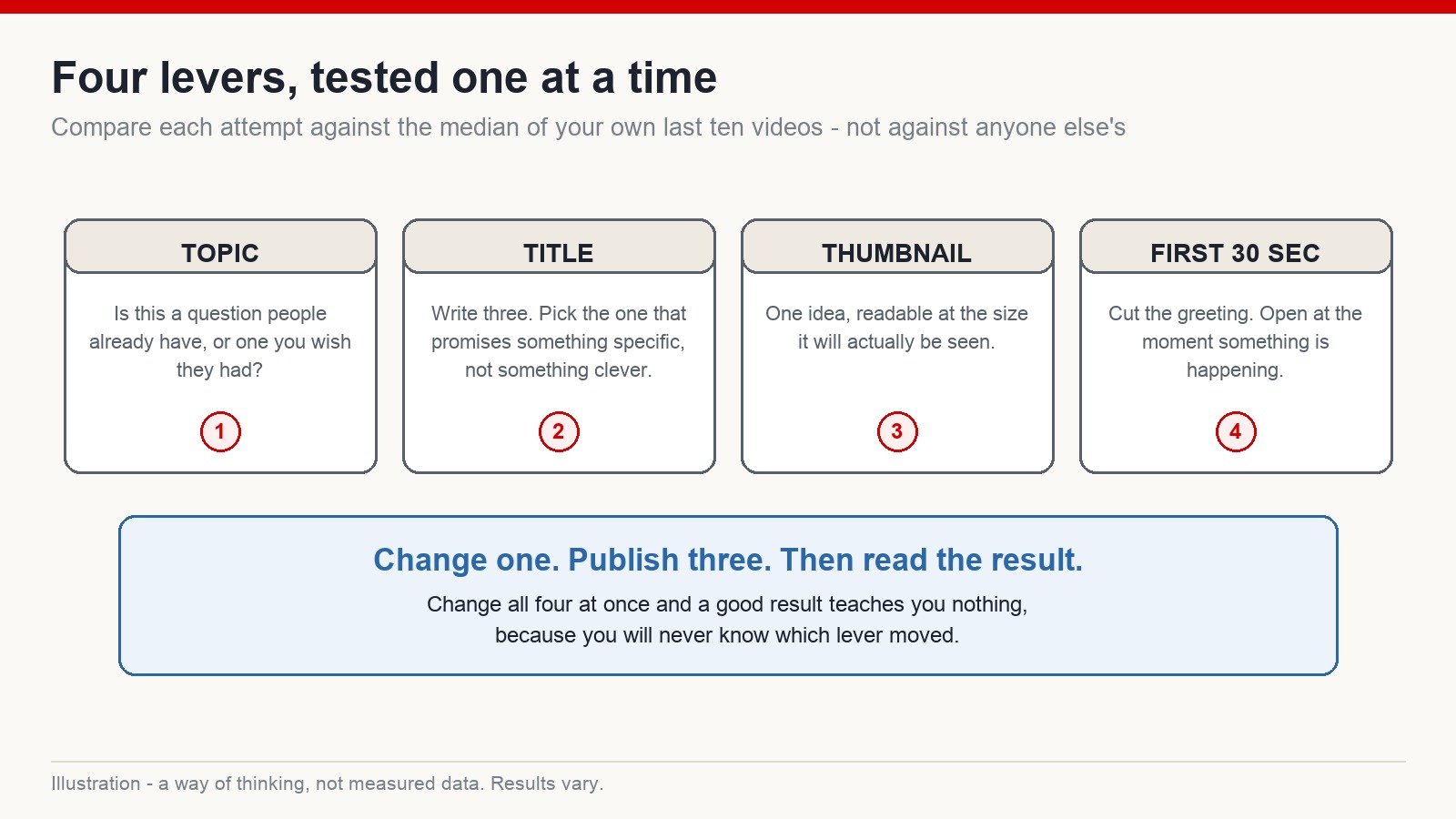
Here is where most people undo their own work. They diagnose correctly, then change the topic, the title style, the thumbnail design and the format all in the same week. Something improves. They have no idea what.
Change one lever. Publish three videos with it. Then compare those three against the median of your own last ten – not against a benchmark you read somewhere, not against a channel with a decade of head start. Your own median is the only fair control group you have, and it is available today.
Three videos is not a scientific sample. It is simply enough to stop you reacting to a single unusual result, which is the more common failure.
When changing the niche really is the answer
I do not want to leave the impression that the subject is never the problem. Sometimes it is.
Change it if there is genuinely no audience for it – if nobody, anywhere, is watching this kind of thing. Change it if you cannot stand it, because two years of a subject you resent will beat you before the channel does. Change it if the viewers it attracts have nothing else they would want from you afterwards.
What is rarely a good reason: three flat months. Or a competitor doing well in a different subject. Or the tiredness that arrives around video forty and disguises itself as a strategic insight.
Narrow usually beats broad
Beginners often reach for the biggest possible subject on the theory that a bigger pond holds more fish. In practice a broad subject means you are competing with everyone and speaking clearly to no one.
A channel about one specific thing – one workflow, one recurring problem, one kind of story told one way – gives a stranger a reason to subscribe rather than just watch. The platform does not ask how large your channel is. It asks whether this particular video was the right thing to show this particular person. A narrow channel answers that question more often than a broad one.
Frequently asked questions
How many videos before I decide my niche is not working?
There is no fixed number, and anyone quoting one is guessing. What matters more is whether those videos were varied enough to be informative. Fifty near-identical videos tell you less than fifteen where you deliberately changed one thing at a time.
Should I start a new channel or fix the one I have?
Usually fix the one you have. A back catalogue and a working production routine are worth more than a clean start, and the packaging problems you have not solved will follow you to the new channel anyway.
Is my niche too competitive?
Competition normally means demand, which is a good sign. The practical move is to get narrower within it rather than leaving it – serve one clearly defined slice of that audience better than the generalists do.
Can a small channel still reach a large audience?
Yes, and it happens regularly, because each video is evaluated largely on its own merits. It is not guaranteed and it is not predictable, but channel size is not the gate people assume it is.
What should I change first?
Whatever the first “no” in the four checks points at. If people are not clicking, work on titles and thumbnails. If they click and leave, work on the opening. Fixing the wrong lever first is how months disappear.
If you want a structured way to work through this on an English-language channel rather than guessing, that is what we build at mmoyoutube.com. Platforms change and results vary – the method is what carries over.