The First Video Works. Now What? Four Ways to Expand Without Losing the Thread
The most dangerous moment in a channel’s life is not the flat stretch at the beginning. It is the week after something finally works.
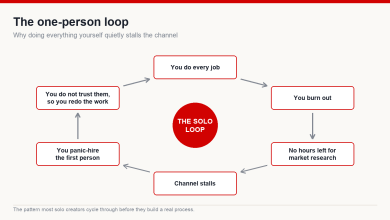
A video takes off. Subscribers arrive. There is real momentum for the first time, and the instinct that follows is almost universal: try something completely different next, while people are watching.
It is a reasonable instinct and it usually kills the run. The channel spent months establishing what it was about, finally got understood, and then immediately said something else. Growth stalls, and the stall gets blamed on an algorithm change rather than on the pivot that caused it.
When a channel starts working, the job is not to find more subjects. It is to build outward from the thing that worked.
Four directions that keep the thread
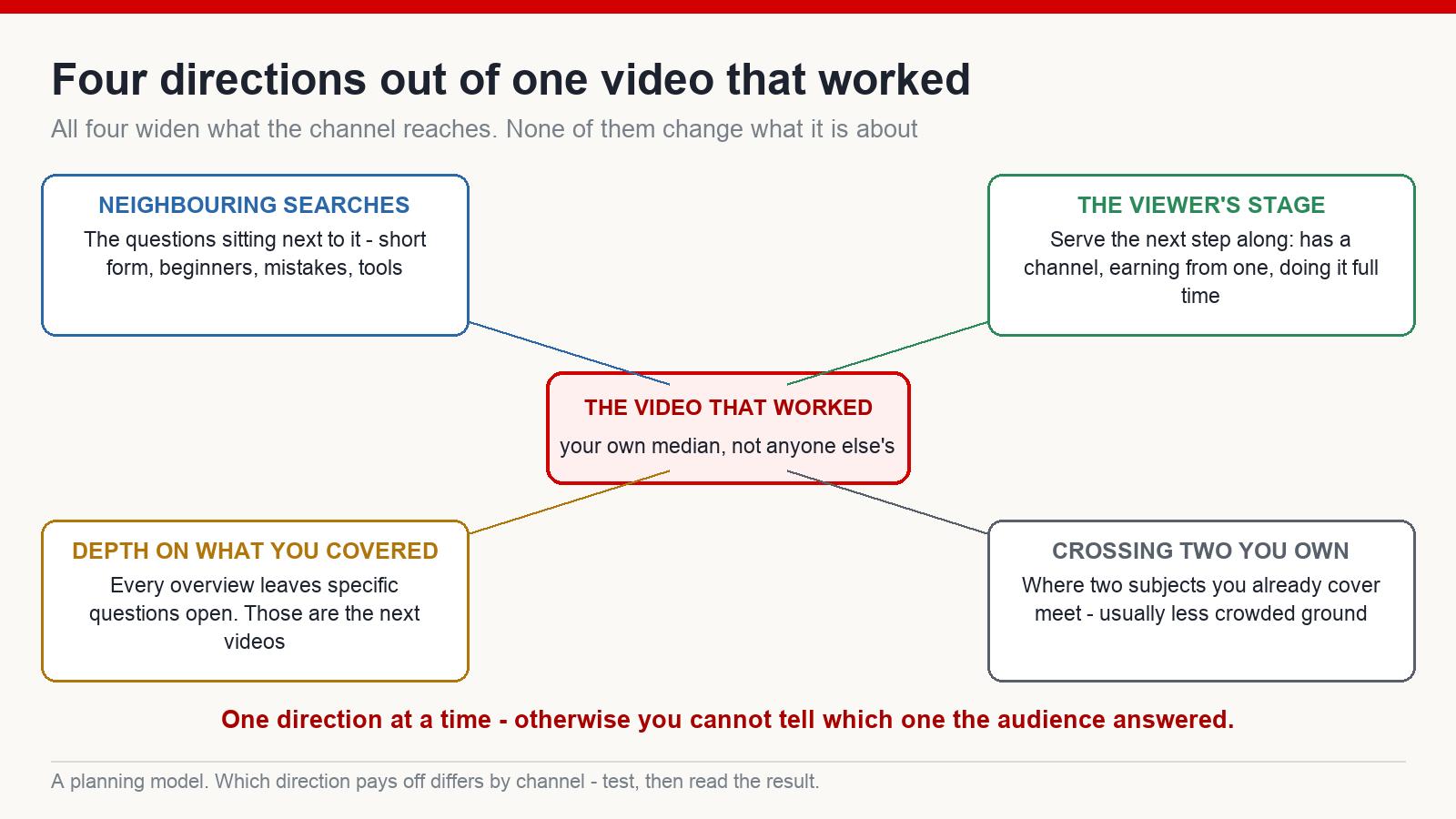
There are four useful directions to expand in, and all of them keep the channel recognisable while widening what it reaches.
1. Neighbouring searches
If a subject worked, do not simply publish the same subject again with different words. Move to the questions sitting next to it.
A video on video search optimisation opens onto: how the same thing works for short-form, what changes when the audience is international, the mistakes that undo it, how to approach it as a complete beginner, and how the tools have altered the job.
Same territory, five distinct searches. The library gets deeper without the positioning getting vaguer – and each one can point viewers back to the video that started it.
2. The viewer’s stage, not their age
Most channels begin by serving one specific group: usually people at the very start. That is a good place to begin and a bad place to stay, because your best viewers keep advancing past it.
The expansion is to serve the next stage along. People who have a channel already and want it to work better. People trying to earn from one. People using video for a business rather than as the business. People doing it full time.
Do it gradually. Move too fast toward advanced material and the beginners who built your audience find nothing for them any more, and they were the reason the channel grew.
3. Depth on what you already covered
An overview video is an invitation, not a full answer. Every one of them leaves several specific questions open, and those questions are your next videos.
A general video on choosing a subject area opens up: how to judge whether one has room, the errors people make choosing, which research tools are worth the time, how to find ideas once you are inside one, and how different areas differ in what they can support.
Made deliberately, that stops being a set of separate uploads and becomes a cluster – a group of videos that reference each other, sit in one playlist, and let a viewer stay for an hour instead of eight minutes. It is also the clearest signal a channel can send about what it is actually expert in.
4. Crossing two subjects you already own
The least obvious of the four and often the most productive. If the channel covers two adjacent things, the intersection is unclaimed ground.
Suppose you have covered search optimisation and you have covered production tools. The crossing videos – how the tools change the optimisation work, which ones actually save time, the ways people use them that make videos harder to surface – reach both groups at once and tend to have less competition, because most channels cover one or the other.
One condition: the crossing has to be real. Joining two subjects because both are getting attention, when the video has no genuine connection to make, produces a title that promises something the video does not deliver. Viewers notice quickly, and the disappointment costs more than the extra reach was worth.
The test before you publish an expansion
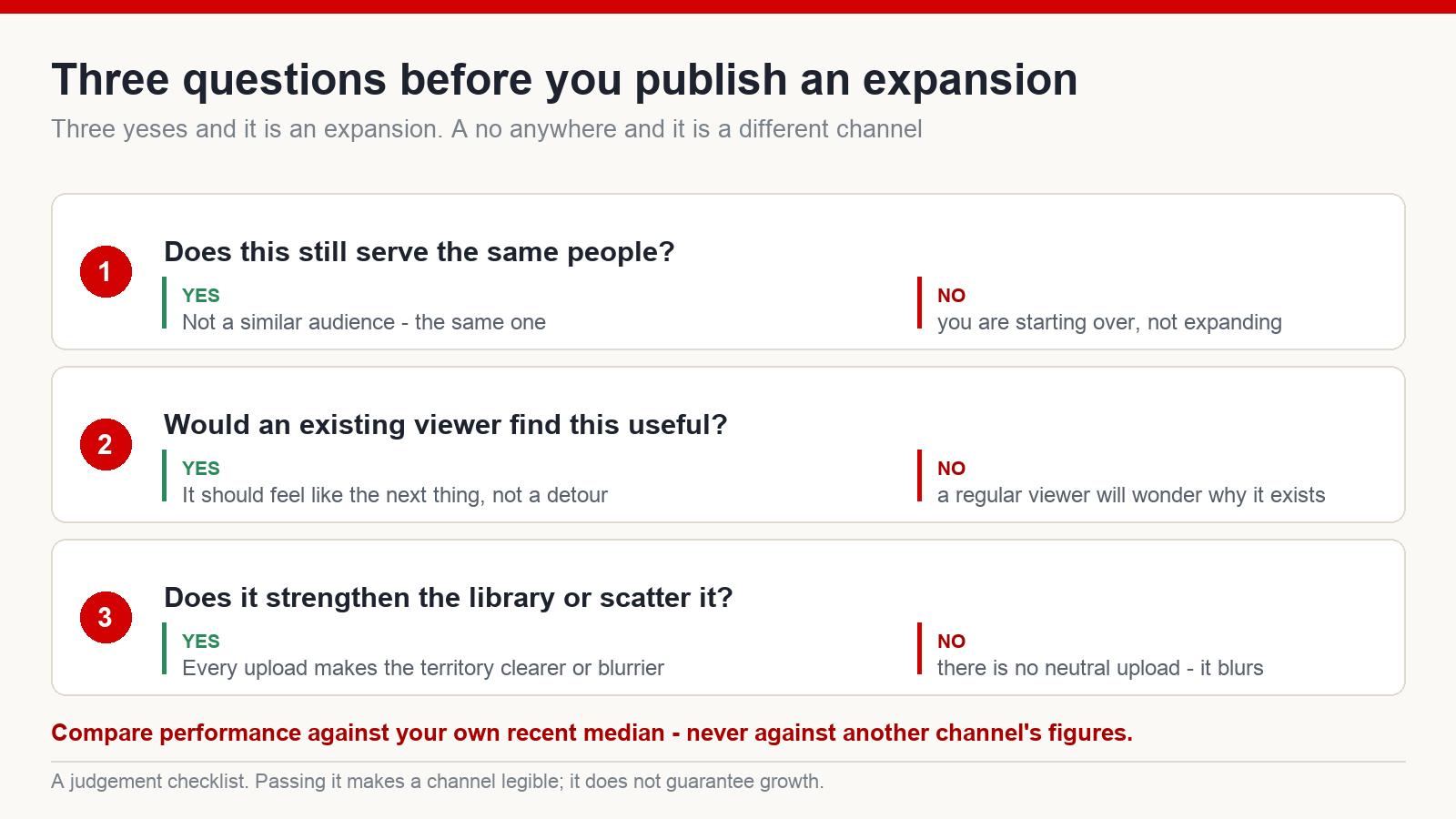
Three questions, and they take a minute:
Does this still serve the same people? Not a similar audience – the same one. If the person who subscribed after your best video would not care about this, you are not expanding, you are starting over.
Would an existing viewer find this useful? Expansion videos should feel like the next thing, not a detour. If a regular viewer would be confused about why it exists, that is the answer.
Does it strengthen the library or scatter it? Every video either makes the channel’s territory clearer or blurs it. There is no neutral upload.
Three yeses and it is a genuine expansion. A no anywhere and it is probably a different channel wearing this one’s name.
The procedure, in order
- Identify what actually worked – the specific video or small group of videos performing above your own recent baseline. Compare against your own median, not against anyone else’s numbers.
- List the questions it left open. Comments are the fastest source; so is watching where people ask follow-ups.
- Extend into neighbouring searches that sit close to the original.
- Connect the videos – through titles that clearly belong together, playlists, cards, and end screens.
- Watch which direction the audience took, and put the next month’s production behind that one.
The fifth step is the one people skip. Expansion is a series of small tests, and the data decides which of the four directions is worth more effort on your particular channel. Guessing works less well than looking.
Do not trade positioning for a spike
There is always a subject that would get more views than yours. There always will be. The question is what a channel is left with afterwards.
One video can bring a crowd. A channel is built by twenty or thirty videos that answer versions of the same problem, so that someone who found one of them has a reason to watch the rest. That is the asset. Views on a video that has nothing to do with the rest of the catalogue mostly buy you a spike in the graph and a group of subscribers who will not open the next upload.
Worth being honest about the limits here too: doing all of this correctly does not guarantee growth. Subjects saturate, formats tire, and platform behaviour shifts. What deliberate expansion does is make the channel legible – to viewers and to the systems recommending it – which is a precondition for growth rather than a promise of it.
Frequently asked questions
When should I start expanding?
When several videos in the same territory have done consistently well and you can describe the audience they attracted. One successful video is not enough evidence to build a quarter’s plan on.
Can I move to a completely different subject?
You can, but be clear that it is a restart rather than an expansion. If the new subject serves a different audience, a separate channel is usually the cleaner answer – it keeps both sets of viewers getting what they subscribed for.
Is crossing two subjects just keyword stuffing?
No, and the difference is whether the video makes a real connection. A genuine crossing has something to say about how the two things interact. Stuffing puts two popular terms in a title and hopes.
How many directions can I test at once?
One at a time, usually. Running several simultaneously makes it impossible to tell which one the audience responded to, and reading the result is the entire point of the exercise.
Does expanding hurt the videos I already have?
Not if the expansion stays inside the same territory – if anything, a denser library helps older videos by giving viewers somewhere to go next. Jumping to an unrelated subject is what causes the damage.
What to do the week after something works
Resist the pivot. Take the video that worked, write down every question it did not answer, and make those. Then connect them so a viewer who finds one lands in a group rather than at a dead end.
Expansion is not about leaving the subject you chose. It is about taking the viewer further along the same road.
If you want a structured way to plan that for an English-speaking audience, that is what we work on at mmoyoutube.com.