Building a YouTube Channel When Nobody Around You Supports It
Nobody has to be interested in what you are building. Nobody is obliged to encourage you, to notice the improvement between video four and video fourteen, or to hand you an opportunity because you have been working hard in private.
That sounds bleak. Read it once more and it is the opposite, because it also means nobody’s approval is a gate you have to pass through first. If encouragement was never coming, its absence is not a verdict, and you were never actually waiting for anything.
I have spent nine years building channels for English-speaking audiences, and I have watched a lot of capable people stall on this exact point – not on strategy, not on tools, but on the quiet expectation that somebody should confirm the plan before they are allowed to start.
What is actually powering your week
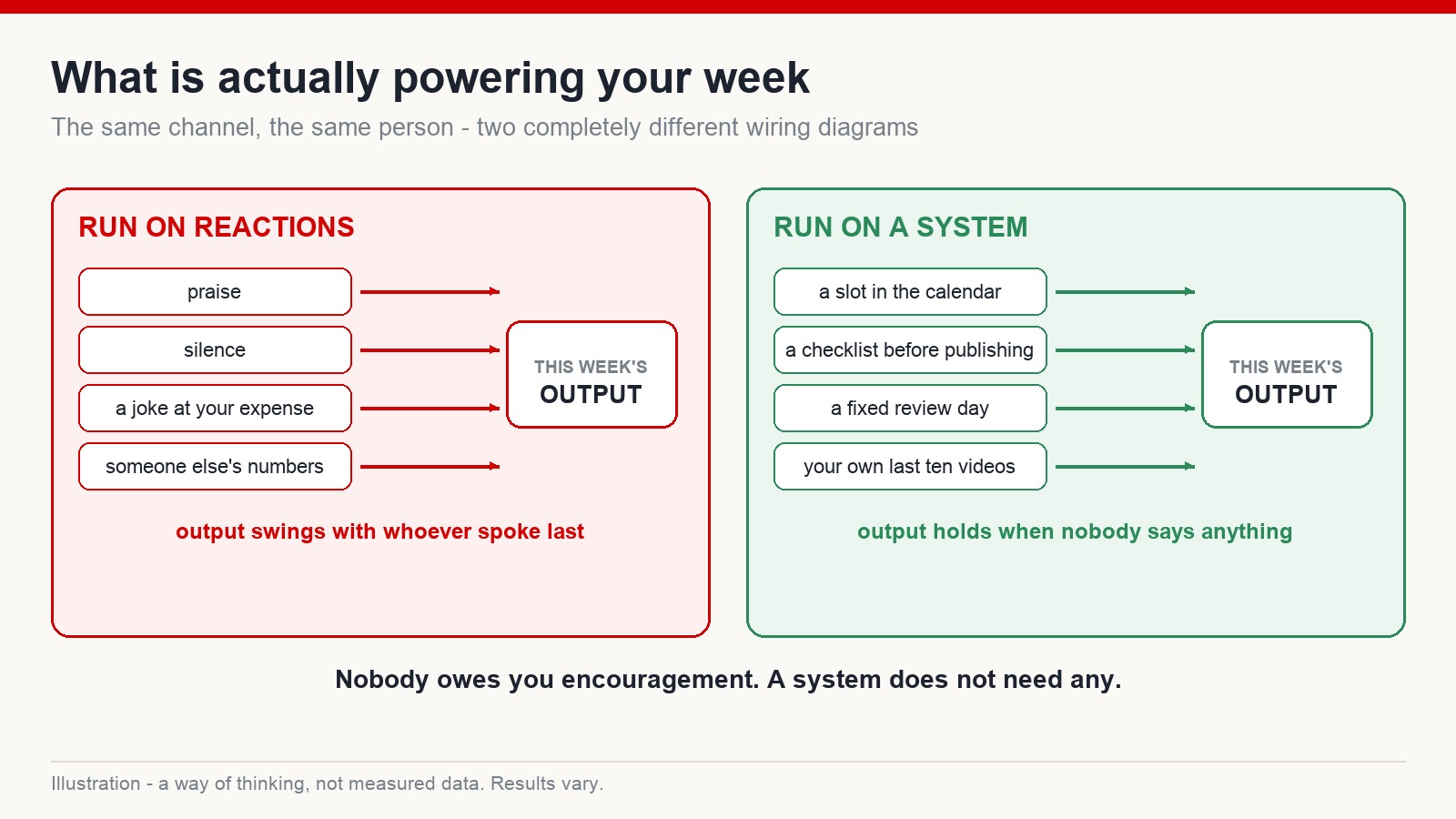
Draw the wiring diagram of your own working week and you will find one of two arrangements.
In the first, the inputs are reactions. Somebody praises the last video and you work all evening. Nobody says anything and the next one slips. A friend makes a joke about your “YouTube thing” and you quietly stop mentioning it. You see somebody else’s numbers and the whole week goes sideways. Output swings with whoever spoke most recently, and none of those people are thinking about you as much as you are thinking about them.
In the second, the inputs are structural. A slot in the calendar. A checklist before publishing. A fixed day for reviewing. Your own last ten videos as the comparison. Output holds steady when nobody says anything at all – which is most weeks, for most channels, for a long time.
The second arrangement is not colder. It is simply not dependent on a supply that was never guaranteed.
The permission you are waiting for was abolished
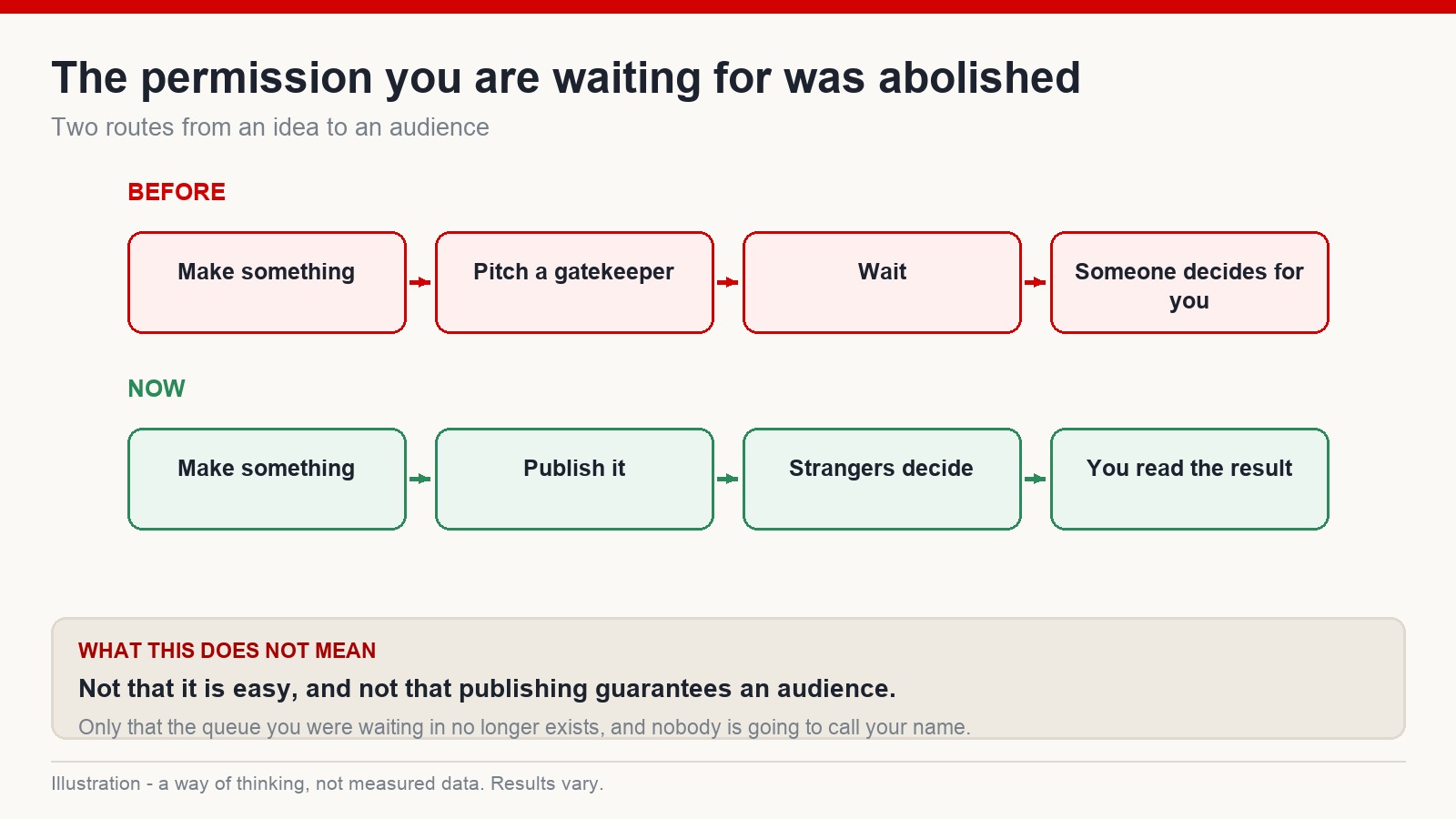
It is worth remembering how recently this changed. Reaching a large audience used to require somebody to pick you: a commissioner, a producer, an editor, a budget holder. You made something, you pitched it, you waited, and someone else decided.
The route now has one fewer step and no queue in it. You make something, you publish it, strangers decide, and you read the result. A phone and a laptop is a working version of the whole apparatus.
I want to be precise about what that does and does not mean. It does not mean it is easy, and it certainly does not mean publishing produces an audience – most videos are seen by very few people, including plenty of good ones. What it means is narrower: the queue you thought you were standing in does not exist, and nobody is going to call your name.
Why the people around you are unconvinced
It helps to understand the doubt rather than resent it, because the doubt is usually not personal.
They cannot see the work. You spent six hours learning to cut an opening properly and the visible output was a video that looks broadly like the last one. Improvement in this job is nearly invisible from outside until it accumulates.
The word means something different to them. When you say “I am building a channel”, many people hear something closer to “filming myself”, or they picture the handful of enormous creators they have heard of and privately place the odds accordingly.
And often they are trying to protect you. Discouragement frequently arrives dressed as concern, from people who would rather you were disappointed now than later. That is worth being gentle about, even while you carry on.
None of these are reasons to argue. Arguing about a thing you have not done yet is the least persuasive position available.
A week that runs without applause
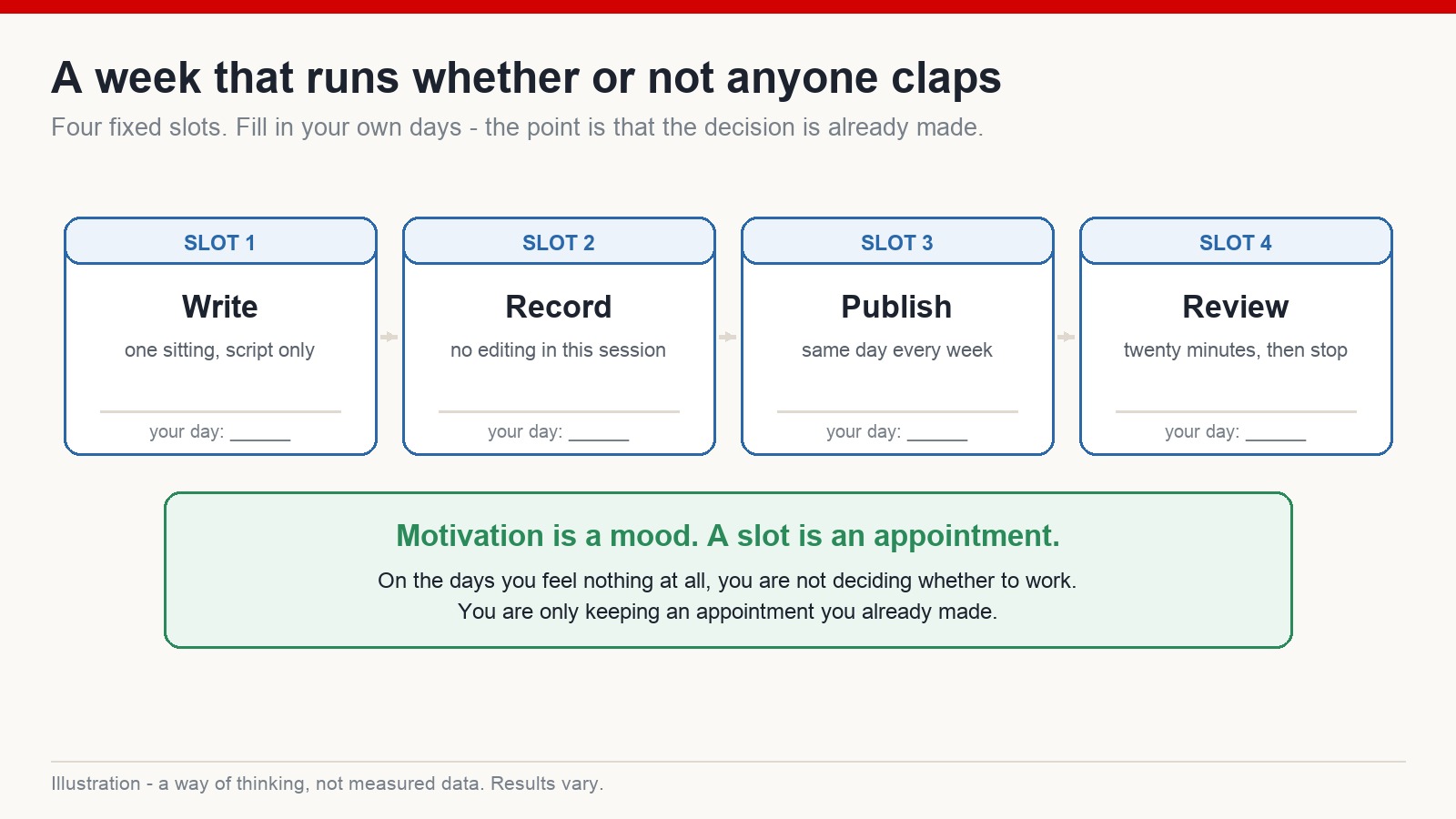
The replacement for encouragement is not willpower. It is a schedule specific enough that showing up is not a daily decision.
Four slots is enough. One for writing, in a single sitting, script only. One for recording, with no editing allowed in that session. One for publishing, on the same day every week. One for review – twenty minutes, then stop, because a review you dread is a review you skip.
Put your own days against those four. The value is not the particular arrangement; it is that the decision has already been made. On the mornings when you feel nothing at all about any of it, you are not deciding whether to work. You are keeping an appointment you made when you were in a better mood.
Answer with the work
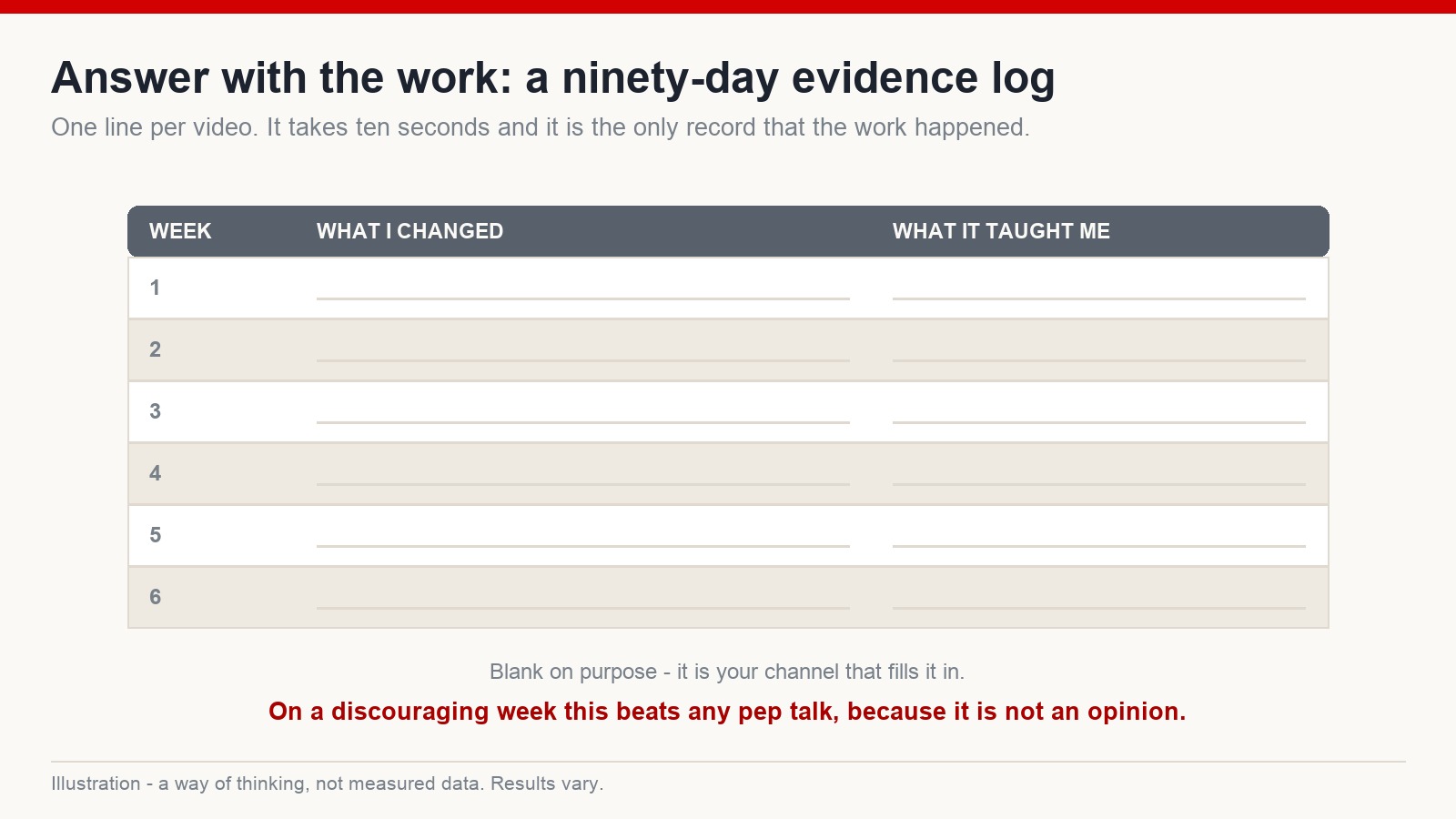
When somebody asks what you are doing with all these evenings, the strongest answer is not an explanation. It is a record.
Keep one line per video: the week, the single thing you changed, and what it taught you. It takes ten seconds. Six weeks later it is the only proof that exists of the work you did, and it is also the most useful planning document you own, because it stops you re-running experiments you already ran.
On a discouraging week this beats any pep talk, for one reason: it is not an opinion. You either changed something and learned something, or you did not, and both of those are facts you can act on.
Independence is not the same as isolation
One correction, because this idea is easy to over-apply. Not needing permission does not mean not needing feedback. It means being selective about whose feedback counts.
Weight the opinion of people who have published something and been ignored. They know what the first year feels like and their notes will be about the video. Weight lightly the opinion of people who have never made anything for strangers – not because they are stupid, but because they are guessing, and their guess will mostly reflect how risky the whole idea sounds to them.
Borrow judgement freely. Do not borrow permission, because it is not actually available.
What changes once you start acting
The genuine reward for a few weeks of this is not views, and I am not going to pretend otherwise. Views are unpredictable and largely outside your control.
What you do get is a shift in where you are looking. You complain less, because complaint is a thing you do when you feel you have no moves. You compare less, because you have a record of your own to compare against. And you find that a small amount of evidence about yourself – twelve videos published, twelve things changed – is worth more than any amount of encouragement you were waiting for.
Nobody is going to arrive and make your life more interesting. That is the bad news and the entire opening, in the same sentence.
Frequently asked questions
What if my family thinks making YouTube videos is a waste of time?
Assume they are working from a different picture of what the work involves, and stop trying to convince them in advance. Set a time limit and a small definition of progress for yourself, keep the log, and let the evidence do the talking later.
Should I tell people I have started a channel?
You do not have to. Some people work better with the accountability, others do better with no audience of acquaintances at all. If announcing it would make quitting harder, announce it. If it would make publishing harder, do not.
How do I stay motivated when nobody watches?
Stop relying on motivation. Move the work onto fixed slots and give yourself credit for the process – published on the day, changed one thing, logged it – because that is the part you control while the audience side is still quiet.
Whose feedback should I actually listen to?
People who have published and been ignored, and the viewers themselves – through what they click, where they stop watching, and what they say in comments. Everything else is a guess about your future, offered by somebody who is not going to live it.
Does this mean I should ignore everyone?
No. Ignore permission, not information. Support is useful when it arrives; it just cannot be the input the whole system runs on.
If a defined structure would help more than another round of self-persuasion, that is what we build at mmoyoutube.com for English-language channels. No claims about results – audiences are never guaranteed.