A Little Bit of Everything: Why a Mixed Channel Stays Invisible
There was a stretch early on where I published across whatever interested me that week. News one day, a tool review the next, something about health after that. The reasoning felt sound: more subjects, more possible viewers, more chances that one of them lands.
Nothing moved. Not badly – just nothing. Video after video landing in the same small, flat range, with no signal in the data about why.
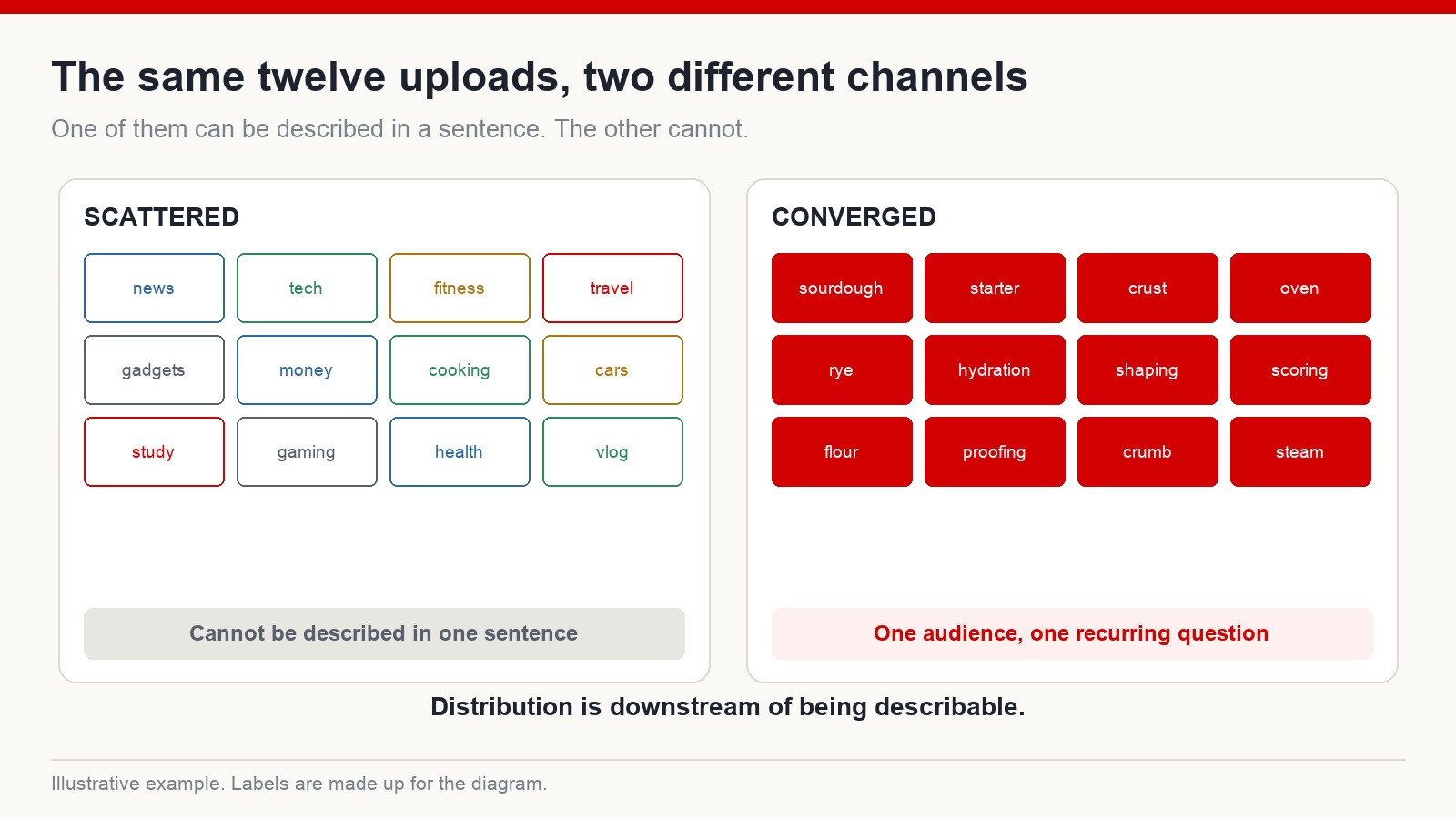
The explanation, when it finally arrived, was not about quality. It was that nothing about that channel could be described in a sentence. Not by me, not by a viewer, and not by the system deciding who to show it to.
Three things a scattered channel loses at once
The system has nothing to match you against
Distribution is a matching problem. The platform is trying to work out which existing audience your video belongs in front of, and it does that partly from the video and partly from everything the channel has published before.
Give it twelve videos on twelve subjects and the channel-level signal cancels out. Every upload starts from close to zero, testing into an audience the system has to guess at, because your history contains no usable pattern. You are not competing badly. You are being handled as an unknown, every single time.
A subscription stops being a decision
Someone finishes a video, likes it, and hits subscribe. What have they agreed to? On a focused channel, they know: more of this. On a scattered channel, they have taken a bet, and the next three uploads will probably not be what they came for.
The visible result is a channel where subscribers accumulate slowly and the ones you have do not turn up. That looks like an audience problem. It is a promise problem.
You never accumulate craft
This one gets discussed least and probably costs most. Making the tenth video about the same thing is a completely different job from making your tenth video about ten different things. The research gets faster, the sources are already open, the format is settled, and the improvements compound.
Switching subjects resets that every time. Six months in you have not made ten videos – you have made your first video, ten times.
The order most people get backwards
Underneath the scatter is usually a sequencing error. Make something, then hope somebody wants it.
Reverse it. Find where the appetite already is, then make for it. It is the difference between opening a shop and stocking it with whatever you personally like, versus stocking what people in that street keep asking for. The second is not cynical – it is the basic courtesy of paying attention to who you are serving before you start serving them.
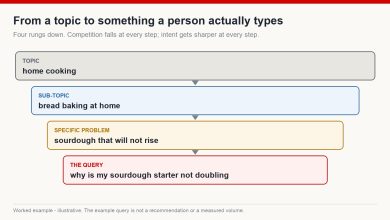
In practice this means the research happens before the camera does. What are people in this space actually searching for? What question keeps coming back in the comments under other people’s videos? What is being asked that nobody is answering properly? Those are cheap to find out and expensive to guess at.
But does a narrow channel cap how big you can get
This is the standard objection and it deserves a straight answer.
The audience you can actually reach is not the size of the interested population. It is that population divided by how well it is already being served. A huge subject with thousands of established channels leaves a newcomer almost nothing. A much smaller subject with nobody covering it properly can leave a newcomer everything that exists.
And narrowing is reversible. A channel with a clear identity and a real audience can widen later, carrying that audience with it. A channel with no identity cannot narrow retroactively – the history is already there, and it already says nothing.
The goal is not to be the biggest channel on the platform. It is to be the best available answer in one small room. That is achievable in a way the first thing is not.
Four questions before you commit
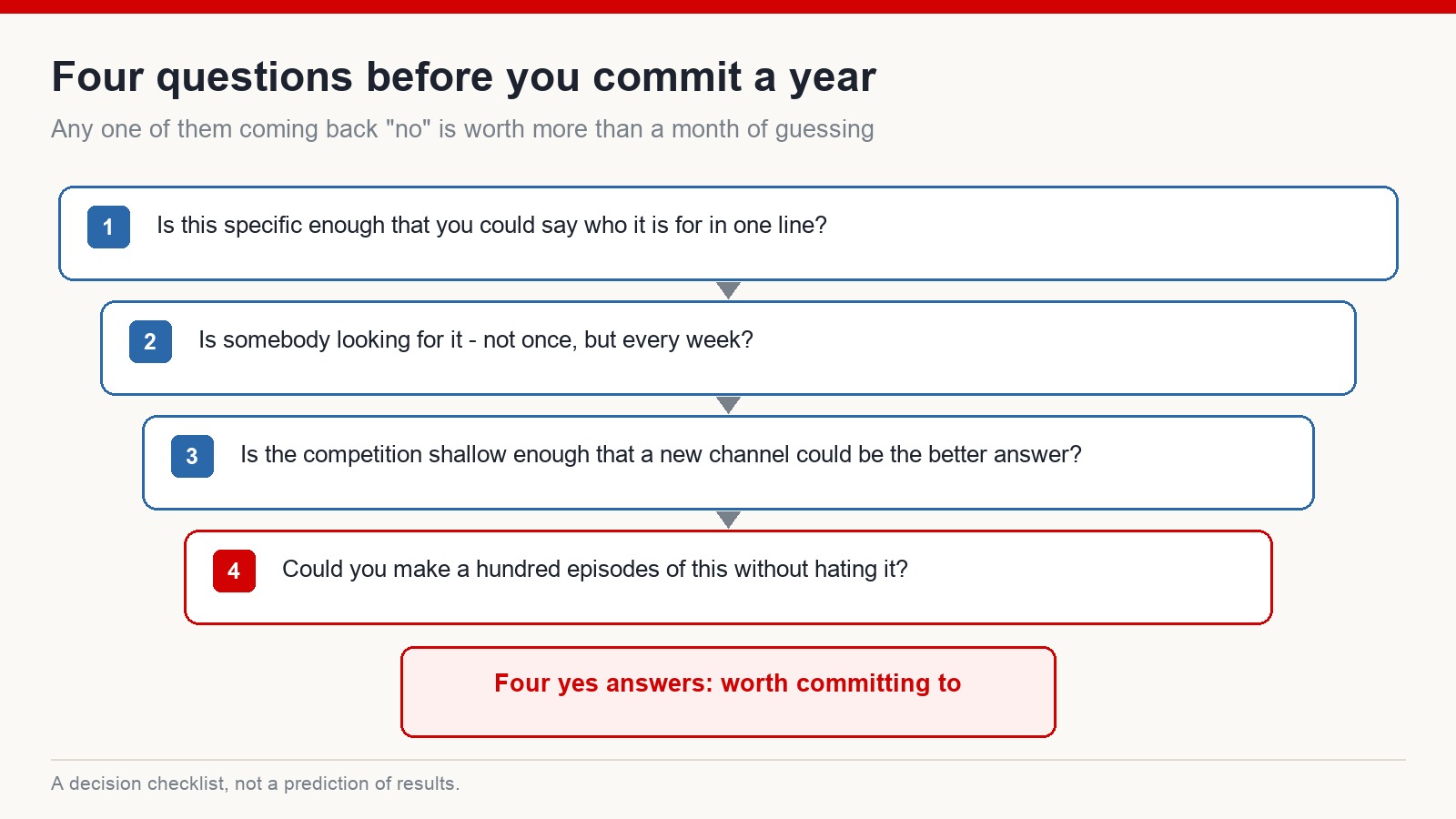
The last one is the one people skip and the one that decides most outcomes. A sub-niche that supports six good videos is a video idea, not a channel. Sketch what episode fifty looks like before you make episode one; if you cannot picture it, you have found out something important for the price of ten minutes.
The third question matters too, and it is worth being honest about. Prefer the phrase small enough that a channel with no history could plausibly be the better answer to it, rather than the largest phrase you can find. Big phrases are where the established channels already live.
If you are already scattered
Do not delete anything. Deleting old videos removes whatever watch history they were still generating and does not clean the signal the way people imagine it does.
Converge going forward instead. The channel’s identity is built from the bulk of what you publish, and the bulk is a rolling thing – it shifts as you add to it. Point the clear majority of new uploads at one recurring question and let the old material sit there. Within a couple of dozen uploads the recent pattern is unambiguous, which is what the classification is mostly reading anyway.
Expect it to feel worse before it feels better. Narrowing means giving up the occasional video that would have done fine on curiosity alone, in exchange for a channel that eventually gets distributed on purpose rather than by accident.
Where this leaves you
Nobody wins by publishing the most. The channels that grow are the ones where the person running them can say, without hesitating, exactly who it is for and what question it keeps answering. Everything else – thumbnails, pacing, upload frequency – works better once that sentence exists, and works poorly until it does.
Results vary, and platform behaviour changes. But being describable is not a growth tactic; it is the precondition for any of the tactics to matter.
If you want the fuller process for building faceless channels aimed at English-speaking audiences, it is set out at mmoyoutube.com.
Frequently asked questions
Does a narrow niche limit how many views a channel can get?
Less than people assume. Reach depends on how well the space is already served, not only on how many people are interested. A narrow, underserved subject can leave more room for a new channel than a large, crowded one.
Should I delete my off-topic videos?
Generally no. Deleting removes whatever value those videos still generate and does not reset how the channel is understood. Converging your future uploads shifts the pattern more effectively than removing the past.
How many videos before a channel reads as focused?
There is no fixed number, and anyone offering one is guessing. What matters is that the recent majority points the same way – a couple of dozen consistent uploads makes the pattern hard to misread.
Can I ever cover more than one subject?
Yes, once there is enough history for the channel to absorb it. The safe version is a clear majority inside the subject and a small minority testing outside it, rather than an even split between two identities.