Can You Spot a High-Earning Keyword Before You Publish?
The number that people mistake for money
Somebody opens a keyword tool for the first time, types in a subject, and finds a phrase with tens of thousands of monthly searches attached to it. The conclusion arrives immediately: this is the phrase that pays.
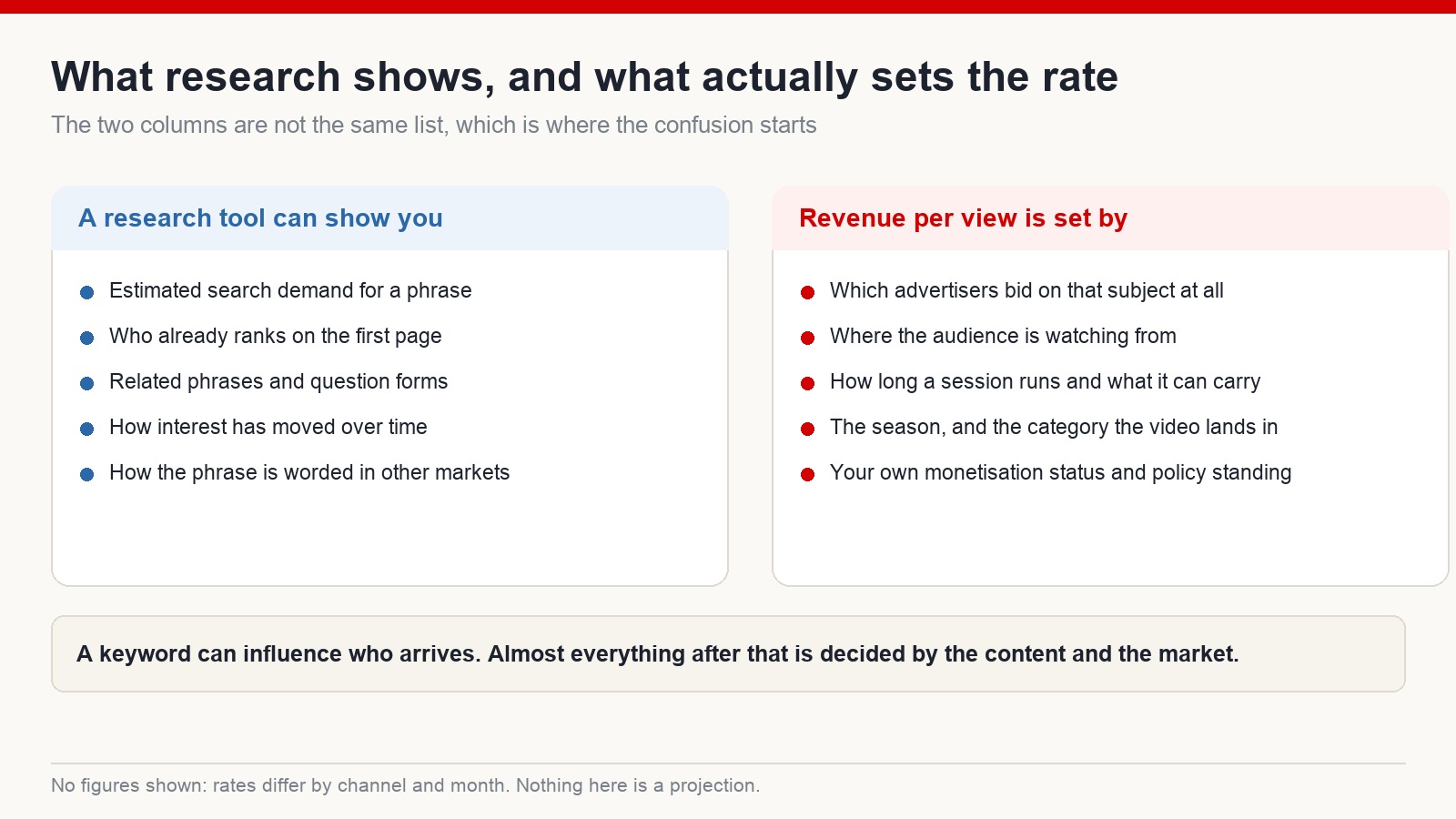
It is an understandable jump and it is the wrong one. Search demand and revenue per view are two unrelated measurements that happen to sit next to each other on the same screen. A phrase with heavy demand can bring an audience that is worth very little to advertisers. A phrase with modest demand can bring an audience that is worth a great deal, because of who those people are, where they are watching from, and what they do once the video starts.
The useful question is not how many people search for something. It is who is doing the searching, and whether your channel can serve them properly.
Start with titles that are already carrying a channel
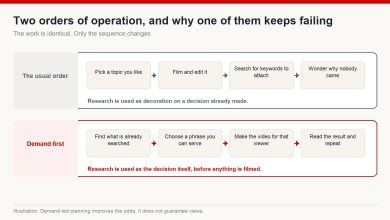
Guessing is the slowest possible research method, and there is a faster one sitting in plain sight: the channels already making a living in the niche you are considering.
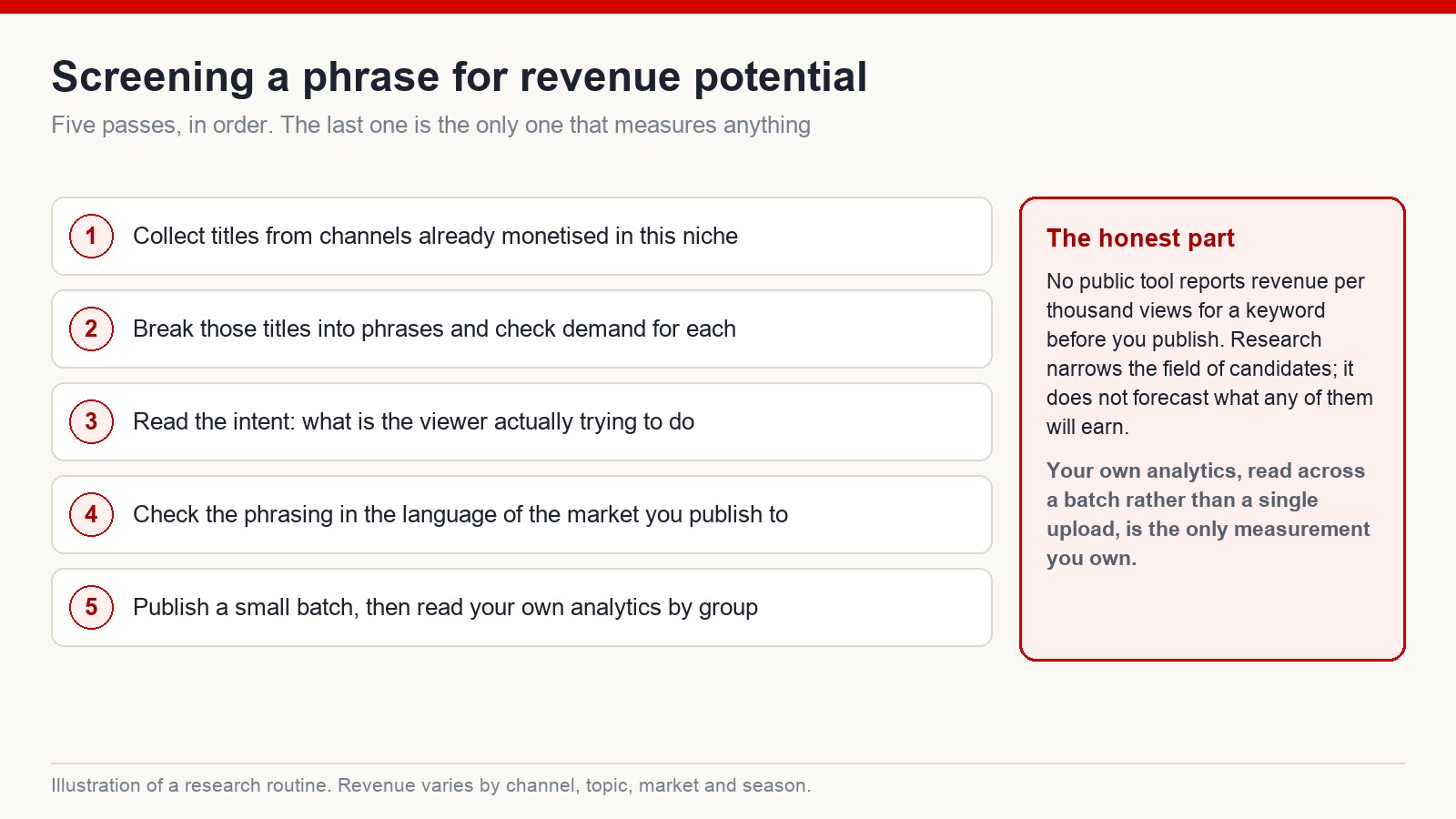
Find the ones that publish consistently and have been doing it for a while. Then read them the way an editor would rather than the way a fan would. Which phrases appear across many titles rather than one? What promise does the thumbnail make? How does the description open? What vocabulary do the same three or four videos keep returning to?
What you are looking for is not a title to copy. It is the shape of the demand underneath a set of titles — the words this audience uses when it describes what it wants. Copying a title gets you one video that resembles somebody else’s. Understanding the vocabulary gets you a list of candidates you can build on for a year.
Check the demand, then remember what you checked
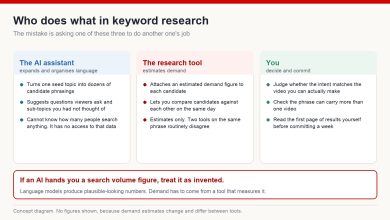
Once you have a handful of candidate phrases, put them through a research tool. Most of them — the browser extensions, the standalone keyword tools, the trends interfaces — will give you a reading on rough demand, some indication of how contested the phrase is, how interest has moved over recent months, and a list of neighbouring phrases you had not thought of.
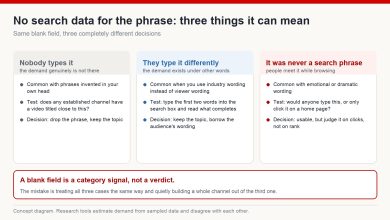
That is genuinely useful, and it is worth being precise about what it is not. These figures are estimates modelled from sampled data. Two tools looking at the same phrase on the same afternoon frequently disagree, and both revise their numbers over time. None of them is reporting a revenue figure for the phrase, because no such figure exists before a video has been published and watched.
There is also no confirmed demand band that produces better monetisation. Some creators prefer mid-sized phrases on the theory that they balance demand against competition, and that is a reasonable working heuristic rather than a discovered law. The only version of it that means anything is the one you calibrate against your own results.
Two phrases, the same demand, completely different people
This is the step most people skip, and it is the one that actually separates candidates.
Take two phrases with similar search demand. Funny cat compilation and relaxing nature sounds for sleep might sit close on a tool’s readout. The people behind them have almost nothing in common. One wants ninety seconds of amusement and will be somewhere else shortly afterwards. The other is opening something they intend to leave running for an hour, probably in the evening, possibly on a television.
Those two behaviours produce completely different sessions. Different watch lengths, different times of day, different device mixes, and different advertising contexts around them. None of that is under your control, but the phrase you choose is what decides which of the two groups turns up.
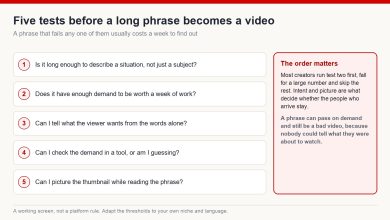
So when a phrase clears the demand check, ask the second question before you commit: what is this person actually trying to do, and can my content genuinely do it for them?
If you are publishing to another market, research in that language
Making content for an English-speaking audience while researching in your own language is a common and expensive mistake. Demand does not translate. The phrase people actually type in one market is often not the literal equivalent of the phrase used in another, and word order, plurals and slang all shift.
Research in the language of the market you are publishing to. Translation tools and language models are useful here for producing candidates, drafting titles and localising descriptions — and they are unreliable at telling you whether a phrase sounds natural to a native speaker. Check the wording against real search suggestions and real titles in that market before you build anything on it.
The only measurement you own
Everything above narrows the field. None of it measures anything. The measurement happens after publication, in your own analytics, and it needs to be read carefully.
The practical approach is to publish in small batches rather than one-offs. Group several videos around one keyword family, several around another, keep the production quality comparable, and then compare the groups rather than individual videos. Look at how many people clicked, how long they stayed, and what the revenue reporting says for each group over a period long enough to survive normal week-to-week noise.
Single videos are terrible evidence. Any one upload can outperform or collapse for reasons that have nothing to do with the phrase — a thumbnail that happened to work, a week when the whole category was quiet, an opening that lost people. Patterns across a group of videos, watched over a couple of months, are the smallest unit of honest information you can get.
The trap at the end of this road
There is a failure mode worth naming, because it catches people who have done everything else correctly: choosing a subject purely because somebody said it monetises well.
If you know nothing about the subject, cannot produce it consistently, and have no interest in learning it, the research advantage evaporates within a dozen videos. You will not be able to tell a good script from a mediocre one, you will run out of ideas, and viewers will notice the thinness before the analytics do.
The candidates worth pursuing sit where four things overlap: you can actually produce the content on a schedule, an audience genuinely wants it, there is stable rather than momentary demand, and the subject has some commercial context around it. Remove any one of those and the other three tend to stop mattering.
Frequently asked questions
Does high search volume mean higher earnings?
No. Demand describes how many people look for a phrase. What a view is worth depends on the subject, the market the audience is in, how long sessions run, seasonality and your own channel’s standing — none of which the demand figure reports.
Is there a tool that shows a keyword’s revenue rate?
No public tool can tell you what a phrase will earn before you publish. Estimates you see quoted elsewhere are inferences. Your own analytics after publication is the only figure that describes your channel.
Should I copy titles from channels that are doing well?
Study the structure and the intent behind them, then write your own. A copied title arrives with none of the trust the original had, and it caps you at being a slightly worse version of an existing channel.
Can AI tools help with research for other markets?
They are good for generating candidates, translating and drafting. They are not a substitute for checking that a phrase reads naturally to a native speaker and that real demand exists for it in that market.
How long before a keyword test tells me anything?
Longer than most people wait. Several videos per group, and enough weeks that a single unusual upload cannot dominate the comparison.
Research narrows. It does not predict
The honest summary is that keyword work improves your odds and forecasts nothing. It stops you spending a week producing something nobody was looking for, and it points you towards audiences that tend to be better served by the kind of content you can actually make.
What it cannot do is tell you what a phrase will earn. That answer only exists after you publish, in your own data, and it will differ from mine and from everyone else’s. Results vary by channel, subject, market and season, and platform behaviour changes without notice.
If you want the full process for building a faceless channel aimed at English-speaking audiences, that is what I teach at mmoyoutube.com.