Think Like a Media Company: The Context Strategy Behind Channels That Last
There is one mistake that shows up in almost every channel people send me to look at. It goes: find a topic that is clearly doing numbers, write a title with some tension in it, build a thumbnail that shouts, publish, and wait for the algorithm to make a decision about you.
Then you look at the channels that are still standing three years later – still earning, still expanding into new formats – and you notice they are not playing that game at all. They are not optimizing videos. They are optimizing the whole environment the videos live in.
That is the difference between a creator and a small media company, and it is mostly a difference in the question being asked. The first asks how do I get this video seen. The second asks how do I make this channel something a platform is comfortable recommending for years.
I have been building faceless channels since 2017, aimed mostly at English-speaking, German and Japanese audiences. Every durable result I have had came from the second question. Here is what actually goes into it.
The majority rule: you are judged on the body of work
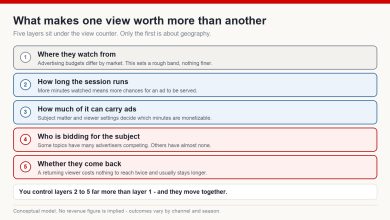
Nothing about a channel is decided by one upload. The systems that distribute your videos are reading a pattern across everything you have published: what subject you keep returning to, who watches it, how consistently it behaves, and whether the whole library looks like something safe to put in front of strangers.
This is why a single breakout video so often changes nothing. The video worked. The channel around it still reads as unclear, or unstable, or as five different channels wearing the same avatar.
So the practical unit of strategy is not the video. It is the mix.
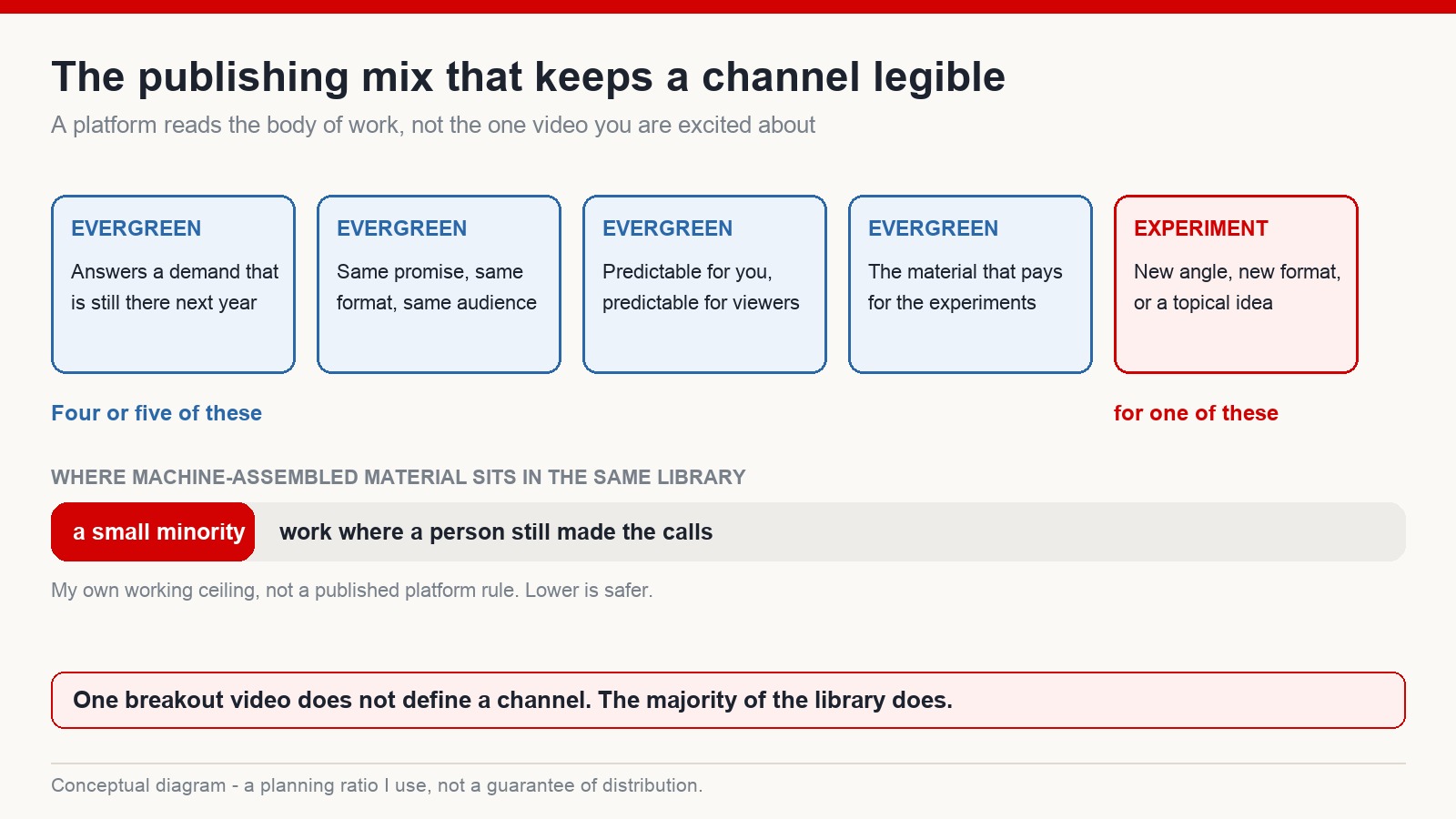
The ratio I plan around is four or five evergreen pieces for every experiment. Evergreen means the subject answers a demand that will still exist a year from now – the same promise, the same format, the same audience each time. The experiment slot is where a new angle, a new format or a topical idea gets tested without putting the channel’s identity at risk.
Two things happen when you hold that ratio. The channel stays legible, so the recommendation system always has a clear idea of who to show it to. And you still get to take swings, because four predictable videos are what pay for the fifth unpredictable one.
Where AI belongs inside that mix
Generative tools genuinely compressed production. Scripting, voice, editing assistance, translation – all of it is faster than it was, and pretending otherwise is silly.
But if the entire library carries the same machine fingerprint, whatever advantage the speed gave you evaporates, because everyone else has the same speed. What is left to distinguish you is judgement, and judgement is the one part that does not come out of a tool.
My own working ceiling is that fully machine-assembled material stays a clear minority of what a channel publishes. That is my rule, not a published platform policy – and lower is safer than higher. The rest is work where a person chose the angle, the structure and the examples, even if a tool helped execute it.
Platform rules on this move, and they have moved several times. Anything I could tell you about the current wording would age badly, so read the policy yourself before you build a workflow on top of an assumption.
Research the market with two witnesses, not one
Most topic research is a single anecdote: someone saw one big channel doing something and copied it. That tells you the subject worked for that channel, at that size, at some point. It does not tell you whether a newcomer can get in.
Start with an established channel in the niche – big enough that its results are clearly not luck. Pull its twelve strongest videos and resist the urge to analyse them individually. Tally them instead. If half of those twelve sit on one specific theme and the rest scatter across three others, the tally just told you where the demand actually is, and it is usually narrower than the channel’s own description of itself.
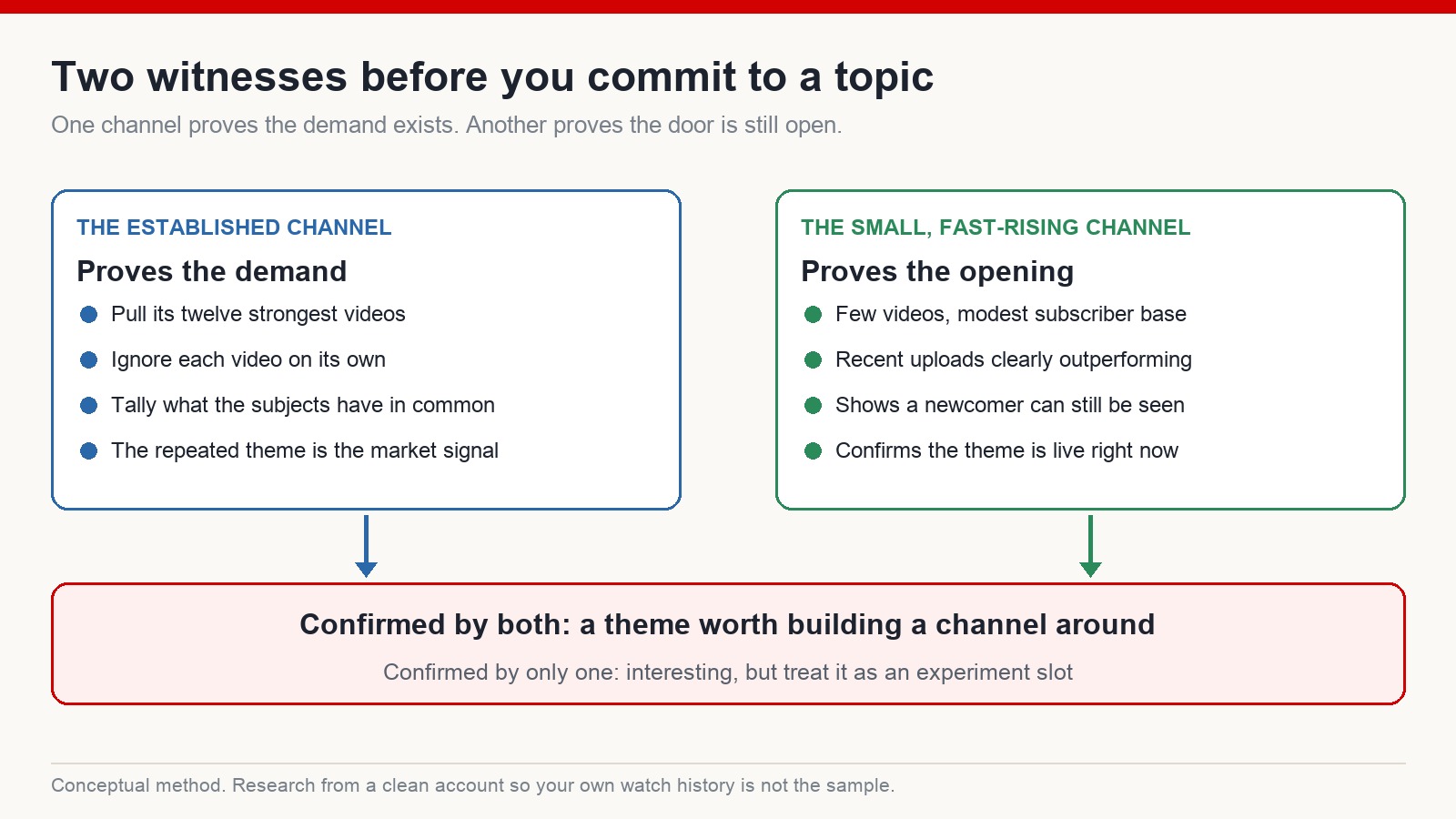
Then go looking for the second witness: a small channel, few videos, modest subscriber count, whose recent uploads are clearly outperforming its size. That channel is evidence of something the big one cannot give you – that the door is still open right now.
When both agree, you have a theme worth committing a channel to. When only one does, treat it as an experiment slot rather than a foundation.
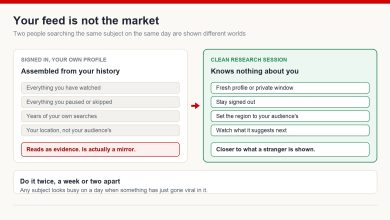
One practical note that changes the quality of everything above: do this research from a clean account. If you browse a niche on the account you use every day, the recommendations you see are partly a mirror of your own history, and you end up studying yourself rather than the market.
The funnel runs backwards from what beginners assume
Creators spend hours on the edit and minutes on the packaging, which is exactly the wrong way round given how the decision is actually made on the other side.
Nobody arrives at your video by way of your topic. They see the thumbnail, and in something under a second they decide whether the video is worth existing for them. Only then do they meet the content, and only after that do they form any opinion about the subject as a whole.
Thumbnail, then video, then topic. If the packaging does not answer a want the viewer already had, the rest of your work never gets assessed at all.
The related mistake is spending the drama too early. It is tempting to front-load every dramatic moment into the first ten seconds, because everyone has been told the opening is everything. But a video that peaks at second eight has nowhere left to go, and the retention graph shows it. Open with enough tension to earn the next minute, build, and keep your strongest moment for where it does the most good.
Brand is context you can control
The last layer is the least exciting and the most neglected. A strong channel is not remembered as a set of videos, it is remembered as a name attached to a subject.
A naming system helps more than a clever name does. Something like [brand] Wildlife, [brand] Rescue, [brand] Stories – one brand word plus the theme – gives every future channel and playlist a slot to fit into, and means that when someone searches your theme, more than one thing you own can turn up.
Then keep the presentation still. If the brand word is capitalised, capitalise it the same way everywhere: not one spelling in the channel name, another in the banner, a third in your descriptions. Tags are the exception – lowercase is the convention there, and consistency in casing matters less than consistency in the terms themselves.
None of this affects distribution directly. It affects whether a viewer who liked one video can recognise you the next time you appear, which over a couple of years is worth more than any single optimisation.
The parts only matter together
Most people are competing on production speed right now. It is the obvious thing to compete on when tools keep getting faster.
The channels I would bet on are competing on system: an evergreen core, a controlled amount of experimentation, market evidence from two independent sources, packaging built for how the decision is actually made, and a brand consistent enough to accumulate.
Run those together and a video stops being a lottery ticket. It becomes one more link in something that was already working before you published it, and will still be working after that video has stopped being interesting.
Nothing here guarantees an outcome. Platform behaviour changes, niches saturate, and plenty of well-built channels never take off. What a system does is make your results legible enough to learn from, which is the only compounding advantage actually on offer.
Frequently asked questions
Is context strategy just a fancy way of saying titles and thumbnails?
No. Packaging is one layer. The strategy also covers what proportion of your library is evergreen, how you gather market evidence, how much machine-assisted work you allow, and how the brand stays consistent across everything.
Can I build a channel entirely with AI tools?
You can produce one. Whether it grows is a different question, and platform policy on machine-generated material has changed repeatedly. I keep such material a minority of the library and read the current rules before relying on any workflow.
Why look at small channels at all if big ones are already succeeding?
A big channel proves demand existed. A small one rising quickly proves a newcomer can still be seen today. The first tells you about the market, the second tells you about your odds.
How long before this approach shows anything?
Longer than most people want. The point is not a faster result but a readable one – after twenty videos built to a consistent plan, you can tell what worked. After twenty scattered videos, you cannot.
If you want to see how this thinking is applied end to end on channels built for English-speaking audiences, that is what I work on at mmoyoutube.com.