Same Video, Different Title, Different Viewers: How YouTube Title Research Sorts Your Audience
For years I wrote titles the way most people do. I stared at the box until something sounded good, deleted it, typed it again, swapped a word, swapped a number, and published whichever version I was least tired of arguing with. Some of those videos did well. I could never explain why, which meant I could never do it again on purpose.
What replaced that habit is far less romantic, and it changed more for me than any headline formula ever did. I stopped asking whether a title sounded good and started asking a colder question: which group of viewers does this line put the video in front of?
A Title Is a Sorting Instruction
Nobody reads your title as a sentence. Viewers scan it in a fraction of a second, and the platform never sees a sentence at all — it sees phrases, and it matches those phrases against what people type into the search bar and what people with similar habits have watched before.
Which makes a title behave less like a headline on a magazine cover and more like a label on a shelf. It does not persuade anyone from a distance. It decides which shelf the video sits on, and therefore which shoppers walk past it in the first place.
That reframing has a practical consequence. If the phrases in your title describe a demand nobody has, the video is offered to a crowd with no reason to click, and the click-through rate you see afterwards is not a verdict on your thumbnail. It is a verdict on your sorting.
The Same Video, Two Different Rooms
Take a wildlife edit — slow footage, ambient sound, twenty minutes long. Call it Wildlife Compilation and it gets shown to people who want highlights: chases, kills, dramatic rescues. They arrive, find no action in the first fifteen seconds, and leave. Retention collapses, and the video looks like a failure.
Call the identical file Peaceful Wildlife Moments for a Quiet Evening and it goes to a different room entirely: people winding down, people who leave something on in the background, people looking for a mood rather than an event. Nothing about the video changed. The audience it was sorted into did.
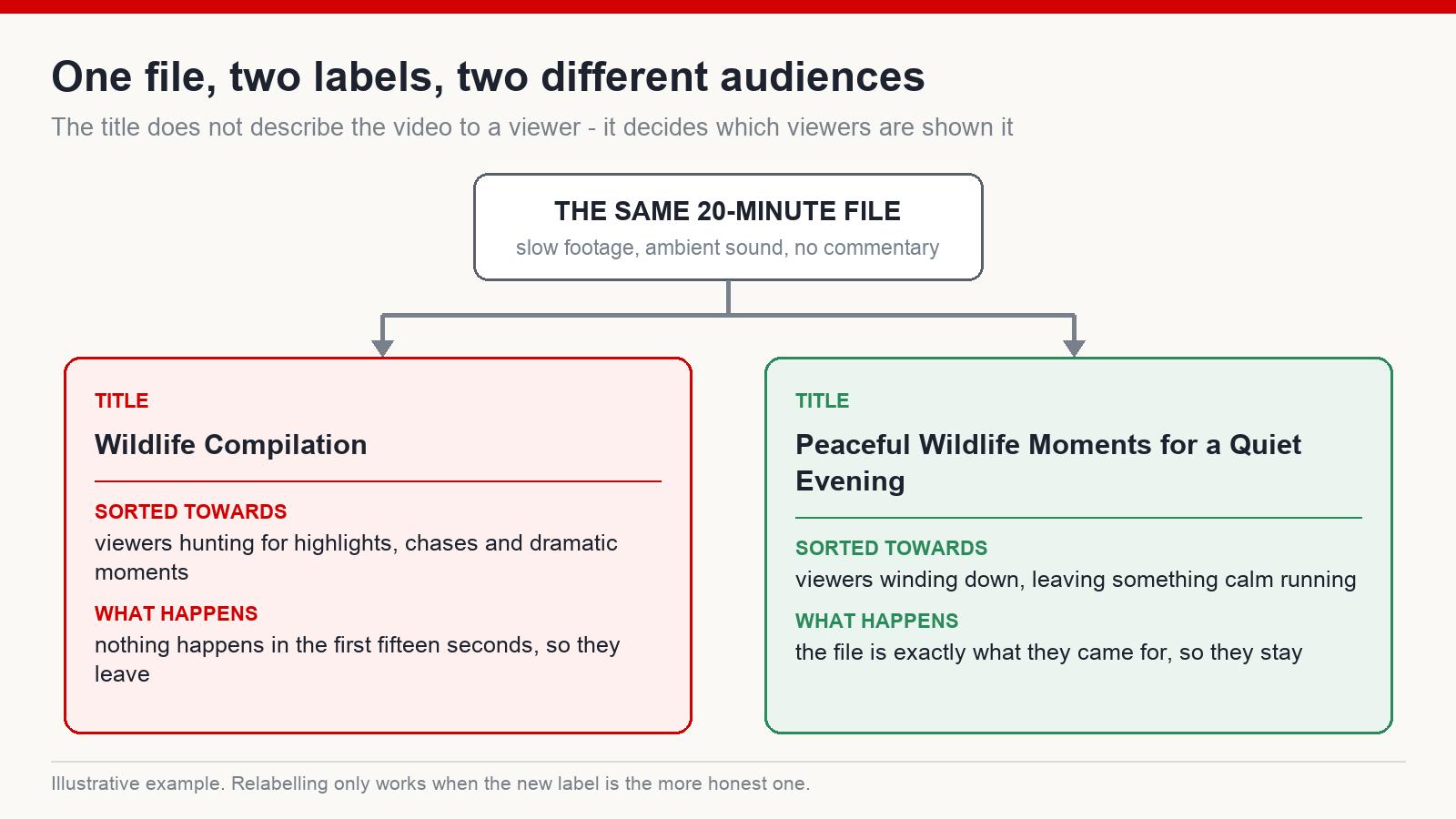
I want to be precise about what this is and is not. It is not a trick for making weak videos travel. It only works when the new label is more honest than the old one. If your footage really is fast-cut action, calling it peaceful will destroy your retention faster than a bad thumbnail ever could. Repackaging fixes a mislabel. It cannot fix a mismatch.
Every Phrase in a Title Is a Separate Door
Once you see a title as a sorting instruction, you start reading the strong ones piece by piece. A line like 10 Peaceful Wildlife Moments for Deep Relaxation is not one idea. It is four or five doors bolted together: peaceful wildlife, wildlife moments, deep relaxation, relaxing nature, peaceful moments. Each door leads in a different crowd.
The first time I broke down titles in a nature niche, I assumed the phrases carrying the weight would be the subject words — wild animals, animal rescue, wildlife stories. They were not. The phrases with steady demand behind them were the mood words: peaceful, calm, relaxing, tranquil. The subject was almost incidental.
That tells you something you cannot get from a thumbnail: it tells you which shelf you are actually on. If the demand behind your video is a mood rather than a topic, your competition is not the other animal channels. It is ambient music, rain sounds, fireplace loops and sleep tracks — different formats, same shelf.
Type the Phrase Back Into the Search Bar
Most people stop the moment they find a phrase they like. The step that actually pays is the boring one: type that phrase back into YouTube and read the first two screens as if you were the viewer.
Three things are worth writing down while you scroll. First, the words that keep reappearing in other people’s titles that were not in yours — those are the vocabulary of the demand. Second, the formats being served: footage, music, narration, long static scenes, short edits. Third, and most useful, what is missing. A demand with ten near-identical videos and no version at the length, time of day or setting you can produce is an opening.
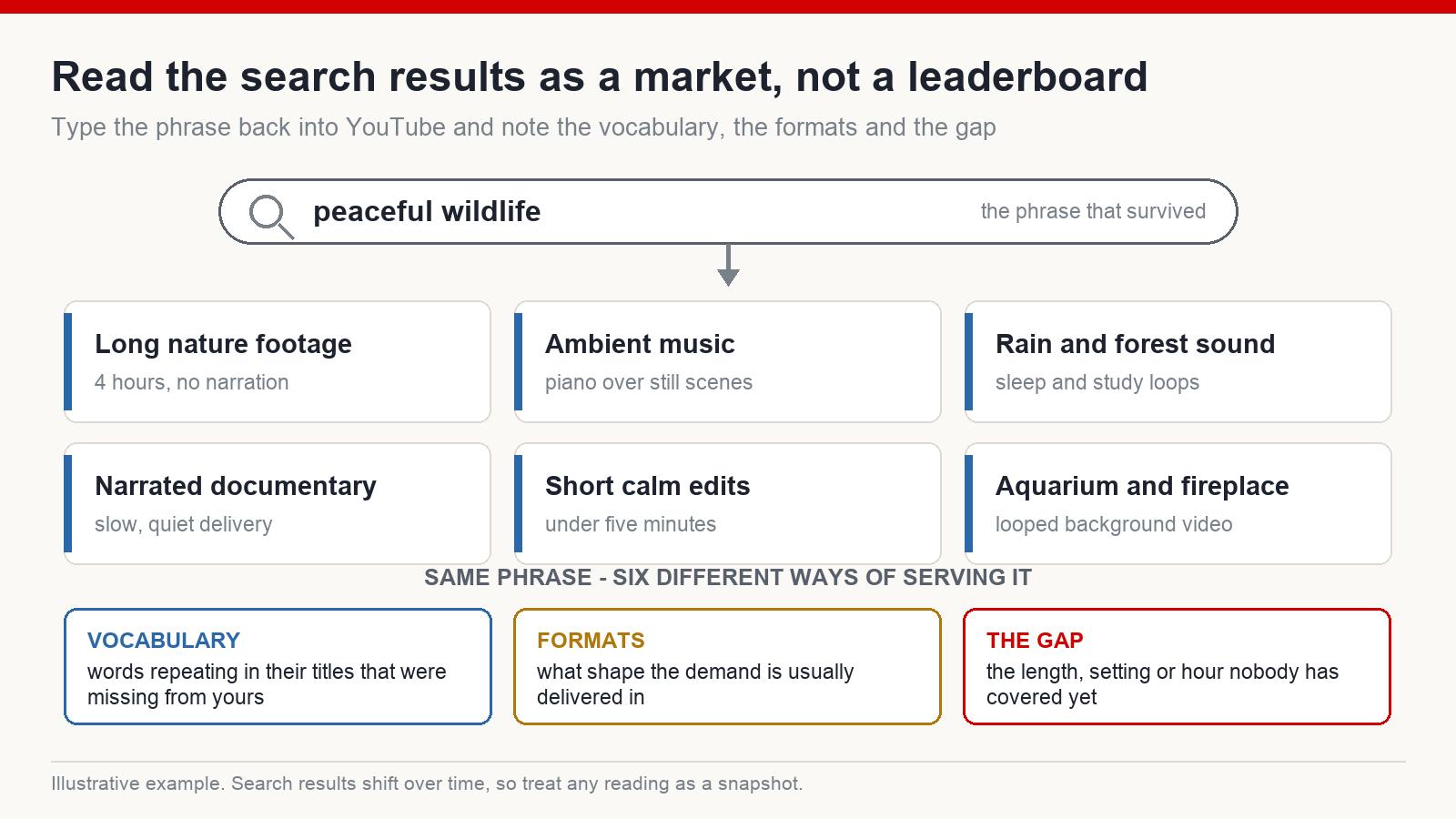
At that point you are no longer researching a video. You are reading a small market: who serves it, in what language, in which formats, and where the thin spots are.
From One Phrase to a Content Line
A phrase that survives that check is worth more than a single upload. This is where the whole exercise stops being about titles and starts being about a library.
Once a demand is verified, I plan a run of videos around variations of it rather than a one-off: different lengths for different uses, different settings, different times of day, different intensities of the same mood. Six to ten videos on one verified demand builds something a scattered upload schedule never does — a channel that a viewer, and a recommendation system, can recognise as being about something.
The alternative is what most new channels do: thirty videos, thirty unrelated guesses, no accumulated signal, and no way to tell which guess was the good one.
A Repackaging Test You Can Run This Month
You do not have to take any of this on faith. Pick one older video whose content you genuinely stand behind but whose title you wrote by feel. Rewrite the title around a phrase you have checked, and change only that — not the thumbnail, not the description, not the tags. One variable.
Then compare against your own baseline rather than anyone else’s numbers: the median views of your last ten videos over a comparable window. Give it a few weeks, and read the result carefully. An older video is past its initial push, seasons move demand around, and one test proves very little on its own. Run it three or four times on different videos before you trust the pattern, and expect results to vary.
The Honest Answer About RPM
Creators I work with often ask whether this raises RPM. Rewriting a title does not raise RPM by itself. What advertisers pay is driven by who is watching, where they are, what the subject is and how much ad inventory a video can carry — not by the words in the title.
The link, where there is one, is indirect. If a new phrase genuinely brings in a different audience, that audience may sit in a different advertising market, which can move the number in either direction. Treat that as a possible side effect worth observing, never as a plan. Chasing phrases purely because they are rumoured to be lucrative usually costs you relevance, and relevance is the thing that was working.
Where AI Speeds This Up
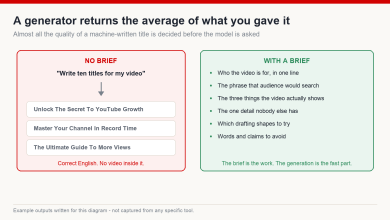
AI is genuinely useful in the mechanical parts of this: breaking a batch of titles into phrases, suggesting related wording you would not have thought of, grouping phrases into clusters, and generating title variants once you have decided on the angle.
What it cannot do is judge. It does not know your channel’s baseline, has not seen your footage, and cannot tell you whether the phrase it just produced describes the video you actually made. It shortens the work. It does not make the decision.
The Short Version
- Treat the title as sorting, not decoration — it decides who is offered the video
- Break strong titles into phrases and notice which kind of phrase is carrying the demand
- Search the surviving phrase and read the results page as a market, not a leaderboard
- Turn one verified demand into a line of videos instead of a single upload
- Test one rewrite at a time against the median of your own last ten videos
Beginners ask how to write a better title. People building a library ask what words their audience is already using to look for something. Those are different questions, and over a few hundred videos they produce very different channels.
Is breaking down competitor titles the same as copying them?
No. You are reading their titles for the demand underneath, then writing your own line for your own video. Copying a title wholesale gives you a name that already belongs to someone else and tells the viewer nothing new.
How many phrases should one title carry?
Usually one clear demand phrase and one human reason to click. Stacking four keyword phrases into one line reads like a machine wrote it, and viewers scroll past machine-written titles as fast as they scroll past bad thumbnails.
Can I change the title of a video that is already performing well?
I would leave it alone. Rewrites are for videos that never found their audience. When something is working, the sorting is already correct.
Does this work outside faceless channels?
Yes. The method is about how people search and what they want to feel, not about what kind of channel you run, so it transfers to tutorials, health, technology and personal channels just as well.
If you want to see this run end to end — niche selection, demand research and packaging for a channel aimed at an English-speaking audience — that is the workflow I teach at mmoyoutube.com.