YouTube Engagement On A Faceless Channel: How To Earn Real Comments (And What Gets Channels Removed)
Most people who start a faceless YouTube channel for an English-speaking audience believe the same thing I once did: if the content is good, the views will come. That is true, but it is only half the story.
I have watched a lot of genuinely good videos die quietly. Decent script, clean edit, solid footage – and a comment section with three replies, two of them from bots selling something. A few weeks later the video has stopped being recommended at all. Meanwhile another video, no better made, collects hundreds of comments in the first afternoon. The difference is almost never luck. The second creator understood what actually triggers a viewer to type something.
I have been making YouTube content since 2017, and for years now the channels I build and teach are faceless ones aimed at viewers in the US, the UK, Germany and Japan. This is what I have learned about YouTube engagement – what earns real comments, what the five-step chain behind them looks like, and which popular shortcuts will get a channel wiped out.
Why engagement matters more than the raw view count
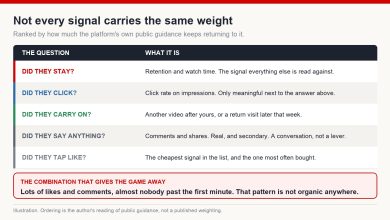
When someone comments, replies to another comment, likes, or shares, they are telling the platform something a view alone cannot: this made me react.
YouTube does not only count how many people opened a video. It reads how they behaved once they were there – whether they stayed, whether they came back, whether they went on to another video, whether they bothered to respond. A video that produces a feeling usually produces engagement, and a video that produces engagement usually gets shown to more people.
For a faceless channel chasing an international audience this matters even more, because your audience pool is enormous and completely undifferentiated at the start. YouTube has no idea who your video is for. Strong early response signals are one of the fastest ways it works that out. Nothing here is a guarantee – recommendation behaviour changes and results vary by niche – but the direction is consistent enough to plan around.
Engagement does not start in the comment section
This is the single biggest reframe I can offer. After analysing a lot of English-language faceless channels, mine and other people’s, I stopped thinking of comments as a thing you ask for at the end. Comments are the last link in a chain, and every link before them has to hold.
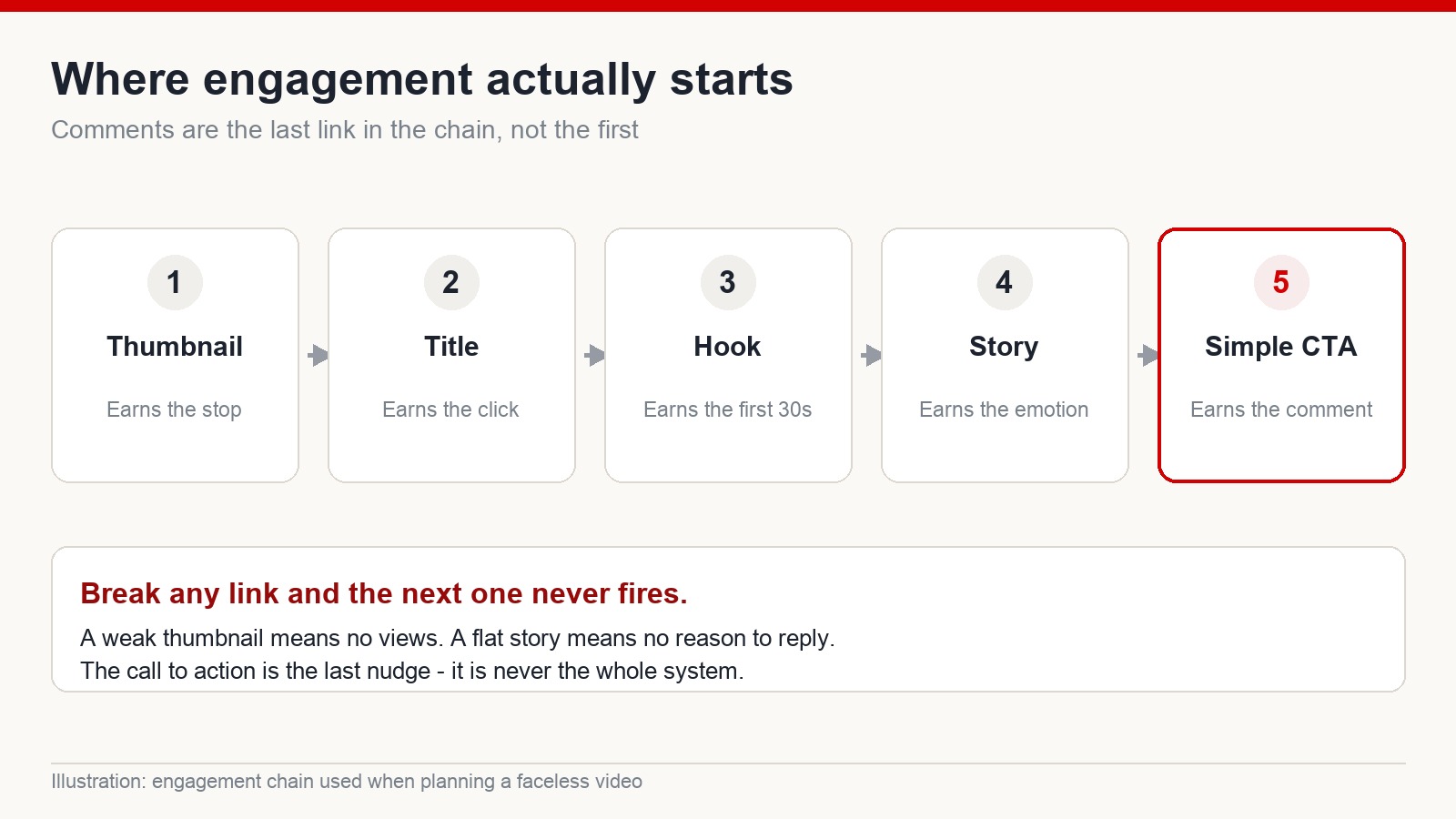
If the thumbnail does not make someone stop scrolling, there is no view. If the title does not resolve the curiosity the thumbnail created, there is no click. If the first thirty seconds wander, there is no watch time. If the story never makes anyone feel anything, there is nothing to say. The call to action at the end is a nudge on a viewer who is already leaning forward – it is not a magic phrase that works on a viewer who has already checked out.
So when someone tells me their comment section is dead, my first question is never “what is your CTA?” It is “what happens at second twenty-five?”
The simple call to action: make the ask cost one second
That said, the ask itself is worth getting right, and it is the thing most creators get wrong through pure habit.
Why the standard outro fails
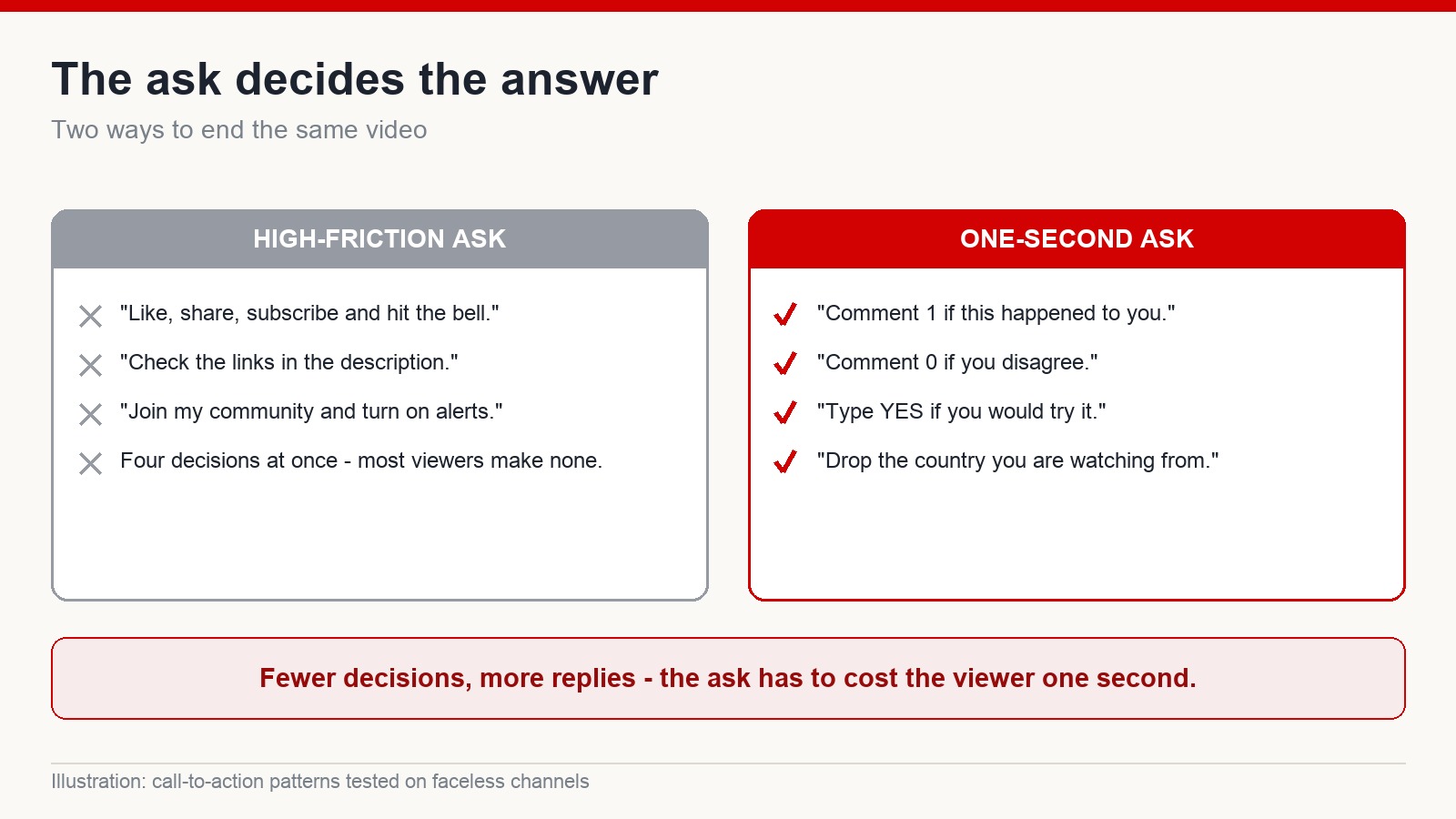
The default ending – “don’t forget to like, share, subscribe and hit the notification bell, and check the links in the description” – asks a viewer to make four or five decisions in eight seconds. Faced with that many choices at once, most people make none. It is not laziness. It is friction.
Asks that take one second
The alternative is an ask so small that saying yes is easier than ignoring it:
- “Comment 1 if this has happened to you.”
- “Comment 0 if you think I am wrong.”
- “Type YES if you would actually try this.”
- “Drop the name of the country you are watching from.”
No thinking required, no sentence to compose, no opinion to defend. That last one is especially useful on a faceless channel with an international audience – people genuinely enjoy planting a flag, and it tells you where your viewers actually are, which is information you cannot get any other way at that speed.
One caution: the ask has to match the video. A light “comment 1” line under a serious piece reads as cheap and can cost you more trust than the comments are worth. Put the ask where the emotion already is.
A comment is the last step of an emotion
A video that gets people talking usually walks them through a sequence of states rather than presenting information flatly.
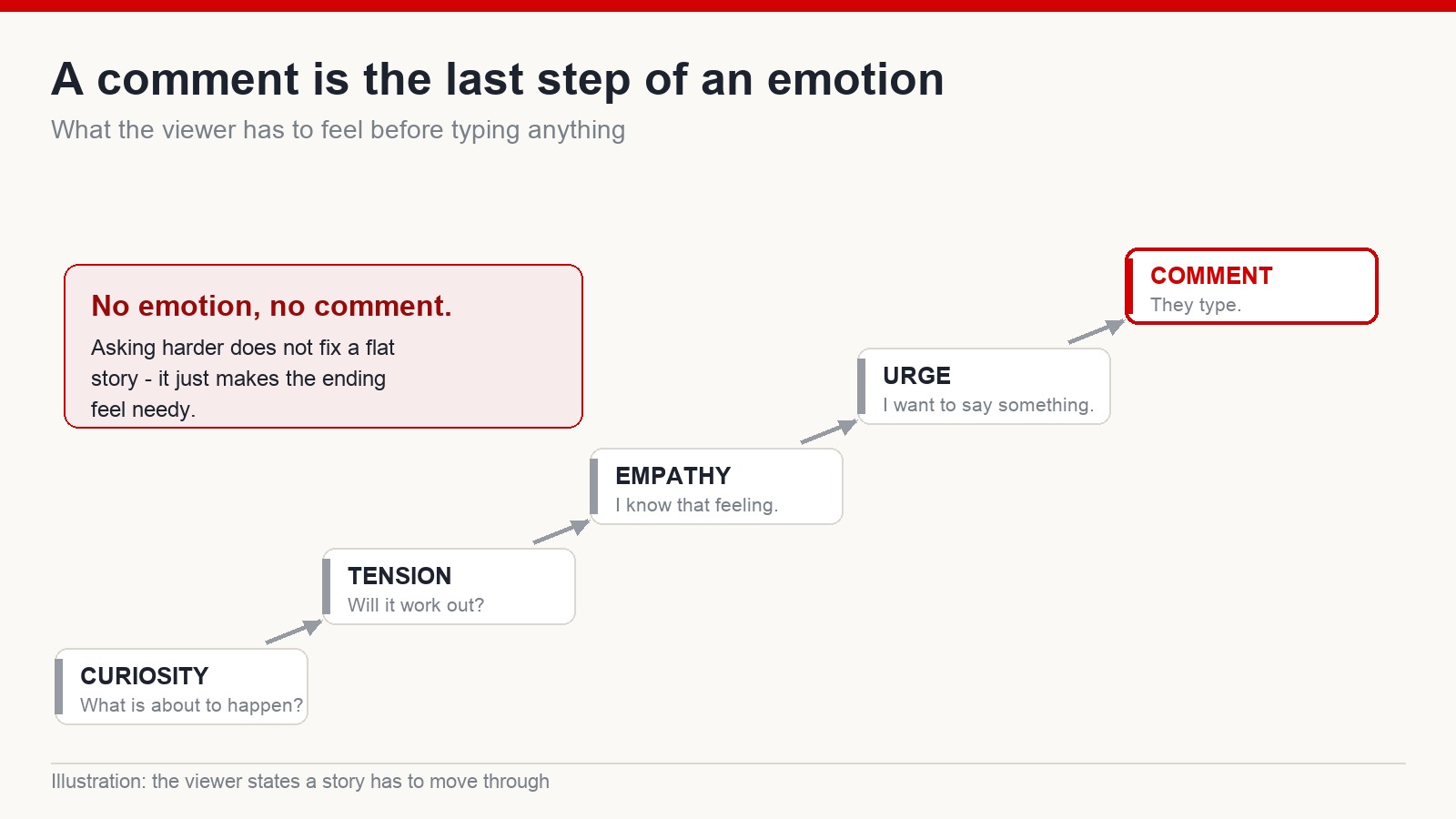
Curiosity first – what is about to happen here? Then tension – is this going to work out? Then empathy – I have felt that. Then the urge – I want to say something about this. Only then does anyone open the comment box. If you want more YouTube engagement, the first job is not writing a better ask, it is building a script with enough of a curve in it that the viewer arrives at the end with something unspent.
Say it, show it
One small production rule does more for this than anything else: the picture has to match the sentence. If the narration says “the snake struck without warning”, the frame on screen at that moment must be the strike – not a generic shot of jungle. Every time the audio and the image drift apart, the emotional charge leaks out. On faceless channels built from stock or licensed footage this drift is constant, because it is far easier to grab an approximate clip than the exact one. Resist it. Tight audio-visual sync is one of the clearest differences I see between a faceless channel that grows and one that plateaus.
Before you publish: get the channel ready properly
A lot of new creators build a channel and start uploading the same hour: no banner, no about section, no idea what the audience in that niche expects. Then they change the name twice in a week and wonder why nothing lands.
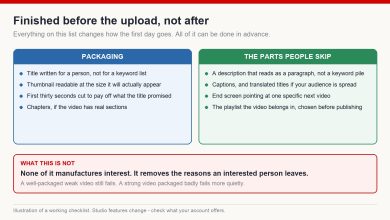
The useful preparation is unglamorous. Finish the profile – name, description, banner, links, a channel trailer if it fits. Then spend real time in your niche as a viewer: watch the top videos end to end, read their comment sections, notice which questions keep coming up and which phrasings get replies. That reading is not busywork. It is where the specific, concrete calls to action come from – the ones written in the audience’s own language rather than in translated marketing English.
What I am describing is research and setup, not signal manufacturing. Which brings me to the part of this topic people usually want a shortcut for.
The engagement shortcuts that get channels removed
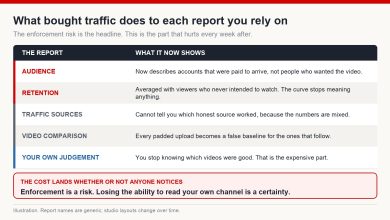
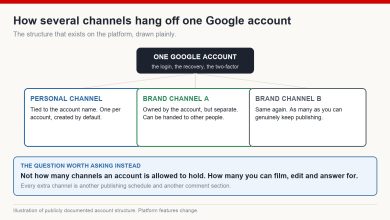
There is a whole category of advice built around producing engagement that no real viewer produced: buying comments, running a network of secondary accounts to seed likes and replies under your own uploads, joining pods where members agree to comment on each other’s videos regardless of interest, or buying an established channel with a large subscriber count in an unrelated topic and repurposing it.
I am not going to explain how to do any of that, because it is the fastest way I know to lose a channel.
YouTube’s spam and deceptive practices policies treat artificially inflated metrics as fake engagement. Enforcement is not theoretical: engagement obtained this way can be stripped out, videos can be removed, and channels can be terminated. Bought comments and pod comments also poison the data you need – your topic looks validated when it is not, and you keep making videos for an audience that does not exist. The purchased-channel version fails for a plainer reason: subscribers who signed up for something else do not watch, so the channel carries a large number and a dead audience, which is worse than starting clean.
If you have already gone down this road, the cleanup is straightforward. Stop buying immediately – one purchase does not usually end a channel, but a pattern does. Delete the fake comments you can see and mark the obvious spam accounts. Leave the pods. Then publish for a while with no external push at all so you can see what your real click-through rate and retention actually look like. That baseline is uncomfortable and it is the only honest place to build from.
The five-step engagement stack
When I plan a video now, I check the same five things in the same order:
- Thumbnail – creates the question.
- Title – promises the answer without giving it away.
- Hook – earns the first thirty seconds.
- Story – builds curiosity, tension and recognition.
- Simple call to action – converts the feeling into one second of typing.
And then a sixth thing that is not really a step: answer the comments. On an international faceless channel this is where a lot of creators quietly give up, especially when replies arrive in a language they do not speak. Translation tools handle this well enough now that there is no excuse for silence. A short, specific reply to an early comment often pulls a second and third comment out of the same person, and it makes the section look alive to everyone who arrives later.
Frequently asked questions
What is a simple call to action?
An ask that requires almost no effort or thought – typing a single character, a single word, or the name of a country – as opposed to a list of instructions at the end of a video.
Do comments actually help a video grow?
Comments are one of several signals that show how an audience responded to a video. They are not a lever you can pull on their own, and they matter less than whether people watched.
Should every video end with a request for comments?
Not automatically. Match the ask to the tone of the video. A misplaced one costs you more credibility than the extra replies are worth.
What matters more than the call to action?
The story and the packaging around it. If the video never creates interest, no ending line will rescue it.
Is it safe to ask viewers to comment a specific word?
Yes. Asking your own audience to respond is normal creator behaviour. What crosses the line is generating that response artificially, through purchased comments, bots or accounts you control.
Where to start
Next time you finish a script, do not jump straight to writing the outro. Ask instead: what will the viewer feel at the last frame? If the honest answer is “nothing much”, the ending line is not the problem, and no amount of asking will fix it. Build the feeling first, then make the response cost one second.
If you want the full workflow I use for building faceless channels aimed at English-speaking audiences, that lives on mmoyoutube.com. Results vary, platform policies change, and nothing on a channel is guaranteed – but the chain above is the part you control.