Your Channel Is Flat Because You Skipped Steps, Not Because You Are Bad At This
One in the morning, a hundred videos, a flat line
Past one in the morning. On the screen is a folder holding more than a hundred videos, each one several evenings of cutting until your back hurt. And the graph in the analytics page is a straight horizontal line, as though it has never learned how to point upward.
You are not lazy. You have not missed a week. You had a real career before this and you were good at it. And you have been improving as you go – adding something here, fixing something there, making each video a little better than the last thing you learned. The channel has not moved.
Then the sentence arrives, at the hour when there is nobody left to perform being fine for: maybe I am just not good at this. Maybe I do not have whatever it takes.
I have sat next to someone on exactly that night. I have also been the person in that chair, more than once, in the years before any of this worked. So let me say the thing I end up saying to almost every room I stand in front of.
Nobody here is stupid. What is happening is that almost none of you are following the process. That is the single biggest reason this does not work.
Nine years on this platform, most of them spent teaching it, and I have never once met someone too dim to do the work. Not one. What I meet, over and over, is a written process that nobody follows all the way through.
The thing keeping your channel flat is not inside your head. It is in the gap between the process you were handed and what you actually do on a Tuesday evening. This article is about that gap: what it is, why it eats your work, and how to close it.
The wrong diagnosis, and a test with four pens
I run an exercise in workshops that looks like a children’s game. Four pens on the table. Arrange them in this order: red, blue, black, green. That is the whole task. No thinking, no creativity, no ability required.
A surprising number of people get it wrong.
Not because they are incapable. In that room are people who have run offices for a decade, people who have run businesses, people better at their old trade than I am at mine. A child could order four pens. The difficulty is not in the task.
What happens is that they glance at the instruction, register roughly what it is asking, think yes, got it, and then arrange the pens by feel. That is the whole failure, and it is your channel in miniature.
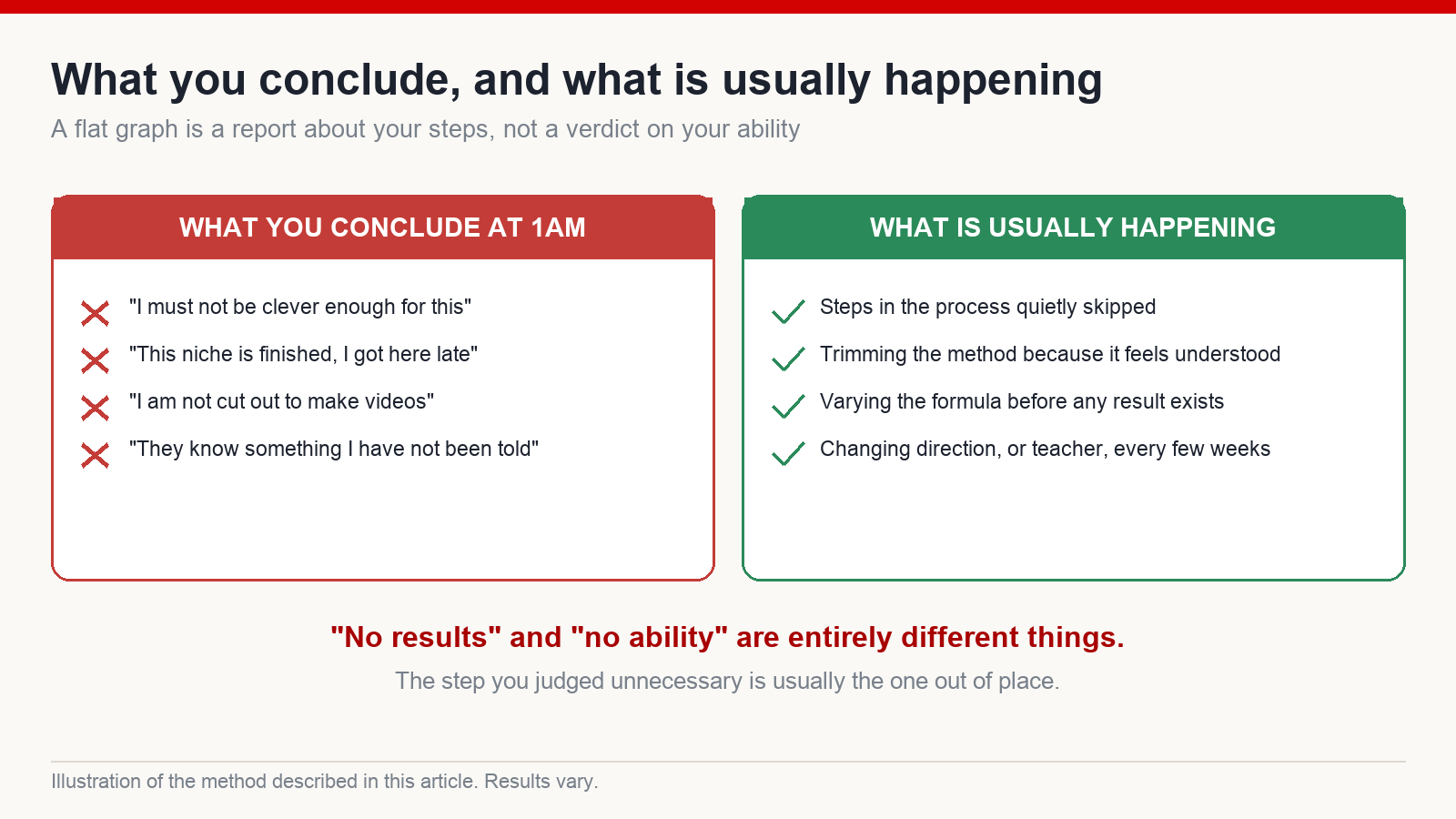
Hold on to this, because it unties the knot: no results and no ability are entirely different things. A flat channel is not a verdict on you. It is a report that some steps got skipped, or done at half effort.
So before you spend another night interrogating your own worth, ask the plainer question. Across the last few dozen videos, did you do every step, in the given order? Or were there steps that struck you as unnecessary, or fussy, or beneath you – which you quietly dropped?
That step you judged unnecessary is, nine times out of ten, the blue pen you put in the wrong place.
The quiet saboteur: believing you have already got it
Here is something I did not expect when I started teaching. The people who come apart earliest, and hardest, are usually not the beginners. They are the ones who were already good at something else before they arrived.
The reason makes sense once you see it. You study for a week, a month, you notice you are picking it up faster than the person next to you, and a very calm voice says: right, I understand this now. From there you start trimming steps and adjusting the process to your own taste. The professional identity that fed you for years turns into the rock in the road.
I call it the illusion of already knowing. It does not shout. It just murmurs that you have enough, which is all it needs to do to get you loosening bolts on a machine that was running.
The cure is simple and hard to swallow: reset to zero. Put the ego down. Learn like someone who knows nothing. You were an editor, a writer, a good operator in some other arena – fine. Put the medal in a drawer for now.
Because the harder sentence is this one: what you think is good is frequently not what the audience wants. The overwhelming majority of people I have worked with are making the thing they like, and calling it audience research. That is not a jab. It is the trap. We routinely mistake our own taste for somebody else’s need.
So, honestly: the video you just cut – did you make it for yourself or for the person watching? Somebody on the other side of the world does not care what you used to be good at. They stay if what you put in front of them is the thing they were looking for.
Premature variation: taught one, you do one and a half
The illusion of already knowing breeds a second disease, quieter and more common, and I see it in nearly every hard-working creator.
Think back to the person at the top of this article, up at one in the morning with a flat graph. Not lazy – the opposite. So diligent that every single week they improved something. Taught one thing, they did one and a half. The following week something looked like it could be better, so they made it two.
That is where it dies. I call it premature variation, and it comes from misplaced diligence rather than laziness. You learn a formula, you have not run it enough times to understand why it works, and you are already seasoning it to taste. This video takes half of the method and half of your own instinct. The next one changes the mix again. The result is noise. Nothing gets repeated enough times to produce a readable signal, so you never learn which parts worked – and you go on changing things in the dark, forever.
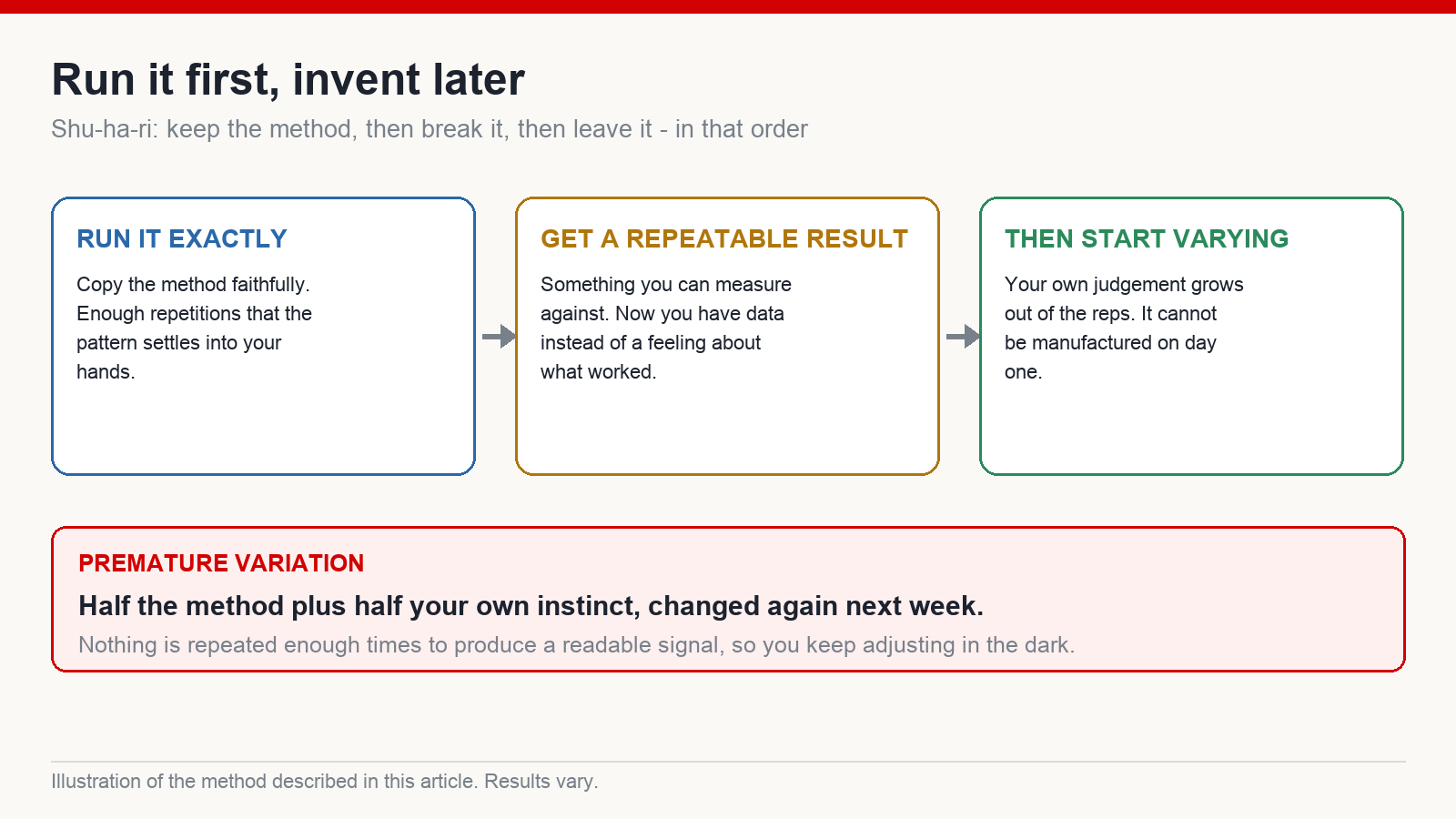
The line I repeat: run it first, invent later. Follow the method exactly until the channel produces something repeatable, and only then start varying. Not because originality is bad, but because without data you genuinely cannot tell whether you are innovating or vandalising.
Japanese craft training has a name for this – shu-ha-ri, roughly “keep, break, leave”. In the first stage you do exactly one thing: copy faithfully. Copy, repeat, accumulate enough reps that the pattern settles into your hands. Your own judgement grows out of that stage. You cannot manufacture it on day one, no matter how clever you are.
So the honest question: have you run one method correctly and enough times, or did you get bored after a handful and change it? I am not promising that repetition produces views or income – nobody can promise you that. I am saying it is the precondition. Without it, everything downstream is guesswork.
A printed checklist beats your own willpower
Now the awkward truth about human beings, and it includes me. There is a built-in resistance to process. You write ten steps. Today you do all ten. Tomorrow you do eight. By next week you are down to five, and nothing dramatic happened in between.
It is not laziness. The mind quietly hunts for shortcuts, and any step that has started to feel familiar is the first thing it drops. Which is why you should not trust your memory, and you certainly should not trust your willpower. Willpower is the most fragile substance in the building: full in the morning, empty by evening. What survives the evening is a machine and a piece of paper taped where you can see it.
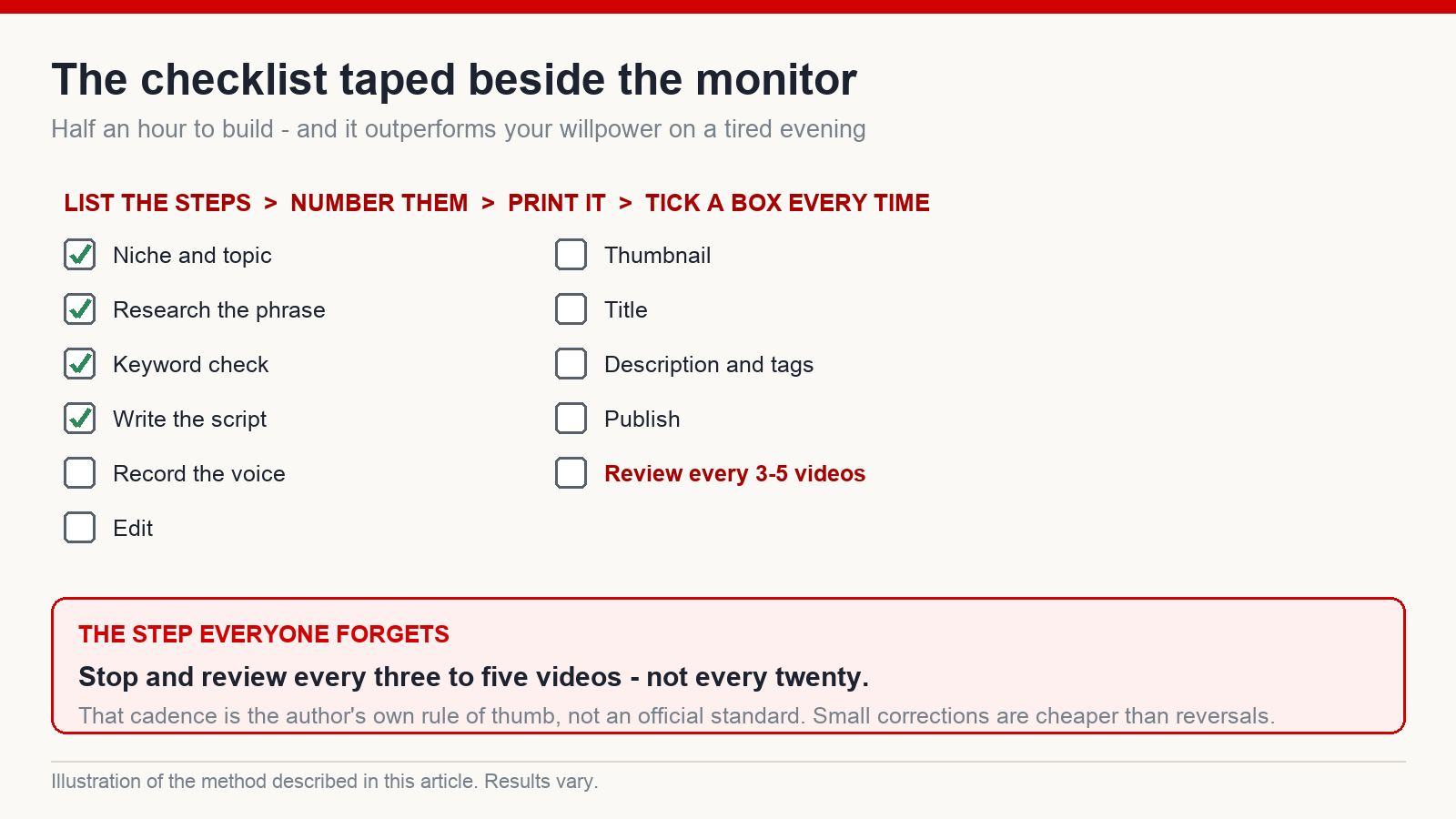
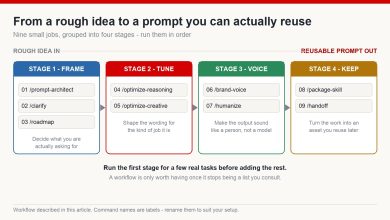
Half an hour of work, today. Open an empty file and list every step involved in producing one video – niche, research, keyword, script, edit, thumbnail, title, description, publish. Messy order is fine. Then get a language model to tidy the list into a sequence and number it. Print it. Tape it beside your monitor, in the place your eye lands first when you sit down. From now on, finish a step, tick the box.
It sounds trivial. That small tick is what keeps you on the rails on the evening you are tired and would otherwise skip three things and tell yourself it made no difference.
There is one more kind of discipline almost everybody forgets: the discipline of stopping to look. Do not put your head down and produce twenty, fifty, seventy videos before you look up at what the audience is doing. By then the error is baked into everything and it is not fixable. Put a line at the bottom of the checklist: every three to five videos, stop and review – what are viewers responding to, where am I drifting. Three to five, not twenty. That number is my own rule of thumb rather than anything official, but small corrections are always cheaper than a full reversal.
Too many teachers
One more trap, and almost every beginner falls into it, including the diligent ones. No results yet, but five or six different courses saved on the laptop. In the morning one teacher says build the channel this way; that evening another says do the opposite. Each is right within their own system. You stand between them nodding at everything and completing nothing.
Collecting teachers while you have nothing working is not studiousness. It is a very comfortable way of never starting.
Knowledge does not become yours by being understood. It becomes yours when you do it, get it wrong, and fix it. And to get it wrong in a way that teaches you something, you have to run one direction long enough to find out where it breaks.
My own version: three or four years on one niche, one core subject. I took hits and kept going. Only when the hits stopped did I have anything I would call experience. Not talent – just a refusal to switch roads every time the current one got dull.
You have heard the folk rule that only a small minority of people who start anything actually finish. Whether the ratio is exact hardly matters. What is worth saying plainly is that which group you land in is not fate and not aptitude. It is a choice, made repeatedly. Pick one teacher, one direction, and walk the whole road. You can choose again today.
Three pillars, and the human at the end of the line
All of it compresses into three words.
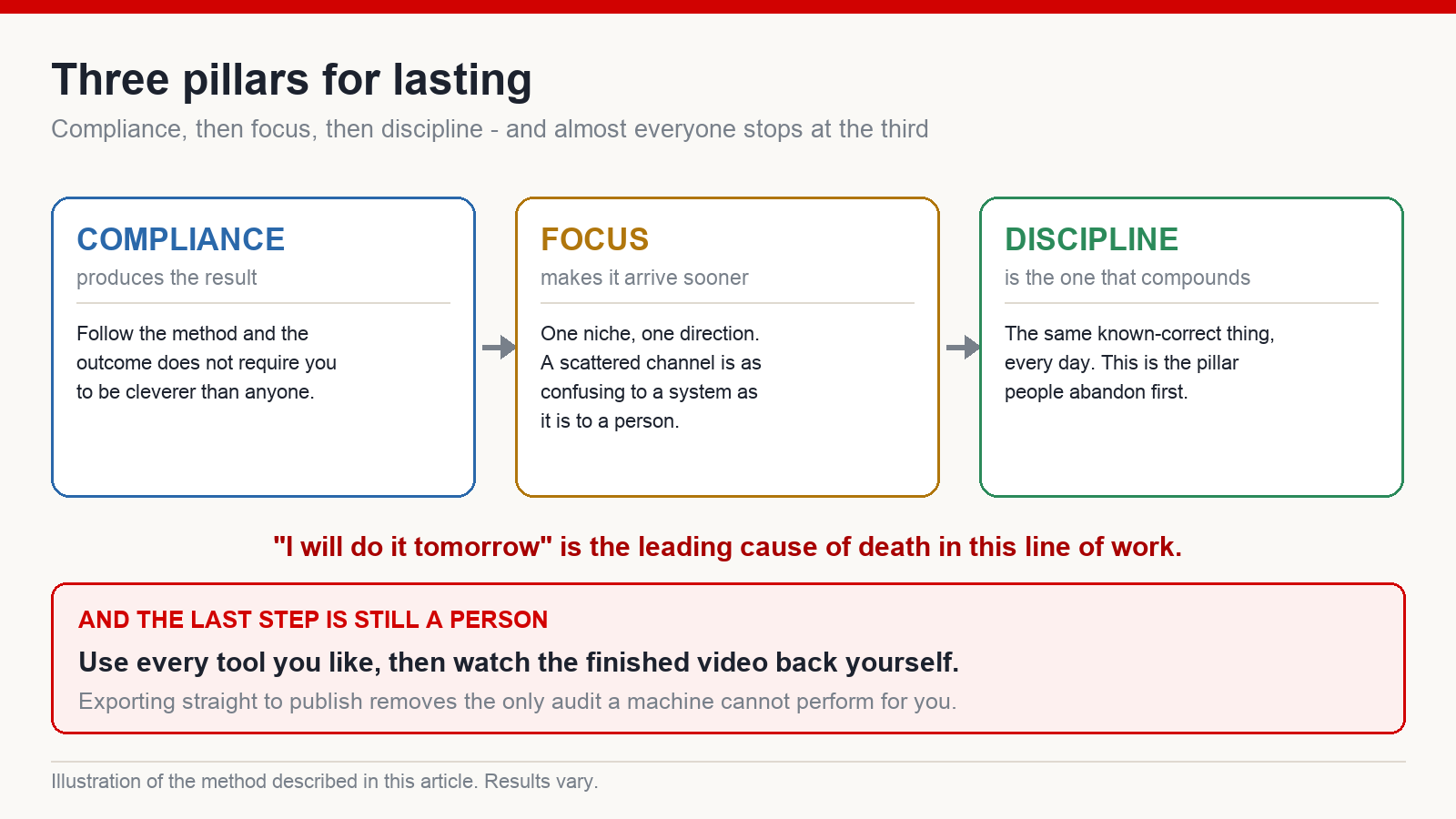
Compliance produces results – follow the method and the outcome does not require you to be cleverer than anyone else. Focus makes them arrive sooner – one niche, one direction, nothing scattered. And discipline – doing the same known-correct thing every day – is the only one of the three that compounds. “I will do it tomorrow” sounds harmless and it is the leading cause of death in this line of work. Success is quick. Staying successful is the difficult part.
One fear worth addressing before you close the tab: being made obsolete by automation. Use the tools. Use all of them, as much as you like. But the last pass belongs to you. Watch your own video back and work out where it is weak, instead of exporting and publishing blind. The human is the final step in the line, and that is not sentiment – it is the only part of the process a machine cannot audit for you.
Which brings me back to the person at one in the morning, staring at a hundred videos and a flat line. If they stopped improving things, reset to zero, printed one page and worked through it box by box, the story reads differently. That sheet of paper taped beside the monitor is an unglamorous object, and it is the strongest thing in the whole build.
So if you do one thing today: open an empty file, write down the process you are supposedly following, number the steps, print it, tape it up. That is it. If you want a structured English-language programme to hang that discipline on, that is what I run at mmoyoutube.com – it is a frame for consistency, not a promise about views or income, and this work stays unpredictable no matter how well you run it.
You are not bad at this. You need a process, and enough discipline to reach the end of it.
How many videos before a channel starts to move?
There is no golden number, and anyone who gives you one firmly is selling hope. The thing worth counting is not videos – it is whether you have repeated one method correctly enough times to read a signal from it. Stop and review every three to five videos rather than producing dozens before you look up.
Should a beginner copy a proven formula or try to be original?
Copy, at the start. That is the first stage of shu-ha-ri: hold to the method, run it enough times that it settles, and let your own judgement emerge from the reps. Run it first, invent later – do not start varying before the channel has produced a result you can measure against.
Is a faceless channel still viable now that automation does so much of the work?
It is, provided you keep the human at the last step. Use the tools to move quickly, then review the finished video yourself and know where it is weak rather than exporting straight to publish. I am not guaranteeing outcomes – those depend on your niche and your persistence – but process and discipline are what let you last long enough to find out.
Why do experienced professionals often struggle more than complete beginners here?
Because competence in one field arrives with an ego attached. You pick things up quickly, conclude you have understood, and start editing the process to taste before you have run it. Beginners have no such shortcut available, so they follow instructions – which, at this stage, is the advantage.
What goes on the checklist?
Every step you actually take to produce one video, in order and numbered: niche and topic, research, keyword, script, edit, thumbnail, title, description and tags, publish. Then one final line that is easy to forget – stop and review every three to five videos. Print it and tick the boxes; the point is to survive the evenings when your memory and your motivation have both gone.