Most People Use AI to Draft. Almost Nobody Uses It to Think.
Watch how most people actually use an AI assistant. Write this email. Outline this post. Shorten this paragraph. All of it is output – and all of it sits downstream of a decision that was already made.
The expensive work happens upstream. Why is this actually broken? What am I assuming that might be wrong? Who does this hurt that I have not asked? Get those wrong and the best-written email in the world is still sending the wrong message.
The reel behind this article puts it bluntly: most people use AI to draft, and almost nobody uses it to think. And when they do, they ask one loose question and take the first answer. No structure, no pushback, no second pass. That is not analysis. It is a shortcut wearing analysis as a costume.
From one loose question to real analysis
The fix, as the reel says, is not a better model. It is a better question – and then a willingness to argue with the answer.
| 1. Structure → | 2. First answer → | 3. Push back → | 4. Second pass → | 5. Decide |
|---|---|---|---|---|
| A structured prompt Name the method: root cause, assumption audit, scenarios |
Read it as a draft Not as the conclusion |
Challenge it What did you assume? What would prove this wrong? |
Run it again With the objections and any missing facts added |
You choose Then, and only then, ask for the email or outline |
| The shortcut: “Why are my views down?” |
The shortcut: Takes the first plausible reason |
The shortcut: Skipped |
The shortcut: Skipped |
The shortcut: Acts on a guess |
Step one is where the twenty prompts in the reel help: each names a specific method, so the answer has a shape instead of being a paragraph of general advice. Steps three and four are where most of the value is, and no prompt list can do them for you.
Twenty prompts, six questions
Twenty is a lot to remember. Grouped by what they are for, they come down to six questions – which is a much easier list to reach for when a problem lands on your desk.
| Family | Prompts from the reel | The question underneath |
|---|---|---|
| Why it happened | Root cause analysis; Performance diagnostic; Data pattern detection | What is actually causing this, not just what it looks like? |
| What you are assuming | Assumption audit; Argument deconstruction; Bias and blind spot check | Which beliefs does this rest on, and which are weakest? |
| Who it affects | Stakeholder impact analysis; Sentiment and tone analysis | Who gains, who loses, and how will it land? |
| What could go wrong | Risk assessment; Scenario planning; Trend extrapolation | What are the plausible futures, and what are the early warning signs? |
| Which option wins | Comparative analysis; Pros and cons, weighted; Cost-benefit breakdown; Decision framework application; SWOT analysis | Given the criteria, which choice holds up best? |
| Where you stand | Competitive positioning; Before and after gap analysis; Categorisation and clustering; Content or copy critique | Where are we now, where do we want to be, and what is in the way? |
Each prompt in the image follows the same pattern: name the method, say exactly what to produce, and leave a bracket for your material – [insert problem], [insert data], [insert decision]. As with any copy-paste prompt, the bracket decides the quality. One vague sentence in, one vague analysis out; we covered why in the one part that decides whether a prompt works.
The post this came from
Watch the reel
Twenty Claude prompts for analysis, in one image. Posted on the BANI Academy page.
The pushback is where the thinking happens
A structured prompt gets you a better first answer. It is still a first answer. The step that turns it into analysis is arguing with it, and a handful of follow-up lines does most of that work:
- “What did you assume that I did not tell you?” This exposes the gaps the model filled with averages.
- “What evidence would prove this conclusion wrong?” If the answer is “nothing you could check”, the conclusion is weaker than it sounds.
- “Rank these by how confident you are, and say why.” A flat list of five causes hides which one actually matters.
- “Argue the opposite case as strongly as you can.” If the opposite case is nearly as convincing, you do not have an answer yet.
Then run the second pass: the original prompt again, with the objections and any missing facts added. The difference between the first and second answer is usually the most useful thing you learn. If you run these follow-ups often, save them as one-word shortcuts – the setup is in save once, call in one word.
Which prompt for which channel problem
Most of the twenty were written for business in general. Here is where they earn their place on a YouTube channel.
| Channel problem | Prompt to run | What to put in the bracket |
|---|---|---|
| Views dropped this month | Performance diagnostic, then root cause | Paste the real Studio numbers, not your memory of them |
| Two video ideas, one slot | Comparative analysis or weighted pros and cons | State your criteria first: search demand, effort, fit with the channel |
| A title you are unsure about | Content or copy critique, then bias and blind spot check | Ask what a first-time viewer would misunderstand |
| Trying a new format | Scenario planning and risk assessment | Ask for the warning sign that would tell you to stop |
| A competitor is overtaking you | Competitive positioning | Describe what you actually see on their channel, not guesses |
| Comments turned negative | Sentiment and tone analysis | Paste the comments; ask what the complaint is underneath |
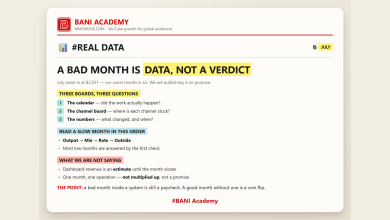
The first row is the one people most often get wrong, because it is where a loose question is most tempting. “Why are my views down?” with no data gets you a list of every possible reason. The real numbers get you an answer; how to read them without panicking is in reading YouTube Studio and a bad month is data.
Where analysis prompts mislead
A structured prompt makes an answer look rigorous. That is useful, and also a risk. A SWOT table with confident bullet points reads like expertise even when half of it is generic filler. Three habits keep it honest.
Give it real material. A data pattern prompt with no data will describe patterns anyway. Always paste the actual numbers, comments or document – never ask it to analyse what it has not seen.
Keep the decision. The model can lay out the options and the trade-offs. Choosing between them depends on things only you know: your audience, your energy, what you are willing to risk. The same line runs through agents research, you decide.
Check what it claims about the outside world. Trends, competitors and market figures can be stated with confidence and still be wrong. Treat them as leads to verify, not findings. Sometimes, too, careful analysis will point at the right answer and the result still disappoints – which is not a failure of the method, as we found in the research was right and the video still failed.
Frequently asked questions
Do these prompts only work in Claude?
No. They are plain structured instructions, so any capable assistant can run them. The reel names Claude because that is where they were written.
Which one should I learn first?
Root cause analysis or the assumption audit. Almost every other problem starts with one of those two questions.
Can the model analyse my YouTube data?
Only the data you paste in. It cannot see your Studio account unless you connect it, and it should never be trusted with numbers it has not been shown.
How do I know the analysis is good?
It survives the pushback. If “argue the opposite” is just as convincing, keep digging.
Run one before your next draft
Next time you are about to ask an assistant to write something, stop one step earlier. Pick the family that matches the problem, paste the real material into the bracket, push back once, and run the second pass. Then ask for the draft.
The draft will be easier to write, because you will finally know what it is for.
Learning a lot does not make anyone good. Doing a lot does.
If you want the structure that turns that into a habit, that is what our free challenge is built for: no barrier to entry, a genuine commitment to action, and a refundable commitment fee you get back when you finish. You are not paying for the knowledge. You are betting on yourself finishing, and we hold the stake.
Which one would you run first? Tell us on the original reel – comment “ANALYZE” there and we will send you the full-size version of all twenty.
For more on building channels for English-speaking audiences, that is what we work on at mmoyoutube.com.

3 Comments