Scared to Post Your First YouTube Video? Here Is What Actually Happens
Some evenings I sit and watch the light go out of the sky. I am not doing anything clever with it. Not checking analytics, not opening the dashboard, not thinking about the next upload. Just watching the last of the day come down, and asking myself the same question.
If today were the last day I was allowed to begin something, what would I begin?
I ask it because tonight it gets dark again whether or not I did anything, and so does tomorrow. That is the whole of it. Nine years into building channels for English-speaking audiences, the thing I am most sure of is not a tactic. It is that the people who never got started almost never stopped because they failed. They stopped because they never posted anything to fail with.
Waiting is not a neutral state
The comforting story about delay is that nothing happens while you wait. You are just not-starting for a while, and the option stays open.
It does not work like that. Every time you promise yourself “tomorrow” and do not deliver, you teach yourself something about how much your own commitments weigh. Every time you say “once it is perfect”, you hand the fear a very respectable-sounding reason to stay. And every time you watch somebody else post and feel only a dull ache, you have burned an opportunity to study what they did.
Six months of waiting does not leave you where you were. It leaves you in the same place, more tired, less certain, and more afraid of the thing you have now been avoiding for half a year.
A video you never posted answers nothing
Here is the argument that finally moved me, and it has nothing to do with courage.
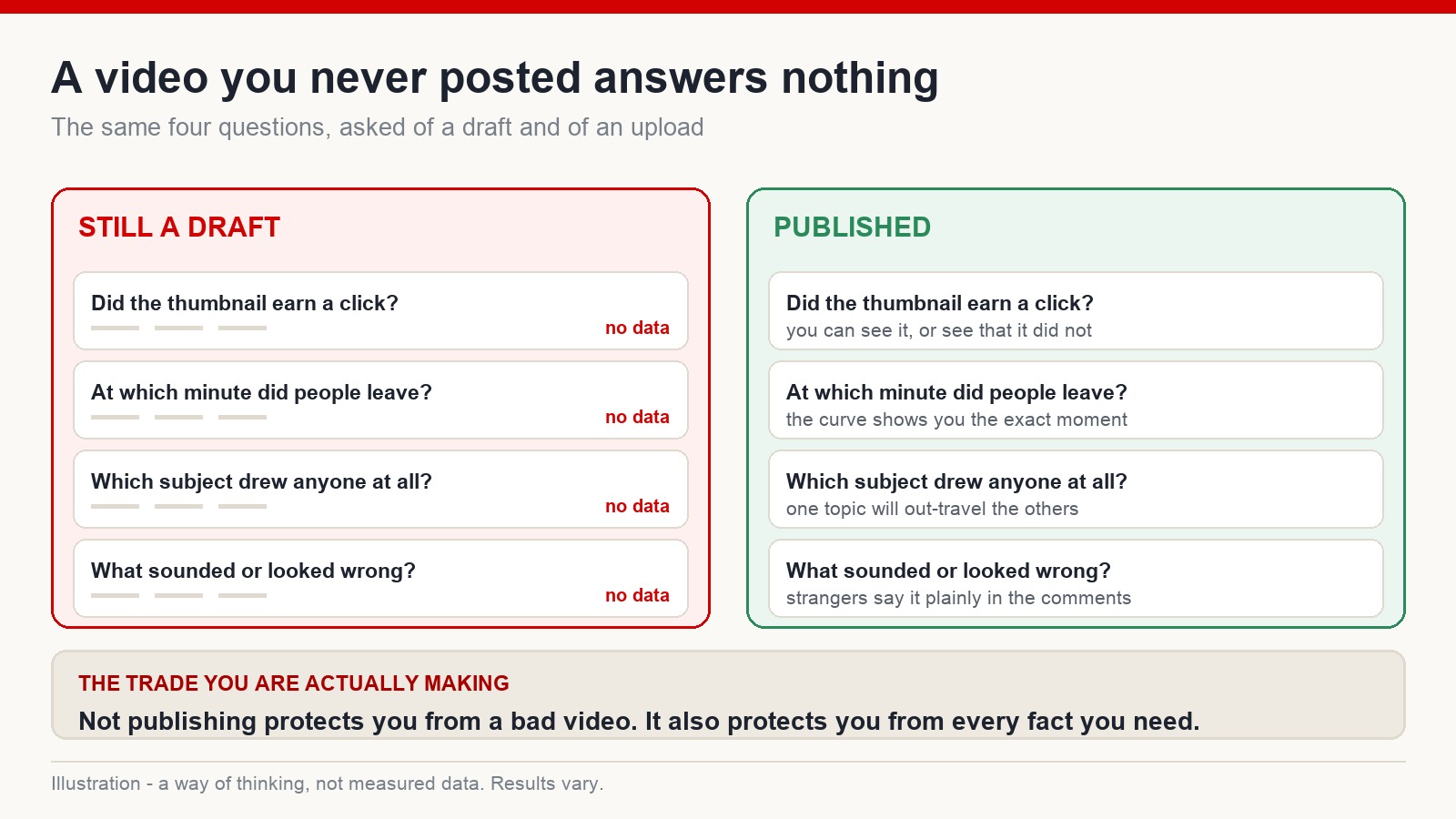
Ask four questions of a video sitting in your drafts folder. Did the thumbnail earn a click? At which minute did people stop watching? Which subject drew anyone at all? What sounded or looked wrong to a stranger?
The draft answers none of them. Not badly – at all. The information does not exist yet.
Ask the same four questions of a video you published last week and every one has an answer, even if the answer is small and unflattering. You can see whether anybody clicked. You can see the exact moment the curve fell off a cliff. You can see which of your topics travelled further than the rest. And somebody, sooner or later, will tell you plainly in the comments about the audio problem you had stopped hearing.
That is the real trade. Not publishing protects you from making a bad video. It also protects you from every single fact you need in order to make a good one.
What people fear, and what usually happens
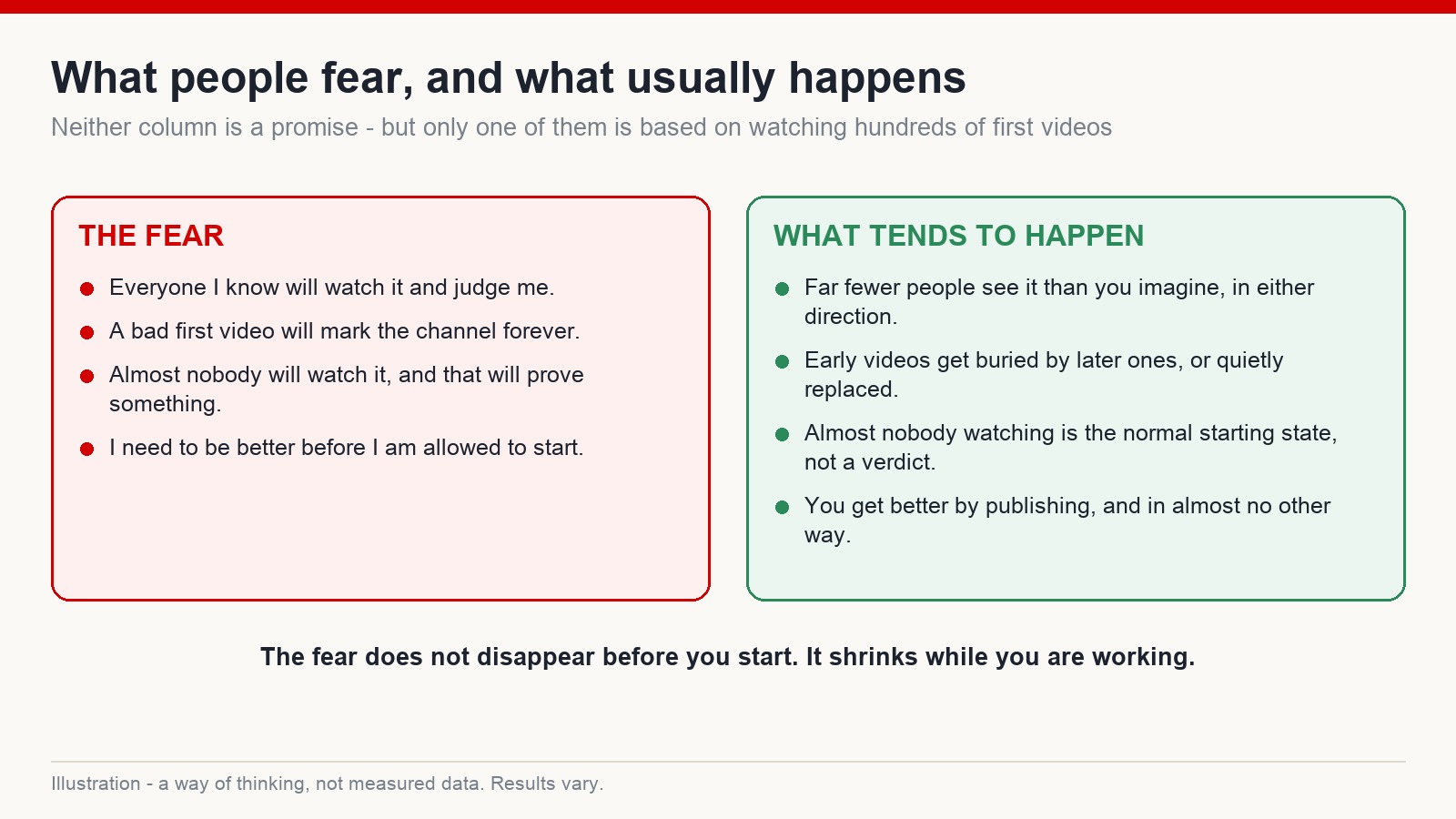
The fear is almost always more specific than “failure”. When I ask, it comes out as one of four things: everyone I know will see it and judge me; a bad first video will follow the channel forever; nobody will watch it and that will prove I am not cut out for this; I need to be better before I am allowed to start.
The honest answers, in order. Far fewer people see a first video than you imagine – which cuts both ways, and is mostly a relief. Early videos get buried by later ones almost immediately, and you can unlist or replace them whenever you like. Almost nobody watching is not a verdict; it is the ordinary starting condition of every channel, including the ones you admire. And the last one has the causality backwards: you do not get better and then publish. Publishing is the mechanism by which you get better.
None of that makes the fear go away before you start. It shrinks while you work, and only then.
Lower the bar until the first video is unavoidable
The practical fix is not to feel braver. It is to make the first video so small that refusing it would be silly.
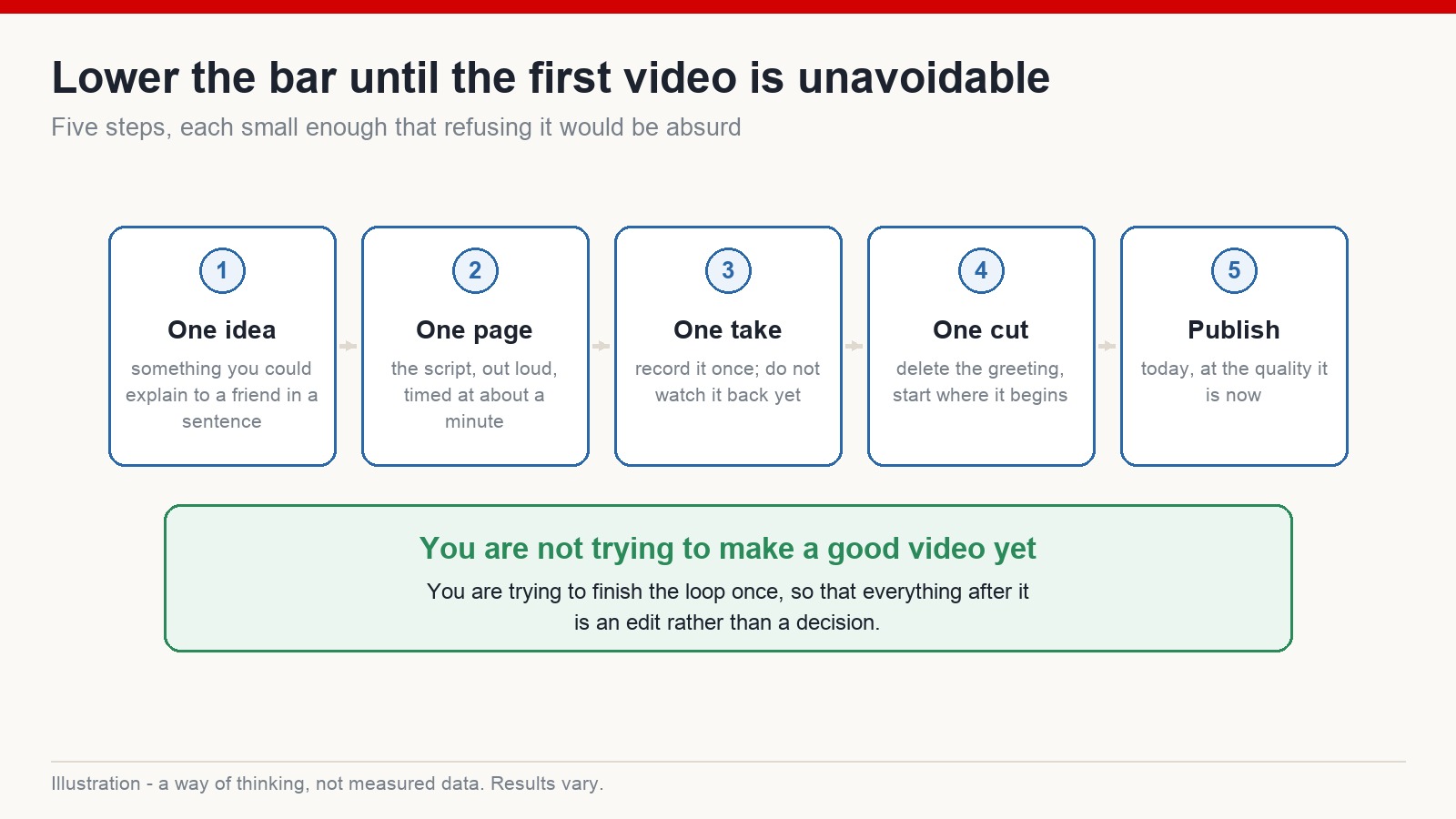
One idea. Something you could explain to a friend in a single sentence. Not your best idea – your clearest one. Save the ambitious concept for when you know how the tools behave.
One page. Write the script and read it out loud. Roughly a minute of speech. If it is boring to say, it will be worse to watch, and you have just found that out for free.
One take. Record it once. Do not watch it back yet – that is where first videos go to die.
One cut. Delete the greeting and the throat-clearing. Start at the moment something actually happens. That single edit does more for a beginner’s video than any effect.
Publish. Today, at the quality it currently is.
You are not trying to make a good video yet. You are trying to complete the loop once, so that everything afterwards is an edit rather than a decision.
The things people wait for
Let me go through the usual list honestly, because pretending none of it matters is its own kind of dishonesty.
Better gear. Sound matters more than picture, and a cheap wired microphone in a room with soft furnishings solves most of it. Camera quality is far down the list. Nobody has ever left a video because it was 1080p.
A better voice. Clear beats beautiful. Slow down, stand up, stop apologising in the first ten seconds. That is most of the gap.
Editing skill. Cut the boring parts. That is the whole craft at the start, and it is learnable in an afternoon.
Confidence. Not available in advance. It is a by-product, not a prerequisite.
Less competition. Never coming. Competition means the audience exists, which is better news than an empty subject.
What to do when the first one lands quietly
Most first videos land quietly. Plan for that, so it does not read as a catastrophe.
Give it a week, then look at three things. Did anyone click it at all? Where in the video did people stop? Did anything you did prompt a response – a comment, a share, a message from a friend saying they actually watched the whole thing?
Then make the second one, changing exactly one of those things. Not the niche. Not the format. One thing. The second video will teach you more than the first, and the fifth more than the second, because by then you will have something to compare against – your own earlier work, which is the only fair comparison available to a new channel.
What publishing does not promise
I am not going to tell you that shipping the first video changes your life, because plenty of people publish consistently and stay small. Audiences are unpredictable, the platform changes its mind, and effort does not convert into attention at a fixed rate.
What publishing does is narrower and still worth having: it moves you from a position where nothing can be learned to one where something can. It replaces speculation with evidence. And it settles, permanently, the question of whether you are the kind of person who does the difficult thing or the kind who describes it.
It gets dark tonight either way. The only variable is whether there is something published on the other side of it.
Frequently asked questions
Should I post my first video even if it is bad?
Yes, with one caveat: bad in the sense of unpolished, not bad in the sense of misleading or harmful. An unpolished video generates information. A draft generates nothing. You can always unlist it later.
What if people I know watch it and judge me?
Some will watch, most will forget within a day, and the reaction is almost always milder than the version you rehearsed. If it genuinely matters, start on a channel that does not carry your name and appear on camera only when you want to.
Do I need good equipment for my first YouTube video?
No. Prioritise audio, use whatever camera you own, and record somewhere with soft surfaces to kill the echo. Gear becomes worth upgrading once you know you will keep going.
How long should a first video be?
Short enough that you finish it. About a minute is a perfectly good first target. Length is a decision to make later, once you know how long you can stay interesting.
My first video got almost no views. Should I stop?
That is the normal result and not a signal about your potential. The useful question is not how many people watched but what the video taught you to change. If you cannot answer that, the problem is measurement, not talent.
If you would rather work through this with a structure than improvise it alone, that is what we build at mmoyoutube.com for English-language channels. No claims about outcomes – just a clearer order of operations than waiting.