Reverse-Engineer a Viral Post: Take the Principle, Leave the Paragraph
Take a post that performed unusually well, work out why, and apply the reasoning to your own niche. That is the whole of this prompt template – and it is a good one, mostly because of the two constraints at the bottom.
Do not copy the original content, wording, structure or distinctive ideas. And if performance data is unavailable, clearly separate observations from assumptions, and do not claim the content went viral solely because of any one factor. Those two lines are what turn this from a copying machine into a research tool.
What the template actually asks for
Five steps, in order.
| 1. Pick the post → | 2. Add the context → | 3. Eight lenses → | 4. Split fact from guess → | 5. Five original ideas |
|---|---|---|---|---|
| One that worked in your world Not the biggest post on the internet |
Platform, niche, audience, numbers Performance data if you can see it |
Hook, idea, emotion, structure… The prompt’s own checklist |
Observation or assumption? The step that keeps you honest |
For your niche, in your voice Hook, takeaway, angle, format |
| A post your audience would plausibly see | Without this, every answer is generic | Eight angles beats one opinion | “It had a strong first line” vs “that is why it spread” | Principles applied – not a rewrite of theirs |
The fifth step is the payoff and the most commonly botched: five ideas for your niche, each with a hook, a core angle, a key takeaway and a recommended format. Not five versions of their post with the nouns changed.
The eight lenses, and what each one tests on your side
The value of eight lenses rather than one question is that it stops you fixating on whichever feature you noticed first.
| # | Lens | What you are looking for | What it maps to on your channel |
|---|---|---|---|
| 1 | Hook and first impression | What happens in the first line or first second | Your opening sentence, your thumbnail promise |
| 2 | Core idea and value proposition | The one thing a viewer gets | Whether your video has a single clear promise |
| 3 | Curiosity, emotion or tension | What makes someone need to know the end | The gap between the question and the answer |
| 4 | Structure and pacing | Where it speeds up, where it lands | Your script order, not your script wording |
| 5 | Relatability and audience relevance | Why this audience in particular cared | Whether you are talking to your viewers or to everyone |
| 6 | Shareability and conversation potential | Why someone would send it to a friend | What in your video gives people something to say |
| 7 | CTA and engagement triggers | What it asks for and how naturally | Your ending, and whether it earns the ask |
| 8 | What makes it different from typical content | The thing the category does not usually do | Your angle, the reason to watch you and not them |
Lenses one, three and eight carry most of the weight. A strong hook, a genuine curiosity gap and a real difference from the category will explain more posts than anything else on the list. The same three decide a thumbnail and title pair, which is why thumbnail ideas and the curiosity gap is the sister piece to this one.
The post this came from
Watch the reel
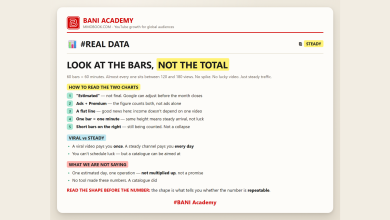
The full prompt template on one card, ready to copy. Posted on the BANI Academy page.
What a viral post can and cannot tell you
This is why the prompt’s second constraint matters so much. Given a post and no numbers, a model will produce a confident explanation – and confidence is exactly what you should not buy here.
| Factor | What you can observe | What stays hidden |
|---|---|---|
| The hook and the promise | Visible in the post itself | – |
| The structure and pacing | Visible, and safe to learn from | – |
| The angle that made it unusual | Visible, if you know the category | – |
| Whether the format suits the platform | Partly visible | Watch how it was published, not just what it says |
| How many similar posts failed | – | Invisible. You only see the survivors |
| The account’s existing audience | – | A post from an account with a large following is not a fair comparison |
| Timing and distribution | – | Same post, different day, different result |
| Whether it was promoted | – | Paid reach looks identical from outside |
The fifth row is the big one. You are looking at a survivor. Somewhere that same week, dozens of accounts published something with a similar hook and structure and got nothing, and you will never see those posts. Any conclusion of the form “this went viral because of X” is unprovable from the outside.
The honest version is narrower and more useful: this post does X well, X is something I can also do, and doing X is unlikely to hurt. That is a principle worth copying. The claim about causation is not – and the same trap sits behind videos that follow all the rules and still underperform, which we wrote about in the research was right and the video still failed.
The line between reference and imitation
The prompt forbids copying the wording, the structure and the distinctive ideas. That third item is the one worth thinking about, because it is where well-meaning people cross a line without noticing.
A principle is portable: open with the problem before the solution, put the payoff in the first fifteen seconds, end by asking one specific question. Nobody owns those. A distinctive idea is not portable: a particular framing someone invented, a series concept, a phrase they are known for, a format their audience associates with them. Reusing that is imitation even when every word is different, and audiences spot it faster than you would expect.
The practical test takes a second. If the creator you studied saw your post, would they recognise their own idea in it, or just good practice? Good practice is fine. Their idea is theirs.
There is a self-interested reason to care as well. Imitation caps you at second place in a comparison you chose to invite. The channels that grow past their references are the ones that took the mechanism – why the thing held attention – and pointed it at a subject only they could cover.
Five posts, not one
One post gives you a story. Five posts in the same niche give you a pattern, and a pattern is the thing you can act on.
Run the template on five posts that worked in your category and look only at what repeats: how long the openings are, whether faces appear, how early the payoff arrives, what kind of ask is at the end. The repeated features are your design brief. Anything that appears once is that creator’s personality, and copying it will read as imitation.
That is the same method as reading a competitor’s channel properly rather than a single video, which we set out in surface topic, real audience. And it is the reference-not-copy rule we apply to thumbnails in four commands to fix a thumbnail: borrow the layout and the logic, bring your own face, words and colours.
Frequently asked questions
Is studying a competitor’s post copying?
Studying structure is normal practice. Reproducing their wording, distinctive ideas or artwork is not, which is why the prompt bans it outright.
Which post should I analyse?
One from your own niche, at roughly your own size. A megahit from a huge account teaches you about their audience, not yours.
Do I need the view counts?
They help a lot. Without them, insist the answer marks each point as observation or assumption, exactly as the prompt says.
How often is this worth doing?
Once a month, on one post, is plenty. Three principles you actually apply beat twenty analyses you read once.
Run it on one post this week
Pick a post from your niche that clearly worked. Paste it in with the platform, the niche, your audience and any numbers you can see. Ask for the eight lenses, then for three to five principles, then for five original ideas in your own voice – and tell it plainly not to reuse the wording or the distinctive ideas.
Then do the part no prompt does: pick one idea and publish it. A viral post is evidence, not a recipe – take the principle, leave the paragraph.
Learning a lot does not make anyone good. Doing a lot does.
If you want the structure that turns that into a habit, that is what our free challenge is built for: no barrier to entry, a genuine commitment to action, and a refundable commitment fee you get back when you finish. You are not paying for the knowledge. You are betting on yourself finishing, and we hold the stake.
Which post would you run this on first? Tell us in the comments on the original reel.
For more on building channels for English-speaking audiences, that is what we work on at mmoyoutube.com.