How Long Does It Take to Grow a YouTube Channel? Year One, Three and Five
The honest answer to “how long does it take to grow a YouTube channel” is one nobody wants: longer than the enthusiasm lasts, and shorter than it feels while you are in it.
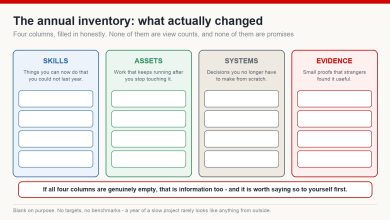
I have been making YouTube videos for nine years, most of that time on faceless channels aimed at English-speaking viewers. The first five were the ones that actually rearranged my life, and almost none of that rearrangement showed up in the first eighteen months. What I want to lay out here is what genuinely changes at year one, year three and year five — measured in capability, not in income, because income depends on a dozen things neither of us controls.
Nobody sees the years underneath
People look at a working channel and read it backwards, as though it arrived intact. What is invisible is the part that took the longest: the evenings editing until your eyes burn, the uploads that got forty views, the specific feeling of putting real effort into something and watching the internet decline to care.
And under that, the questions that repeat: am I on the wrong path? Am I actually any good at this? Is this thing ever going to work?
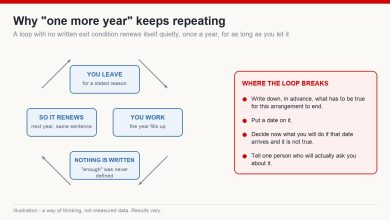
I kept going, and not because I was inspired. Mostly because I understood that quitting reset everything to zero, and I had already paid too much to go back to zero.
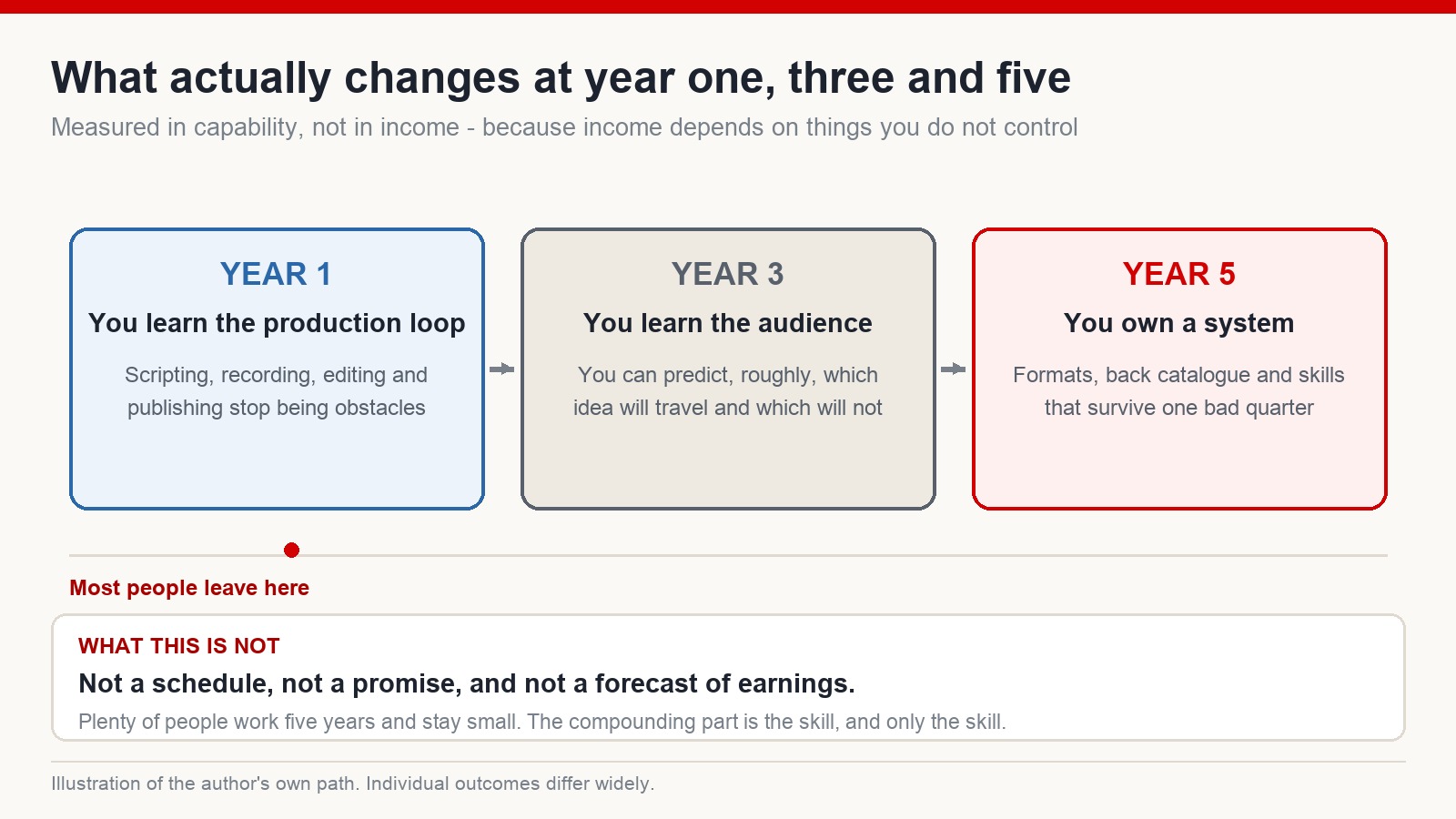
Year one: you learn the production loop
Year one is not about the audience. It is about turning production from an obstacle into a routine.
At the start, everything takes four times too long. Writing a script is agony. Recording means eleven takes because you keep stumbling. Editing eats an entire weekend. The thumbnail gets made at midnight in a hurry because you are exhausted and just want it up.
By the end of a serious first year, that loop has collapsed into something repeatable. You know how long each stage takes you. You have templates and defaults. You stopped rebuilding your process from scratch every video. That sounds unglamorous next to a growth graph, but it is the thing that makes a second year possible — most people quit in year one not because they failed, but because the work was still costing them more than they could sustain.
What you probably will not have yet: an audience worth the name, meaningful revenue, or any confidence that the topic you picked was correct.
Year three: you learn the audience
Around year three, if you stayed in roughly one place, something quiet happens. You start being able to predict.
You look at an idea and you can say, with reasonable accuracy, whether it will travel — not because you got smarter in the abstract, but because you have now watched a hundred of your own ideas meet real people. You know which thumbnails earn a click from a stranger. You know where in your scripts attention leaks. You know which topics bring polite silence and which bring comments.
Three years will not necessarily make you rich, and plenty of three-year channels are still small. But you will be a completely different operator than you were at the start, and that difference is the thing everything else is built on.
Year five: you own a system, not a lucky video
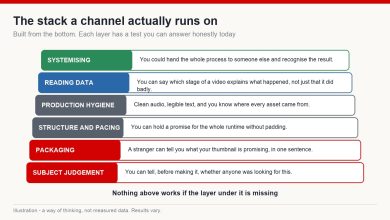
By five years, if the work was continuous, what you have is structural. Formats that reliably work for your audience. A back catalogue that keeps bringing people in while you sleep. Skills — writing, packaging, reading data, editing, understanding a market — that transfer to any platform and survive one bad quarter.
That is the part I would emphasise over any number. The freedom people notice from outside is really just optionality: being able to choose what you work on, when, and with whom. It is bought with capability, and capability compounds on a slow clock.
I should say plainly that this is my own path, not a schedule and not a forecast. Plenty of people work five years and stay small. Others find traction much faster. The compounding part is the skill, and only the skill.
Almost nobody makes it to year five — and the reason is boring
Most people stop somewhere in month three. A lot more stop in year one. Very few are still there at five.
It is not talent, and it is not that the opportunity closed. It is that they changed direction too fast.
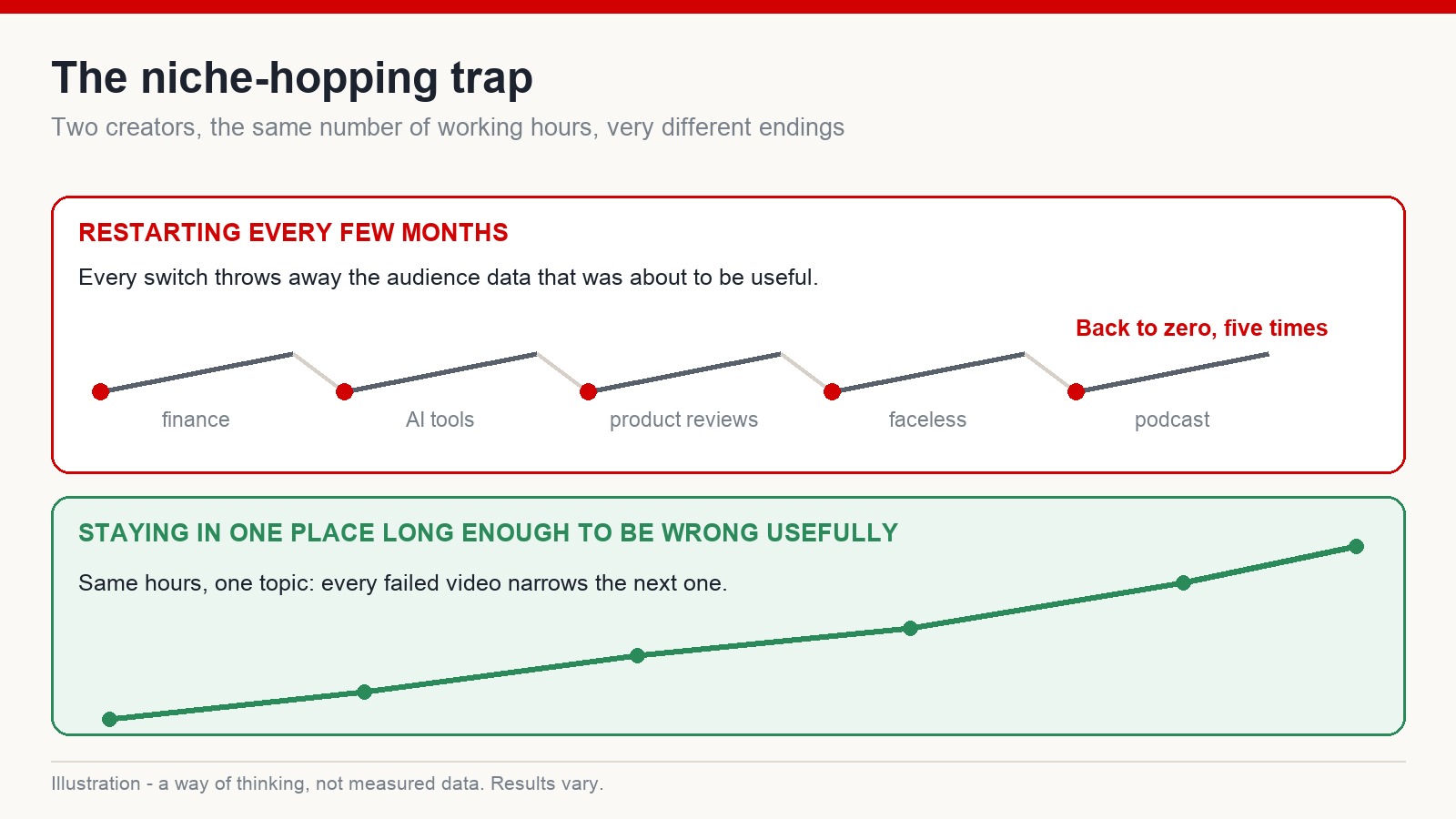
The pattern looks like this: finance this quarter, AI tools next, product reviews after that, then a faceless format, then podcasts because someone else’s podcast took off. Enormous effort, spread across five shallow beginnings, accumulating nothing deep enough to be worth anything.
YouTube does not reward movement. It rewards staying in one place long enough to understand a specific group of people — long enough to be wrong usefully, where each failed video narrows the next one instead of erasing it.
Check these six before you blame the niche
Here is the trap inside niche-hopping. When videos underperform, “wrong niche” is the most comfortable available explanation, because it makes the problem external and the solution exciting.
Usually it is not the niche. It is the packaging or the execution, and those are fixable without throwing away everything you have learned.
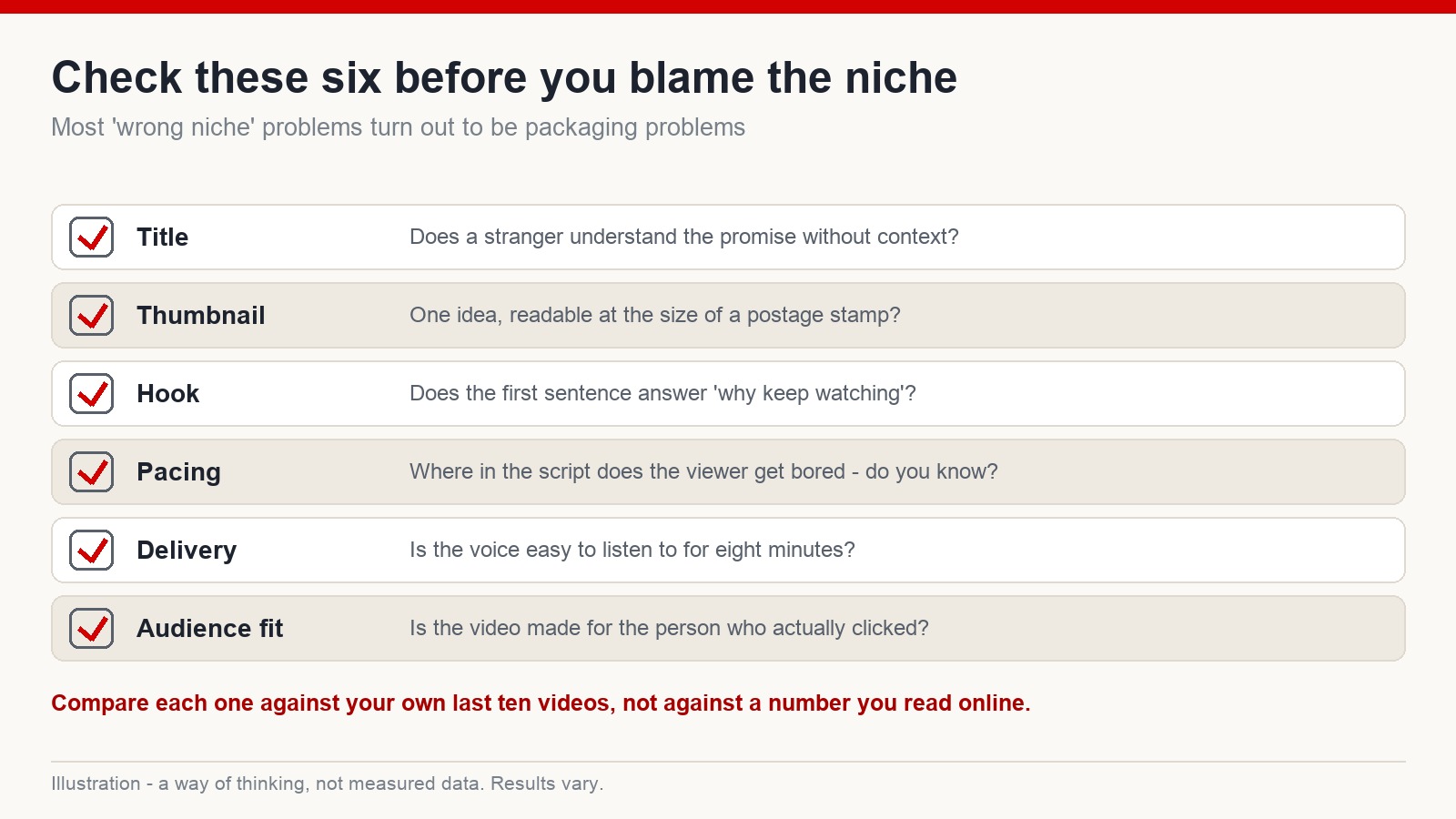
Before you switch, work through these honestly:
- Title — does a stranger with no context understand the promise?
- Thumbnail — one idea, readable at the size of a postage stamp?
- Hook — does the first sentence answer “why should I keep watching”?
- Pacing — do you know the exact timestamp where viewers get bored?
- Delivery — is the voice comfortable to listen to for eight minutes?
- Audience fit — is the video made for the person who actually clicked, or for the person you imagined?
Compare each of those against your own last ten videos rather than against a benchmark you read somewhere. Public figures for a “good” click-through rate come from other niches, other countries and other years; your own back catalogue is the only fair control group you have.
If you have worked through all six and genuinely improved them, and the topic still refuses to move — then change. But change with evidence, not with relief.
Treat it as an asset, not a magic trick
Let me be blunt about the thing that gets oversold: YouTube is not a machine that turns a few uploads into a different life. It is not passive, and it is not fast.
What it is, is unusually fair in one narrow sense. Better content tends to get distributed better. Understanding your viewer tends to hold them longer. Publishing consistently gives you more data. Optimising with that data tends to improve your odds. Every one of those takes tests, mistakes and repetition.
The useful mental model is asset-building. One good video can keep bringing viewers in for months or years. A coherent channel becomes a system rather than a series of one-offs. That can open into products, services, a community or work you would not otherwise have been offered. None of it arrives for someone working halfway, and none of it is guaranteed — ad rates move, platform rules change, and audiences shift. Anyone promising you a timeline to a specific income is selling something.
The freedom is downstream of the discipline
From the outside, time freedom looks like the absence of constraint. In practice it is the product of a fairly strict one: years of ordinary days where you wrote the script without inspiration, published the video while it was still getting forty views, and learned something specific from a failure instead of just feeling bad about it.
Want freedom over your time? You will need to be good at managing time first. Want more options? You will need capability that makes options available. There is no version where the outcome comes before the work.
So the real question is not how long it takes. It is whether you are willing to pay for the years — not in words, but in the specific acts: switching the machine on when you feel flat, publishing when you are afraid of being judged, going back to a failed video to find out what it was telling you.
Three years changes what you can do. Five changes what you can choose. Ten can look like a different life entirely. But only for the version of you that stayed in one place long enough for the compounding to start.
Frequently asked questions
How long does it take to grow a YouTube channel?
There is no fixed number, and anyone quoting one is guessing. Expect year one to be about making production sustainable, year three to be about genuinely understanding your audience, and year five to be about owning a system rather than chasing individual videos. Outcomes vary enormously by niche, market and how consistently you publish.
Why do most people quit YouTube early?
Because they expect results on a timeline the platform does not run on. A few months of low views gets read as “I am not suited to this”, when it is usually just the phase where you are still learning to package ideas and read your own data.
Should I change my YouTube niche if videos are not working?
Not until you have checked title, thumbnail, hook, pacing, delivery and audience fit — and improved them. Most “wrong niche” problems turn out to be execution problems. Switching before you have that evidence just restarts the learning clock.
Can YouTube realistically replace an income?
For some people it does, over years, and usually through several revenue lines rather than ads alone. It is not passive and it is not predictable: ad rates fluctuate, policies change, and a format that works can stop working. Treat it as a long-term asset you are building, not a plan you can budget against.
How should a complete beginner start?
Pick a topic you can stand to work on for a long time, get specific about who the viewer is, write one script, record it, publish it, and then read what happened. Then do it again. The first ten videos are a research phase, not a verdict.
If you want a structured route through those early years for an English-language channel, that is what I teach at mmoyoutube.com.