When Everyone Has AI, the Edge Is Whoever Is Behind the Channel
Something is going to happen to a large number of faceless channels over the next few years, and it will not be because the platform got harder.
It will be because the advantage they were built on stopped being an advantage.
When everyone has the same tools, the tools are not the edge
The standard faceless workflow is now common knowledge. A model drafts the script. A voice tool reads it. An image tool supplies visuals. An editor assembles it, increasingly with automation doing the assembly too. Upload, repeat, wait.
That workflow built real channels, and I am not dismissing it – I use most of those tools myself. But an approach that anyone can reproduce in an afternoon is not a competitive position. It is a baseline. Once the whole field is working the same way from the same tools, the output converges, and converged output competes only on volume.
So the question becomes: what is left that cannot be copied by pressing the same buttons?
The answer, unhelpfully for anyone hoping to automate everything, is a person.
The tool is not the brand. The human is.
I have run channels that mix AI production with real human presence for years now, and it continues to hold up while purely synthetic approaches keep getting more crowded.
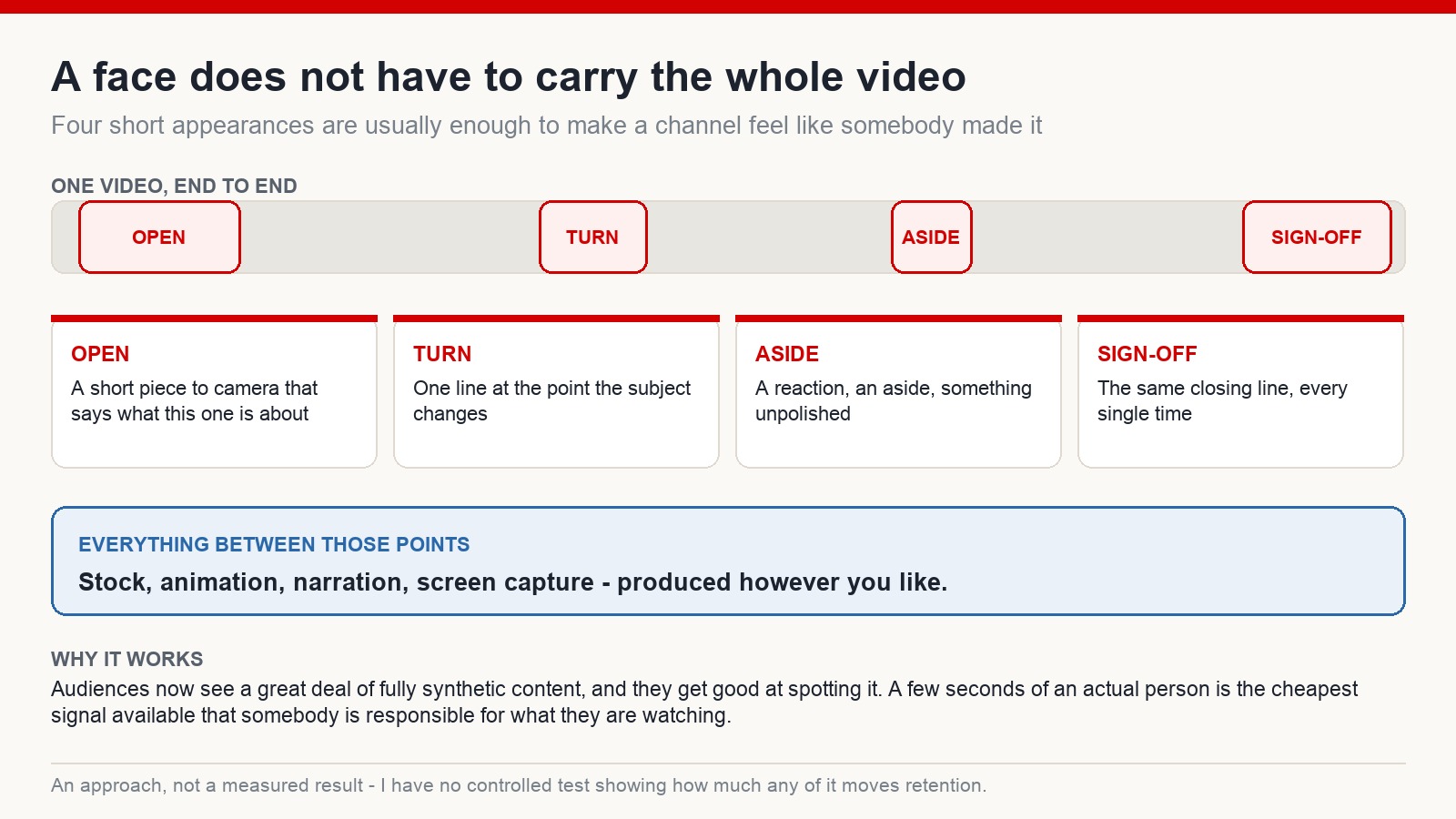
The important part is how little presence it takes. Nobody needs a presenter narrating for twenty minutes. What changes the feel of a channel is:
- A short opening piece to camera that says what this video is about.
- One line at the point where the subject turns.
- An aside somewhere in the middle – a reaction, a small unpolished moment.
- The same closing line every time, until viewers can predict it.
Everything in between can be stock, animation, screen capture, narration, whatever suits the format. Viewers will not remember the individual sentences. They will remember that a person seemed to be responsible for what they watched.
Why that matters more now than it did
Audiences are exposed to a great deal of fully synthetic content, and they are getting quicker at recognising it. The same voices, the same sentence rhythms, the same stock-image aesthetic, and a flatness where a point of view should be.
Against that backdrop, a few seconds of an actual human is a strong differentiator, simply because so little of the field bothers with it.
I want to be careful here, because this is where articles like this usually start quoting numbers. I do not have a controlled test. I cannot tell you that adding a presenter lifts retention by a specific amount, and neither can anyone else who has not run the same video both ways with the same audience. What I can say is that channels with a recognisable person attached tend to hold their audience through changes – format shifts, algorithm moves, a bad month – better than channels whose only identity is a topic. Treat that as an observation, not a metric.
Do not buy a video. Build a library.
If you decide to hire a presenter on a freelance marketplace, the common mistake is to brief it like a purchase: one script, one video, delivered.
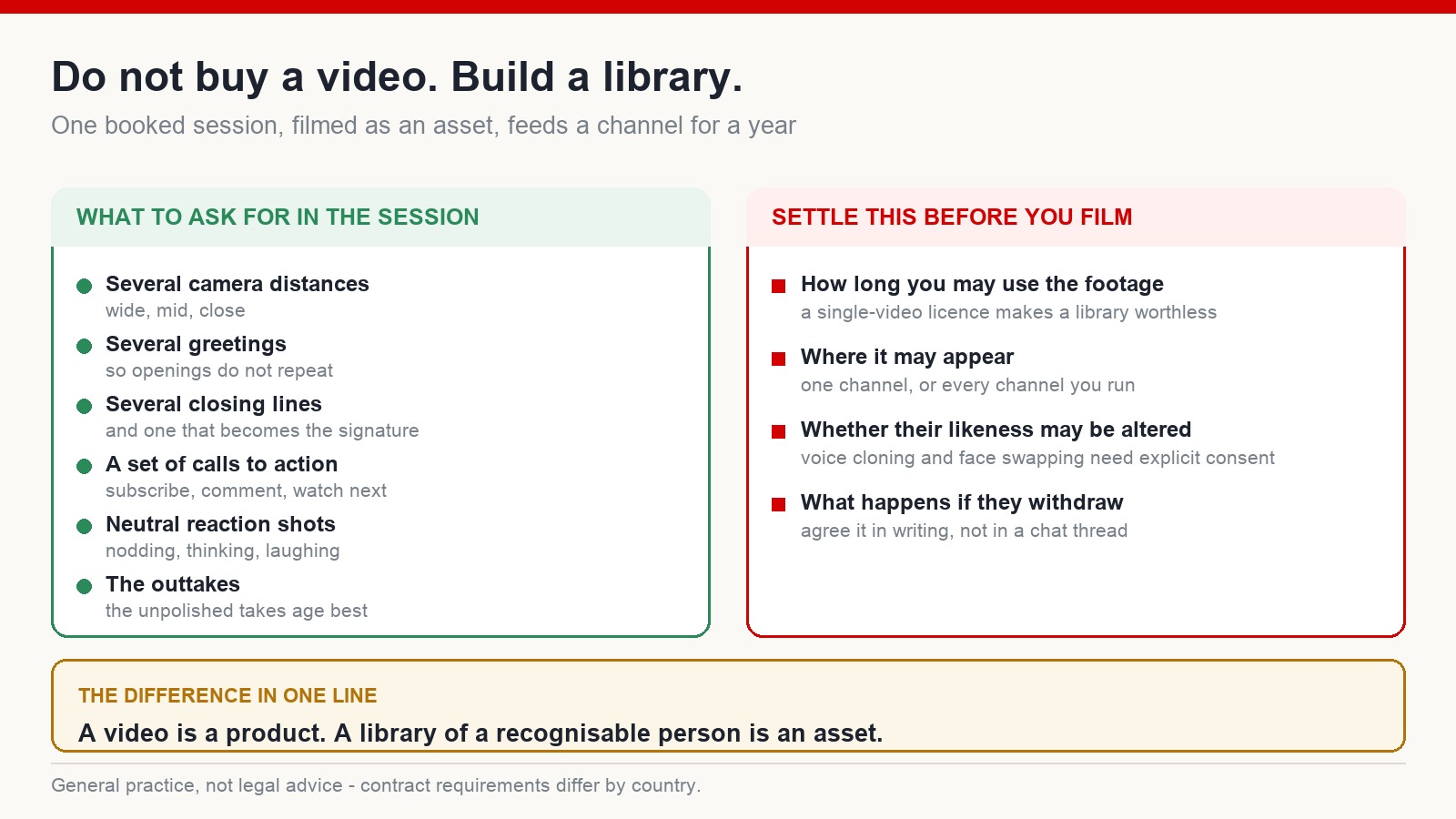
Brief it like an acquisition instead. In a single booked session you can capture:
- Several camera distances – wide, mid, close – so the same clip can be cut into different edits.
- Several greetings, so your openings do not repeat word for word.
- Several closing lines, including one you intend to use as a signature.
- A set of calls to action, delivered flatly rather than performed.
- Neutral reaction shots: nodding, thinking, laughing.
- The outtakes. Unpolished takes age far better than perfect ones.
That is not one video. That is raw material for a year of them.
Settle the rights before the camera turns on
This is the part beginners skip and regret. Before you film, agree in writing: how long you may use the footage, whether it covers one channel or every channel you operate, whether their likeness or voice may be modified – voice cloning and face swapping need explicit, specific consent – and what happens if they later want out. A single-video licence makes a library worthless, and discovering that after the shoot is an expensive lesson. Requirements vary by country, so if the arrangement is significant, get proper advice rather than relying on a chat thread.
Two ways of thinking about the same work
A video maker asks how to get views on this week’s upload. Someone building a media property asks how this character shows up across the next few hundred videos, and what else it could support.
The first mindset optimises a product. The second builds an asset. They produce completely different decisions about who you hire, what you record, and what you keep.
One caution on scaling, since this is where the idea gets abused: replicating near-identical channels to multiply output is a good way to fall foul of platform rules on spam and repetitious content. Scaling a recognisable identity across formats is a different thing from mass-producing clones of the same channel, and only one of those is durable.
Build a character, not just a channel
Plenty of creators pour hours into thumbnails, titles and search optimisation. That work matters. It is also the work everyone else is doing, with the same tools and the same advice.
What is harder to copy is recognition. When viewers know a face, a phrase or a way of approaching a subject, you are no longer competing on production efficiency. You are competing on something that took time to build, which is exactly why it holds.
Use AI to scale, not to replace
These are two different strategies wearing the same vocabulary.
One says: let AI produce the content. The other says: let AI let a small team produce more, faster, without losing what makes the channel itself.
The second is the one that compounds – and note that platforms increasingly expect synthetic content to be disclosed, so building an identity that does not depend on hiding how the work is made is also the safer position.
I do not think the channels that last will be the ones using the most AI. I think they will be the ones combining three things: AI for production speed, a human for trust, and a brand for the part that keeps its value when the tools change again. Which they will.
Can a channel be built entirely with AI?
It can, and many are. The difficulty is not making it – it is being distinguishable from everyone else making the same thing the same way, and staying distinguishable as the tools improve.
Does a presenter need to appear throughout the video?
No. An opening, a mid-point line and a consistent sign-off are enough to give a channel an identity. Most of the runtime can be produced any way you like.
Is hiring a presenter expensive?
It depends entirely on the market and the person, and it is worth thinking about per usable clip rather than per session. Footage you can legitimately reuse across many videos is a very different proposition from a one-off delivery – which is why the licensing terms matter more than the day rate.
Will AI replace creators?
It is already replacing repetitive production tasks, and that will continue. What it does not supply is a point of view, a set of standards, or a reason for someone to come back to your channel specifically.
Where should I start if my channel is fully synthetic today?
With the sign-off. One consistent closing line, delivered by a real person, is the smallest change that begins to make a channel recognisable – and it costs one short recording session.
If you want the full picture of building a faceless channel for an English-speaking audience with this kind of durability in mind, that is what I teach at mmoyoutube.com. Results vary between channels, and platform rules on synthetic media are still changing – check the current policies before you build a process around them.