AI Scriptwriting: The Prompt That Returns 20 Short-Form Video Ideas Built to Hold Attention
There is a blunt truth about short-form video: viewers do not leave because the content is bad. They leave because nothing gave them a reason to stay. The problem with most Reels, Shorts and TikToks is not a shortage of ideas — it is that the ideas arrive with no retention structure attached, so the thumb keeps moving three seconds in.
This article is the fix I use myself: a single AI scriptwriting prompt that returns twenty short-form video ideas already shaped around the way people actually watch. The prompt is printed in full below. Copy it, fill in eight fields, run it, and you have raw material for several filming sessions instead of a blank page every Monday.
What this prompt actually solves
Most idea generators hand you a headline. A headline is not filmable. It tells you nothing about how the first three seconds work, where the pace changes, or why anyone stays until the end — which is where all the retention actually lives.
This prompt forces the model much further. Every idea comes back as a brief you could shoot tomorrow: a hook, a retention spine, visual direction, on-screen text, a pace-change point, a call to action and a viral score. You are not getting twenty topics. You are getting twenty production plans. It works in any niche and on all three short-form platforms.
The difference is the word structure. A brilliant idea with a weak hook, no pace change and no payoff still bleeds viewers. Framing every idea inside a proven retention shape means even an ordinary topic gets a fair chance, which is more than you can say for filming on instinct.
What you get back: twelve fields per idea
This is where the output quality comes from. For each of the twenty ideas, the model has to return all twelve of these:
- Hook, 3–5 seconds — the opening line that stops the scroll.
- Core idea — what the video says and what the viewer walks away with.
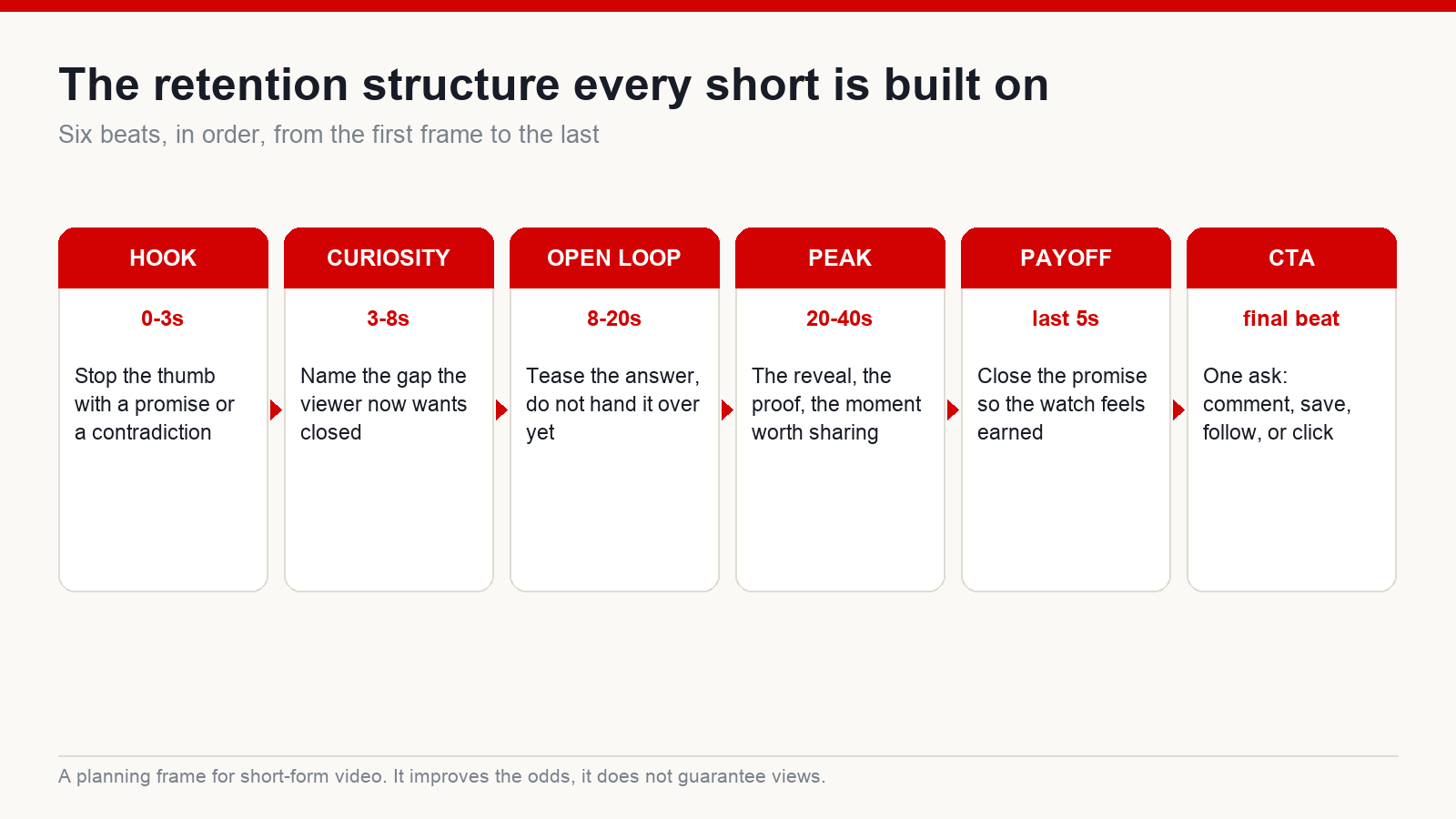
- Retention structure — hook, curiosity, open loop, peak, payoff, call to action.
- Script outline — the beats in order, with nothing missing in the middle.
- Visual direction — shots, B-roll, screen recording, graphics.
- On-screen text — which words appear when, without fighting the voiceover script.
- Pace change — where the angle or rhythm shifts so the video never flattens.
- Emotional driver — curiosity, surprise, mild controversy, humour, relief.
- End reward — the reason to still be there at the last second.
- Call to action — comment, save, share, follow or click, phrased naturally.
- Drop-off risk — where you are most likely to lose people, and the fix.
- Viral score, 1–10 — graded on watch-through, shareability and usefulness.
At the end, the model ranks the top five ideas by retention potential and explains its reasoning. That ranking is the part people underrate: it kills the “they all sound good” trap and tells you what to film first instead of leaving you to guess.
The prompt
Copy the whole thing. Do not delete the twelve-field instruction — that clause is what separates this from a list of headlines.
You are a short-form video strategist who has studied thousands of high-retention Reels, Shorts and TikToks. Your job is to generate ideas that hold attention, not ideas that merely sound clever.
Context:
Platform: [PLATFORM]
Niche / topic: [NICHE]
Audience: [AUDIENCE]
Primary goal: [GOAL]
Video length: [LENGTH]
Style: [STYLE]
My real expertise: [EXPERTISE]
Topics to avoid: [AVOID]Before you generate anything, ask me about every point above that is still ambiguous. Wait for my answers.
Then produce 20 video ideas. For each idea, return all twelve of the following, labelled: (1) hook of 3–5 seconds, written as the exact spoken line; (2) core idea; (3) retention structure, mapped as hook, curiosity, open loop, peak, payoff, CTA; (4) script outline in order; (5) visual direction; (6) on-screen text and when it appears; (7) the pace-change point; (8) emotional driver; (9) end reward; (10) call to action; (11) drop-off risk and how to fix it; (12) viral score from 1 to 10 with a one-line justification.
Score strictly. At least five of the twenty ideas must score below 6.
Finally, rank the top five ideas by retention potential and explain in one sentence each why those five would hold a viewer longest.
The eight fields, filled in properly
The more specific you are, the less the model invents. Here are the eight fields with examples, using a dog-training channel:
- [PLATFORM] — YouTube Shorts. Pick one per run; do not merge all three.
- [NICHE] — training tips for puppies under six months. Narrow beats broad.
- [AUDIENCE] — first-time dog owners, 25 to 40, worried about chewed furniture.
- [GOAL] — followers. Choose one, because the CTA changes with it.
- [LENGTH] — 30 to 60 seconds. New channels should start at 15 to 30.
- [STYLE] — instructional. Keep one style across the batch.
- [EXPERTISE] — five years training dogs, access to a practice yard.
- [AVOID] — no politics, no criticising named food brands.
Those fields are not paperwork. Writing “beauty” gets you generic ideas. Writing “oily, acne-prone skin for office workers” gets you ideas you can shoot this afternoon. Two extra minutes at this stage changes the entire output.
What a good output looks like
To make it concrete, here is one idea the way the prompt should return it — the English lines exactly as they would be spoken:
Hook (0–3s): “Your puppy is not chewing the sofa out of spite. It is chewing because of one thing you do every morning.”
Curiosity (3–8s): “And almost every new owner does it without noticing.”
Open loop (8–20s): “I will show you the fix in a second, but first you need to see what the chewing is actually telling you.” — cut to B-roll of the chewed cushion.
Peak (20–40s): “Here it is: you leave without a wind-down. Ninety seconds of calm before the door closes, every single time.” — demonstrate on camera.
Payoff (last 5s): “Do that for a week and watch what happens to the furniture.”
CTA: “Save this one for tomorrow morning.”
Notice that no beat is decorative. The hook makes a claim, the open loop delays it, the peak pays it off, and the ask arrives after the value, not before it. That is the whole difference between a script and a caption read aloud.
Six habits that stop the output going bland
Same prompt, very different results, depending on how you drive it:
- One platform per run. Merging Reels, Shorts and TikTok produces hooks that fit none of them.
- Make the model ask first. The “ask me what is ambiguous” line is the single most valuable clause in the prompt and the one people delete. Let it question you and it stops guessing.
- Go deeper on the winners. Once you have the top five, ask for a full second-by-second voiceover script for one of them.
- Force strict scoring. Requiring at least five ideas under 6 out of 10 stops the flattery and makes the ranking mean something.
- Save the prompt as a reusable template so next month you are only editing eight fields.
- Do not film all twenty. Shoot the top five, then clone whatever wins.
What to do once you have the twenty
Ideas are half the job; the rest is disciplined execution. Take the top five and ask for a full script for each. Film all five in one session and resist perfecting the lighting. Publish on a steady rhythm rather than in bursts.
Then, after about forty-eight hours, look at watch-through rate and saves rather than the raw view count. Those two tell you whether the structure held. If one idea clearly outperforms, make five variations of it before moving to a new topic. If one collapses, go back to the drop-off risk the model flagged and fix that exact beat — nine times out of ten it was right.
That loop turns short-form production from “post and hope” into something measurable: make, measure watch-through, clone the winner, repair the loser. The longer you run it, the more you learn about which structures your specific audience stays for — and no prompt can hand you that. Only your own channel data can.
Structure, not luck
What makes this prompt worth the setup time is that it forces structure at the idea stage instead of leaving you to shoot and pray. Retention is not luck. It is the result of a hook that earns the next three seconds, a rhythm that never flattens, and a promise that gets closed at the end.
With twenty briefs like that in hand, you have skipped the hardest part and can spend your energy on the part only a human does well: the filming, the delivery and the personality of the channel. The tool moves you faster. What you film, and what the channel sounds like, is still your call.
Results vary from niche to niche, and short-form platforms change how they distribute content regularly, so treat the scores as a way to prioritise rather than a prediction. If you want a structured path through the same process for a faceless channel aimed at English-speaking audiences, that is what we build at mmoyoutube.com.