YouTube RPM Explained: Why Faceless Channels Chase English-Speaking Views
Here is something I wish somebody had explained to me in my first year on YouTube: not every million views is worth the same money. Two channels can post the same view count on the same day and end the month with wildly different payouts.
That gap is the whole reason faceless creators talk endlessly about “international views” – meaning an audience in the United States, the United Kingdom, Canada, Australia, Germany and similar advertising markets. It sounds like a slogan until you look underneath it, where you find a real mechanism: RPM, ad demand, niche selection, video length and retention, all pulling on the same lever.
I have been building and teaching YouTube channels since 2017, almost all of it faceless content aimed at audiences who do not speak my first language. This is how I think about the money side of it.
What RPM actually means, and why it is not CPM
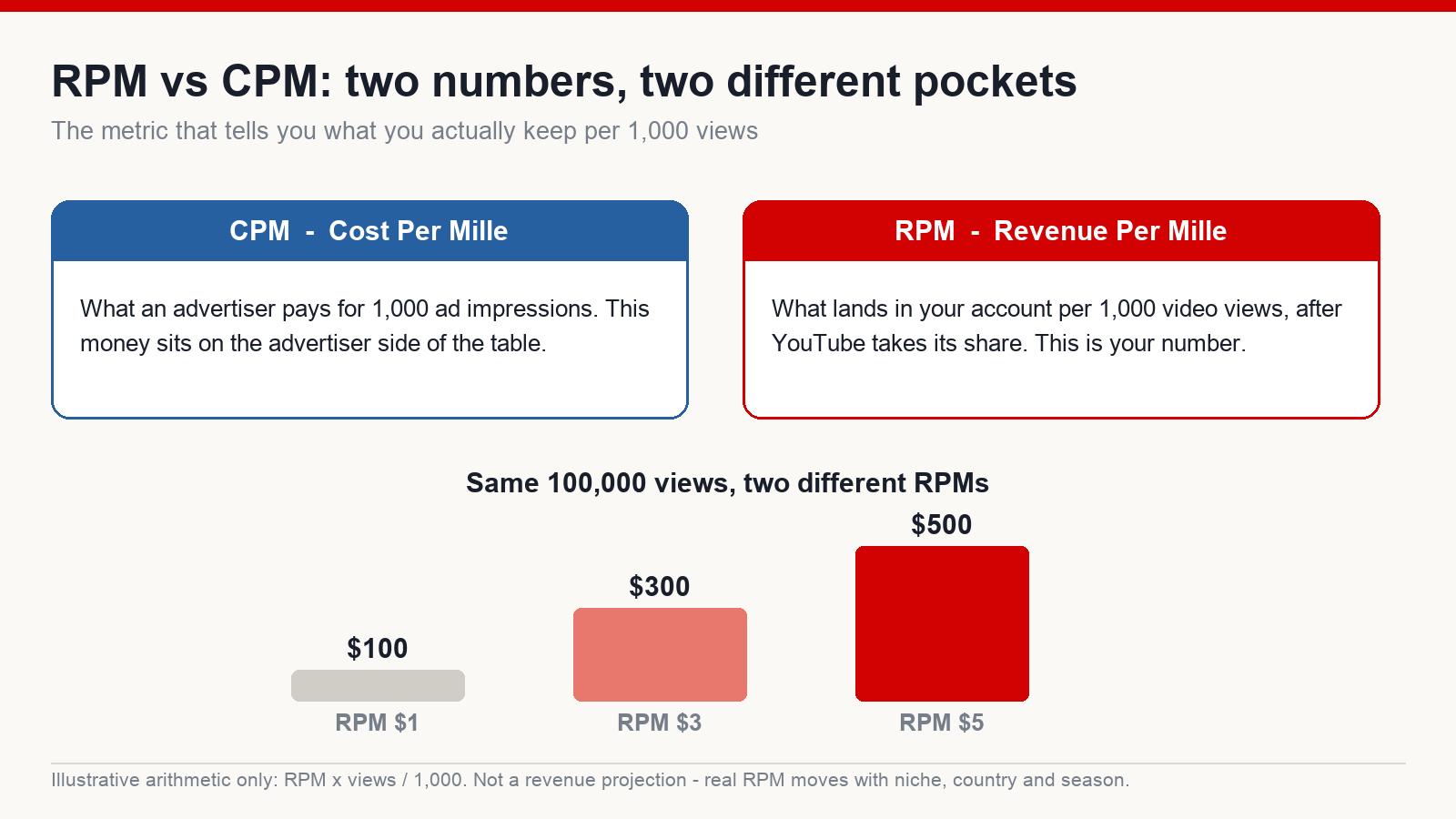
RPM stands for Revenue Per Mille – your revenue per 1,000 video views, after YouTube has taken its share. It is the number that answers the only question that matters at the end of the month: what did I keep?
Beginners mix it up with CPM, which is a different animal. CPM is Cost Per Mille – what an advertiser pays for 1,000 ad impressions. CPM lives on the advertiser’s side of the table. RPM lives on yours. A high CPM in your niche is a good sign, but it is not your income.
Run the arithmetic and the point becomes obvious. One hundred thousand views at an RPM of one dollar is around a hundred dollars. The same hundred thousand views at an RPM of five dollars is around five hundred. Identical view count. Five times the result.
That is why plenty of channels earn well without a single viral hit. They are not winning the view game. They are winning the value-per-view game.
Why advertising markets are not equal
The core reason RPM differs between countries has nothing to do with YouTube playing favourites. It is advertiser budgets.
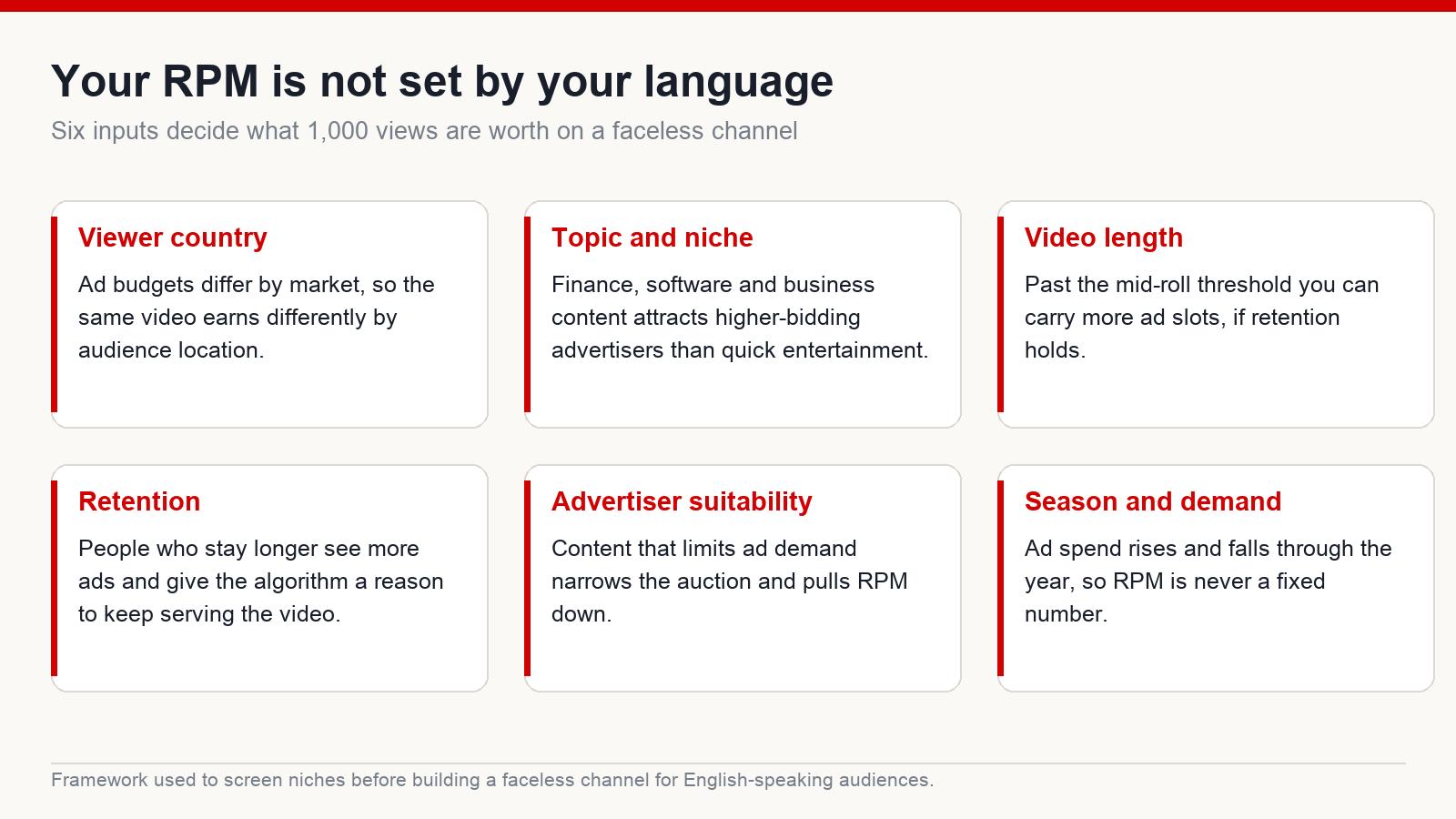
In markets like the US, UK and Western Europe, businesses generally spend more to reach a customer, because the purchasing power of that customer is higher, the lifetime value of an account is higher, and the auction for attention is more crowded. More competition for the same impression pushes the price up. Higher prices on the advertiser side eventually show up as higher RPM on the creator side.
In markets with smaller average ad budgets, that whole chain runs at a lower level, so creators there need far more views for the same revenue.
None of this makes any audience “bad”. It just means that if your goal is revenue rather than reach, where your viewers live is a strategic decision, not an accident.
What a faceless channel can actually do with this
The advantage of the faceless format is that you are not the bottleneck. You do not need to be on camera, you do not need a studio, and your accent is not part of the product. What you need is a script, a voice, visuals and packaging that make sense to the audience you are targeting.
That opens a lot of doors: narrative storytelling, true-story and mystery formats, animal rescue narratives, documentary-style history, science explainers, technology breakdowns, tool tutorials, business case studies. All of it can be built for an English-speaking audience without you ever appearing in a frame.
Three levers, not one
If you want to grow YouTube revenue, there are only three levers you can genuinely pull: get more views, raise RPM, or improve retention so each view carries more ad exposure.
New creators reach for the first lever exclusively. They ask how to get more views, and nothing else. Experienced operators work all three, because lifting RPM from one dollar to five is often far more achievable than multiplying an audience by five.
Which audiences advertisers pay more to reach
Some categories of advertiser simply bid harder: personal finance, insurance, software, business services, education, careers, health, legal services, technology. When your content pulls in the kind of viewer those advertisers want, the ads served against your video tend to be worth more.
This is why serious creators stopped asking “does this niche get views?” and started asking better questions. Who watches this? Would an advertiser want to buy this audience? Where do these viewers live? Can this topic support a longer video? Will this content still be relevant in a year?
That is the difference between running a channel and running a business that happens to be on YouTube.
Is a full-time income realistic?
It can be, and I have seen it happen. But I am not going to hand you a daily dollar figure, because anyone who does is selling you something.
Sustainable channel income is not luck. It is the compound result of a workable niche, an audience in a market with real ad demand, videos long enough to carry ads, retention that holds, click-through that does not collapse, a publishing rhythm you can maintain, and content that stays advertiser-friendly. Miss several of those and the maths never assembles, no matter how many videos you upload.
Results vary enormously between channels, and YouTube’s policies and payouts change over time. Treat any income figure you see online – including from me – as one channel’s outcome, not a forecast for yours.
English alone does not mean high RPM
This is the most expensive misunderstanding I see. People assume that switching to English switches on high RPM. It does not. English opens the door to a larger market. What happens after that depends on the topic, the actual countries your viewers come from, their age, how advertiser-friendly the content is, how long the video runs, how much of it people watch, and what time of year it is.
An English-language meme compilation can pull enormous view counts at a low RPM. A twelve-minute walkthrough of a business software tool can pull a fraction of those views at a much better one.
So when you pick a niche, do not just pick “English”. Pick an English-language topic that advertisers actually compete for.
Evergreen content is the RPM strategy nobody talks about
If you want revenue that does not evaporate the moment you stop uploading, you need evergreen content – videos that stay useful long after publication day.
Think tool tutorials, personal finance fundamentals, historical narratives, documentaries, business case studies, career skills, foundational health explainers, emotional storytelling, science breakdowns, beginner guides. These formats keep pulling search and suggested traffic for months, sometimes years.
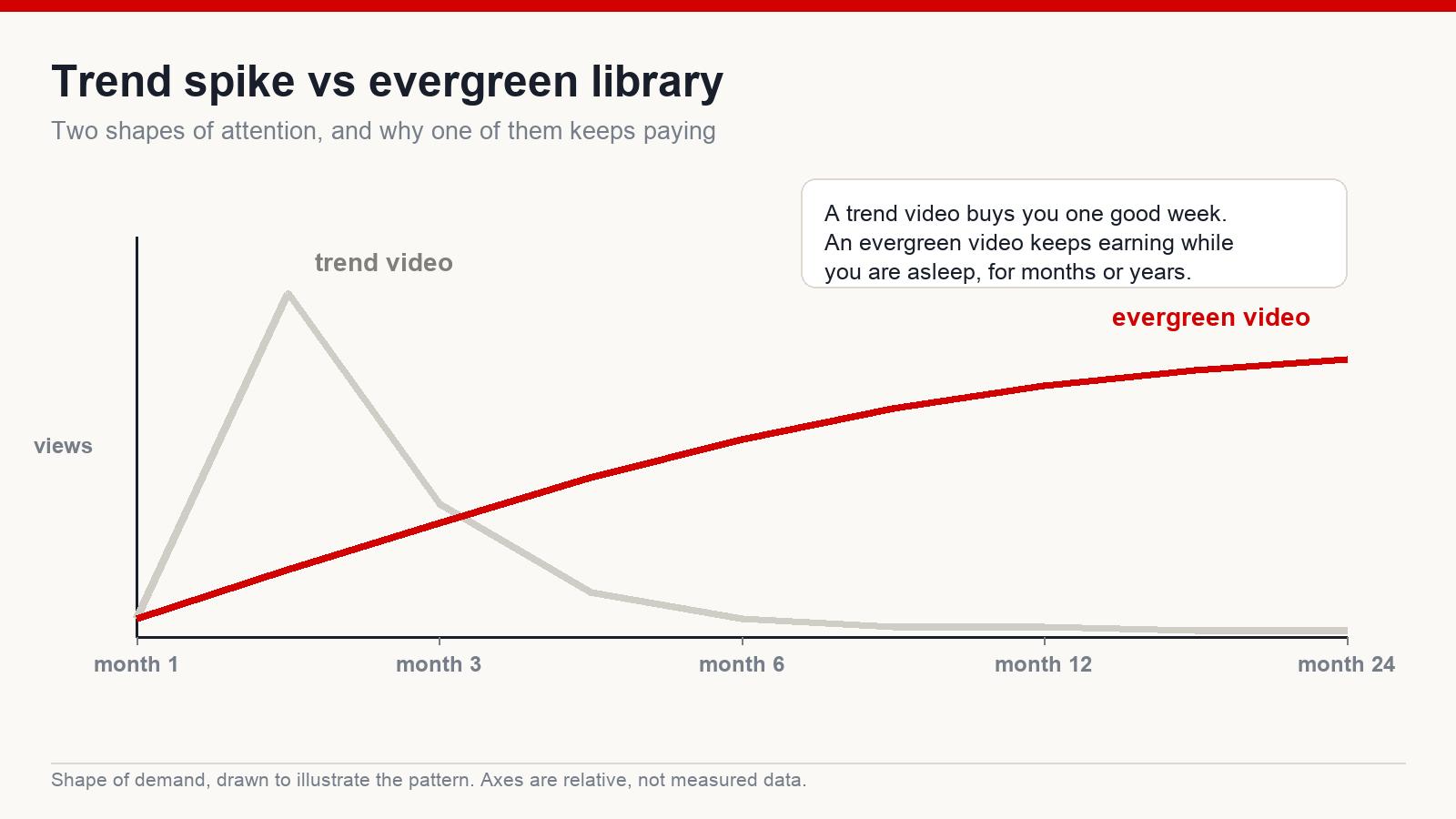
A trend video buys you one good week. An evergreen video with decent RPM becomes an asset that earns while you sleep. Build enough of them and your channel stops being a treadmill and starts being a library.
Why evergreen fits Western audiences so well
Audiences in the US, UK and similar markets search heavily for solutions: how to use a piece of software, how to invest, how to improve their health, how to learn a skill, how to understand something complicated, how to make a better decision. Content that genuinely answers those questions earns both search traffic and suggested traffic, which is the most stable foundation you can build on.
Quality does not raise RPM directly – it raises everything RPM depends on
To be precise: nobody at YouTube looks at your production values and adjusts your rate. But quality feeds every input that does move revenue. Better videos hold people longer. Longer watch time means more ad exposure per viewer. Stronger retention gives the algorithm a reason to keep recommending the video. Repeat viewers build channel-level signals that compound.
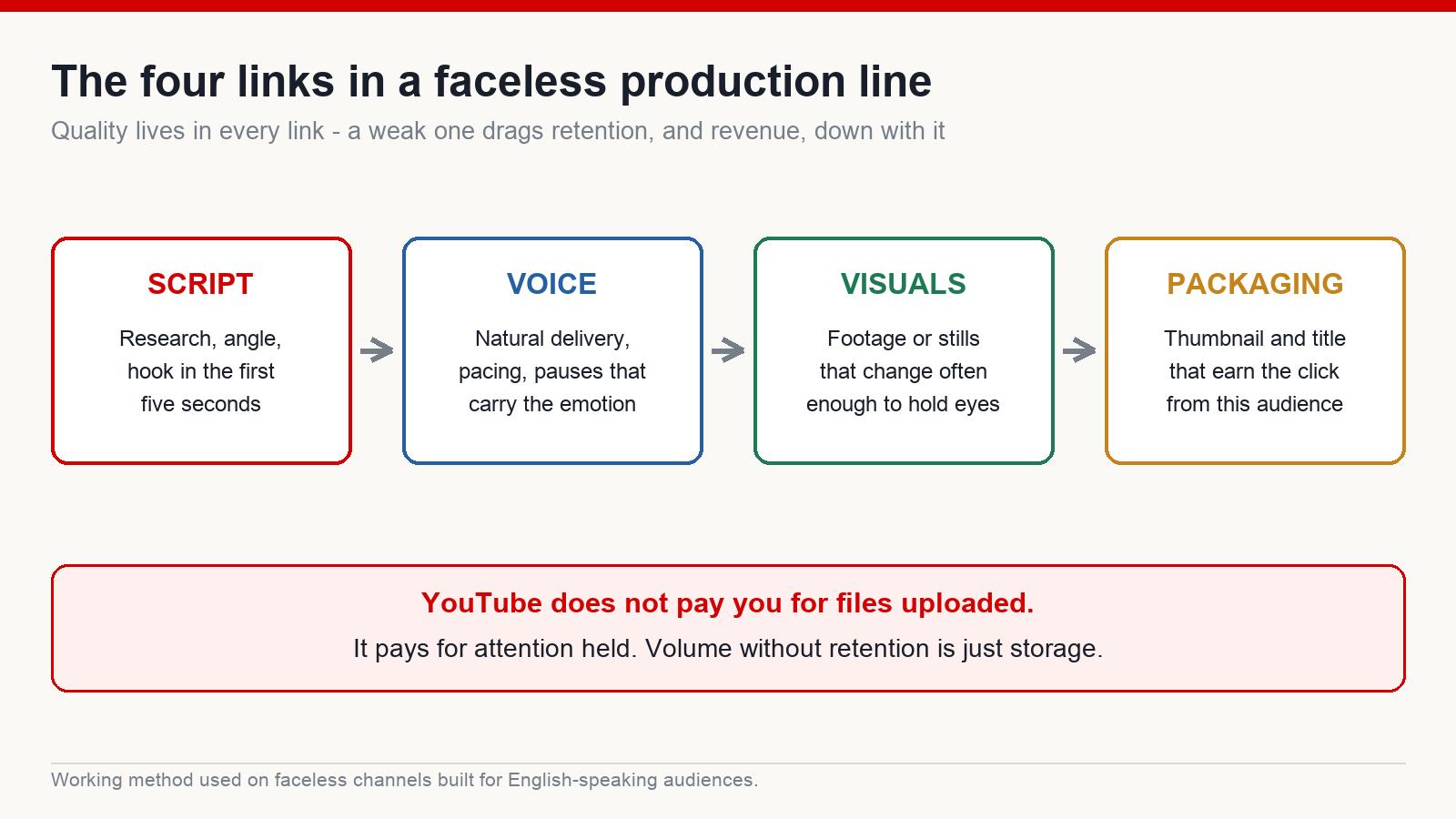
On a faceless channel, quality is not one thing. It is the script, the opening five seconds, the voice delivery, the editing rhythm, the visuals, the music, the thumbnail, the title, the structure of the climax, and how clearly the whole thing lands.
Faster is not automatically better
AI tooling has convinced a lot of people that output volume is the strategy. It is not. YouTube does not pay you for files uploaded. It pays for attention held.
A hundred videos nobody finishes is a weak system. Twenty videos that hold viewers, earn recommendations and generate revenue is a strong one. Prioritise quality over speed – which does not mean working slowly, it means working to a process.
Does longer video mean higher revenue?
It can, when it is done properly. Past the mid-roll threshold you are allowed to place ads inside the video, and on longer pieces with solid retention there are simply more opportunities for an ad to be served. That is why so many creators building for international markets favour the twenty to thirty minute range.
The trap is obvious once stated: a long video that drags is worse than a short one that lands. If people leave after sixty seconds, the remaining twenty-nine minutes are decoration.
Long-form works when it is engineered in beats. A hook that earns the first minute. A reason to keep watching every half minute or so. A genuine peak somewhere in the middle. An open question the viewer wants closed. Visuals that keep changing. A voice with variation in it. Music that supports the emotion. An ending that feels finished rather than abandoned.
Building for another market is not the same as translating into it
This is where most attempts fail. Someone writes a script in their own language, runs it through a translator, generates a synthetic voice, drops in stock visuals and publishes. Nothing happens.
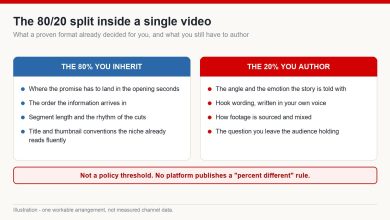
The reason is that an international audience is not just a language difference. It is a taste difference. They respond to different thumbnail conventions, different title structures, different storytelling pacing, different tolerance for synthetic narration, different visual standards, and different cues for whether something is credible.
So study the market instead of translating into it. Watch the channels already serving the audience you want. How do they open? Are titles long or short? What words survive on the thumbnail? How long are the videos? What voice do they use? What is the music doing? What are the comments complaining about? Which video in their catalogue is clearly being pushed hardest?
Do not translate a market. Learn one.
Five questions to screen a niche
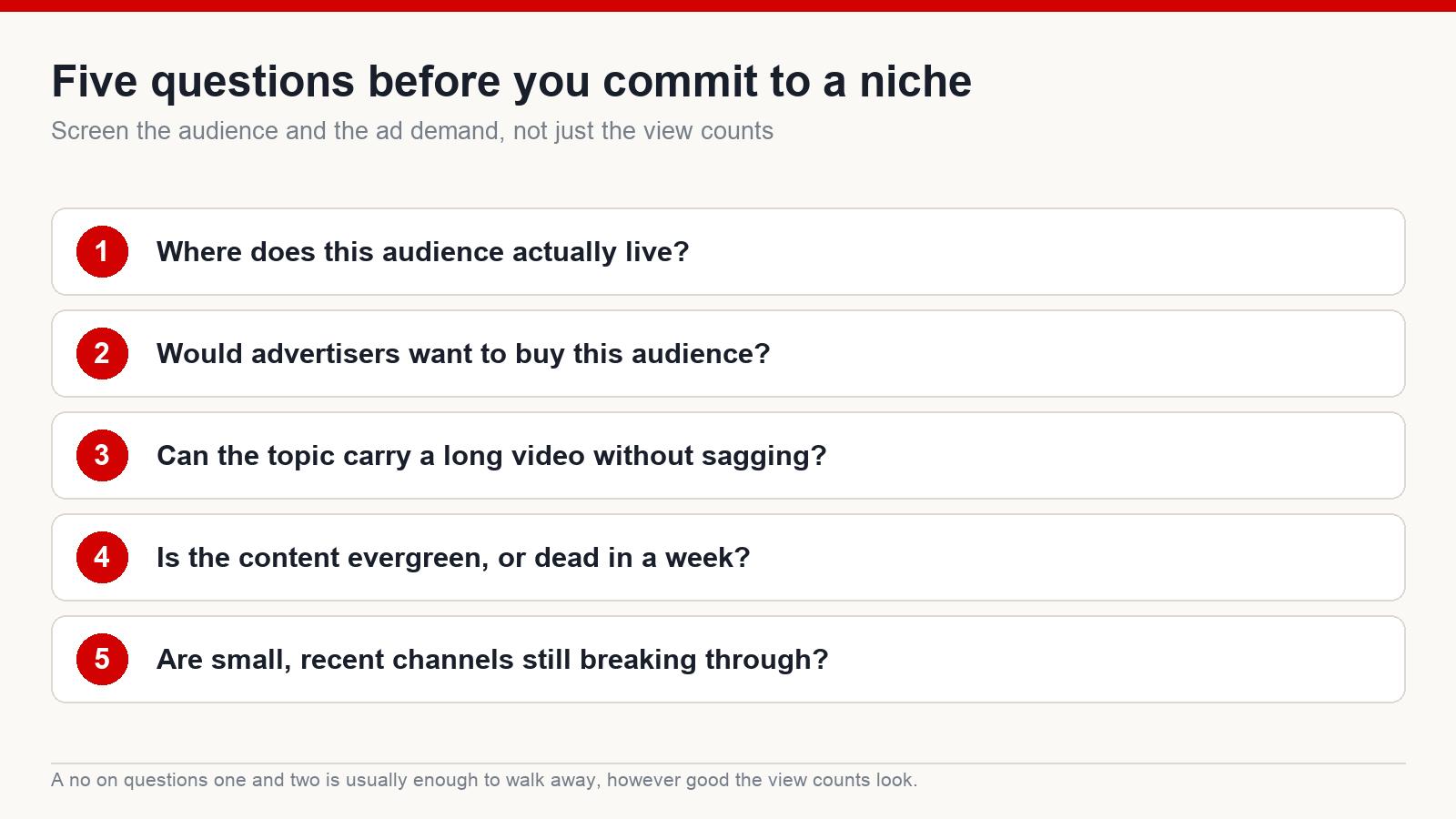
1. Where does this audience actually live?
If the bulk of the audience sits in low-ad-budget markets, you will need enormous volume for modest revenue. If the topic naturally attracts viewers in the US, UK, Canada or Australia, that is a point in its favour.
2. Would advertisers want to buy this audience?
Someone watching a breakdown of business software or a guide to personal finance is generally a more valuable impression than someone watching a quick entertainment clip. Not a universal law, but a reliable direction of travel.
3. Can the topic carry a long video?
Formats that support depth – documentary, storytelling, case studies, tutorials, explainers, tool reviews, event analysis, history, mystery – give you more room to work with. If a topic only makes sense in thirty seconds, you need a different revenue plan for it.
4. Is the content evergreen?
The more evergreen the niche, the more durable the library you are building. A video that keeps earning eighteen months after publication is worth several that died in a week.
5. Are new channels still breaking through?
Do not only study the giants. Look for small channels with low subscriber counts and high view counts. If recent entrants are still landing, the niche is open. If every winner is five years old with a million subscribers, think harder.
Categories worth researching
No list is right forever, and I would rather give you directions than a shopping list. But these are the areas I keep coming back to.
AI tools and software
Strong fit for international audiences: tool walkthroughs, software comparisons, automation workflows, business applications, video tooling, productivity systems. The category is tied to real products with real marketing budgets behind them.
Personal finance
Attractive advertising demand, and a category that demands care. Budgeting, saving, investing basics, credit, side income, retirement planning. Be careful here: this is territory where bad information genuinely harms people. Stick to what you can support, avoid income promises, and make it clear you are not giving individual financial advice.
Business and careers
Remote work guides, in-demand skills, business case studies, productivity systems, freelancing. High-intent viewers, and advertisers who want them.
Faceless documentary
If you can write narrative, this is one of the strongest formats available. History, technology, notable figures, events, unsolved cases, science. Long runtimes, strong retention, long shelf life.
Narrative storytelling
Rescue stories, emotional true stories, moral tales, survival narratives. RPM here is often lower than in finance or software, but strong international reach and long runtimes can still add up to a serious channel.
Mistakes that keep RPM low even when views are high
- Chasing only short-term virality. Viral spikes bring views, but if the topic carries no advertising value the revenue does not follow. Mix trend content with evergreen.
- Being too broad. When your channel covers everything, YouTube struggles to characterise your audience and advertisers struggle to target it. Positioning is worth money.
- Ignoring where viewers come from. Publishing in English while your titles, thumbnails and topics appeal to somewhere else entirely means your traffic lands in lower-paying markets.
- Video too short for the goal. Short content is not inherently bad, but if long-term ad revenue is the aim, longer formats with real retention have the structural advantage.
- Flat synthetic narration. Voice carries an enormous share of retention on faceless content. A monotone read loses people in the first minute, and weak retention weakens recommendation.
- Copying competitors line for line. Reworking a proven format is fine. Reproducing someone’s video almost exactly leaves your channel with nothing of its own, and audiences notice repetition faster than you think.
A working sequence for building an RPM-aware channel
Step 1: pick the market before the topic
Decide who you are actually building for – US, UK, Canada, Australia, or English-speaking international generally – and choose the niche afterwards. Doing it in the other order is how people end up with a topic that cannot reach the audience they wanted.
Step 2: study competitors inside that market
Not competitors in your own country working in your own language. Analyse the channels already serving the exact audience you are targeting: their top videos, their comments, their thumbnails, their edit pace, their runtimes, their narrative structure.
Step 3: favour topics with a long shelf life
Trends are a supplement, not a foundation. Build a spine of content that will still make sense next year.
Step 4: go long where the topic earns it
Do not pad. But when a subject genuinely supports depth, build a fifteen to thirty minute piece with a retention structure planned in advance.
Step 5: invest in voice and script above all
On a faceless channel the voice is the personality and the script is the skeleton. Beautiful visuals cannot rescue a weak version of either.
Step 6: read RPM at the video level
In YouTube Studio, compare RPM video by video rather than staring at view counts. You will regularly find a lower-view video that earns better than a popular one. Those are the videos worth studying, because they are telling you which part of your audience is actually valuable.
Stop asking how to get more views
The most common question I get is how to get more views. It is a fair question, but it is incomplete. The better one is: how do I make each view worth more?
Once you start there, your strategy changes shape. You stop picking niches because they look easy to go viral in. You start picking them because they have a valuable audience, advertisers who want that audience, room for long-form, retention potential, evergreen shelf life, and a production process you can scale to more videos and eventually more channels.
That is the move from making videos to building an asset.
The bottom line
If you only look at view counts, you will be misled constantly. A channel with big numbers may earn little. A viral video may be worth chasing or worth ignoring. A crowded niche may be a trap.
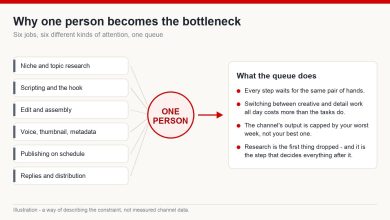
The questions that matter are narrower and harder: where do these views come from, who are these viewers, would an advertiser pay to reach them, does the content hold attention long enough, will it still be relevant next year, and can the production process be repeated without me doing every job myself?
RPM differs between markets because advertising economies differ between markets. That gap is exactly why building faceless channels for English-speaking audiences is worth the effort. But it is not magic. It only pays off when the niche is right, the quality is real, the audience is understood, and the whole content system holds together.
Frequently asked questions
What is YouTube RPM?
RPM is revenue per 1,000 video views after YouTube’s share is deducted. It tells you what you actually keep, which is why it is more useful to a creator than CPM.
Is RPM really higher in the US than in other markets?
Generally yes. Advertisers in the US and comparable Western markets have larger budgets and bid more aggressively for attention, and that flows through to creator RPM.
What counts as an “international view”?
Views coming from audiences in markets with high advertising demand – typically the US, UK, Canada, Australia and parts of Western Europe. Faceless creators target these audiences specifically because of the RPM difference.
Does publishing in English guarantee a high RPM?
No. English widens your reach. RPM still depends on the niche, the countries your viewers are actually in, video length, content type, advertiser suitability and retention.
Can a faceless channel become a full-time income?
It can, for some people, with the right niche, an audience in a strong ad market, decent RPM, real production quality and a repeatable process. It is not guaranteed, results vary widely, and platform policies change.
Do longer videos earn more?
They can, because longer runtimes with good retention allow more ad placements. If viewers leave early, length gains you nothing.
Which niches tend to have the best RPM?
Personal finance, technology, software and AI tools, business, education, careers and certain documentary formats tend to attract higher-bidding advertisers, provided you are reaching the right market.
Should I focus on views or RPM?
Both. Views give you scale, RPM gives each view value. A healthy channel needs a steady flow of views and an RPM worth having.
If you are building a faceless channel as a business rather than a hobby, the shift in question is the whole point: not “how do I get more views” but “how do I make each view worth more”. That is when YouTube starts to look like a system instead of a lottery. I write more about that approach at mmoyoutube.com.