Emotion + Context + Action: A YouTube Title Formula You Can Fill In Tonight
The two fears that freeze you over the title box
You type a line into the title field. You read it back. Delete. Type another. Delete that too. The cursor blinks on empty white while you sit there with your hands on the keyboard and nothing to put down. I know that feeling exactly. I have sat like that for whole evenings, a finished video sitting on my drive that I would not publish because I could not think of a name for it.
Two voices are arguing in your head. The first: make it punchy, nobody clicks a flat title. The second cuts straight in: but if I write it like the channels that are winning, I will get labelled a copycat and lose monetization, and then all of this was for nothing. So you are wedged between two fears. You cannot go forward and you cannot go back.
What you are actually afraid of is not a line of text. You are afraid of pouring one more video into the void. A week of editing, every shot trimmed, the voiceover recorded three times, and then it lies there on a couple of dozen views. The content is not bad. I mean that – your content is probably not bad. Nobody has given it the click that starts everything.
This is where I want you to stop. A good video still dies if its wrapper is ugly. That is unpleasant to hear, and it is true.
The good news is that the wrapper is not a gift you were born with or without. It is a formula. I did not arrive knowing how to write titles; I wrote bad ones for a long time and eventually pulled a few tidy rules out of the wreckage, and this article hands them all over.
As for the fear of looking like everyone else – hold one sentence and the whole article gets lighter: what you copy is the formula, never the content. Those two things are separated by an enormous gap. I will show you exactly where the line sits, so you can write hard-hitting titles and still sleep well.
The title formula: Emotion + Context + Action
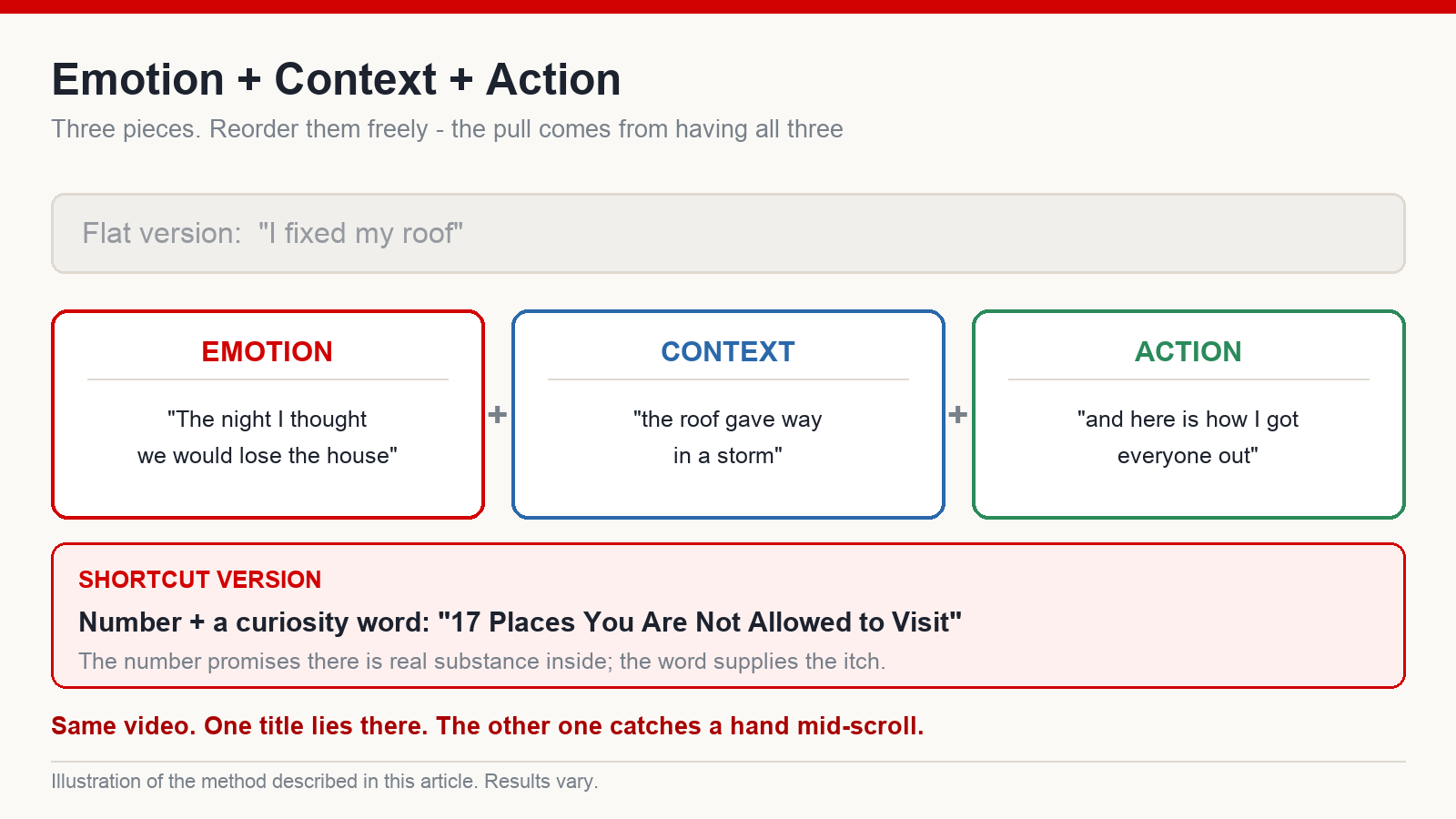
Enough typing and deleting. Here is the frame I use. You assemble a title from it; you do not sit waiting for inspiration to knock.
Three pieces: Emotion + Context + Action. That sounds dry until you see one example.
Say your video is about repairing a roof. The title that jumps into everyone’s head is the same: “I fixed my roof”. Accurate, and completely flat. There is no reason for a stranger to stop a moving thumb. Now fit the frame:
“The night I thought we would lose the house – the roof gave way in a storm, and here is how I got everyone out”
Let me pull the three pieces apart:
- Emotion – “the night I thought we would lose the house”: straight into the fear.
- Context – “the roof gave way in a storm”: a specific scene the reader can picture and almost hear.
- Action – “here is how I got everyone out”: a promise of a way through, a reason to keep watching.
Same video. One title lies there. The other one catches a hand mid-scroll.
What I like most about this frame is that the three pieces reorder freely. Open on the context if you like, lead with the emotion if that lands better – there is no rigid law. As long as all three are present, the sentence has pull, and that stays true even when the body of the video was assembled with AI tools. You are not copying anyone’s title. You are filling a frame.
If you want something even faster, there is a short version: a number plus a curiosity word. One number at the front and one word that creates an itch – “hidden”, “abandoned”, “forbidden”, “dangerous”, “banned”. Something like:
“17 Places You Are Not Allowed to Visit”
Short, and the reader’s mind immediately wants to know which places, and why. The number promises there is real substance inside; the curiosity word supplies the itch that makes them click.
Try it now. Take the flattest title you were about to put on your next video and rebuild it as Emotion + Context + Action. Read it out loud. You will hear the difference yourself.
The thumbnail is the packaging – analyse it first, and let the title follow
Before you pour everything into wording, I have to admit something, because I made this exact mistake.
When I started, I put all my energy into the title. I would spend an afternoon polishing every word until it rang, then throw any old thumbnail on top to be done with it. Wrong. Wrong from the root.
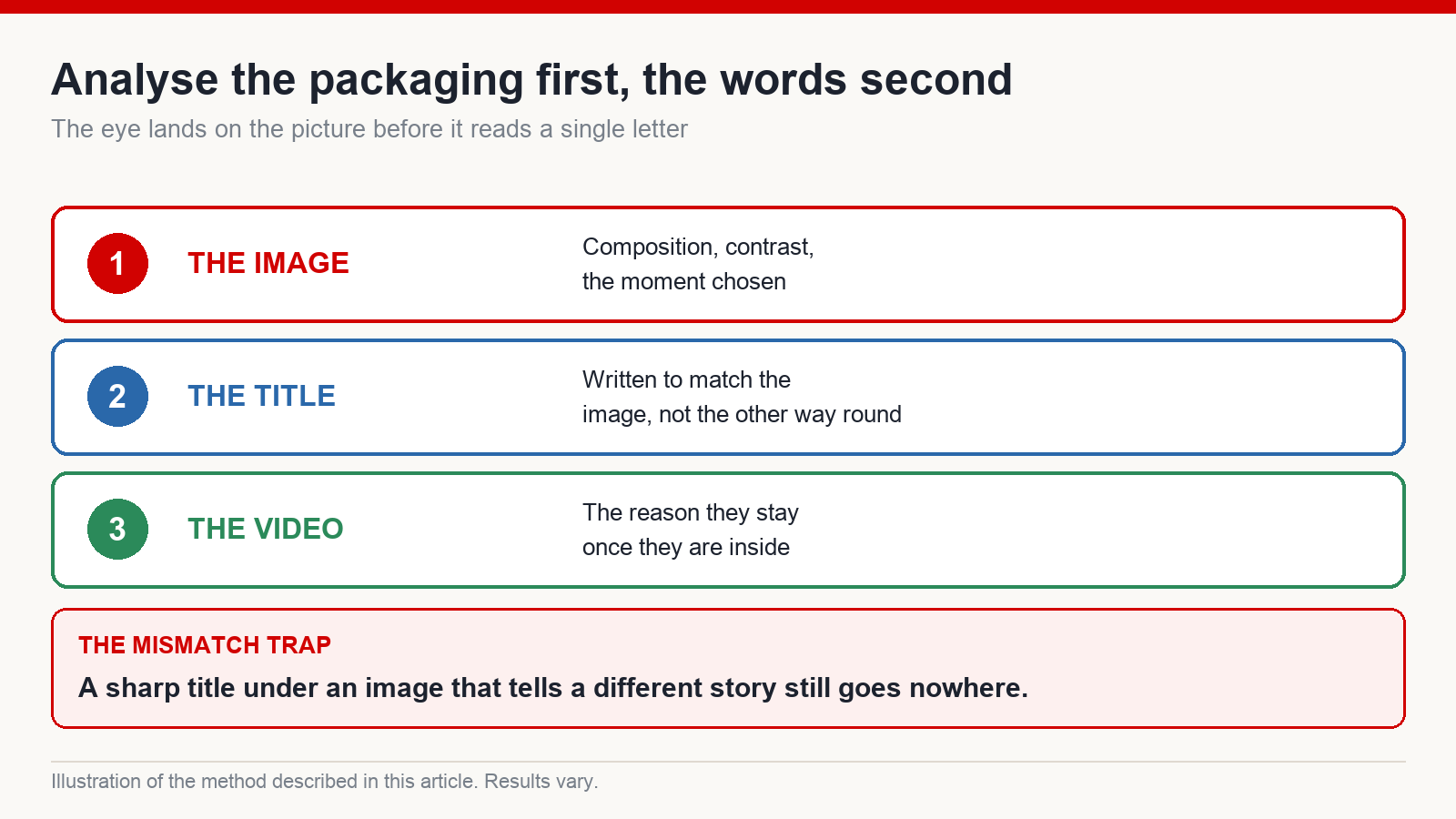
Because the first thing that hits a person is not text. It is the image. On a suggested feed, in a forest of videos, the decision to stop or scroll happens in well under a second – and in that instant they are looking at the picture, not reading the title. So I ended up with a principle I now put ahead of everything else: the thumbnail is the first thing you analyse about any channel. The title only comes after.
It sounds backwards until you audit a channel that is climbing. Its strength is in the image: the composition, the expression, the colour, the moment that was chosen. I dissect that first – why does this frame make someone press? – and only then look at what they wrote to accompany it. Not the other way round.
I think of the thumbnail as packaging. In a supermarket you pick up the box because the outside caught your eye, and only then turn it over to read the ingredients. Nobody reads the label on a box they never bothered to pick up. Video works the same way: the wrapper makes people stop and press, and the title is the line of text that explains the wrapper.
And here is where a lot of people trip: the title and the thumbnail have to tell the same story. However well written your title is, if the image runs off in a different direction, the video sits still. The viewer feels the mismatch, hesitates for half a second, and leaves. The box and the label have to say the same thing before anyone trusts it enough to open.
Copy the FORMULA, never the CONTENT
Talking about eye-catching packaging brings up the question I promised to answer – the second of the two fears from the start. Almost everyone building for an international audience runs into it: if I make something that resembles a competitor, will YouTube penalise me? Is that stealing?
I understand it. You see a video taking off – striking thumbnail, tight title – and you want to learn from it, but your hand stalls, afraid that resembling it will cost you a channel you spent months on. You are stuck on a misunderstanding, and once it is cleared the thing that scares you turns into an advantage.
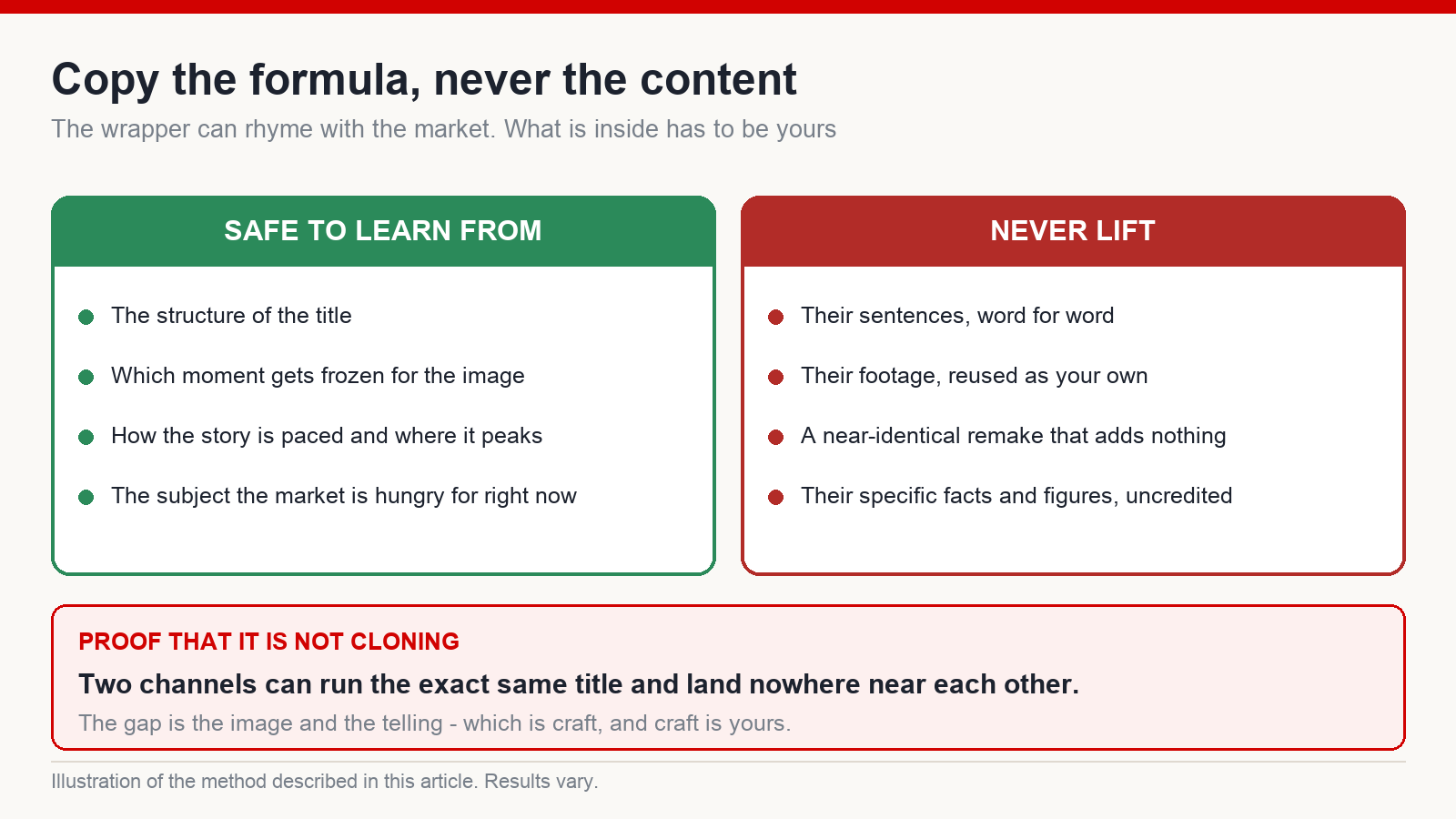
The principle fits in one line: copy the formula, never the content. You learn the structure, the way the story is paced, where the peak is placed – nobody owns those. The actual sentences and the specific details inside are never lifted. I think of it as second-floor copying: the wrapper can rhyme, the inside has to differ.
The wrapper rhymes so you catch the wave the market is currently on – whichever moment and setting are winning, you keep. The inside differs so the viewer nods and thinks “ah, this is part two, this is a new angle”, instead of watching a hollow imitation. Practically, you can use an AI assistant to check that nothing you wrote overlaps someone else’s phrasing: keep the frame, replace the core, and ship a version that is genuinely yours.
And here is the proof that learning the formula does not turn you into a shadow: two channels can run the exact same title and land nowhere near each other. Why? Different thumbnail, different telling. The gap is your craft, not whose words you borrowed.
If you want to lift your own click-through rate, incidentally, spying on competitors is not the easy route – you cannot see their CTR, only their view counts. The easy route is auditing the video on your own channel with the highest CTR: keep the moment that is winning, then change the details and the substance for the next one.
Being different is not a policy loophole. Genuinely different content is the only thing that survives long term.
Clone a winner with niche and country variants
That habit of auditing your own best-performing video does more than raise clicks. It lifts a much heavier weight off you.
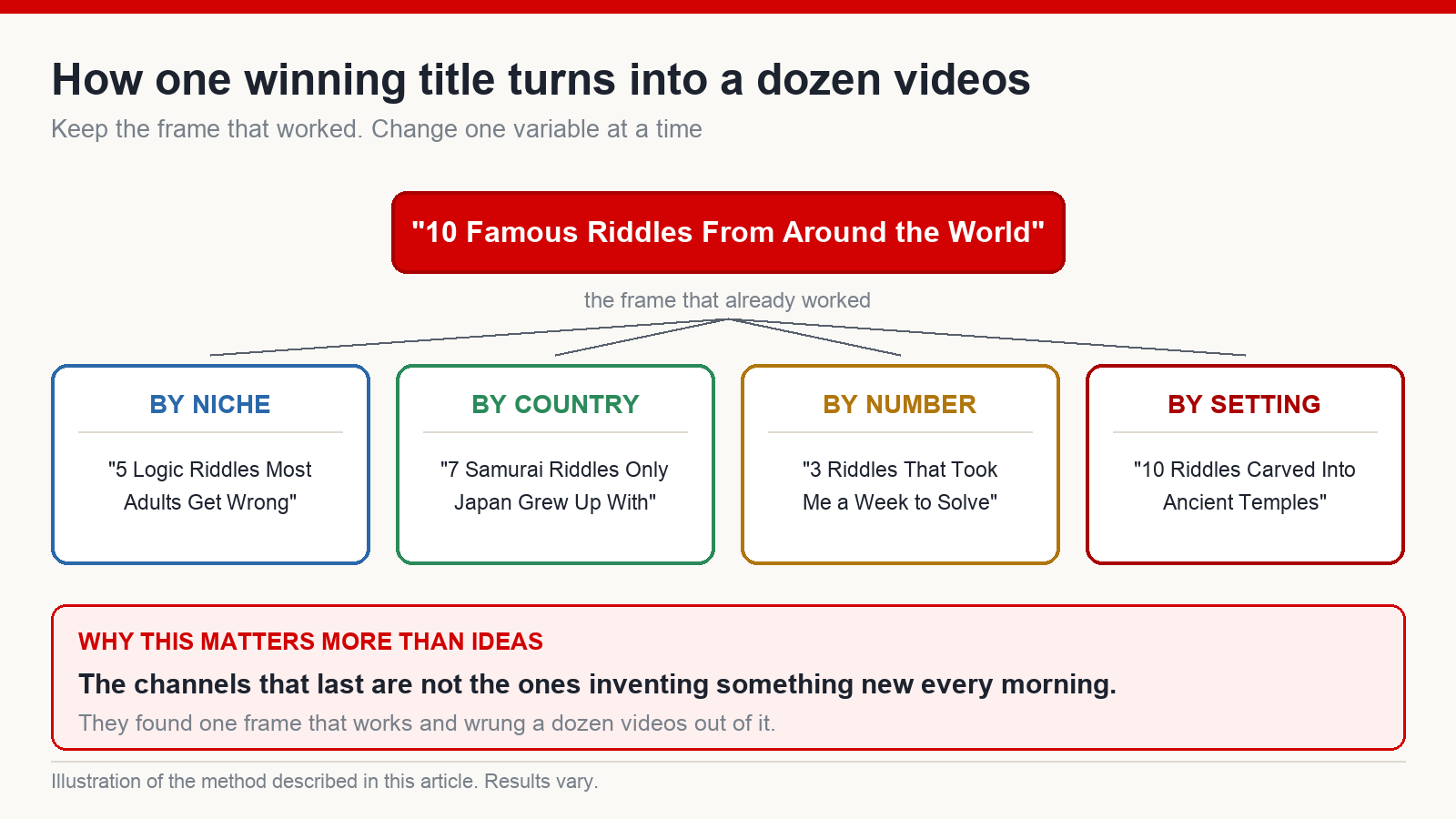
There is a quiet pressure that wears down solo creators: every morning you open the laptop owing the world a brand-new idea. One a day, thirty a month, until you are empty and staring at a blank screen with a blank head. I have been in that exact spot. But look at the channels that last – they are not the ones producing the most ideas. They are the ones that found ONE working formula and wrung dozens of videos out of it.
The rule is simple: when a title has performed, do not throw it away to go hunting for a new one. Keep the frame and change the variable inside it – by niche, by country, by number, by setting.
The example I use most often. You have a title that worked: “10 Famous Riddles From Around the World”. Instead of straining for a different subject, ask an AI assistant for ten similar titles and then NARROW them yourself, by niche and by country: “5 Logic Riddles Most Adults Get Wrong”, “7 Samurai Riddles Only Japan Grew Up With”. Still riddles, still a number, but now rooted in a far more specific group of viewers.
The second method is even lighter: change a couple of short keywords inside the frame. If “growing peanuts from seed” wins, try “growing apples from seed”, “growing grapes from seed”. Or swap the backdrop: a video set “in the desert” doing well branches into “on a mountaintop”, “underwater”, “in the snow”. The frame is untouched; only the scenery behind it changes.
By the same logic, some patterns run for years without wearing out – the “What happened when…” shape, for instance. People keep the question frame and change only the variable, and it keeps working season after season.
Do you see it? A solo creator does not need to be an idea machine. You need one winning frame, then you multiply it. Today, open your own channel and find the video that is winning most – that is your first template.
Use the long-tail phrase as the title itself
Now back to the empty title box we started with. For a while I did this backwards without realising. I would invent a resonant, well-turned headline, enjoy the sound of it, and only then jolt upright – what about the keyword? So I would jam the keyword into a sentence that was already sealed shut. Reading it back, it was horribly clunky, the words tripping over each other, like a jacket that fitted properly with a large patch stitched onto the chest afterwards. Ugly and forced.
It took me far too long to see I was doing it in the wrong order. Do not write the title and then insert the keyword. Take the keyword phrase and make it the title.
Two kinds are worth separating. A short keyword is a two- or three-word phrase like “logic riddles”. A long-tail keyword is four words or more and much more specific, like “logic riddles most adults get wrong”. Here is the useful part: a long-tail phrase already contains the short keywords inside it. Lift the long phrase, set it as the title, and the sentence reads naturally and carries its keywords without any stitching.
The selection bar is also lower than people assume. Many creators wait for a phrase doing 5,000 to 50,000 searches before they dare use it. You do not need that. In my own work, a long-tail phrase doing more than about a thousand searches a month is workable, because the sum of the smaller keywords contained inside it can be considerably larger. That thousand is my working threshold, not a published standard – treat it as a starting point and check it against your own tools.
And one thing has genuinely changed in the last few years. Keywords are no longer written only for people; they are read by machines too. I used to place keywords to help sales. Now I place them so an AI system can read what my channel is about. The method is simple: the main keyword once in the title, and roughly five mentions spread through the description. Picture yourself explaining to a machine, repeating just enough that it cannot mistake what the video covers.
One last note that matters if you are writing in a second language: do not trust a translation from your own tongue. Plenty of phrases sound meaningless once translated, and yet they are exactly what native speakers type into the search box. Trust the original phrase and the search data over your own ear.
Rewrite the opening line, then a checklist for tonight
You have the wrapper now. The wrapper gets people to click. But holding them through the first thirty seconds comes down to a single sentence – the first thing you say. This is where I watch videos with a good wrapper and good content die anyway.
Notice that almost every beginner opens identically: “Welcome to the channel, today I would like to introduce five things…”. Polite. But an international audience does not owe you three seconds of greeting. They clicked because the wrapper promised a story, and now you have put them in a queue. Nobody performs the welcome speech any more. Go straight into the scene, straight into the problem.
What I do: take the highest peak in the video – the moment people would rewind to watch again – and pull it up to the opening line. Explanation and setup come later. An opening that does not feel like an opening. On AI-assisted videos I usually keep the body the machine wrote, but I retype the first few lines myself, because that is the stretch where people decide to stay or go, and I do not hand that stretch to a machine.
Here is the whole article packed into something you can do tonight:
- Sketch the wrapper – the thumbnail – first, and let the title follow it.
- Write the title as Emotion + Context + Action, or lift a long-tail phrase above roughly a thousand monthly searches and use it as the title.
- Once a formula works, multiply it with niche and country variants instead of discarding it for something new.
- Learn the formula from people who are good, but write the substance in your own voice.
- Rewrite the opening lines by hand.
Now stop reading. Pick exactly one of your videos – one – close this page and open it. Rewrite the title. Rebuild the wrapper. Tonight.
Do not let a good video of yours die over its wrapper.
Will YouTube penalise me for making thumbnails and titles that resemble a competitor’s?
What gets penalised is lifting the content itself – copying sentences, reusing footage, producing a near-identical remake that adds nothing. Learning the frame, the structure and the moment the market currently wants is not something anyone can own. My rule: the wrapper may rhyme, the inside must be yours. Same wrapper, different core, is learning a craft rather than stealing.
Should I write the title first or make the thumbnail first?
Thumbnail first. The first thing a viewer’s eye meets is the picture, not the words. I sketch the wrapper, then write a title that matches its story. Doing it the other way round – a strong line under an image that says something else – leaves the video sitting still.
How many monthly searches does a long-tail keyword need to be worth using?
You do not need a giant phrase pulling tens of thousands. In my experience anything over roughly a thousand searches a month is workable, because the smaller keywords contained inside the phrase can add up to considerably more. Take that long phrase and make it the title, rather than writing a headline and inserting a keyword afterwards.
How do I publish consistently when I have run out of ideas?
Stop forcing a new idea every day. Find the video already winning on your own channel, keep the frame and change one variable – the niche, the country, the number, the setting. One winning template can yield dozens of videos.
A note on the numbers: the search thresholds and rules of thumb in this article come from my own work building and teaching channels, not from published platform standards. I am not promising views or income – results depend on the niche you pick, your craft and how many times you are willing to rebuild. What I am sure of is that neglecting the wrapper costs a good video dearly.
Written by Phuc, a YouTube trainer who has been building on the platform since 2017 (nine years), working mainly on faceless channels aimed at English-speaking audiences.
The full step-by-step system I run with the creators I work with lives at mmoyoutube.com.
Disclaimer: personal experience and method, not a guarantee of any result. YouTube’s policies and ranking behaviour change over time.