The 80/20 Rule for Video: Keep the Structure, Change the Experience
There is a question I get from almost every new creator, and it usually arrives phrased as a self-accusation: if I keep studying other people’s videos, how is my channel ever going to sound like mine?
The honest answer is that most creators whose work you admire did not begin by inventing a format. They learned one the market had already validated, made it fluently enough that the mechanics stopped taking up room in their head, and only then started bending it. The originality came last. It usually does.
Japanese craft traditions have a name for that sequence: shu-ha-ri. Shu is following the form exactly. Ha is departing from it once you understand why the form exists. Ri is leaving it behind entirely and working from your own instinct. Nobody reaches ri by skipping shu. It has nothing to do with video, and it still describes what happens on a channel more accurately than most advice about finding your voice.
What the 80/20 split actually means
Think about building a house. You do not reinvent how a foundation is poured. Foundations are a solved problem, and getting creative with one is how buildings fall down. What you change is the layout, the light, the materials, the way it feels to walk in the door.
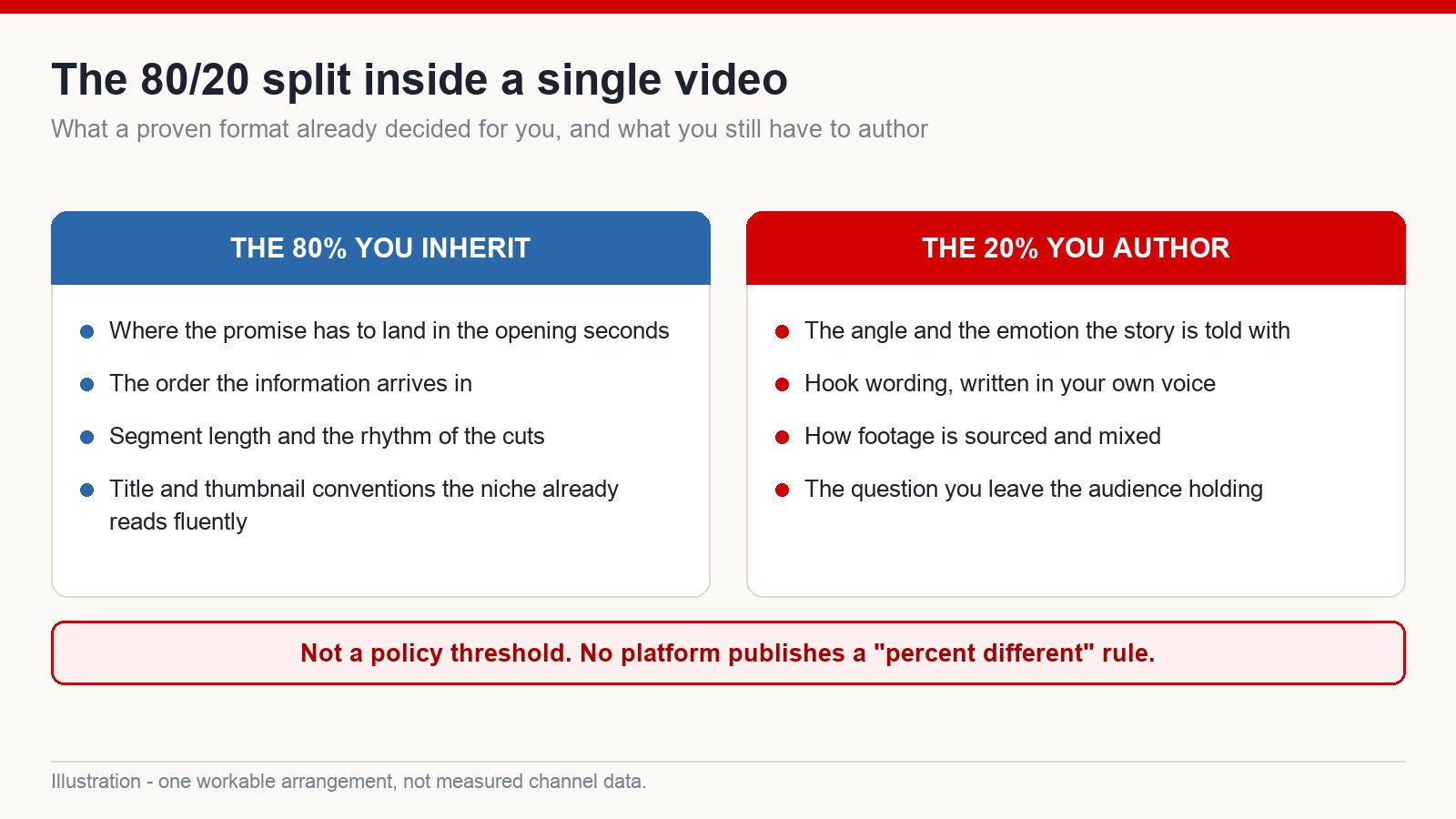
A video works the same way. Roughly four fifths of it is load-bearing structure that the format has already settled: where the promise has to land in the opening seconds, the order the information arrives in, how long a segment runs before the viewer needs a change, the title and thumbnail conventions the audience in that niche reads without thinking. Those are conventions, not property. Nobody owns a countdown, a cold open, or a “how this animal survives that place” premise.
The remaining fifth is where your channel actually lives: the angle, the emotion the story is told with, how you write the first line, where the footage comes from, what you leave the viewer holding at the end. That fifth is small and it is decisive. It is the difference between a video somebody watches and a video somebody remembers came from you.
What 80/20 is not
Before the practical part, one correction, because this idea gets confused with a much more dangerous one.
There is a persistent myth that a video only has to be a certain percentage different to be safe: change 30 per cent and you are clear, or 20, or 40, depending on who is repeating it. No platform publishes such a number. No copyright framework works that way. The figure is invented, and creators who build on it get hurt.
Two separate tests apply to any video that borrows from elsewhere. First, do you have the right to use the material at all? Second, has enough original work been added on top of it that the finished video is your own? Those are judged on the whole video, by humans and systems reading intent and substance, not by a ratio anybody can calculate in advance.
So keep the two ideas apart. The 80/20 rule applies to structure you observed – patterns, pacing, formats, the shape of a good hook. It does not apply to files you took. You can study a video’s architecture all day. You cannot lift its footage, its narration or its edit and file the difference down until it passes.
Six places to spend the 20 per cent
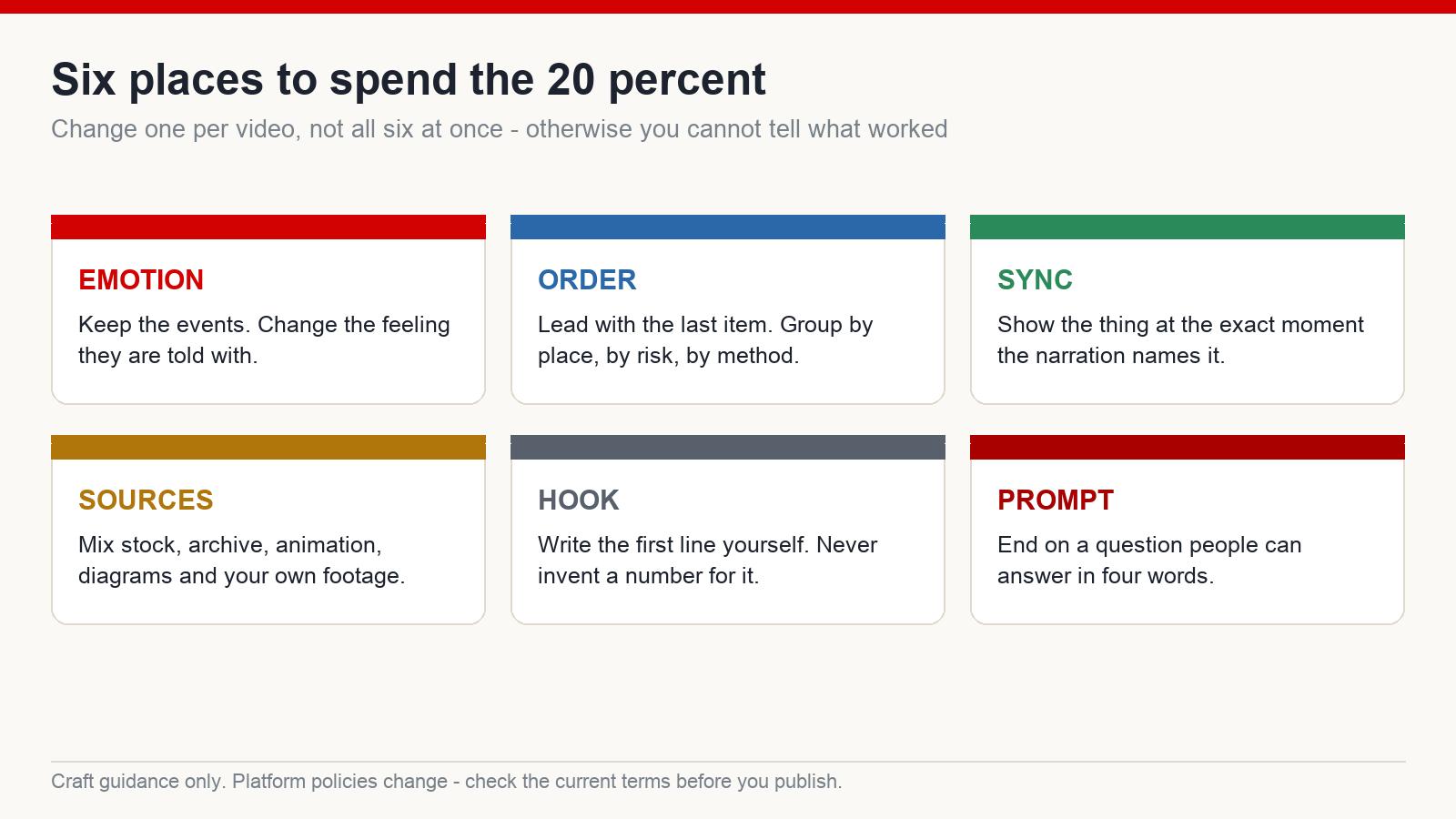
1. Change the emotion, not the events
The same set of facts can be told a dozen ways. A tense match, a dangerous animal, a historic failure – the events stay fixed, but the register does not. Told as comedy, as suspense, as an inspiring turnaround, or from inside the head of one participant, the material barely changes and the viewing experience changes completely.
This is the cheapest lever available and the one most people never touch, because it happens in the script rather than in the edit, and the script is invisible in the finished file.
2. Reorder it
List formats are the obvious case. A ranking of the ten most dangerous snakes does not have to count down from ten. You can open on number one and spend the rest of the video explaining what could possibly beat it. You can group by region instead of rank, or by how the danger works – venom, ambush, camouflage – so the list becomes an argument rather than a queue.
Nothing about the research changed. The experience of watching it did.
3. Say it, show it
This is the single largest quality gap between amateur and professional faceless video, and it is entirely mechanical. When the narration says the animal struck fast, the strike appears at that exact moment. Not two seconds later. Not a still photograph. Not generic footage of the same species standing around.
Audio and image landing together is what makes a moment feel real. Drift between them and the viewer stops trusting the video without ever being able to say why. Getting this right takes patience in the edit and nothing else – no budget, no equipment, no talent you do not already have.
4. Blend your sources
A video assembled entirely from one stock library looks like a video assembled entirely from one stock library. Build it as a mix instead: licensed clips, archive material, illustration, motion graphics, simple diagrams, your own footage where you can shoot it. The shifting texture keeps the eye moving and gives the video a look that cannot be reproduced by anyone typing the same search term into the same library.
Keep a record of where every clip came from and what its licence allows. That record costs minutes now and saves the channel later.
5. Write your own opening line
Content can be near-identical and the first sentence still decides whether anyone stays. “Today we are going to look at…” asks the viewer to wait. A good opening gives them a reason not to.
One warning, because it is a common shortcut: do not invent a statistic to make a hook land. Numbers pulled out of the air get repeated, quoted back at you, and eventually noticed. A hook built on a real tension – a contradiction, a question the viewer already half-holds, a claim the video then earns – works better and does not decay.
6. Ask something answerable
“Like, share and subscribe” is a request for a favour. A question is an invitation. Ask which option the viewer would have chosen, or which of two things they would take, and give them a way to answer in four words. Comment sections built that way read as conversation rather than obligation, and the prompt costs one line of script.
The copying stage matters more than the creative stage
Most new creators want to be original from video one. The problem is that originality without understanding is just guessing. If you cannot explain why a video worked, any change you make to it is a coin flip.
So spend real time in the shu stage, and study deliberately rather than passively. Take a video that performed well in your niche and write down what happens in the first fifteen seconds, where the pace changes, how the story is structured, what the thumbnail is promising, what the creator asks for and when. Not to copy it – to be able to name the mechanism.
Once you can name it, the 20 per cent lands somewhere useful. Change one lever per video rather than all six, or you will have no idea which change was responsible for anything.
Originality is not invention
A lot of creators stall because they are waiting to think of something nobody has ever done. Very little successful content is like that. It sits on structures that have been proven repeatedly, and it wins on how it is told: the angle, the pacing, the emotion, the pictures, the experience of watching.
The 80/20 rule does not cost you your creativity. It puts your creativity somewhere it can be felt, on top of a foundation the audience has already shown they will stand on.
Frequently asked questions
Should a beginner try to be completely original from the start?
Usually not. Learn the structure of formats that already work in your niche, make several videos inside that structure, and add your own layer once you can explain why the structure works.
Where should the 20 per cent go?
Anywhere the viewer feels it: the hook, the emotional register, the ordering, the visual sourcing, the closing prompt. Choose one per video so you can tell what made a difference.
Is there a percentage of change that makes a video legally safe?
No. That number does not exist in any published policy or copyright framework. Rights to use the material and value added on top of it are two separate tests, and both are judged on the finished video as a whole.
What creates a lasting difference between channels?
Not an unheard-of idea. It is the ability to give a viewer a better experience of familiar material – clearer storytelling, better rhythm, pictures that match the words, and a point of view that stays consistent across uploads.
The question worth asking next time
The next time you watch a video with a huge view count, do not ask how you could make something entirely unlike it. Ask what would happen if you kept the structure and told it better: which emotion is missing, which order would surprise more, which moment deserves a picture it currently does not have.
That is the fifth of the work that becomes a channel. If you want a structured way to study formats and build your own layer on top of them, that is what we work on at mmoyoutube.com.