Four Decisions That Quietly End Most New YouTube Channels
Ask someone whose channel stalled why it stalled, and you will usually hear a version of the same three sentences. The algorithm does not push new channels. The niche is too crowded. It is too late to start now.
I have watched a lot of new channels since I started making videos in 2017, and that is almost never what happened. What happened was a set of decisions made in the first month – before the algorithm had anything to judge – that made the channel very hard to grow no matter how much work went in afterwards.
A word about the numbers people quote here. You will see claims that some enormous percentage of new channels are abandoned within a month. Nobody can verify figures like that, and I am not going to repeat one. What I can say is that abandonment early on is extremely common, and that the reasons tend to rhyme.
Here are the four I see most.
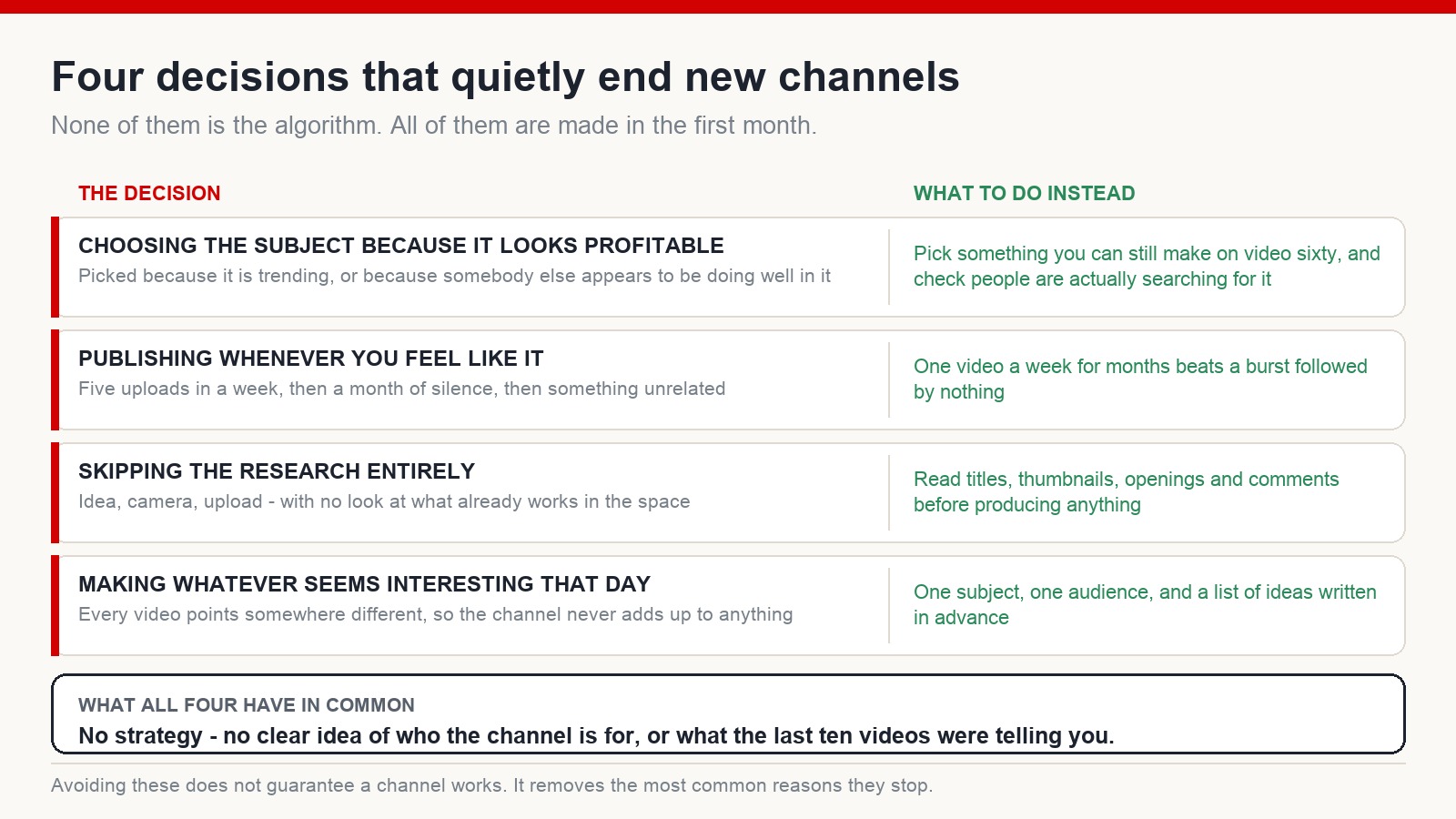
One: choosing a subject because it looks profitable
This is the biggest one, and it is the hardest to undo later.
Somebody picks a subject because it is trending, or because a channel in it appears to be doing well, or because a video told them it was a high-value category. What they never ask is whether they can still be making videos about it on number sixty.
Three questions worth answering honestly before committing:
- Can you list fifty or a hundred video ideas inside this subject right now?
- Do you know enough – or are you willing to learn enough – to be worth watching rather than repeating what is already there?
- Is there evidence people are actually looking for it, rather than a claim that the category pays well?
A subject that attracts views but that you cannot sustain is not an opportunity. It is a commitment you will break in eight weeks. And the ones that look most profitable are, by definition, the ones with the most competition already established.
Two: publishing whenever you feel like it
Five uploads in one enthusiastic week. Then nothing for a month. Then a return with something completely unrelated.
The damage is not that the algorithm punishes irregularity – it is subtler than that. It is that nobody, human or system, can form an expectation around a channel like this. Viewers do not know what they subscribed to. The recommendation system has no stable idea of who to show it to.
Consistency is a widely misunderstood word here. It does not mean daily. It means three things at once: a subject that stays roughly the same, a schedule you can actually hold, and a clear sense of what the channel is for.
One video a week, held for six months, beats fifteen videos in a fortnight followed by silence. The second pattern feels more productive and produces less.
Three: skipping the research entirely
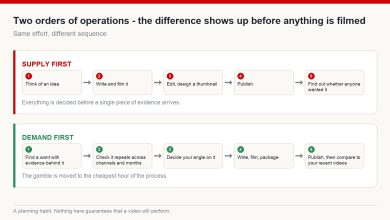
Open the app, think of something, start filming. It is the most natural way to work and it is the reason a great many well-made videos are never seen.
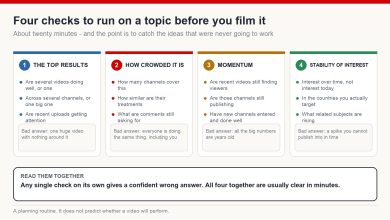
The creators who move fastest spend a disproportionate amount of time before production – reading titles, studying thumbnails, watching how openings are constructed, reading the comments under the videos that did well to find out what viewers wished had been covered.
The goal is not to copy any of it. It is to find out three things: what this audience is currently interested in, which presentations are working, and where the obvious gap is that nobody has filled. That is an hour that saves you a month of guessing.
Four: making whatever seems interesting that day
Today it is one subject, next week something unrelated because a trend looked promising, the week after something else again.
Each video may be fine. The channel is not, because it never accumulates into anything. There is no reason to subscribe, since there is no promise about what comes next, and the system has nothing consistent to work with.
The fix is unglamorous: one subject, one audience, and a written list of ideas covering the next several weeks. Not because spontaneity is bad, but because a plan is what lets you be spontaneous inside a shape rather than in place of one.
What all four have in common
None of these is a skill problem. You can be good at cameras, editing and writing and still make every one of them.
They are all the same absence: no clear answer to who the channel is for, no view about where it is going, and no habit of reading what the last ten videos were saying.
Making videos is one skill. Running a channel is a different one – noticing, comparing, adjusting – and it is the second one that decides whether a channel is still alive in a year.
If I were starting again
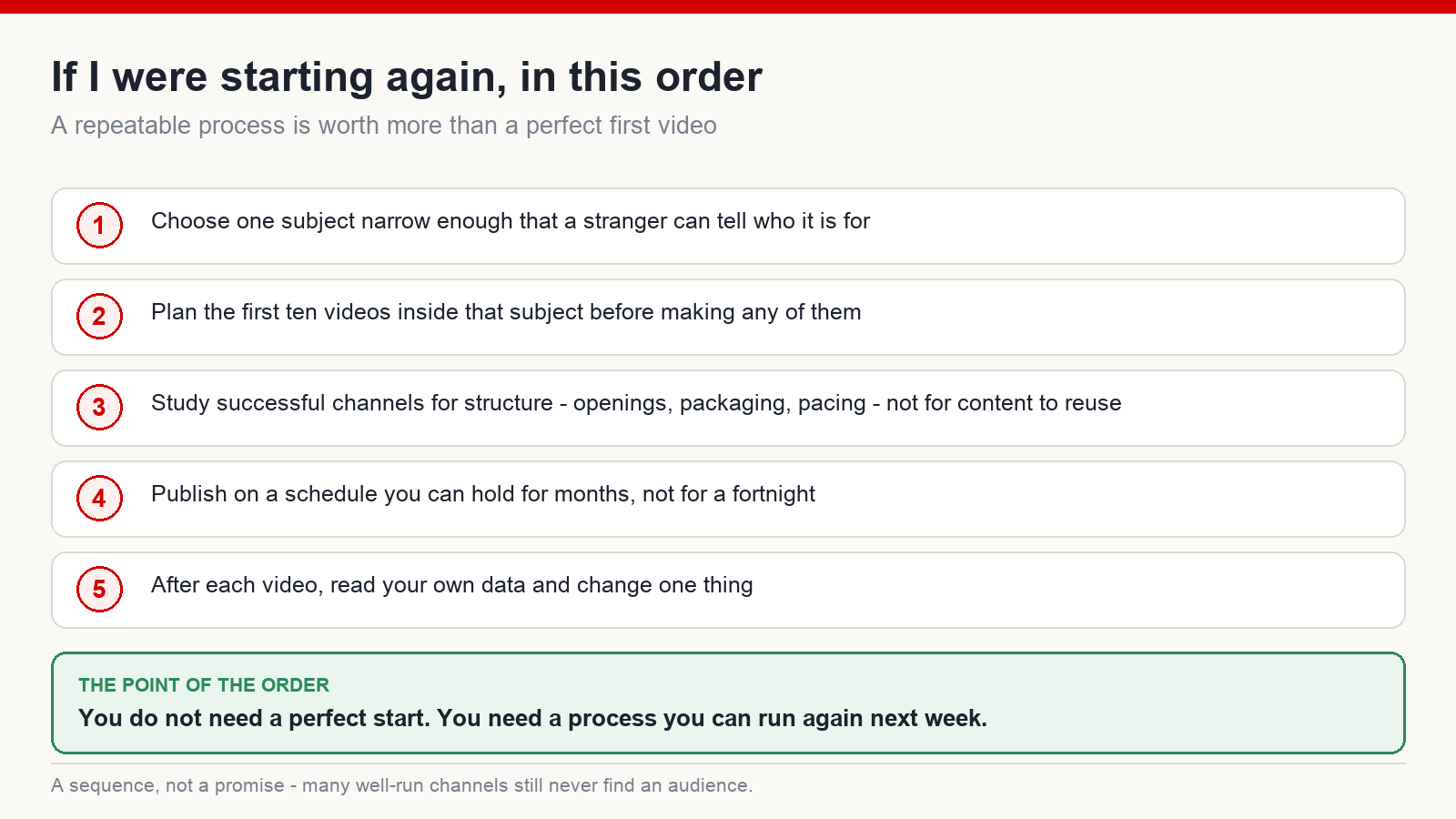
In this order, and not a different one:
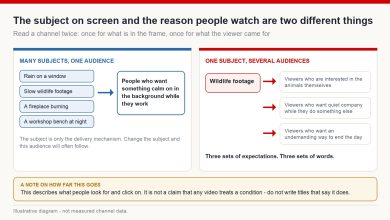
- Choose one subject narrow enough that a stranger could tell who it is for from the channel name and three titles.
- Plan the first ten videos inside it before making any of them, so the channel does not depend on how you feel next Tuesday.
- Study the channels already working for structure – openings, packaging, pacing – and not for content to reuse.
- Publish on a schedule you can hold for months, whatever that turns out to be.
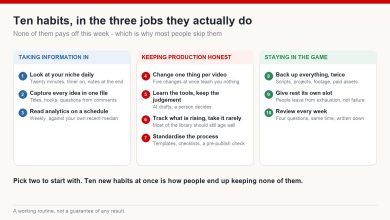
- After each video, read your own data and change one thing. One, so you know what caused the difference.
You do not need a perfect start. You need a process you can run again next week, and again the week after.
The honest version of the conclusion
Avoiding these four does not mean a channel will work. Plenty of well-run, well-researched channels never find an audience, and anybody who tells you otherwise is selling something.
What avoiding them does is remove the most common reasons channels stop – and staying in the game long enough to learn from your own data is the one thing every channel that eventually works has in common.
Should I change niche if my first videos get no views?
Not immediately. A handful of videos is not enough to conclude anything about the subject. Look at the packaging first – titles, thumbnails, openings – and at whether people who clicked stayed. Most early failure is packaging, not subject.
How long before I judge whether a channel is working?
There is no fixed point, and it varies enormously by subject and format. A more useful test than time is whether you have enough published videos to see a pattern, and whether you have been improving on evidence rather than repeating the same approach.
Do I really need a content plan from the start?
A basic one, yes. It does not need to be elaborate – a subject, an audience, and a list of ideas. The purpose is to stop the channel changing direction every week, which is what quietly kills most of them.
Is it too late to start a new channel?
Subjects get more competitive over time, so broad ones are harder to enter than they were. Narrow, specific ones open up constantly as new needs appear. The barrier now is choosing precisely, not timing.
If you want the longer version of how to choose a subject and package it for an English-speaking audience, that is what I teach at mmoyoutube.com.