Video File Metadata Before You Upload: What It Does, And What It Does Not
In creator communities there is a step that gets passed around as a secret: before you upload, open the video file’s properties on your computer and fill in the title, tags and comment fields with your target keyword. Some people call it raw SEO. The claim attached to it is that YouTube reads those fields and understands your video faster, which gets it recommended sooner.
I have been making YouTube content since 2017, mostly faceless channels aimed at English-speaking audiences, and I have watched this idea travel through course after course. It is worth taking seriously, because the underlying habit is genuinely useful. The claim built on top of it is not.
What the practice actually is
Every video file carries a container of metadata alongside the picture and sound: things like title, author, comments, tags and creation date. On Windows you can edit some of those fields by right-clicking the file, opening Properties and going to the Details tab. On a Mac the equivalent information sits in the file’s info panel and in the media container itself, and editing tools exist for both.
The practice being taught is to fill those fields in with the same keyword you intend to use on YouTube, name the file after that keyword too, and only then upload. The theory is that the platform ingests the container metadata and uses it as an early signal about what the video is.
What YouTube has actually said
Here is the honest position, and I would rather say it plainly than sell you a shortcut.
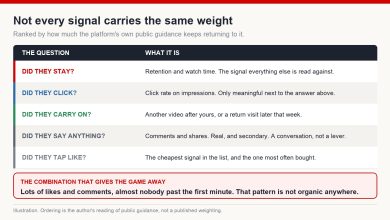
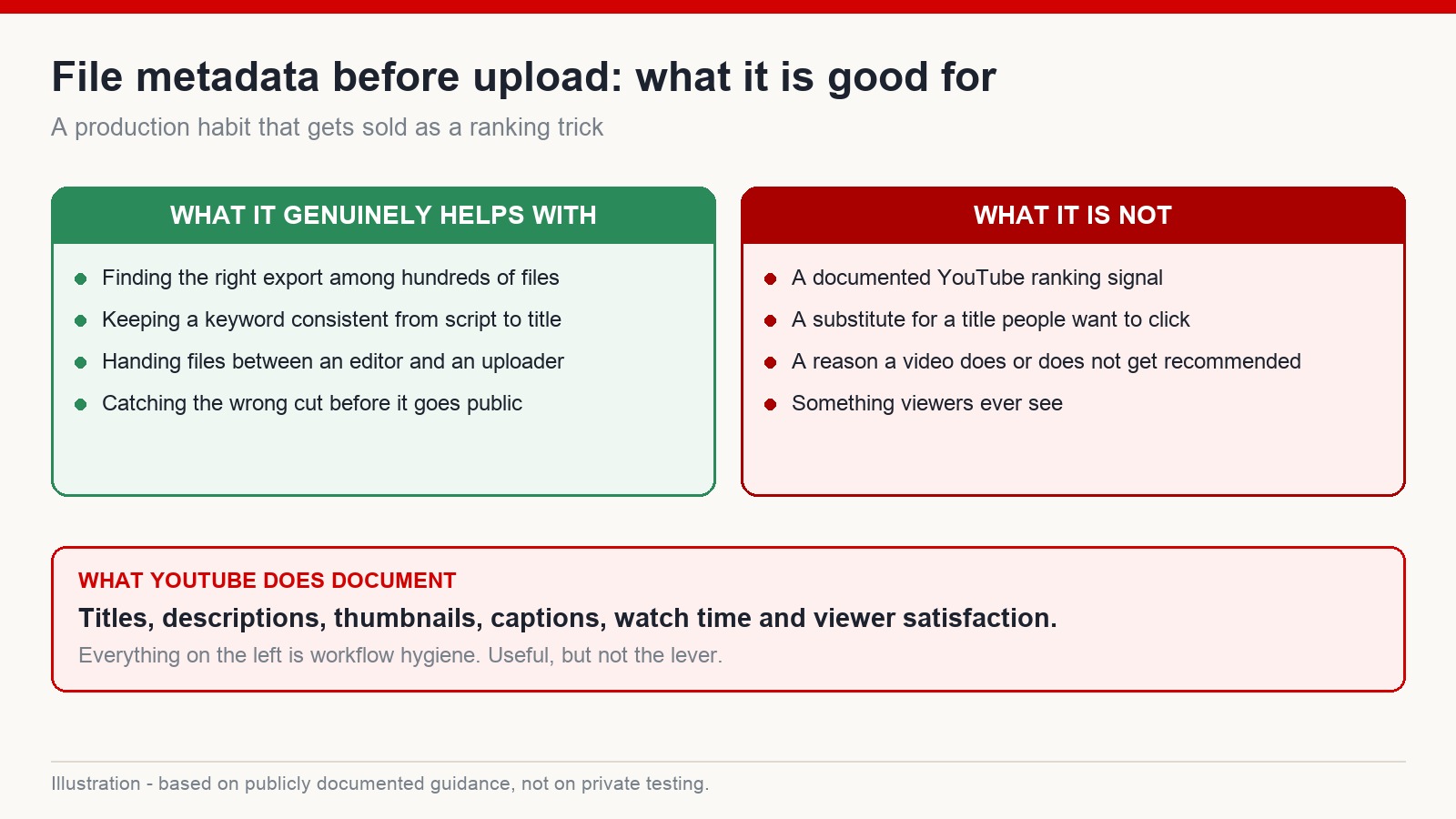
YouTube has never documented file container metadata as a ranking or recommendation signal. What its published guidance does describe, repeatedly, is a different list: titles and descriptions that accurately reflect the video, thumbnails that represent the content, captions and subtitles, whether people click, whether they keep watching, and whether they seem satisfied by what they watched.
That is the whole list of things anyone can point at documentation for. Everything else in this area – including the file metadata claim – is inference. Some of it may be true. None of it has been confirmed, and the people teaching it as fact generally cannot show you how they tested it, because a single creator has no way to isolate one variable across enough uploads to prove anything.
So if someone tells you that filling in the Details tab is why their video took off, treat it the way you would treat any other uncontrolled experiment: politely, and without changing your workflow because of it.
Why I still do a version of it
Now the other half. I do keep file naming and metadata tidy, and I ask people I work with to do the same. Not for the algorithm – for the production line.
Once a channel is running properly you are dealing with a lot of files: several cuts of the same video, a version with music and one without, the export that was wrong, the export that was right. Add a second person and the confusion multiplies. A file named for its topic and its date is findable in six months. A file called final_v3_REAL.mp4 is a small crisis waiting to happen.
There is a second benefit that matters more than people expect. If you have to write the keyword into the file name before you export, you have to have decided on the keyword before you export. That forces the decision earlier in the process, where it belongs – ideally before you write the script, not while you are staring at the upload screen with the video already rendered.
The value is the discipline, not the metadata field. Which is why it survives even though the ranking claim does not.
The pre-upload pass that is worth ten minutes
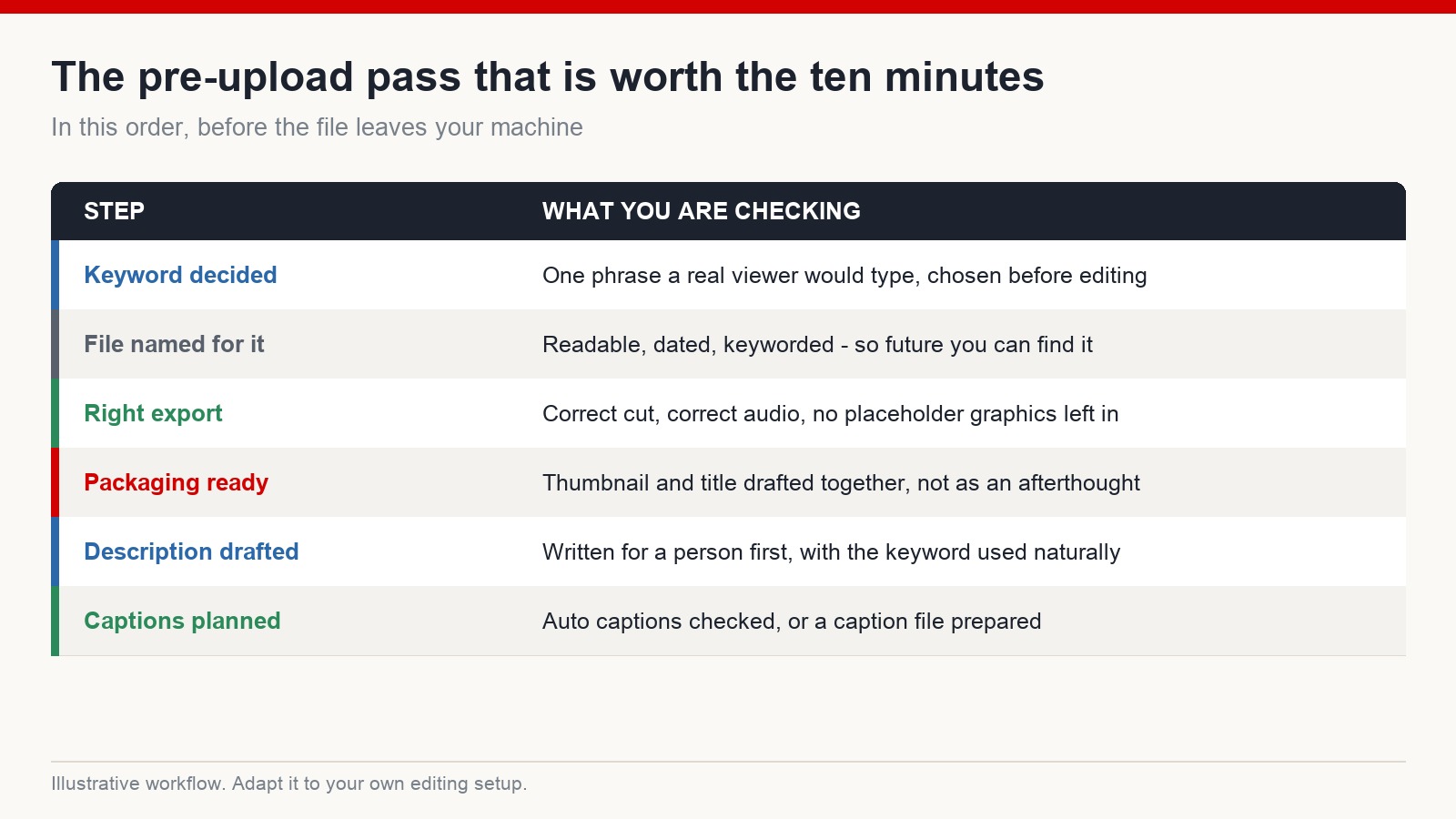
Here is what I actually run through before a file leaves my machine.
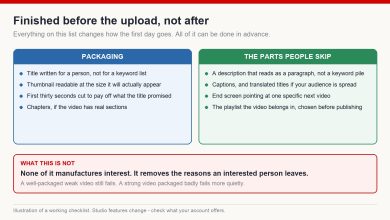
The keyword is decided. One phrase a real person would type or say, chosen for the video rather than because a tool showed a big number next to it. Research tools are useful for checking that a topic has demand and seeing how crowded it is; they are not useful for picking topics you have nothing to say about.
The file is named for it. Readable, dated, keyworded. That is the whole rule.
The export is the right one. Correct cut, correct audio track, no placeholder graphic left in the middle. This is the check that has saved me the most embarrassment, and it has nothing to do with search.
The packaging is ready. Thumbnail and title drafted together, because they work as a pair and a title written after the thumbnail is finished usually repeats it instead of adding to it.
The description is drafted. Written for a person first. The keyword appears because the description is genuinely about that subject, not because it has been dropped in a set number of times.
Captions are planned. Either you have checked the automatic ones or you are uploading a caption file. This is one of the few items on the list that YouTube’s own guidance actually points to, and it is the one most people skip.
Where the file metadata step fits
Somewhere near the bottom, as an optional piece of housekeeping. If you work alone and upload once a week, honestly, skip it. If you run a channel with an editor and an uploader and a backlog of scheduled videos, tagging files properly will save you real time, and you can do it as part of the export routine rather than as a separate ritual.
What matters is that you do not let it stand in for the work that does move the needle. I have seen people spend an afternoon perfecting metadata fields on twenty files and no time at all on why their thumbnails lose to everyone else’s in the same niche. That trade is always a loss.
How to think about any tip like this one
This particular claim is harmless. Others in the same family are not, and the pattern that produces them is worth recognising, because you will meet a new one every few months.
Someone notices a step in their process. A video does well. The step gets promoted to a cause. It spreads through a community, gains confidence with every retelling, and eventually gets taught as a rule by people who never tested it and have no way to.
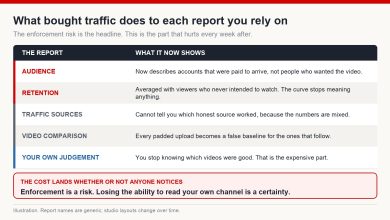
Three questions kill most of these on contact. Is there documentation for it, or only anecdote? What would it cost me if it is wrong – ten minutes, or my channel? And does it require me to do something the platform’s rules describe as spam? File metadata fails the first question and passes the other two, which is why it is fine to do and pointless to defend. Artificially inflating engagement fails all three, which is a completely different conversation.
Questions people ask
Does YouTube read the metadata inside my video file?
Some container information is read on ingest, but YouTube has not documented any of it as a ranking or recommendation factor. Treat any confident claim in either direction with suspicion.
Does the file name become the video title?
The upload flow may pre-fill the title field from the file name, which you then edit. That is a convenience, not a signal. Write the real title yourself.
Is it worth doing on every upload?
Worth doing if several people touch your files or you keep a large archive. Not worth doing for the algorithm, on any channel size.
What actually helps a video get recommended?
The documented list: a title and thumbnail people choose to click, content that holds them once they do, accurate descriptions, captions, and viewers being satisfied enough to watch something else afterwards. It is a shorter and less exciting list than the one sold in courses.
How do I know whether a change I made helped?
Compare against your own recent history rather than a figure from a blog post. Line up your last ten uploads, take the middle value for click-through rate and average view duration, and use that as your bar. Any single video is too small a sample to conclude much from.
The short version
Tidy file metadata is good production hygiene and a decent forcing function for deciding your keyword early. It is not a ranking trick, nobody has shown that it is, and a workflow built on unverified shortcuts will quietly cost you the attention that packaging and content deserve.
If you want the whole process for building a faceless channel for an English-speaking audience, that is what we work through at mmoyoutube.com.