Shiny Object Syndrome: Why Twelve Busy Months Can Leave You Nowhere
“Someday” is the softest word in the language and one of the most expensive.
Someday I will learn the skill. Someday I will start the channel. Someday I will get serious about a second source of income. It sounds like a plan because it has a verb in it. It is not a plan, because nothing in it has a date, and the day it is meant to arrive never announces itself.
What arrives instead is an ordinary Tuesday where something is suddenly needed of you, and what you have available is whatever you built beforehand. Not what you intended to build. What exists.
I have been building channels for English-speaking audiences for nine years, and the pattern I see wreck more people than laziness is not laziness at all. It is motion without direction: a year of enthusiastic starting, and nothing at the end of it that compounds.
Nobody starts ready
Almost everyone who does not start says a version of the same thing: not good enough yet, not enough time, not enough money, not enough equipment, not enough confidence, not enough knowledge.
Take any creator you currently admire and rewind far enough. The first person to make a faceless channel did not know how to script. The first person to build an audience online did not know how to pick a subject. Every one of them published things nobody watched, in a state of not being ready, because that is the only state available before you begin.
The difference between them and the people still waiting is rarely talent and almost never readiness. It is a start date.
Two ways to spend twelve months
Here is the version of the problem that actually costs people years.
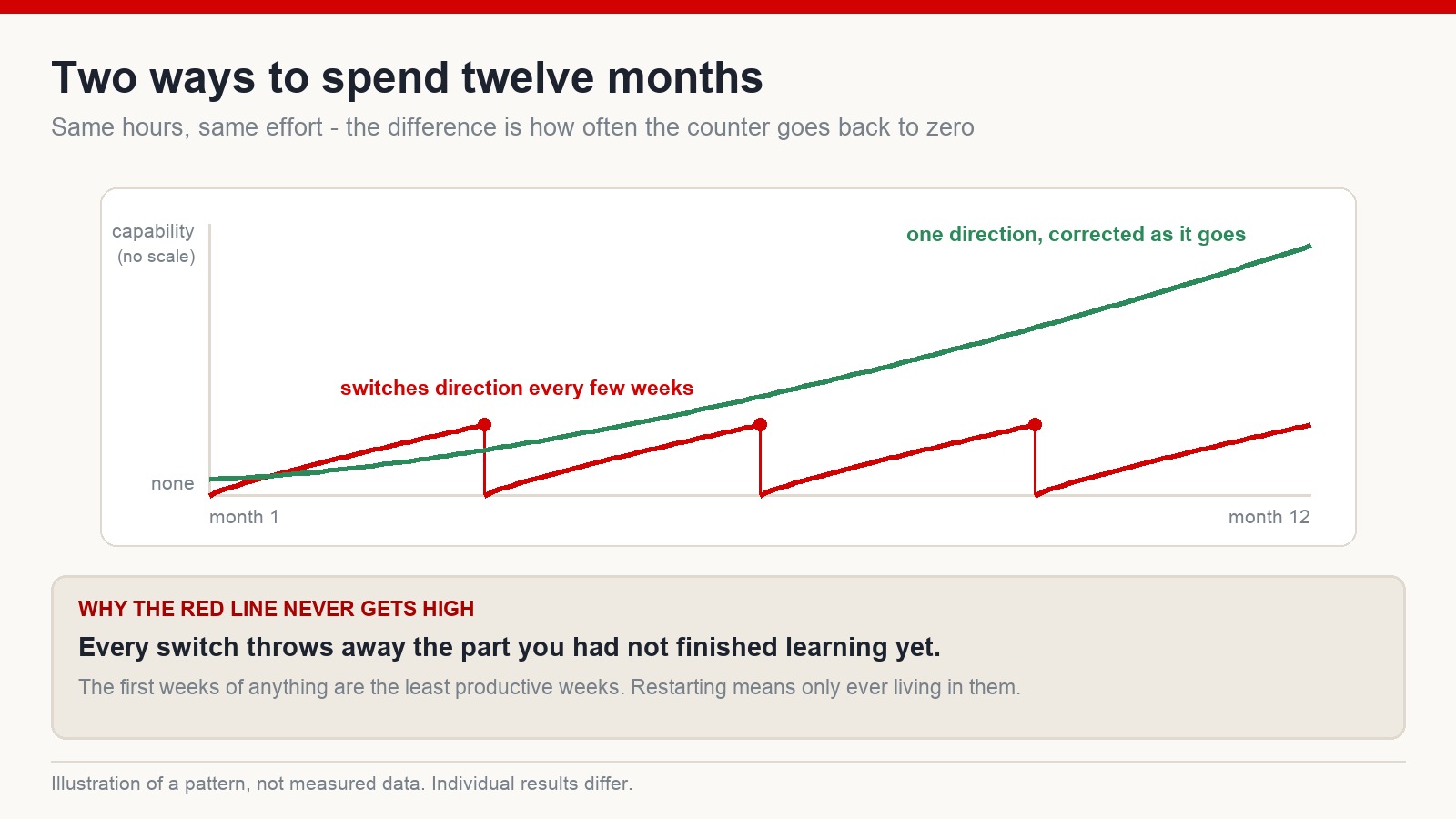
Month one, YouTube looks promising, so you go all in. Month three, a friend is doing well with short-form commerce, so you switch. Month five, a new automation tool is everywhere, so you pivot again. Month eight, something else is climbing, and off you go.
Each individual decision was defensible. You were being responsive. You were following the opportunity. And yet at month twelve you are competent at nothing in particular, because you spent the whole year in the beginner phase of four different things.
The first weeks of anything are the least productive weeks – all setup cost, no return. Restarting every couple of months means never leaving them. It is not that the switching people work less. Often they work more. They just keep resetting the counter.
Learn, do, repeat
If you are stuck between options, three words are enough to organise a year.
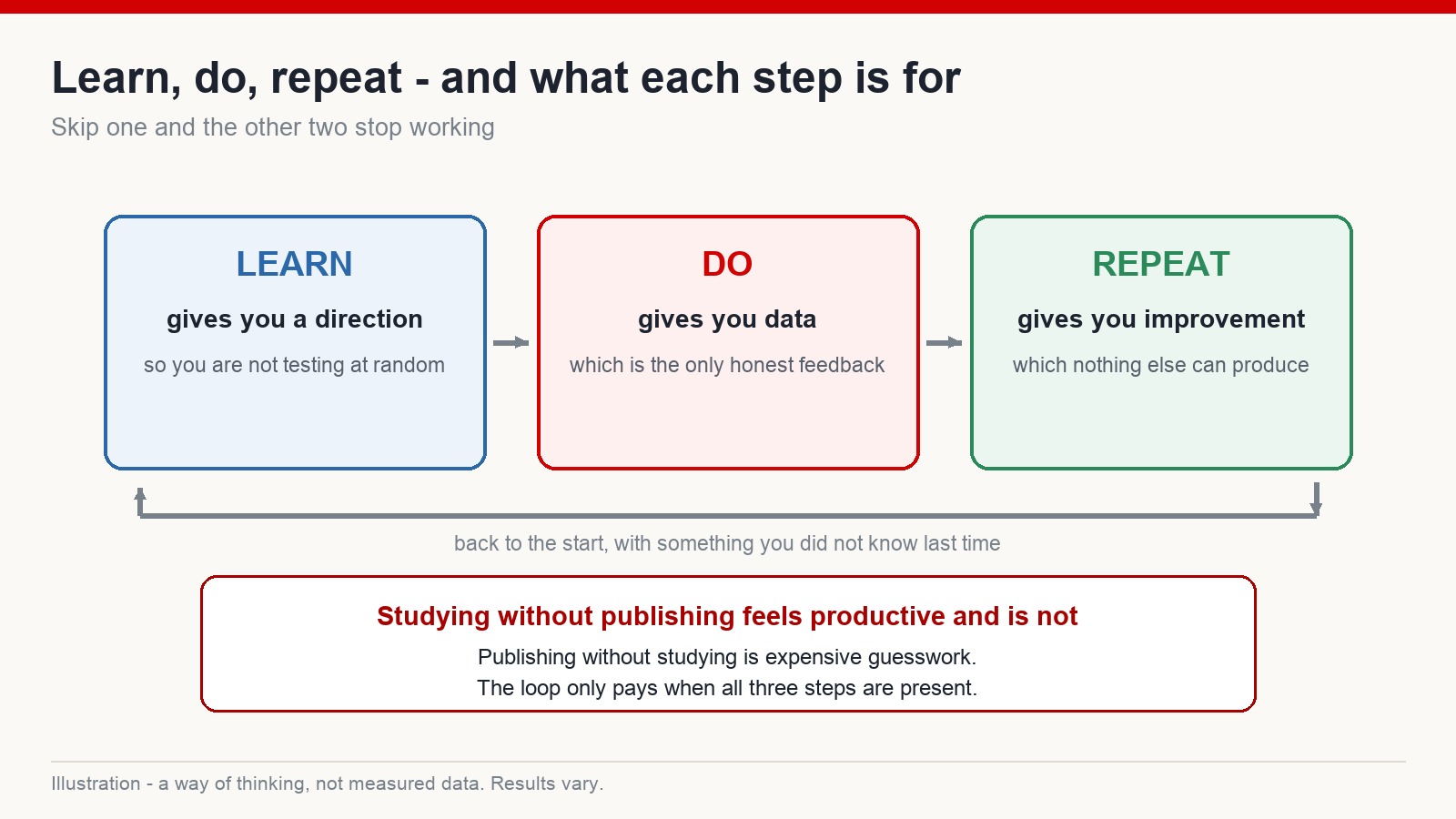
Learn gives you a direction, so you are not testing at random. Do gives you data, which is the only feedback that is not somebody’s opinion. Repeat gives you improvement, which nothing else can produce.
Take out any one and the machine stops. Studying without publishing feels enormously productive and generates nothing you can read. Publishing without studying is expensive guesswork. Doing both once and never returning is how people conclude, wrongly, that a subject does not work.
There is no trick underneath any of this. There is only the person who kept going round the loop after the point where it stopped being interesting.
What carries over and what expires
The reason direction-hopping is so costly becomes obvious once you sort what you are learning into two piles.
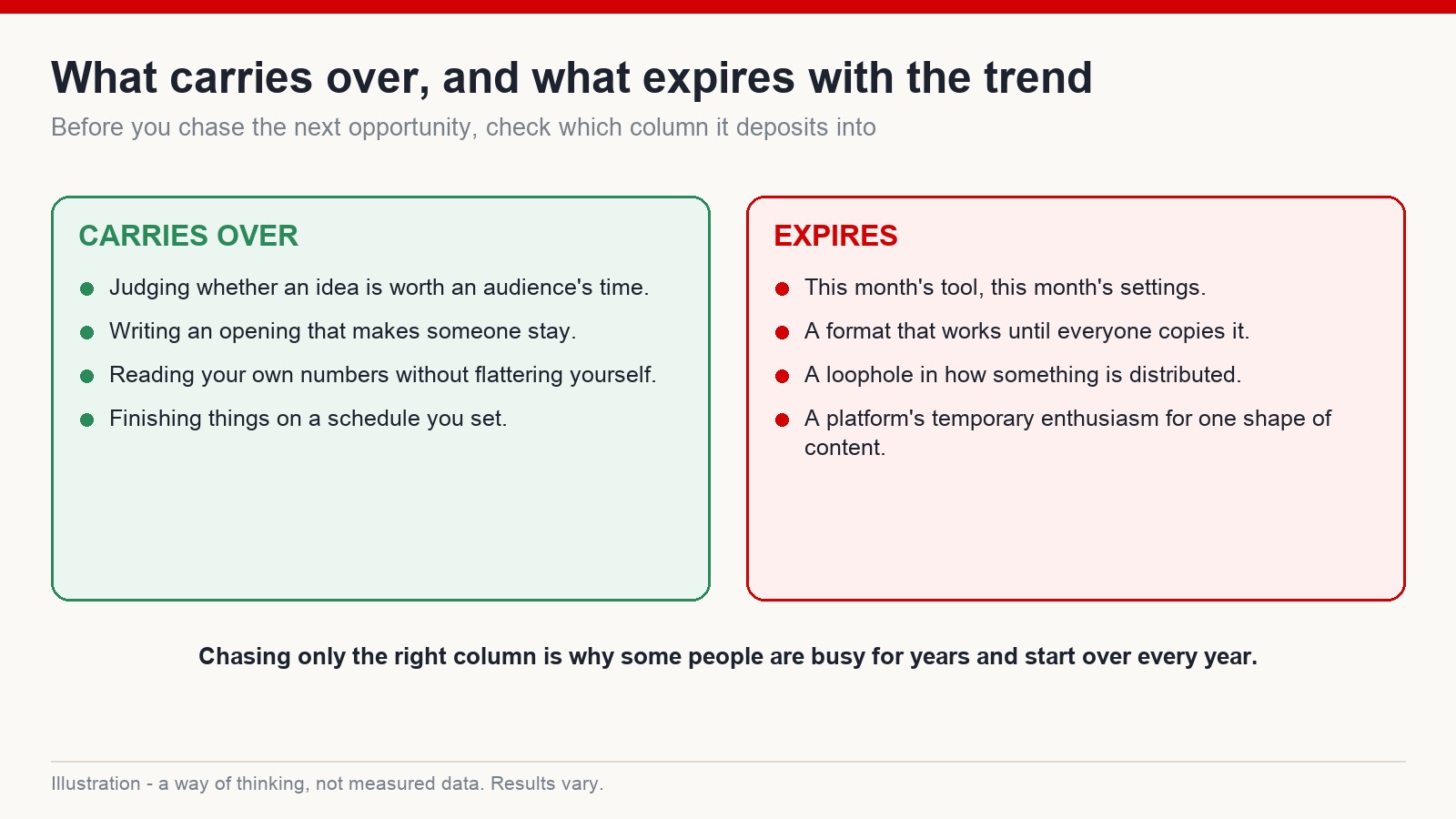
Some of it carries over: judging whether an idea is worth a stranger’s time, writing an opening that makes somebody stay, reading your own numbers without flattering yourself, finishing things on a schedule you set. Those transfer to any platform, any format, any decade.
Some of it expires: this month’s tool and its settings, a format that works until everyone copies it, a quirk in how something gets distributed, a platform’s temporary enthusiasm for one shape of content.
Both piles are worth something. But if you only ever collect from the second, you will be busy for years and still be starting over every year, because everything you learned had a shelf life.
How to tell a real pivot from shiny object syndrome
Changing direction is sometimes correct. Here is the test I use before allowing myself to do it.
Did I complete the loop at least once? Published, measured, adjusted, published again. If not, I have no evidence about this direction – only a feeling about it.
Am I moving towards something or away from something? Towards is a strategy. Away is usually the ordinary discomfort that shows up around the point where the beginner’s enthusiasm runs out.
Does the new thing solve the problem the old one had? If nobody was clicking your thumbnails, moving to a different platform does not fix that. It relocates it.
Then a simple rule that has saved me a lot of wasted years: pick a direction, give it ninety days of genuine effort, and refuse to renegotiate during those ninety days. Not because ninety days is magic, but because you cannot evaluate anything while you are still allowed to quit it daily.
Where I want to be careful
I am not telling you to bet your household on a channel. Building an audience takes an unpredictable amount of time, plenty of people work at it seriously and stay small, and none of this is financial advice or a plan for handling a real emergency. If money is genuinely tight, the stable income keeps paying the bills while the skill is being built, and there is no shame in that being the order.
What I am saying is narrower and, I think, harder to argue with. Capability is the one asset nobody can take back and no platform update can delete. It is built by choosing one direction and staying with it long enough to get past the part where you are bad at it. Every switch resets that clock.
The tiredness of building something is real. So is the tiredness of standing still and asking yourself, every night, when things are going to change. You are choosing between two kinds of tired. Only one of them accumulates into anything.
Frequently asked questions
How do I know if I have shiny object syndrome?
Count how many directions you have started in the last twelve months and how many you took through a full learn-do-repeat cycle. If the first number is much larger than the second, the pattern has you, regardless of how good each individual reason sounded.
How long should I commit to one direction before judging it?
Long enough to complete several cycles rather than one. Ninety days of consistent effort is a workable minimum for most content work – not because results arrive on that schedule, but because that is roughly when your own data starts being worth reading.
Is it ever right to switch?
Yes: when there is genuinely no audience, when you cannot sustain interest in the subject for years, or when the direction cannot lead anywhere you want to go. Those are strategic reasons. Boredom at week six is not one.
Should I learn more before I start?
Learn enough to avoid the obvious mistakes, then start. Beyond that point, studying becomes a comfortable way of not being judged. The information you need next only becomes visible once you have published something.
Can I run more than one project at once?
Once one of them is genuinely working and running on a routine, sometimes. Before that, splitting attention usually means two projects that never get past the setup phase.
If you want one direction with an actual sequence attached to it, that is what we work through at mmoyoutube.com for English-language channels. No outcome promises – just an order of operations you can stay in.