How to Run a YouTube Channel in a Language You Do Not Speak
For a long time I assumed that making videos for an audience in another country meant being fluent in their language. If you could not speak it properly, that door was shut.
The longer I worked on YouTube, the more obviously wrong that turned out to be. A lot of channels are quietly serving audiences whose language the person behind the channel barely speaks. It is not a trick and it is not new – it is just that the tooling got good enough that the language stopped being the bottleneck.
I have been making videos since 2017, mostly faceless channels aimed at viewers in the US, the UK, Germany and Japan. This is the honest version of how that works when you are not a native speaker of the language you are publishing in: what the workflow actually looks like, where it breaks, and what it does not solve.
The short answer: yes, but the difficulty moved rather than disappeared
You can absolutely build a channel in a language you do not speak well. Plenty of people are doing it right now.
What matters is no longer how many languages you speak. It is whether you have a production process that reliably turns an idea into a finished video – and a review step that catches the things a machine gets wrong.
Work that used to require a translator, a native-speaking presenter and a local editor can now be largely automated. That is a genuine change. But automation moved the hard part rather than removing it: the difficulty is no longer producing the words, it is deciding which twelve minutes are worth a stranger’s time, and then checking that the machine did not quietly mangle them.
Why creators do this at all
The usual reason is that not all audiences are worth the same to advertisers.
A view is not a unit of money. It is a unit that gets priced, and the price depends on where the viewer is, what the subject is, what time of year it is, and whether the audience is one that advertisers want to reach. Two videos with identical view counts can be worth very different amounts. That is not unfair; it is just how the ad auction works.
So a creator looks at their own market, looks at a larger one, and decides the extra production step is worth it. Reasonable enough.
But I say the same thing to every creator I work with: a better-paid audience is potential, not outcome. Views, retention and how long the channel survives still decide the result, and all three of those come back to whether the content is any good. Nobody has ever been rescued by a favourable market.
The production pipeline, five stages
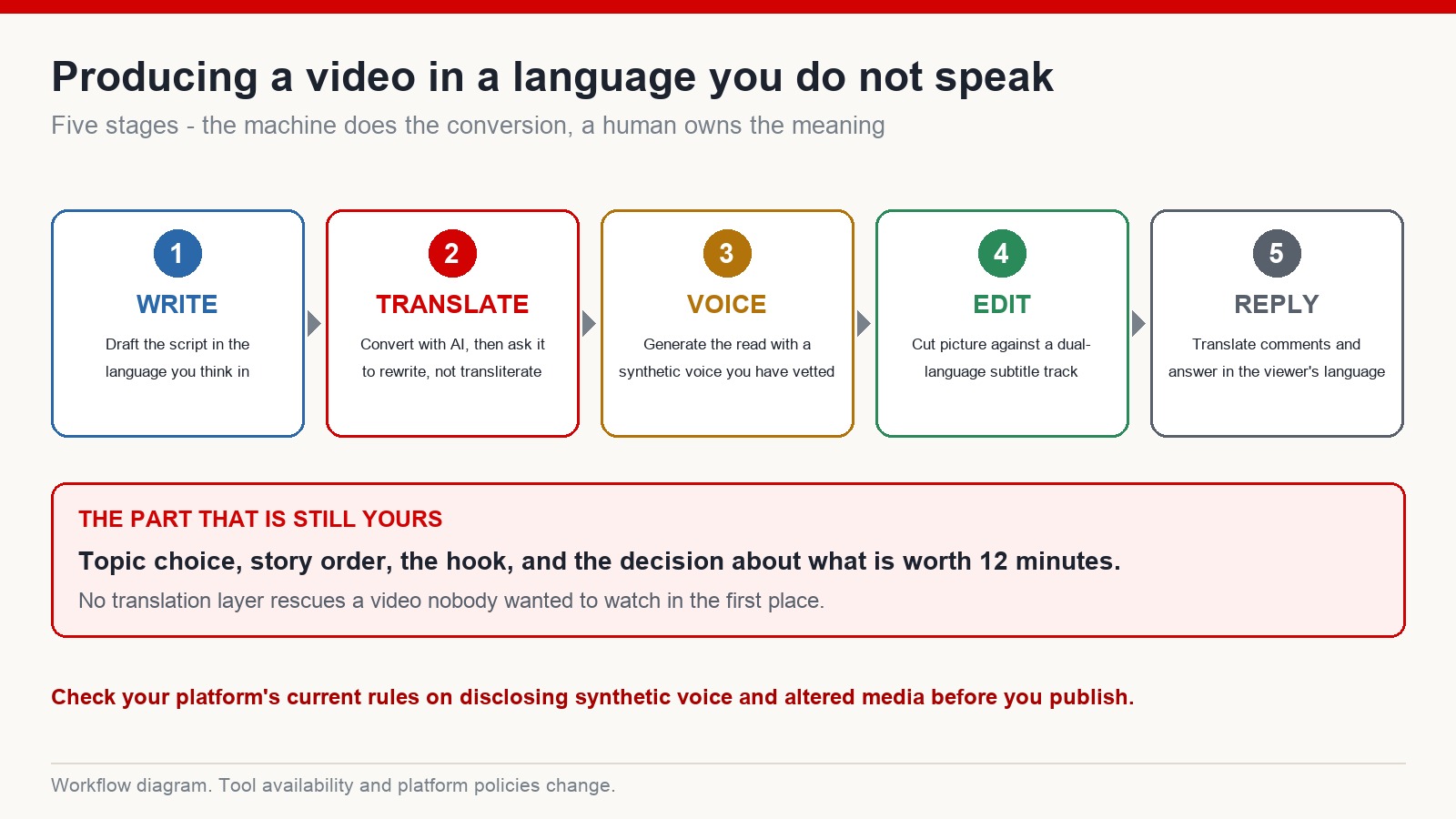
1. Write in the language you think in
This is the stage that decides everything downstream, and the one people are most tempted to skip.
Do not try to have ideas in a language you are not fluent in. You will write blander, safer, shorter sentences, and the video will be worse in a way that no translation step can repair. Research the topic, build the structure, write the hook and draft the whole script in whichever language you actually think in.
A good script converts well. A weak script converts into a weak script in a second language.
2. Translate, then ask for a rewrite
Run the script through a capable language model, then do the step most people miss: ask it to rewrite the result the way a native speaker would say it, not to translate it.
Those are different requests and they produce different output. Straight translation preserves your sentence structure, which is exactly the thing that makes a script sound foreign. A rewrite pass will reorder clauses, drop the constructions that do not exist in the target language, and shorten anything that got clumsy in transit.
Then read the back-translation. If the argument drifted, the fault is usually in your source sentence, not in the tool.
3. Generate the narration
Text-to-speech is the technology that actually opened this up. Current tools produce narration that most viewers will not question, in a long list of languages, from typed input.
Two things to watch. First, pick a voice and stay with it – a channel that changes narrator every few videos never builds a recognisable identity. Second, listen to the whole render before you commit. Proper nouns, dates, units and acronyms are where synthetic voices embarrass you, and you cannot hear the mistake if you do not speak the language, which is exactly why you play it to someone who does.
4. Edit against a dual-language subtitle track
This is the practical trick that makes the rest workable.
Put both languages on the timeline: the target language you are publishing in, and your own underneath. Now you can see precisely which sentence the narration is on at any frame, and cut picture to meaning rather than guessing from the waveform. Without it you end up placing footage against sounds instead of against sense, and viewers feel that immediately even if they cannot name it.
5. Answer comments
Once the channel finds an audience, comments arrive in a language you may not read. Ignoring them is a waste; a reply is one of the cheapest signals of a channel that is actually run by someone.
Translate the comment, draft a short reply, read it back before posting. Keep it brief – long machine-written replies read strangely in any language.
Where a human still has to check the machine
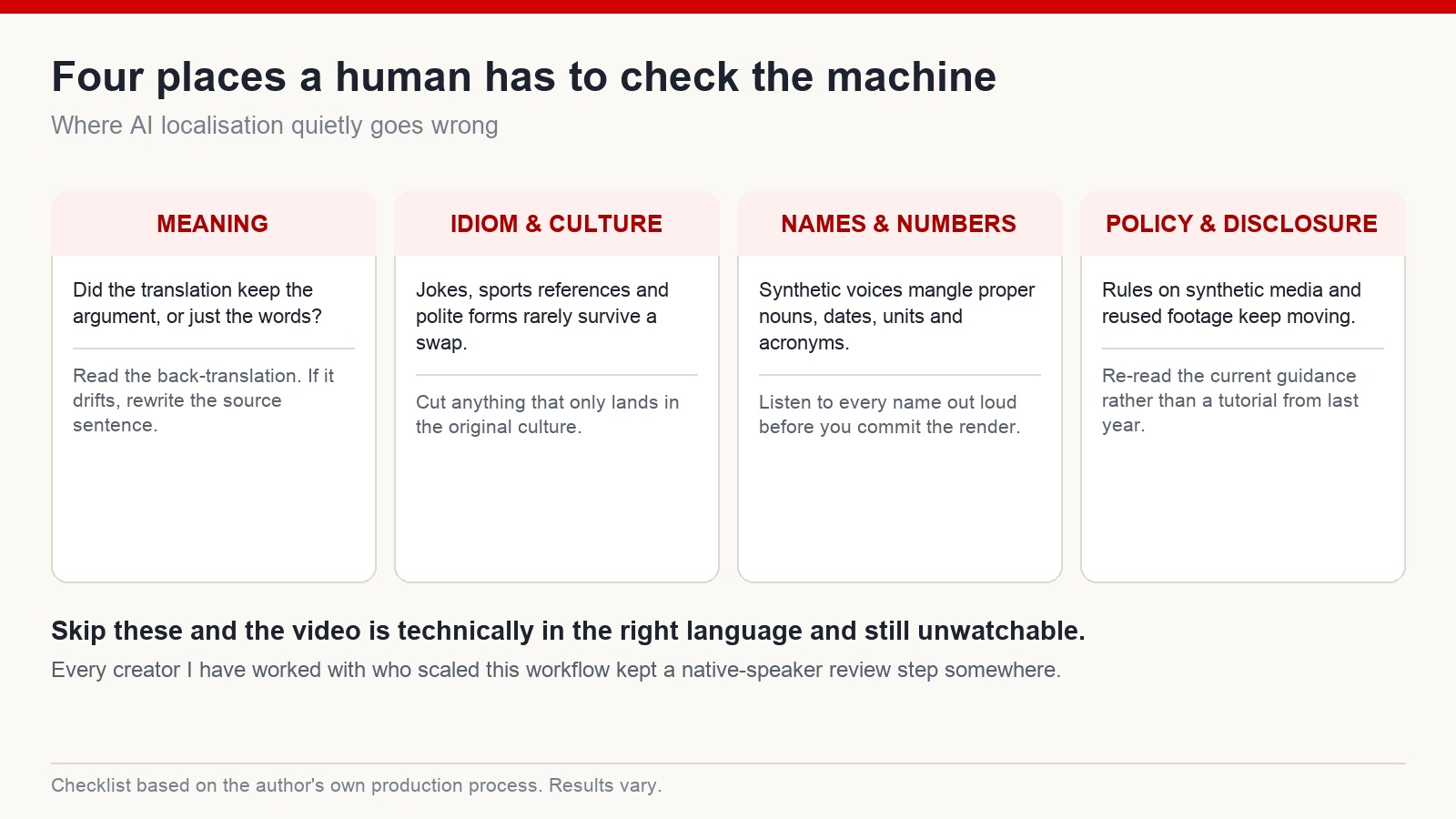
Every creator I know who has scaled this workflow ended up with a review step somewhere – usually a native speaker checking the script, or at minimum the final audio. Four things are worth checking specifically.
Meaning. Did the translation keep the argument, or only the words? Back-translate and read it.
Idiom and culture. Jokes, sports references, idioms and politeness levels rarely survive a language swap intact. Anything that only lands in the original culture should be cut rather than translated.
Names and numbers. Listen to every proper noun out loud. This is the single most common way an otherwise-good video announces that nobody involved speaks the language.
Policy and disclosure. Rules on disclosing synthetic voice and altered media have changed repeatedly and will change again. Read the platform’s current guidance rather than a tutorial from two years ago, and disclose where required.
Three mistakes I see constantly
Picking a niche that is far too competitive. Finance, tech and news look attractive because the audiences are enormous, which is exactly why they are already served by channels with better production and years of head start. A narrower subject gives a new channel somewhere to actually stand.
Getting absorbed by the tools. It is easy to spend a month comparing voice generators. None of that produces views. Ideas, hooks, retention and whether the video is worth watching produce views, and no tool supplies those. If the content is dull, better narration just makes it dull in a nicer accent.
Not researching the audience. A different language is also a different culture, different reference points and different expectations about pacing, humour and how directly things get said. Watch what already works for that audience before assuming your instincts transfer.
What this actually comes down to
The language barrier is real, but it sits somewhere different from where most people put it. Translation and narration are solved problems. Judgement is not.
Topic choice, story order, the hook, and the decision about what deserves twelve minutes of someone’s attention – those stay with you, and no localisation layer rescues a video nobody wanted to watch in the first place.
Worth saying plainly: this is not a shortcut, results vary enormously, plenty of people run this workflow carefully and still end up with a channel that does not take off, and platform rules can change under you. Treat it as a way to widen who your work can reach, not as a route to a predictable income.
If you want a structured path for building a faceless channel aimed at an English-speaking audience, that is what I teach at mmoyoutube.com.
Frequently asked questions
Can I really run a channel in a language I do not speak?
Yes, and many people do. The workflow is write in your own language, translate with a rewrite pass, generate narration, edit against a dual-language subtitle track, and get a native speaker to check the result before you publish. The last step is the one people skip and the one that matters most.
Which text-to-speech tool should I use?
Judge on output rather than on brand. Listen to the same paragraph of your own script through several tools, in the actual language you are publishing in, and pick the one that handles your proper nouns and your sentence lengths best. They all improve constantly, so re-test occasionally.
Which market should a beginner target?
English-speaking markets tend to attract stronger advertiser demand, and they are also the most competitive. Depending on your niche, a smaller language market with less competition can be an easier first channel. There is no single right answer, and it depends more on the subject than on the language.
Do I need to hire a native speaker?
Not to produce the video, but a review step is strongly worth it – even an hourly proofread of the script, or one person listening to the final narration. It costs little and catches the errors you are structurally unable to hear.
Do I have to disclose that the voice is synthetic?
Requirements around synthetic and altered media have been tightening, and they differ by platform and by region. Check the current rules before you publish rather than relying on what was true when you started, and when in doubt, disclose.