Twenty-Six Free Channels, One Track at a Time: How to Actually Learn AI on YouTube
You do not need a two-thousand-dollar course. Some of the best teaching on this subject has been sitting on YouTube for years, free, with no enrolment and no deadline.
Which is also the problem. Free removes the price and leaves everything else: no order, no sequence, and no point at which anyone tells you that the video you are watching assumes six months of material you have not done yet.
So the list below is arranged as five tracks rather than twenty-six recommendations. The order is the useful part. The channels are just what is in each one.
Five tracks, in order
Each track assumes the one before it. Skipping forward is the single most common reason people bounce off this subject and conclude they are not technical enough.
| 1. Foundations | 2. Machine learning | 3. Deep learning | 4. Generative AI & LLMs | 5. Agents & engineering |
|---|---|---|---|---|
| The maths, the code, the intuition
Where most people should start and almost nobody does. |
Supervised learning, data, real algorithms
The first point at which you can build something that works. |
Neural nets, transformers, architectures
Explains why the models behave the way they do. |
Building with ChatGPT, Claude, Gemini, open models
Where everyone tries to start. It makes far more sense fourth. |
Shipping systems that survive production
Only relevant once something of yours is actually running. |
Track four is the trap. It has the exciting thumbnails, and it is entirely possible to follow along, get a working demo, and understand none of it – which feels like learning right up until something breaks and you have no idea where to look.
The twenty-six channels
Checked in September 2026. One of them appears under a new name – the MLOps Community channel was renamed to AAIF Live earlier this year, which is the sort of thing that quietly breaks every older list.
| Track | Channels | What you should be able to do afterwards |
|---|---|---|
| 1. Foundations | Khan Academy · freeCodeCamp.org · MIT OpenCourseWare · StatQuest with Josh Starmer · 3Blue1Brown · GenAI Works | Read a formula without flinching, write basic code, and understand what a model is doing rather than what it is called. |
| 2. Machine learning | Data School · codebasics · CampusX · sentdex · Krish Naik | Load a dataset, train something, and explain why the result is or is not any good. |
| 3. Deep learning | Yannic Kilcher · deeplizard · Aladdin Persson · Andrej Karpathy · DeepLearning.AI | Follow a paper or an architecture diagram, and understand why transformers changed things. |
| 4. Generative AI & LLMs | Hugging Face · AssemblyAI · Sam Witteveen · Matthew Berman · Prompt Engineering | Build with the current models and know which failures are yours and which are the model’s. |
| 5. Agents, MLOps & engineering | LangChain · LlamaIndex · Weights & Biases · Arize AI · AAIF Live | Put something into production and keep it running when reality arrives. |
Notice the third column. It is deliberately written as things you can do, because “watched the playlist” is not a checkpoint. The only honest test of a track is whether you can produce something without the video open next to you.
Watch the reel
All twenty-six on one card, grouped by track. Posted on the BANI Academy page.
The real problem is finishing, not finding
Nobody fails at this because the material was not available. They fail because free courses have no mechanism that makes anyone complete them – no cohort, no deadline, nothing that notices you stopped.
So the protocol matters more than the list. Five rules, all boring, all effective.
| Rule | Why it works |
|---|---|
| One track only | Parallel tracks feel productive and finish nothing. Close the other four tabs. |
| A fixed slot, not spare time | Spare time does not exist. Forty minutes, same days each week, beats three-hour bursts that stop in week two. |
| Build the smallest thing after every section | Watching is recognition; building is recall. The gap between them is where the illusion of learning lives. |
| Keep a log of what broke | Your errors are the curriculum. A list of them is worth more than notes on the videos. |
| Finish before you evaluate | Track four always looks more exciting from inside track one. It will still be there. |
The fourth rule is the one that converts this from consumption into practice. Writing down what you predicted, what you changed and what you learned is the whole difference between working alone and guessing alone – the loop we set out in self-taught on YouTube.
How much of this does a creator actually need?
Honest answer: for most people running a channel, track one and a bit of track four. That is it.
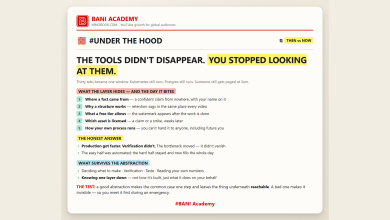
You are not training models. You are using them, which means the valuable part is knowing what the tool is doing on your behalf – enough to recognise a confidently wrong answer, enough to understand why a prompt failed, enough to know which problems are fixable and which are the model being a model. That is one layer down, not ten, and it is exactly the argument in the tools did not disappear.
Tracks two, three and five are genuinely worth it if you want to build things rather than use them. They are not a prerequisite for making better videos, and treating them as one is a very comfortable way to postpone making videos.
The practical version for a creator is smaller than this list suggests: understand the foundations well enough to be sceptical, learn to specify a task properly – the five slots in vague in, vague out – and give your tools your own context, as in stop re-explaining yourself. Those three cover most of the real-world gap.
What this list is not
It is not the only list you need, and it will not future-proof anyone’s career – that promise gets attached to every list of this kind and it has never been true of any of them.
It is also a snapshot. Channels rename, go quiet, or change direction, and one entry here already carries a new name from this year. Before committing a month to any of them, open the channel and check the upload dates. A track built on a channel that stopped publishing in 2024 is a slower path than it looks.
And nothing here was assembled by spending months on research. It is the reel’s five tracks, checked in September 2026, presented in the order that makes them usable.
Frequently asked questions
Do I really need the maths?
To use AI tools, no. To understand why an output is wrong rather than just noticing that it is, yes – enough to follow an explanation, not enough to derive anything.
How long does one track take?
Longer than the playlist. Forty minutes a session, three sessions a week, with something small built after each section, puts most people at a few months per track.
Can I start at track four if I only want to build with LLMs?
You can, and many do. Expect to hit a point where the errors stop making sense, and expect that point to send you back to track one anyway.
Are paid courses ever worth it?
Sometimes – usually for the deadline, the cohort and the feedback rather than the content. You are buying completion, not information.
Pick one track today
Open the list, choose the track that matches where you actually are rather than where you would like to be, and put three sessions in your calendar this week. Build the smallest possible thing after the first section, and write down what broke.
That is the entire method. The material is free and has been for years; what has always been scarce is the finishing.
Learning a lot does not make anyone good. Doing a lot does.
If you want the deadline and the accountability that free material cannot give you, that is exactly what our free challenge is built for: no barrier to entry, a genuine commitment to action, and a refundable commitment fee you get back when you finish. You are not paying for the knowledge – the knowledge is on this page for nothing. You are betting on yourself finishing, and we hold the stake.
Which track are you starting with? Tell us in the comments on the original reel and we will reply with the first thing we would build in it.
For more on building channels for English-speaking audiences, that is what we work on at mmoyoutube.com.