How to Write a Dramatic YouTube Title Without Tipping Into Clickbait
A title can multiply the clicks a video gets. It can also be the reason a channel never builds anything that lasts. Both of those things are true at the same time, which is why the question “how dramatic should my title be?” gets answered so badly online. One camp says push it as hard as you can. The other says stay boring and safe. Neither camp is running a channel you would want to own in three years.
I have been building YouTube channels since 2017, most of that time on faceless channels made for English-speaking audiences in the US, the UK, Germany and Japan. The creators I work with who are still growing after their first lucky video did not pick a side. They learned where the line sits between a title that creates tension and a title that makes a promise the video cannot keep, and they stayed on the right side of it deliberately.
The Line Is Not Drama. It Is the Promise.
Here is the misunderstanding at the centre of this whole topic. People think the risky ingredient in a title is intensity — capital letters, charged words, exclamation marks. It is not. You can write an intense title that is entirely honest, and you can write a calm, tidy title that lies.
The ingredient that gets channels into trouble is the unpaid promise. A title implies the viewer will get something. If the video hands it over, the drama was earned. If the video does not, the viewer leaves early, and that is the signal the recommendation system actually reads. Click-through rate is only the front door. What happens after the click decides whether the video gets shown to anyone else.
So before optimising anything, run one test on the title you just wrote: if a stranger clicked this expecting exactly what it says, would the first ninety seconds of my video satisfy them? If the answer is no, the title is not too dramatic. It is wrong.
The Intensity Ladder
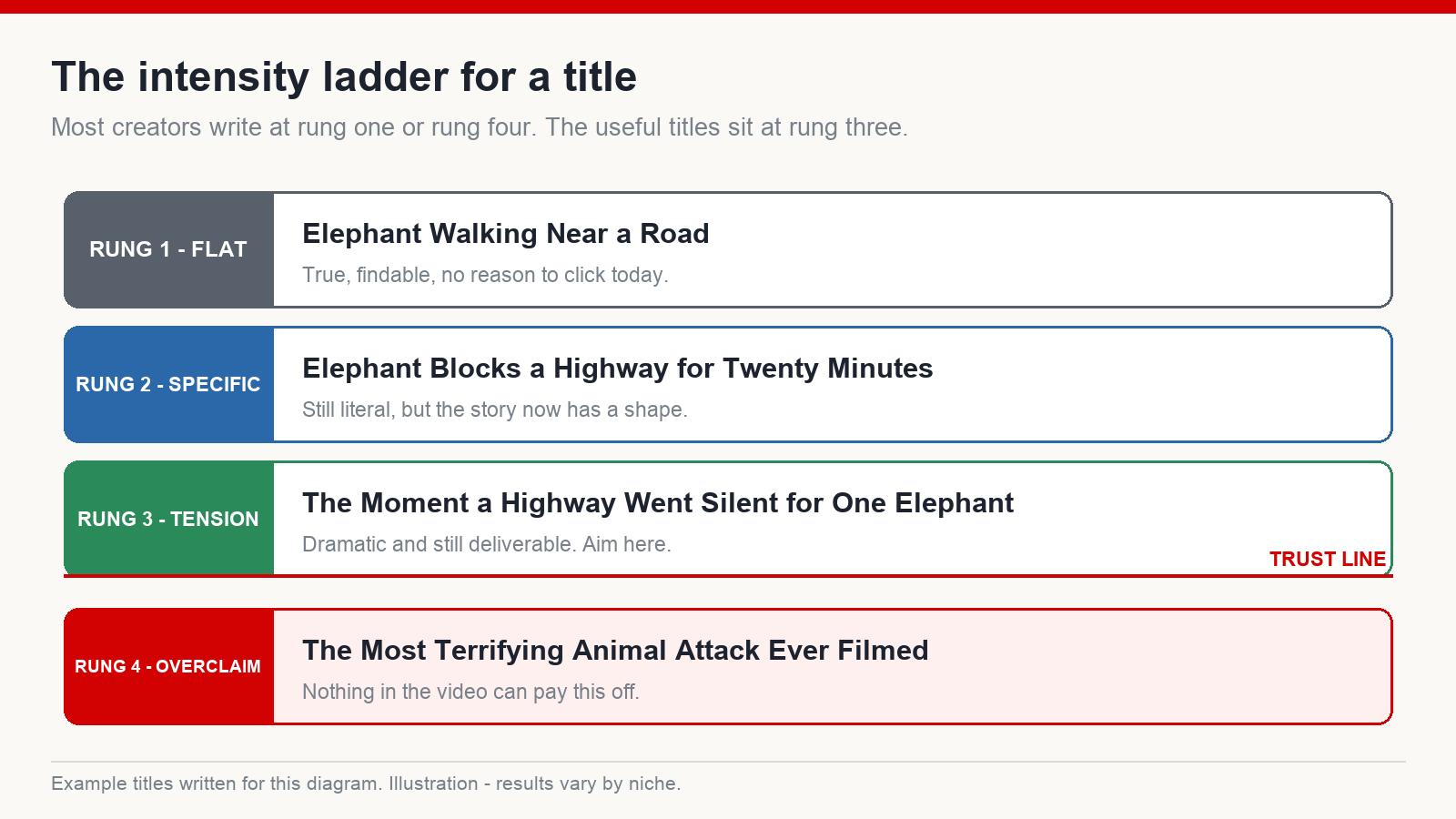
Most creators write at one of two volumes: flat or maximum. There are useful rungs in between, and they are where the durable titles live.
- Rung 1 — flat. Elephant Walking Near a Road. Accurate, findable, and no reason to click today rather than never.
- Rung 2 — specific. Elephant Blocks a Highway for Twenty Minutes. Still literally true, but now there is a shape to the story.
- Rung 3 — tension. The Moment a Highway Went Silent for One Elephant. Emotional, unresolved, and still deliverable.
- Rung 4 — overclaim. The Most Terrifying Animal Attack Ever Filmed. Nothing in the video can pay this off, and the superlative belongs to a video somebody else will make.
Rung three is where I want most uploads to sit. It reads as dramatic to a viewer scrolling a feed, and it costs nothing in trust because the video genuinely contains the moment described. Rung four spends credibility you have to earn back later.
There is a second reason to avoid the top rung. Superlatives have nowhere to go. Once your channel has published “the most shocking” video, the next one has to be more shocking or it reads as a downgrade. Titles built on specificity do not have that ceiling.
Escalate the framing, not the adjectives
When a title feels weak, the instinct is to reach for a stronger adjective. Usually the better move is to make the situation more concrete. Unbelievable Wildlife Footage is weaker than Rare Footage a Camera Caught by Accident, even though the second one contains no superlative at all. Rarity, timing, an unexpected witness, an unfinished outcome — those create pull without inflating a claim.
A Publishing Mix, Not a Per-Video Decision
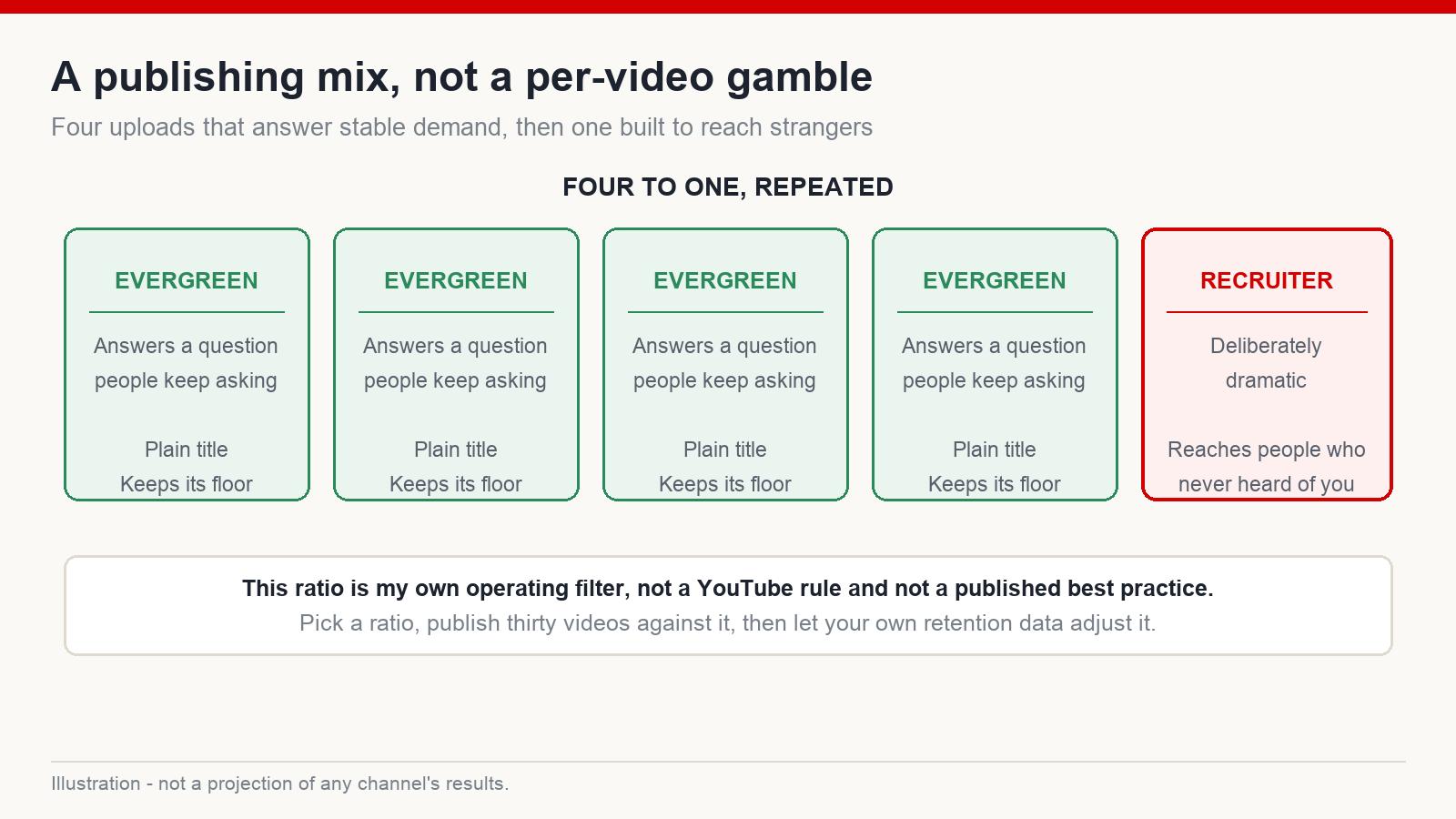
The trap in this conversation is treating every video as its own bet. It is easier to manage at the level of the channel.
The working ratio I use is four to one: four evergreen uploads that answer a stable demand and read plainly, then one deliberately dramatic upload aimed at reaching people who have never heard of the channel. The dramatic video is the recruiter. The evergreen four are the reason anyone stays.
To be clear about what that ratio is: it is a personal operating filter, not a YouTube rule and not a published best practice. It exists to stop a channel drifting into a library where every single thumbnail and title is shouting, because that is the state where an audience stops believing any of it. If your niche is naturally calmer, five to one or six to one may serve you better. Pick a ratio, publish thirty videos against it, and let your own retention data adjust it.
Numbers That Travel
A digit in a title works as a stop-scroll moment: it breaks a wall of words and gives the eye something to land on. That mechanic is well worn and it still works. The part people building for international audiences forget is that not every number reads the same everywhere.
Thirteen carries an unlucky association across much of the English-speaking world. It is a small thing, and it is free to avoid. Rounder, more familiar counts — 3, 5, 7, 10, 15, 30, 50, 100 — carry no cultural baggage in the markets most faceless channels target, and they read as a count rather than as a message.
Two habits keep number titles honest. Use the real count: if the video has eight moments, do not write ten. And keep the number attached to something concrete, so it describes the content instead of decorating the title.
Softening Words for Tense Subjects
Some niches are naturally tense — wildlife, survival, disaster footage. If every title in the library sits at maximum tension, you narrow the audience to people in the mood for tension, which on any given day is a small slice of your potential viewers.
Mixing in calm words widens it without weakening the hook: peaceful, quiet, rare, gentle, nature. A title like Quiet Forest Sounds and the Moment an Elephant Appeared still has an unresolved event in it, but it also promises an experience that somebody could put on in the background. Two doors into one video.
Formatting Is Part of the Title
Presentation does quiet work on whether a title is trusted before a word of it is read.
- Capitalise your brand consistently, and write it the same way everywhere it appears.
- Do not set the whole title in capitals. It reads as shouting and it is measurably harder to scan on a phone.
- Keep the front of the title carrying the meaning — the end is what gets truncated on mobile.
- Use one separator style across the channel rather than a different punctuation experiment every week.
Read Winning Titles for Parts, Not for Copy
Studying the videos that are working in your niche is the fastest way to calibrate how much intensity that audience accepts. Copying their titles is the fastest way to become a blurred version of them.
When you open a competitor’s best performers, pull out the components instead of the sentence: which phrase creates the curiosity, which words look like real search demand, what the sentence structure is, whether a number is used and how, and which emotion is being aimed at. Then rebuild those components around your own footage. What you take is the pattern. What you leave is their identity.
What to Watch After You Publish
A dramatic title is a hypothesis, and the data that settles it is not click-through rate alone. Compare the video against the median of your own recent uploads on two things: how many people clicked, and how many were still watching a minute in. A title that lifts the first number while dropping the second is not a winner. It is a loan.
Results vary by niche, by audience and by season, and YouTube’s systems change. That is exactly why an internal comparison against your own recent videos is more useful than any published benchmark you will find in a blog post.
Frequently asked questions
Is a dramatic title the same as clickbait? No. Clickbait is defined by the gap between what the title promises and what the video delivers, not by how loud the title is. A calm title can be clickbait and a dramatic one can be completely honest.
Can I use a superlative at all? Occasionally, when it is literally defensible for your own library — “our longest” or “the rarest we have filmed”. Avoid superlatives that make a claim about the entire internet.
Should I change a title if a video underperforms? Yes, that is a normal thing to do. Change one element at a time, leave it long enough to gather data, and note what you changed so the result teaches you something.
Does a stronger title help a weak video? Briefly, and then it hurts. The click is the cheap part of the equation. Everything after it depends on the video actually being worth the click.
The Short Version
Stop asking whether a title is dramatic enough and start asking whether the video pays for it. Sit most uploads on the tension rung rather than the overclaim rung, escalate by getting more specific instead of louder, keep a mix so the whole library does not shout, choose numbers that travel, and judge each title against your own recent videos rather than a benchmark from a blog post.
Titles are one part of a larger system — niche choice, packaging, and a library that pays back the clicks it earns. If you are building faceless channels for English-speaking audiences and want the rest of that system in one place, that is what I write about at mmoyoutube.com.