The Majority Principle: Why the Bulk of Your Uploads Decides What Your Channel Becomes
After going through a great many faceless channels aimed at English-speaking audiences, one thing separated the ones still running from the ones that quietly stopped. It was not luck, and it was not production quality. It was a rule so plain it sounds like nothing.
Whatever holds the majority decides the outcome.
I call it the majority principle, and it is one of the few ideas that determines whether a channel lasts. If you are building for an international audience it matters even more, because you cannot sit at the screen every hour rescuing a channel each time something shifts.
What the majority principle means
The short version: your channel is judged on what appears on it most, not on any single video and not on your best one. Not a moment. The body of work.
If the bulk of your uploads sit in one topic group, the system reads that as what the channel is. If the bulk is useful, consistent and safe, the channel tends to be treated as safe. And if the bulk carries risk, the bill arrives eventually – later than you expect, and larger.
Where this bites: risk management
Here is the trap almost every new creator walks into. They see a shocking video, an argument, something deliberately inflammatory pull enormous numbers, and they decide to turn the whole channel into that.
Views may well go up at first. Over any longer horizon it is a bad trade, and the reason is structural rather than moral.
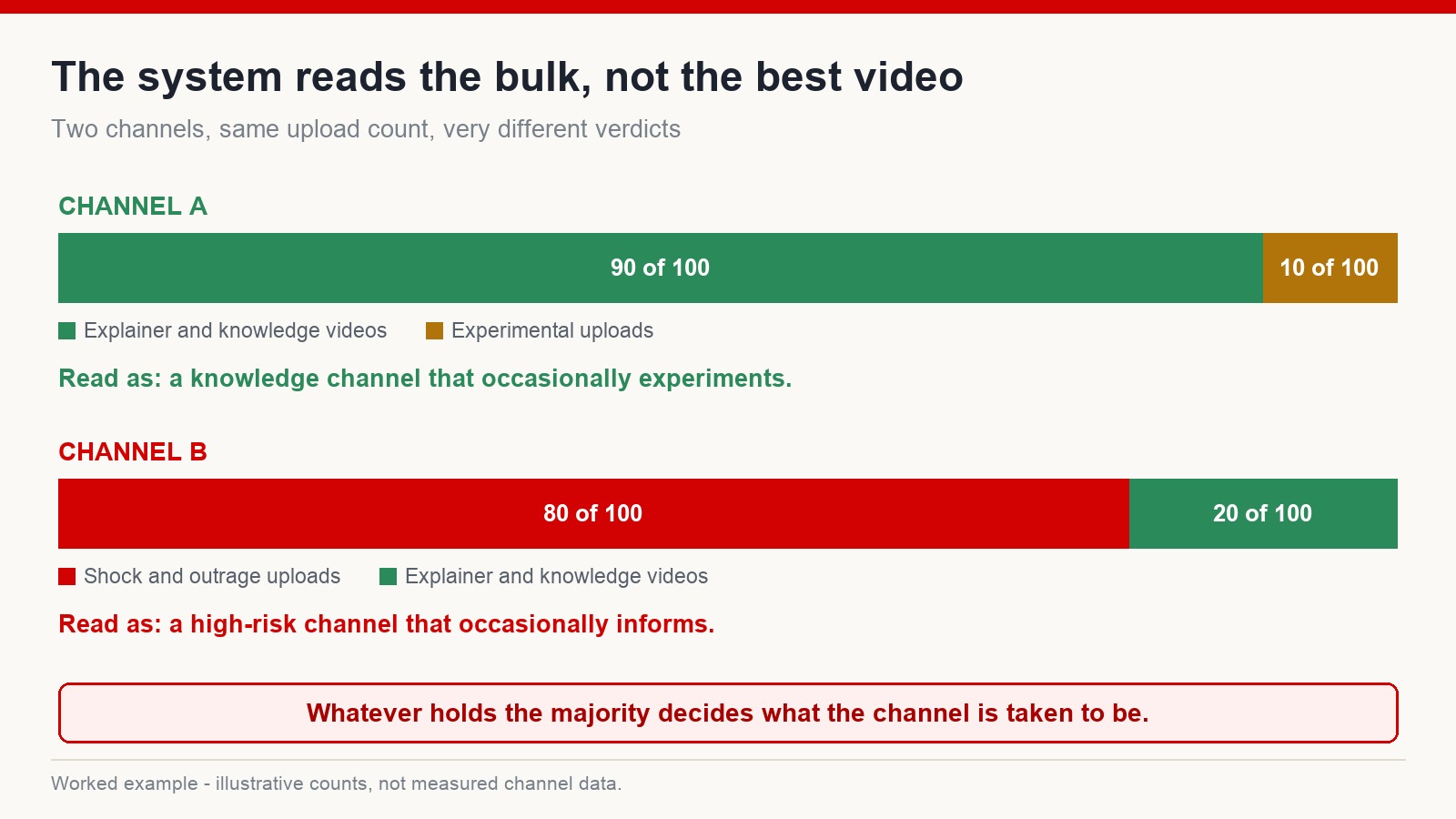
Consider two channels with identical output. The first has ninety explainer videos and ten experiments; the majority is knowledge, so it reads as a knowledge channel that occasionally tries something. The second has eighty inflammatory uploads and twenty explainers; the majority is risk, so it reads as a high-risk channel that occasionally informs.
Same number of videos. Completely different standing. And the second one lives permanently one policy update away from a very bad week.
This is also why channels seem to lose distribution “suddenly” when nothing obvious changed. Usually something did change – gradually, one upload at a time, until the majority tipped over into a category the creator never chose deliberately.
Rotations that keep the majority where you want it
None of this means never experiment. It means deciding in advance what proportion of the channel experimentation is allowed to occupy, then holding that proportion.
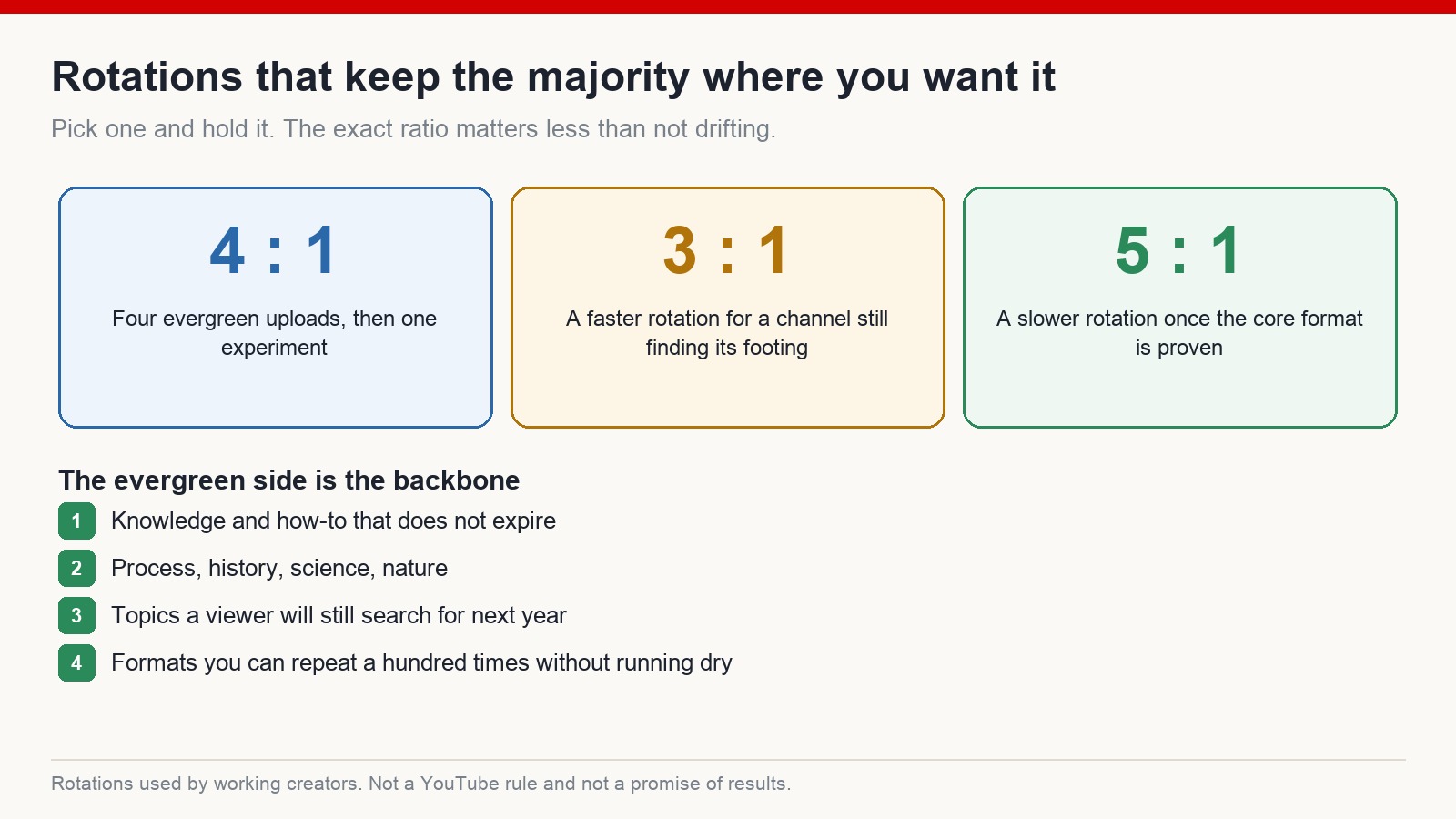
Four evergreen uploads then one experiment. Three then one, for a channel still finding its footing. Five then one, once the core format is proven and you would rather not disturb it. Pick one and hold it; the exact ratio matters far less than not drifting away from whichever you chose.
The point is not to suppress creativity. It is to make sure the experiments never become the identity by accident.
Why evergreen is the backbone
Evergreen topics have one enormous structural advantage: they do not depend on when they were published. Knowledge, how-to, process, history, science, nature, personal development. A viewer searching next year is searching for the same thing.
A good evergreen video keeps earning views for months or years after upload. That is an asset accumulating. Trend content is a spike that flattens, and a library made entirely of spikes is a treadmill you can never step off, because the moment you stop running the channel stops earning.
The same principle applied to choosing a niche
This is where the majority principle stops being defensive and starts being a research method. It is also what gets people out of picking topics on instinct.
Find channels that are clearly working in the space you are considering. Not the ones with the largest subscriber counts – the ones whose recent uploads are still pulling views, still uploading on a rhythm, with active comment sections. A channel coasting on numbers it earned years ago tells you about a market that has already cooled.
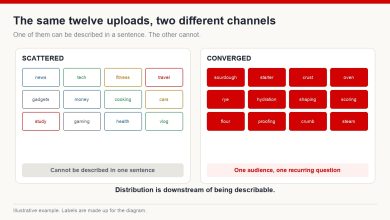
Then take its twelve most-viewed videos and sort them by sub-topic. If five are about police officers and wild animals, four about cars and cattle, and three about venomous snakes, you do not need an opinion about which to make. The majority already answered. That group is what the audience voted for, and it is the group to research further.
Note what you are doing here: reading evidence rather than guessing. The market has already run the experiment and published the results on a public page. Most people scroll past it.
Stop working on inspiration
Health today, animals tomorrow, philosophy the day after, motivational content next week.
The result is that the system cannot tell what the channel is, the audience cannot tell either, and after a while neither can you. Nothing accumulates because nothing repeats. The majority principle solves this by force: when most of the library points the same direction, the channel has a position whether or not you ever articulated one.
Say what it is
A lot of creators now use AI images, AI video and AI narration. That is entirely ordinary and I use these tools myself. The problem is never the tool. It is whether you are honest about it.
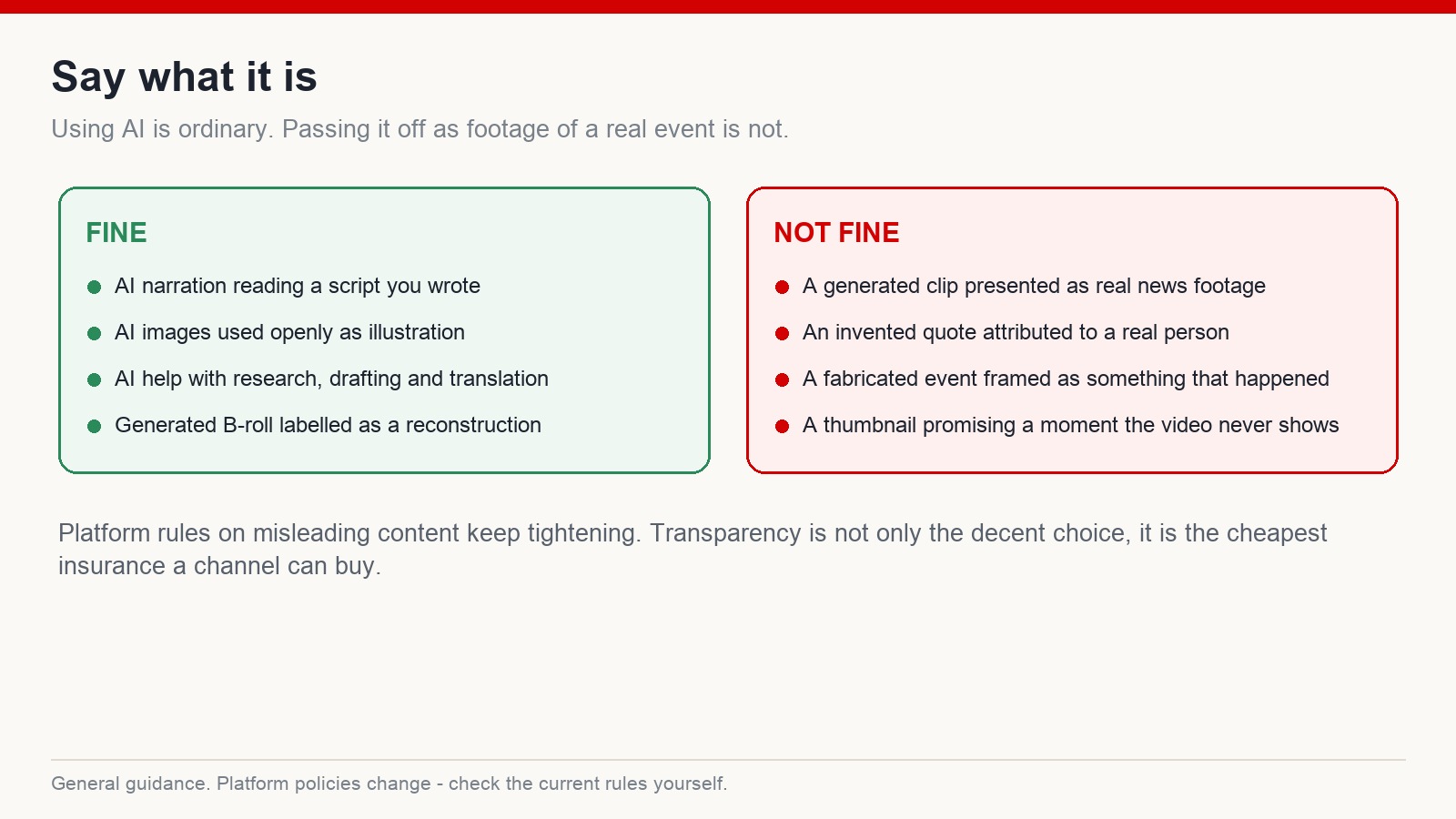
An AI voice reading a script you wrote is fine. Generated images used openly as illustration are fine. Generated B-roll labelled as a reconstruction is fine.
A generated clip presented as real footage of a real event is not. Neither is an invented quote attributed to a real person, a fabricated event framed as something that happened, or a thumbnail promising a moment the video never delivers.
Platform rules on misleading content keep tightening, and they will keep tightening. Transparency here is not only the decent choice; it is the cheapest insurance a channel can buy. Check the current policies yourself rather than trusting anyone’s summary, including mine.
How this removes luck from the process
Plenty of people treat YouTube as a lottery. It is less random than that, and the majority principle is most of the reason why.
When you study channels that already work, sort their best videos by topic, find what dominates, and build a library around the dominant group – you are steadily converting guesswork into evidence. You will still be wrong sometimes. You will be wrong far less often than someone choosing on instinct, and you will find out sooner.
The one line to keep
The majority principle is almost embarrassingly simple, and it sits underneath nearly every durable channel I have looked at. It settles the niche, sets the positioning, manages the risk, and quietly reduces how much luck you need.
If you remember one thing: whatever holds the majority decides what the channel becomes. So build the majority in the direction you actually want to go.
Does this apply to every kind of channel?
Yes. Faceless, vlog or brand channel, the bulk of the content is still what defines how the channel gets categorised.
Why twelve videos rather than three?
One hit can be luck and two can be coincidence. Twelve is small enough to analyse in an afternoon and wide enough that a repeating motif is a genuine pattern rather than a single freak result skewing your reading.
How much of the channel can be experimental?
Less than the core, by a clear margin. Whichever rotation you pick, the deciding question is whether someone landing on your channel page would describe it by the core content or by the experiments.
Should I switch niches when growth is slow?
Rarely, and not quickly. Switching resets the accumulated signal about your audience. Sharpen the angle inside the niche first, and only move if the evidence says the demand was never there.
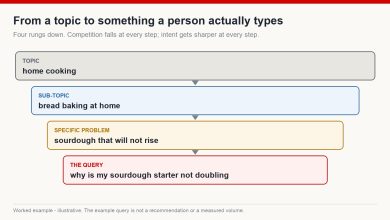
If you do not know what to make, do not start with “what do I like?”. Start with: in a working competitor’s twelve most-viewed videos, what appears most often? The market has usually already left the answer sitting in plain sight.
The full system I use for building faceless channels for international audiences is at mmoyoutube.com. Results vary, and platform policies change.