How to Tell a YouTube Keyword Is Trending Before the Tools Catch Up
Why the tool cannot tell you what is trending
The instinct is reasonable: open a keyword tool, look for phrases with a rising figure, make videos about those.
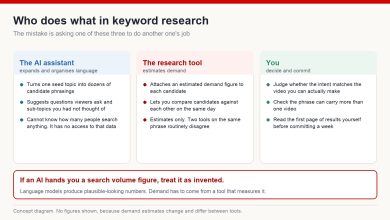
It does not work, and the reason is structural rather than a flaw in any particular tool. Research tools estimate demand from data that already exists. A trend is demand that is forming right now. By the time a phrase has enough history for a tool to put a confident number next to it, a good part of its life has already happened.
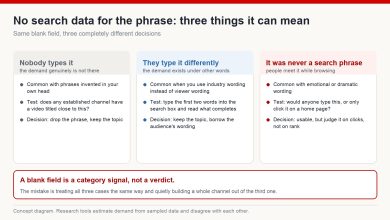
This is why you keep finding videos with enormous reach built on phrases that showed almost nothing beforehand. They were not found through research. They were noticed.
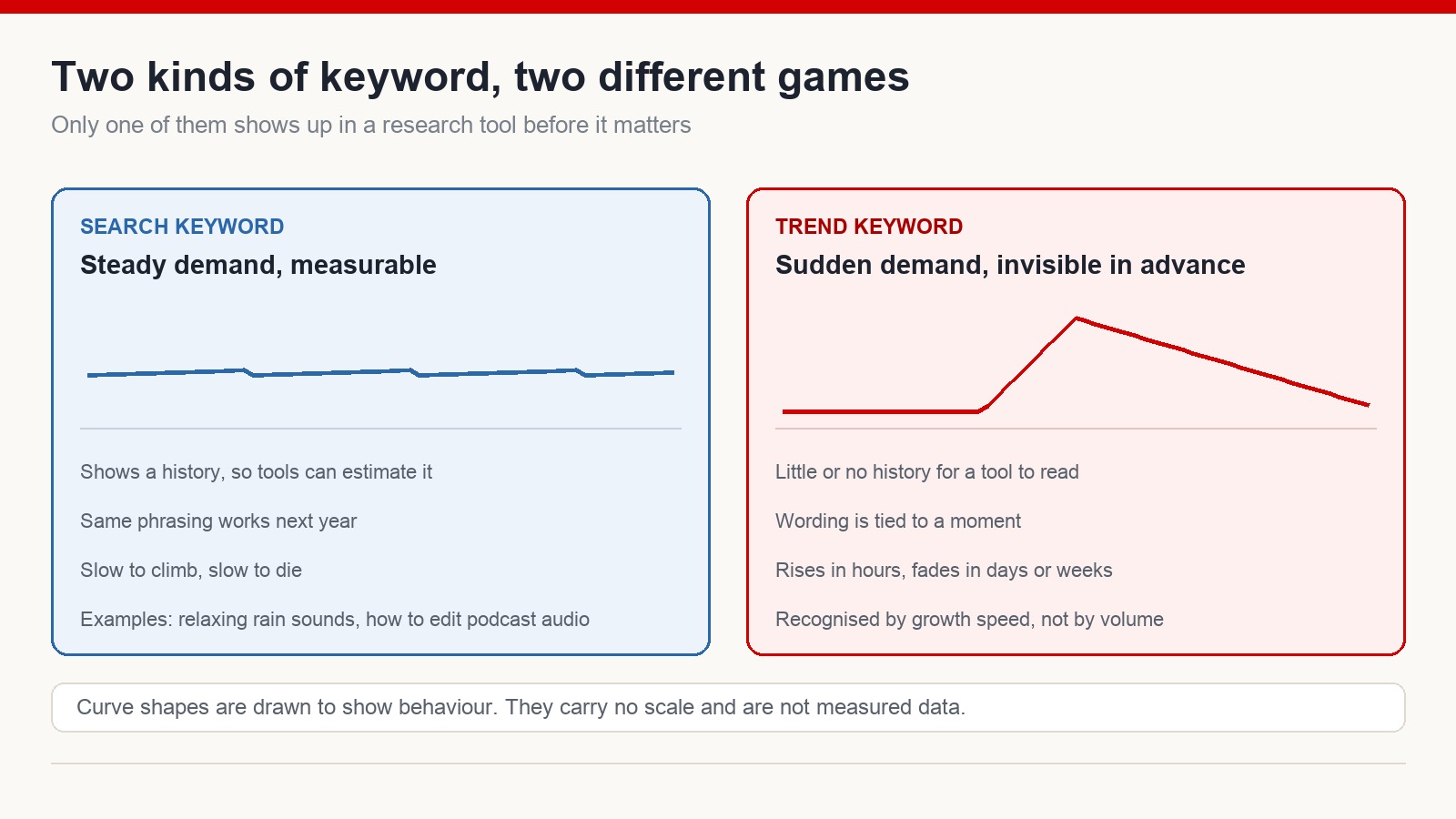
Two different games
It helps to stop treating these as one category.
Search phrases have history. People typed them last year and will type them next year. relaxing rain sounds, how to edit podcast audio, meditation music for sleep. They climb slowly, they decay slowly, and a tool can estimate them because there is something to estimate. This is the base of a channel: traffic that keeps arriving months after publication.
Trend phrases have little or no history. The wording is tied to a moment — a release, an event, a format that suddenly spread, a piece of news everyone is reacting to. They rise in hours and fade in days or weeks. You recognise them by growth speed, not by volume, because volume is the thing that has not been recorded yet.
Both are legitimate. They just require completely different methods, and confusing them is why people conclude that either research is useless or trends are unknowable.
Reading behaviour instead of a number
If a trend cannot be looked up, it can be observed. What you are looking for is not a large total — it is a rate.
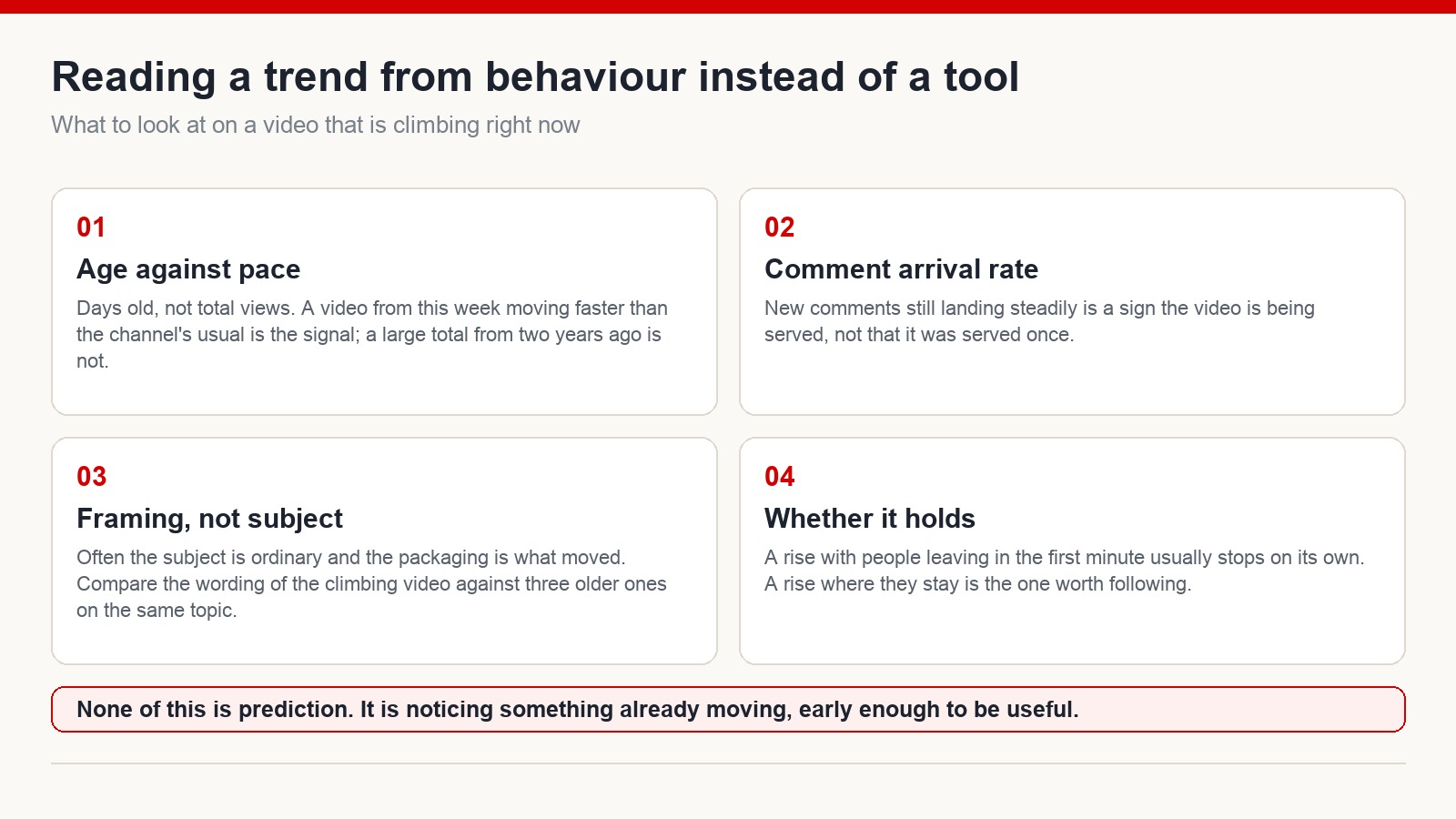
Pace against age
Sort a niche by recent uploads rather than by all-time performance, and look for videos moving faster than the channel that published them normally moves. A big number on a two-year-old video tells you the past. A video from this week outrunning its own channel’s usual pattern tells you something is happening now.
Compare like with like. A large channel gets a fast start on everything; that is not a trend, that is an audience. The interesting case is a modest channel with a video behaving unusually.
Comments still arriving
A steady stream of new comments suggests the video is still being served to people, rather than having been served once. It is a rough proxy and it is available without any tool.
Framing rather than subject
This is the one most people miss. Often the subject is entirely ordinary and what moved was the packaging.
Compare the wording of the climbing video against three older ones on the same topic. If the topic is identical and only the framing changed, the trend is in the framing — and framing travels across subjects, which makes it far more useful to you than the topic would have been.
Whether the rise holds
Some rises are just a burst of curiosity: people click, discover it is thin, and leave. Those stop on their own. A rise where people actually stay is the one worth following, and if you can see completion behaviour in the comments — people discussing something from the middle or the end — that is a small clue.
Signals in the wording itself
Trend phrasing tends to look a particular way. Recognising the pattern helps, as long as you also recognise its risks.
It carries a charge. Curiosity, surprise, disagreement. Top AI Tools is a list. The AI Tool That Just Made Editors Obsolete is an argument. Same subject, different reason to stop scrolling.
It often leans on a large round number. This is a real pattern and it deserves a warning. In topics involving money or health, big round numbers are frequently exaggerated or unverifiable, and repeating them because they perform is how creators end up making claims they cannot support. If you cannot source a number, do not put it in a title.
It is time-bound. The wording assumes the audience knows what is going on this week. That is exactly why it works now and why it is worthless in six months.
The honest part: this is partly luck
I would rather say this plainly than pretend otherwise.
Nobody catches trends reliably. Experienced creators test constantly and are wrong constantly. Whether a piece of content lands depends on timing, on what else is competing that day, on the mood of an audience, and on which viewers the system happens to test it with first. None of those are under your control.
What you can improve is the number of attempts, the speed of your reaction, and your ability to notice something already moving. That is probability management, not prediction, and treating it as prediction is how people burn a month chasing something that had already peaked.
A mix rather than a choice
The practical approach most steady channels use is a ratio.
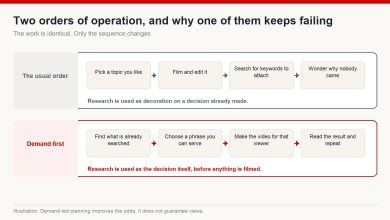
Something like one trend attempt for every one or two durable videos. Trends bring short bursts of attention and new subscribers. Durable videos hold a floor under the channel and keep returning traffic long after publication. Run only trends and the channel is a rollercoaster with no base; run only durable content and it grows, slowly, without ever catching a wave.
The exact ratio matters less than deciding one in advance, because in the moment a trend always feels more urgent than it is.
When something works, stay with it
Here is the mistake I see most often: a video takes off, and the creator immediately moves on to a different subject.
If a video is rising, people are staying, and the audience is responding, that is not the moment for novelty. That is the moment to make three or four more videos on adjacent angles of the same thing, quickly. The demand is demonstrably there and you have already shown you can serve it.
A lot of channel growth happens in exactly these windows. They are short, they close without notice, and the main way people miss them is by getting bored.
Two ways to get this wrong
Chasing every trend. If the trend has nothing to do with your audience, a burst of unrelated viewers arrives, does not come back, and the channel becomes harder to classify. You may get one good week and a harder six months. A trend is only worth following if a version of it belongs on your shelf.
Waiting for the tool to confirm it. By the time an estimate appears, you are late. Tools are excellent for durable phrases and structurally behind on emerging ones. Google Trends is the closest to real time among the general-purpose options, and even that is a lagging view of a fast-moving thing.
What to take away
You cannot know in advance that a phrase will trend. You can learn to recognise one that already is, early enough for it to be useful: strong framing, an unusual rate of growth relative to the channel publishing it, engagement still arriving, and an audience that stays once it clicks.
And the underlying point is worth keeping: the trend is not really in the keyword. It is in how people are reacting to it. The keyword is just the label we put on the reaction afterwards.
Frequently asked questions
Can a keyword tool find trends?
Only late. Tools estimate from existing data, so a phrase forming right now typically has nothing for them to read. Use them for durable phrases and use observation for emerging ones.
What is the clearest sign a keyword is trending?
Rate rather than total: recent videos climbing faster than the channels publishing them normally do, with engagement still arriving rather than having stopped.
Should a channel run only trend content?
It is an unstable way to build. Trends create spikes; durable content creates a base. Most steady channels run a mix and decide the ratio in advance.
Why do viral videos often show no keyword demand?
Because the demand was created by the moment rather than existing beforehand. The audience reacted before there was anything for a tool to measure.
How quickly do I need to move?
Fast enough to be early, but not so fast that you publish something you would be embarrassed by. A trend served badly still teaches an audience that your channel is not worth staying for.
If you want the full method for building faceless channels aimed at English-speaking audiences, including how I balance durable and reactive content, it is at mmoyoutube.com. Outcomes vary and no approach makes trends predictable.