Why the Same View Is Worth Different Amounts: Reading RPM Before You Pick a Niche
Almost everyone starting out has the same objective: more views. It is a reasonable proxy for progress, and it is where the visible feedback is.
Spend long enough around channels that have been monetised for a while and you notice something that breaks the proxy. The video with the largest view count is frequently not the video that earned the most. Sometimes it is not close.
What separates them is not effort. It is who was watching, what they were watching about, and how much advertisers were willing to pay to reach them.
What RPM actually measures
RPM stands for revenue per mille – estimated revenue per thousand views. It is calculated across all your views, whether or not an advert ran on them, and it reflects what actually reaches you after the platform takes its share.
That makes it different from CPM, which describes what advertisers pay for a thousand ad impressions before any split. CPM is a market price. RPM is your outcome. Two channels can sit in the same topic with similar CPMs and end up with different RPMs, because their audiences, formats and viewing patterns differ.
The practical consequence: RPM is not a property you select by choosing a topic from a list. It is an outcome produced by several things at once.
The same views can be worth very different amounts
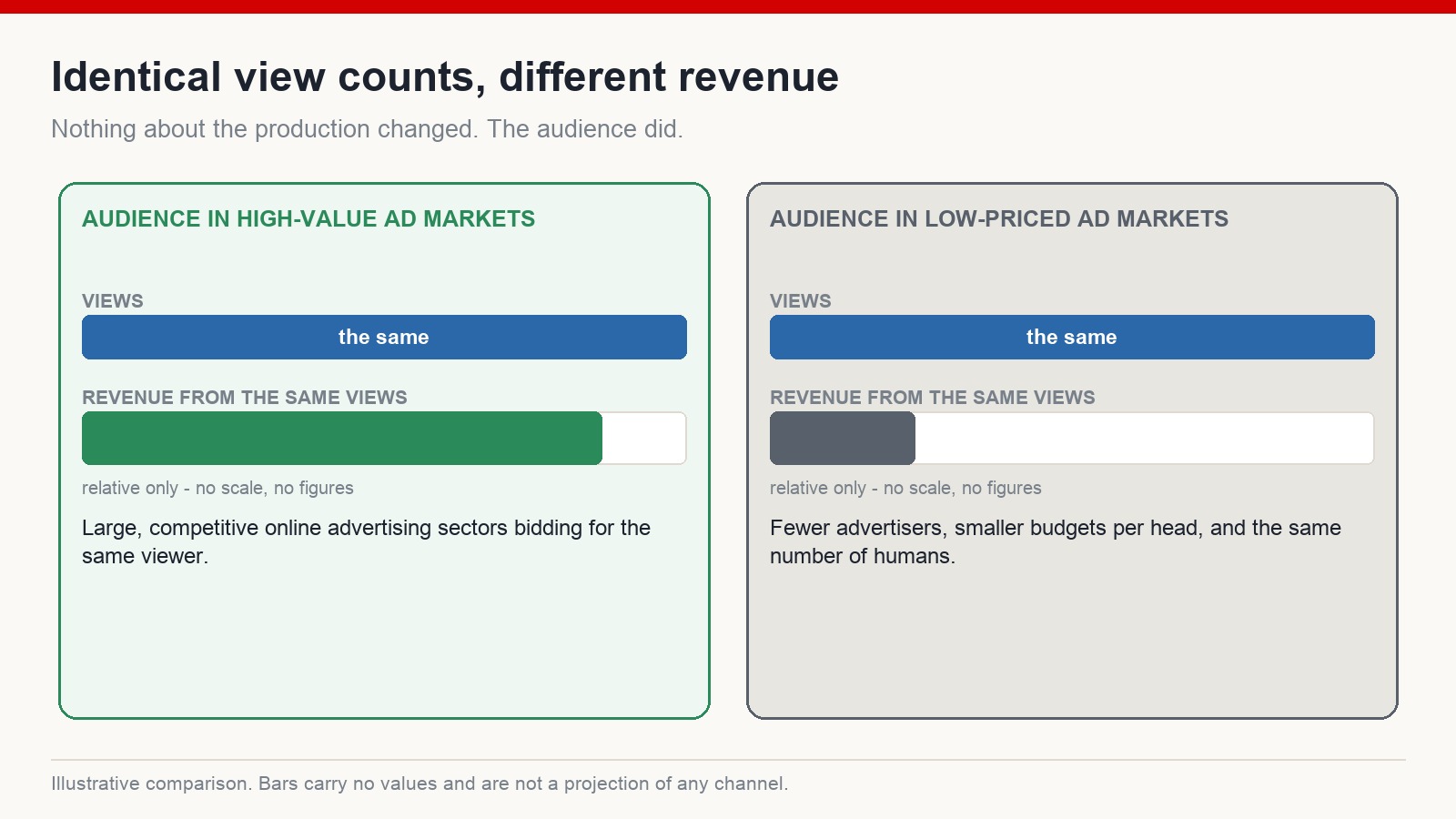
Imagine two channels with identical view counts. One is watched mostly in markets with large, competitive online advertising sectors. The other is watched mostly in markets where advertising budgets per head are much smaller.
Same effort, same number of humans, materially different revenue – and the creator has changed nothing about their production. This is the single most under-appreciated fact in the whole subject.
Five things that move RPM
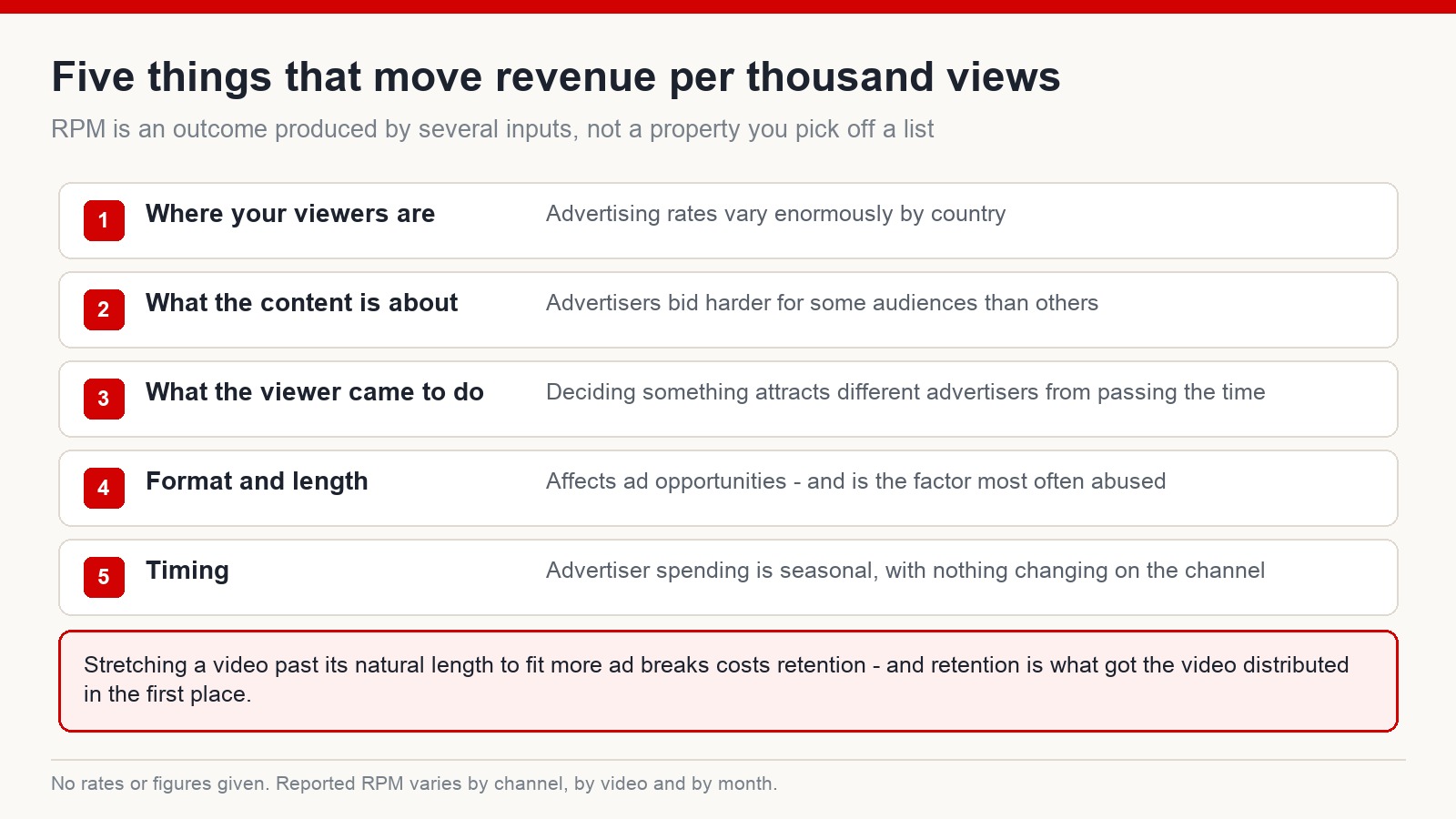
Where your viewers are. Advertising rates vary enormously by country. An audience concentrated in a high-value advertising market behaves very differently on a revenue report from one spread thinly across low-priced markets.
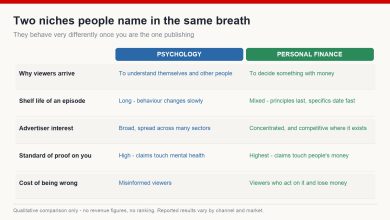
What the content is about. Advertisers bid harder for some audiences than others. A viewer researching business software is worth more to more advertisers than a viewer watching something purely for entertainment.
What the viewer came to do. Content watched with an intent to decide something – compare, choose, buy, learn a skill – attracts different advertisers from content watched to pass the time.
Format and length. How a video is structured affects how many ad opportunities it contains and how many are actually taken. This is a real factor, and also the one most often abused. Stretching a video past its natural length to fit more breaks in costs you retention, and retention is what got the video distributed in the first place.
Timing. Advertiser spending is seasonal. The same video can perform differently on revenue in different months without anything about the channel changing.
Why creators aim at particular markets
The markets that come up repeatedly – the United States, the United Kingdom, Germany, Japan, South Korea, France, Canada, Australia – come up because they have large, mature online advertising sectors. If your content genuinely fits viewers there, the revenue side of the same view count tends to look different.
Two honest qualifications. First, aiming at a market is not the same as reaching it: the content has to actually suit those viewers, not merely be translated for them. Second, none of this overrides quality. A video that does not hold attention does not get distributed, and a video that is not distributed has no RPM worth discussing.
Assistive tools have lowered the language barrier considerably – script translation, voice, subtitles, titles, localisation, thumbnail iteration. What they have not removed is the need to check the output and adjust it for the culture you are addressing. A technically correct translation that reads as foreign still reads as foreign.
Positioning changes who turns up
Some creators optimise not just the content but how it is framed.
A calm, atmospheric video can be presented as being about its subject, or as being about the state it produces – words in the family of tranquil, relaxing, calm, peaceful. Those two framings attract different people arriving for different reasons, and the difference shows up all the way through the funnel.
How well it works depends on the video and on how closely the framing matches what the viewer then experiences. Which is the constraint that matters: the packaging has to be true. A title that sets an expectation the video does not meet buys a click and loses the watch time, and watch time is what the distribution actually runs on.
Verticals that usually attract more advertiser competition
There is no fixed list that holds for all time, but these subjects tend to draw heavier advertiser interest: personal finance, investing, technology, software, artificial intelligence, marketing, business, education, productivity, and general health and self-care.
They come with a warning attached, and it is not a small one. These are precisely the areas where inaccurate content does real damage to people who act on it. If you build here, verification is part of the production process, not an optional extra – and any claim about money or health needs to be either properly sourced or not made at all.
The only arithmetic that is always true
Revenue from advertising is, at its simplest, RPM multiplied by views divided by a thousand. That relationship holds by definition.
Everything else – what RPM you will actually see, how many views you will get, how long either will last – is not predictable in advance, and anyone quoting you firm figures for a topic they have not run is guessing. Reported RPM varies between channels in the same niche, between videos on the same channel, and between months on the same video.
What high RPM cannot promise
A strong RPM on a small number of views is a small amount of money. Total revenue also depends on how many of your views are monetisable, how long people watch, how engaged they are, and a set of factors outside your control entirely.
No topic sits permanently at the top. No keyword guarantees a rate. And a niche chosen only for its advertising value, with no thought given to whether you can produce in it for a year, tends to be abandoned long before the revenue side ever becomes relevant.
Where this leaves you
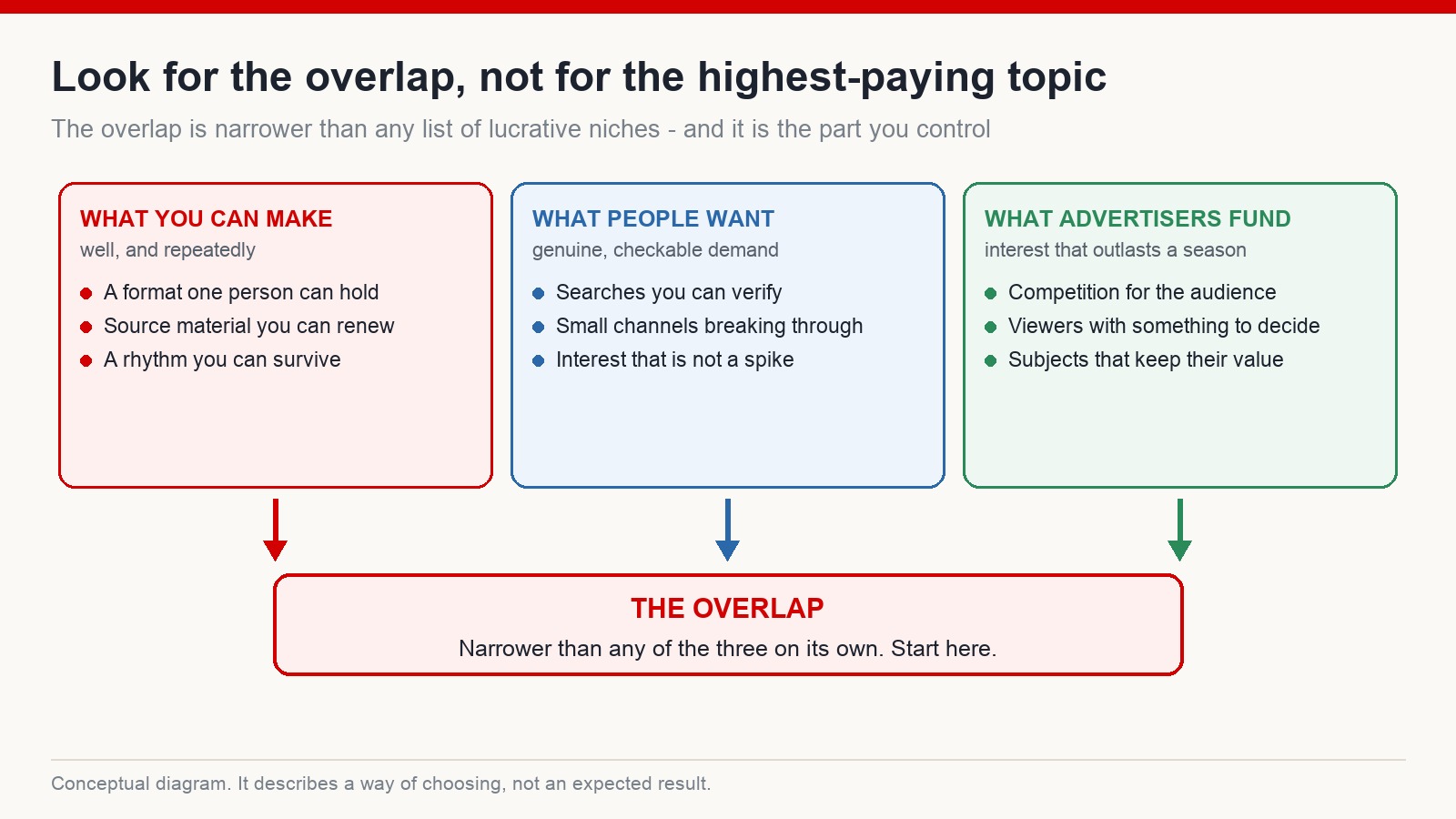
Do not go looking for the highest-paying niche. Look for the overlap between three things: what you can make well and repeatedly, what an audience genuinely wants, and what advertisers are willing to fund.
That overlap is narrower than any list of lucrative topics, and it is the only part of this you actually control.
Frequently asked questions
Does a high RPM mean high income?
No. RPM is one input. Total revenue also depends on monetisable views, watch time, engagement and factors that change month to month. A high rate on a small audience is still a small amount.
What is the difference between RPM and CPM?
CPM is what advertisers pay per thousand ad impressions, before the platform’s share. RPM is estimated revenue per thousand of your views after that share, counted across all views including ones that carried no advert.
Should a beginner build for an international audience straight away?
It is worth considering if you are prepared to research that audience properly rather than translating content made for somewhere else. The research is the work; skipping it is the usual reason the attempt fails.
Is there a formula that guarantees a high RPM?
No. There is no keyword, topic or format that guarantees a rate. Content quality and genuine fit with an audience are the foundation, and everything else is downstream of them.
If you want the full process for building toward an English-speaking audience, it is laid out at mmoyoutube.com.