Using AI to Slice a Topic Into Sub-Niches: The Prompt, and the Part That Comes After
Slicing a broad topic into sub-niches used to be the slow part of starting a channel. You sat with a notebook, wrote down everything you could think of, ran out of ideas after eleven, and then spent a week deciding which of the eleven was least bad.
That part is now cheap. A language model will produce forty candidate slices in the time it takes to make coffee. Which is useful, and also where the new failure mode lives: when generating candidates costs nothing, people stop treating candidates as guesses. The output reads like research. It is not research. It is a list.
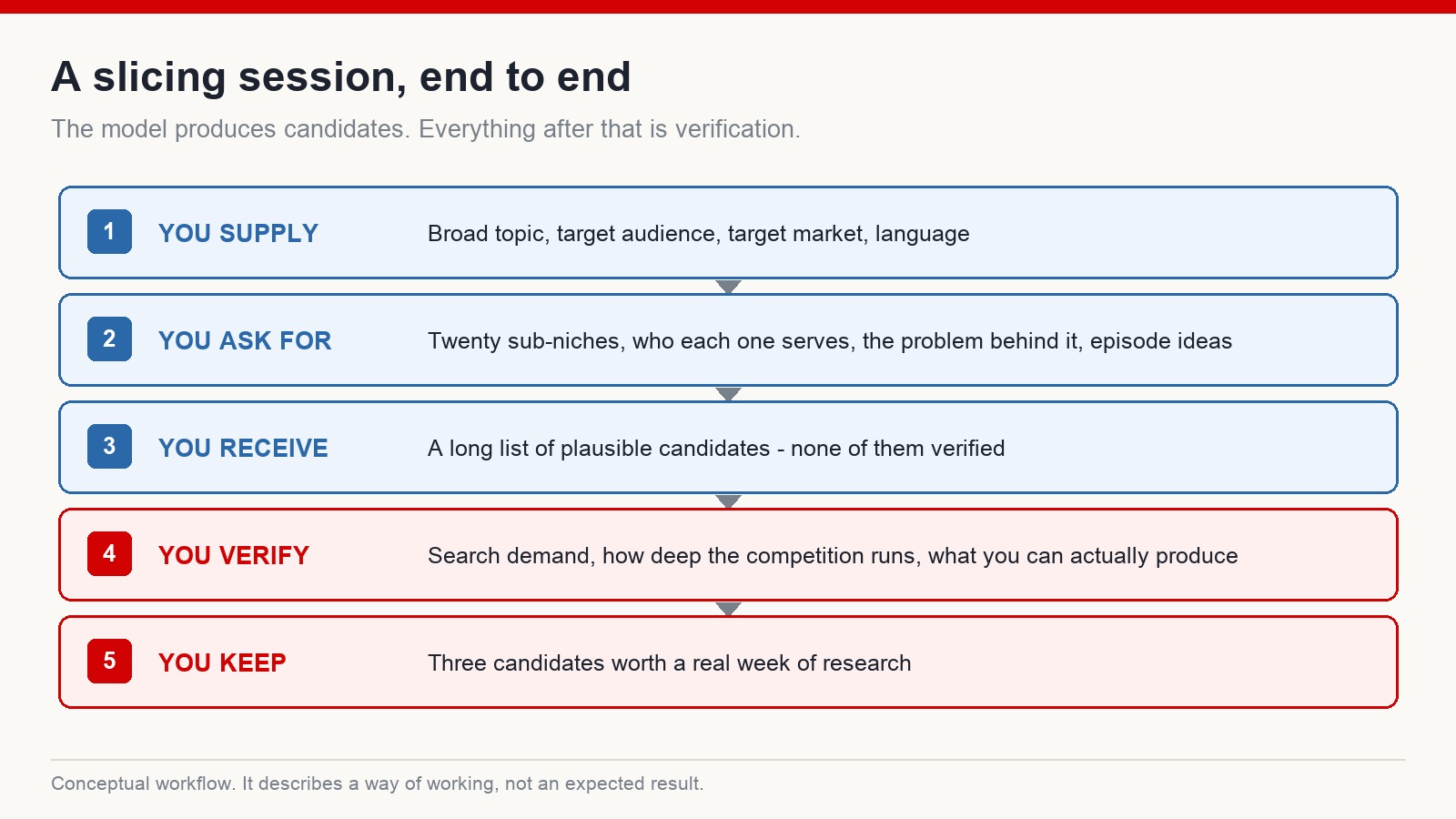
What follows is how I actually run a slicing session, including the prompt, and – more importantly – what has to happen afterwards before any of it counts.
What you are asking the model to do
You are asking for breadth, not judgement. The model has read an enormous amount of text about how topics get divided up, which makes it very good at producing plausible subdivisions and naming the kind of person who might care about each one. It has no idea whether anybody is currently searching for any of them.
So the brief should be shaped to get the thing it is good at: many options, described consistently enough that you can compare them.
The prompt
Paste this as written, replacing the bracketed parts:
You are helping me plan a faceless YouTube channel for an English-speaking audience, mainly in [target market].
My broad topic is: [broad topic].
Break this topic into 20 distinct sub-niches. For each one, give me:
1. The sub-niche in five words or fewer.
2. Who specifically watches it – age, situation, and what is going on in their life that makes them search for this.
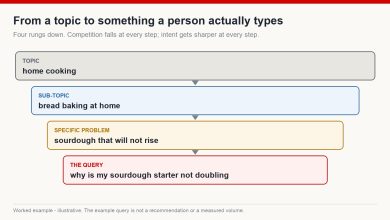
3. The single problem or curiosity behind it, written as a question that person would actually ask.
4. Five video ideas, phrased as titles a person would click without feeling tricked.
5. Whether the sub-niche could support a hundred episodes, and why or why not.
6. What the video would need to show on screen, and how hard that is to obtain.Then, separately: list which five of the twenty you would expect to be least well served today, and say what makes you think so. Mark clearly that this last part is your guess, not data.
The last instruction matters more than it looks. Asking the model to label its own speculation does not make the speculation reliable, but it does stop the whole output arriving in one confident, undifferentiated voice – which is what makes people trust it more than they should.
Reading what comes back
You will get twenty entries, and roughly the following distribution: a handful that are obviously too broad to be sub-niches at all, a handful that are inventions with no audience behind them, several that are real but already thoroughly served, and two or three that make you stop and think.
The ones that make you stop are not necessarily the good ones. They are the ones you had not thought of, which is a different property. Note them, but do not fall in love before the verification pass.
Point six – what the video needs to show on screen – is the entry I have come to read first. A sub-niche can have genuine demand and still be a bad choice for you if every episode needs footage you cannot obtain, licence, or convincingly substitute. That constraint kills more channels than competition does, and it is invisible while you are still enjoying the ideas.
What the model cannot know
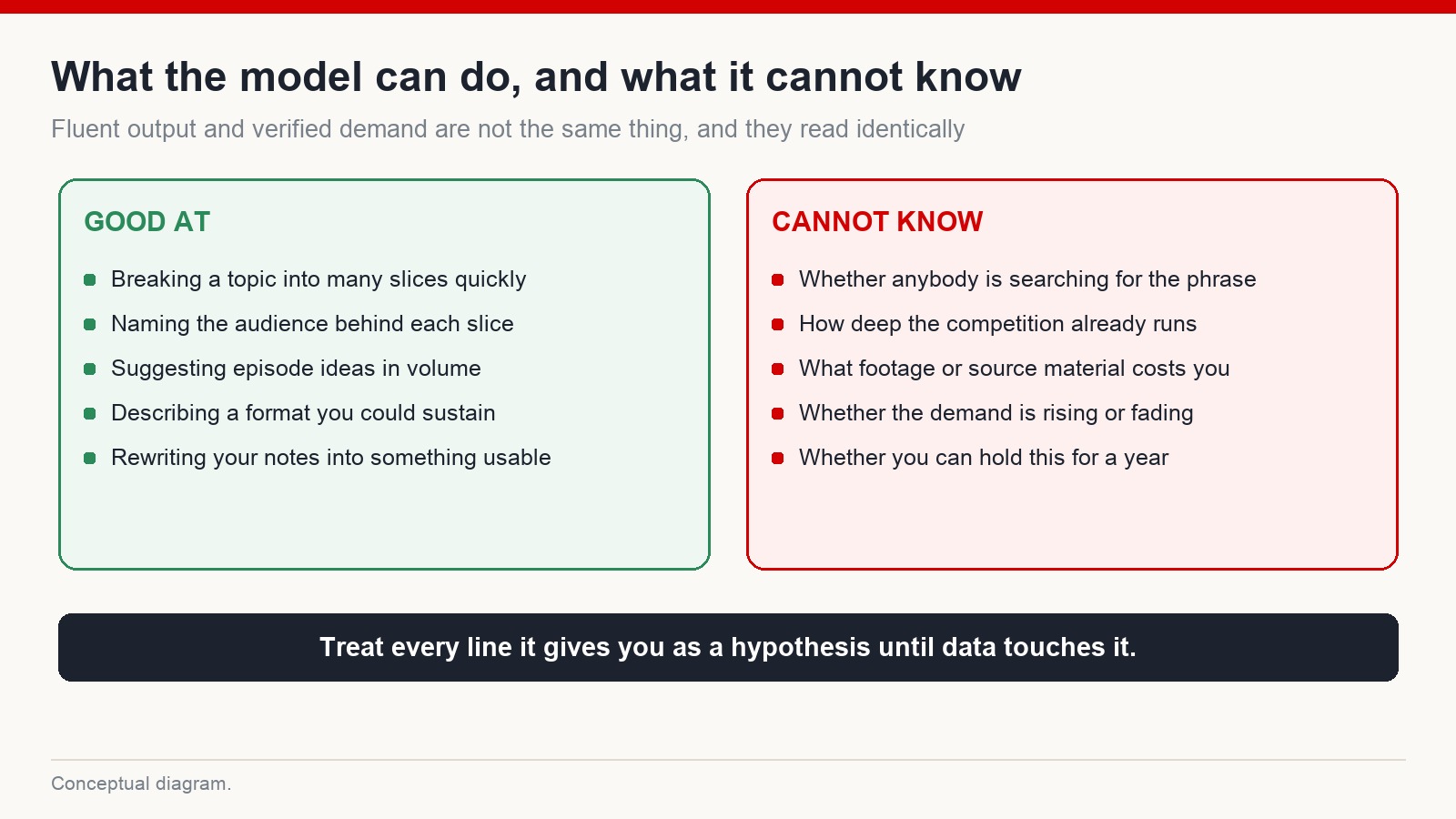
The gap is specific and worth naming, because fluent writing hides it well. The model cannot tell you whether anyone typed the phrase into a search box last week. It cannot tell you how many channels are already answering it properly, or how good they are. It cannot tell you what the raw material costs you in hours or money. And it cannot tell you whether the interest is growing or quietly draining away.
All four of those are answerable, and none of them are answerable by asking the model more confidently.
The verification pass
Take the three or four candidates you liked and put each one through the same three checks.
Is anyone actually looking for it
Take the question from point three of the output and check it as a search phrase in whatever keyword tool you use. You are not looking for the biggest number available – large phrases are where the established channels already live. You want enough demand to be real, small enough that the room is not already full. My own working band sits well below the headline phrases in any topic, and for a channel with no history I go narrower still. Treat that as one person’s habit rather than a standard; the sensible range moves with the topic.
How deep does the competition run
Search the phrase and look at who is answering it. If the first two pages are established channels with long catalogues, the demand may be real but attached to them. If a small channel with a short catalogue is also doing well on the theme, that is the entry-door test passing – the appetite is in the topic itself, and a newcomer is not locked out.
Can you actually produce it, fifty times
Sketch what episode one, episode ten and episode fifty look like. If episode fifty is unimaginable, the sub-niche is a video idea wearing a channel costume. This is where most attractive candidates fail, and it is much cheaper to find out now.
Twenty to three to one
The output of a good session is not a niche. It is a shortlist of three that survived verification, ranked by how confident you are about the production side rather than the demand side – because demand you can re-check in a week, and a format you cannot sustain will still be unsustainable in six months.
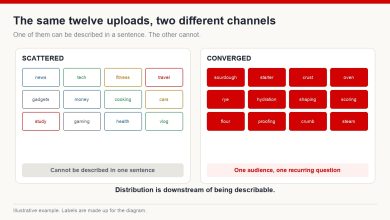
Then pick one, and hold it. The first block of videos on a new channel is doing a job beyond its view count: it is establishing what the channel is about, for the recommendation system and for anyone who lands on the page. A dozen or two uploads pointed at the same recurring question does that work. The same number scattered across four sub-niches does not, no matter how good each individual video is.
Where this leaves you
The model compresses a week of listing into an afternoon, which is genuinely worth having. It does not compress the verification, and the verification is the part that decides whether any of it was worth doing. Every line it gives you is a hypothesis until data touches it.
If you want the wider process this fits into – research, format, and building a faceless channel for English-speaking audiences – it is set out at mmoyoutube.com.
Frequently asked questions
Can I just ask the model which niche to pick?
You can, and it will answer confidently. The answer will be assembled from what sounded plausible in its training data, not from current demand. Use it to widen the field, then decide with data.
How many sub-niches should I ask for?
Twenty is a useful number: enough that the obvious answers get exhausted and the model has to reach, few enough that you will actually read all of them. Asking for a hundred mostly produces variations on the same six.
What if none of the twenty survive verification?
That is a result, not a failure. Run it again on a neighbouring topic. Two or three empty sessions cost you an evening; committing to an unverified niche costs you months.
Is it a problem to use AI in the research itself?
No. The distinction that matters is between using it to think faster and using it to publish faster. Analysis, structuring and drafting are reasonable uses. Mass-producing thin videos on the strength of an unverified list is how channels end up in trouble, and platform policies on this change – so stay current rather than assuming.