Your Comments Are a Content Plan: How to Mine Them for the Next Video
There is a question that eats more creator hours than editing does: what should the next video be about? People open a keyword tool, scroll a trending page, look at what a bigger channel published last week, and still end the session without a decision.
Meanwhile the answer is usually sitting underneath the videos they already published, written out in full sentences by the exact people they are trying to reach.
Comments are the cheapest audience research a channel will ever have access to. They are unprompted, they use the audience’s own vocabulary, and they arrive with the emotion still attached. The problem is that most channels treat them as a social obligation rather than a data source.
Why the comment section outperforms the tool
A keyword tool tells you what phrase people typed. It does not tell you what state they were in when they typed it, what they had already tried, or what they were afraid of. A video works when it lands on a specific want: a frustration, a confusion, a curiosity that has been sitting unresolved.
Those things get said out loud in comments, in plain language:
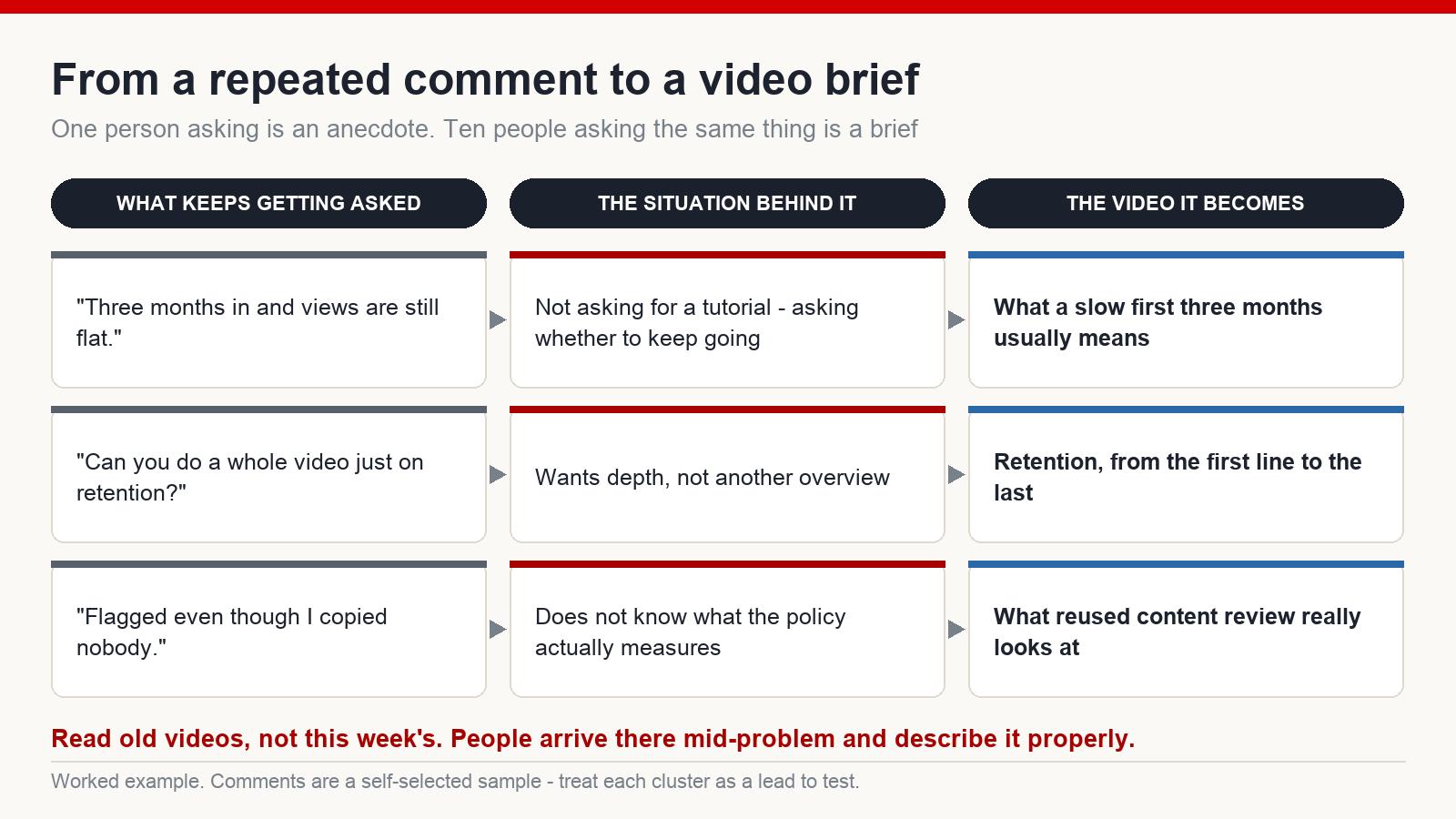
- “Good video but I have been doing this for three months and nothing moves.”
- “Could you do a whole video just on retention?”
- “I keep getting flagged even though I did not copy anyone.”
None of those are really comments. The first is a market position, the second is a request for a video with the demand already proven, the third is a whole series waiting to be built. The vocabulary is free too, which matters more than people expect: viewers phrase things differently to how the industry does, and titles written in the audience’s phrasing tend to feel more like an answer than a category.
What most people do instead
The standard routine is to heart the comment, type something friendly, and move on. That is fine for community, and it does nothing for content planning. The habit worth building is different: read comments in bulk, on purpose, with a document open, in a session that is separate from replying.
That difference explains a lot about who runs out of ideas after fifteen videos and who is still finding material after several hundred. The people who never run dry are not more imaginative. They are reading a feed that keeps refilling itself.
Step one: go back to the old videos
The instinct is to read the comments on this week’s upload. Those are the least useful ones. New videos attract reaction to the video itself, which is mostly praise, complaint, and jokes.
The richer material sits on videos that are one, three, or six months old, and especially on the ones that did unusually well or started an argument. People arrive there through search and suggestions, in the middle of a problem, having found the video because they were actively looking for a solution. That is when comments turn into descriptions of a situation rather than reactions to a performance.
Step two: hunt for the question that repeats
This is the whole technique, and it is almost mechanical. One person asking something is an anecdote. The same question phrased four different ways by ten different people is a signal that a group of viewers is stuck at the same point and nobody has served them properly.
Keep a running list. When a question appears for the third or fourth time, it stops being a comment and becomes a brief. Give each repeated question its own line, and note how it was phrased each time – those phrasings are your title drafts.
A repeated question tends to be worth more than a clever original idea, because the demand has been demonstrated before you spend a day producing anything.
Step three: read the feeling, not just the words
This is where most people stop too early. They extract the topic and throw away the emotion, and the emotion was the useful part.
Take: “I have been at this for three months and the views are still flat.” Read literally, the topic is growth. Read properly, the person is not asking for a tutorial. They are asking whether it is reasonable to keep going. A video titled after the mechanics will get a click from them; a video that acknowledges the doubt in the first ten seconds will keep them.
That is why openings framed as “the mistake that keeps a channel from being recommended” or “if your views have been flat for weeks” hold attention better than a neutral how-to framing of the same material. They name the state the viewer is in before explaining anything.
Step four: turn the comment into an opening line
The most direct use of a comment is as the first sentence of a video. Not quoted – rewritten, so the viewer with that problem recognises themselves without anyone being singled out.
A comment saying “my AI-assisted videos lose people fast” becomes an opening like: “There is one thing that makes a lot of generated videos lose people in the first thirty seconds, and it is not the script quality.” Someone in exactly that situation stops scrolling, because the video appears to know what is happening on their channel.
Do this with a real comment rather than an invented one and the opening tends to sound less like marketing, because the phrasing came from a person rather than from a template.
Step five: use AI to cluster, not to conclude
This is one job a language model genuinely does well. Copy a few hundred comments into a document, paste them in, and ask for the recurring problems, the recurring desires, and the phrasings that show up repeatedly. Ask it to group them and to name each group.
What comes back is a rough map of your audience’s open questions, produced in a minute instead of an afternoon. Two cautions worth keeping in mind. Models will smooth over the odd, specific comment, and the odd specific comment is often the most valuable one – so skim the raw text yourself as well. And comments are a self-selected sample: they over-represent the confident and the frustrated, and say nothing about the majority who watched and never typed. Treat every cluster as a lead to test, not a finding.
Step six: close the loop deliberately
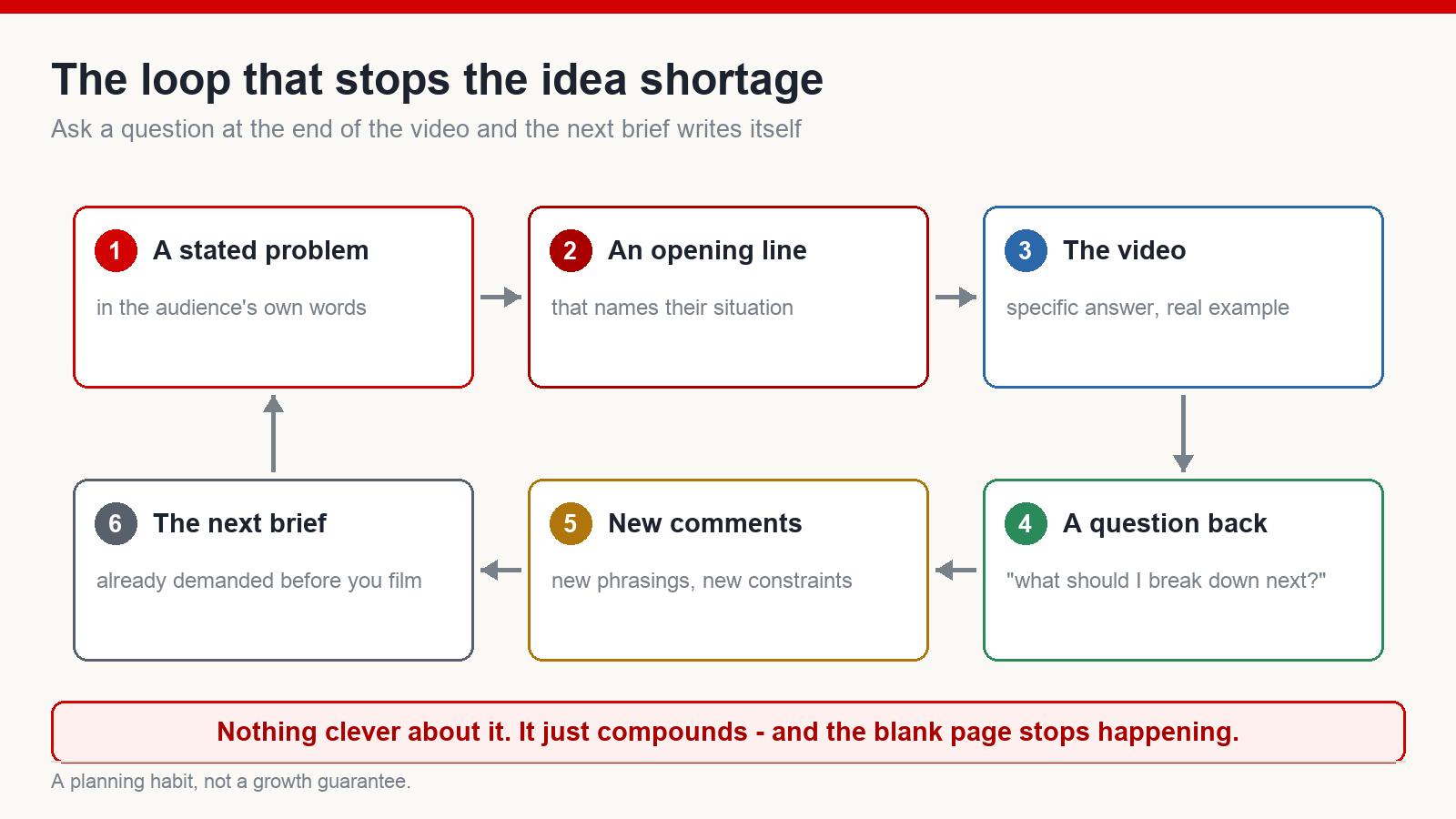
The strongest version of this is not passive. Instead of waiting for useful comments, ask questions that produce them. Ending a video with “which part of this should I break down next?” or “what are you stuck on right now?” turns the comment section into a survey.
Answers come back as new phrasings, new constraints, and new problems, which produce the next batch of videos, which produce the next batch of comments. Nothing about it is clever. It just compounds, and after a year of it the idea shortage stops being a problem.
Three ways this goes wrong
Answering in generalities. Nobody who wrote a frustrated comment wants encouragement. They want a specific mechanism, a real example, and a sequence they can follow.
Paraphrasing thinly. Reading the comment out and restating it at length is not a video. The comment gives you the question; the value has to come from your own analysis, your own examples, and what you have actually seen happen.
Taking the topic and dropping the emotion. The topic gets the click. The emotion is what makes someone stay for eight minutes, and it is the part that is hardest for anyone else to copy.
Before you open a keyword tool
None of this replaces research. It reorders it. Comments tell you which problems are live and how people describe them; the tools then tell you how much search demand sits behind each phrasing, and analytics tells you whether the resulting video actually held anyone.
But the sequence matters. Starting from the tool means guessing at what the audience wants. Starting from the comments means confirming it first and guessing second.
Frequently asked questions
Should I read competitors’ comments too?
Yes, and it is often more productive than reading your own, because a larger channel has more of them. Look at their highest-performing videos and their most argued-over ones. The unanswered questions under someone else’s video are open ground.
Can AI analyse comments for me?
It is good at grouping and naming patterns across a large paste of text. It is less good at spotting the single unusual comment that opens a new direction, so read some of the raw material yourself.
Which comments deserve priority?
Ones that repeat, ones carrying obvious frustration or worry, and ones that attracted agreement from other viewers. A comment with forty likes has been silently endorsed by forty people who did not type anything.
Are videos that answer a specific comment worth making?
Usually yes. They start from proven demand, they are easy to open (“someone asked this and it deserves more than a reply”), and they tend to build the sense that the channel is listening.
Does this work on a channel with almost no comments?
Borrow at first. Use the comment sections of channels serving the same audience, plus forums and communities where those people already talk. Once your own videos start collecting replies, switch to your own feed – it is more specific.
The habit worth keeping
Before deciding what to publish next, open the comment section on something you posted three months ago and read a hundred of them without replying to any. Write down every question that appears more than twice.
Most weeks that list will be longer than your production capacity, which is a much better problem than a blank page. New creators try to guess what a market wants. The ones who last mostly just read what it already said.
If you want a structured way to work through audience research and channel planning for an English-speaking audience, that is what we build at mmoyoutube.com.