How to Start a YouTube Video: The Opening as a Promise, Not a Trick
For a long time I blamed the wrong part of the video. The editing was fine, the thumbnail worked, the research was solid, and the graph still showed most of the audience gone before the first minute was over. Nothing in the middle was broken. The video simply never gave anybody a reason to still be there.
That is the thing about openings. They do not fail loudly. They fail by being reasonable — a greeting, a bit of context, a summary of what is coming — while the viewer’s thumb is already moving. I have been making YouTube videos since 2017, mostly faceless channels for English-speaking audiences, and rewriting openings is still the single change that moves the most for the least effort.
So this is how to start a YouTube video in a way that is honest and still holds people: four beats, written out, with lines you can read aloud and check.
An opening is not an introduction
The habit most of us start with is introduction: who I am, what the channel is, what today’s video covers. It feels polite. It is also completely uninteresting to somebody who arrived four seconds ago from a thumbnail and has no relationship with you yet.
What that person is doing in the first few seconds is answering one question — is there anything here for me? — and answering it on almost no information. Your job in the opening is to make that answer obvious, and then to be worth it.
Which means an opening has to do two things at once. It has to be interesting immediately, and it has to be an accurate description of what the video will actually deliver. Get the first without the second and you have written a trap, and traps show up later: people who feel misled do not come back, and the video after this one starts from a worse position.
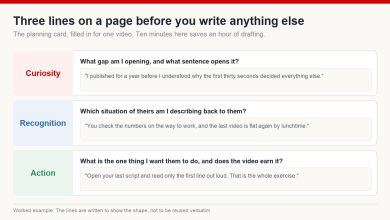
Four beats, in order
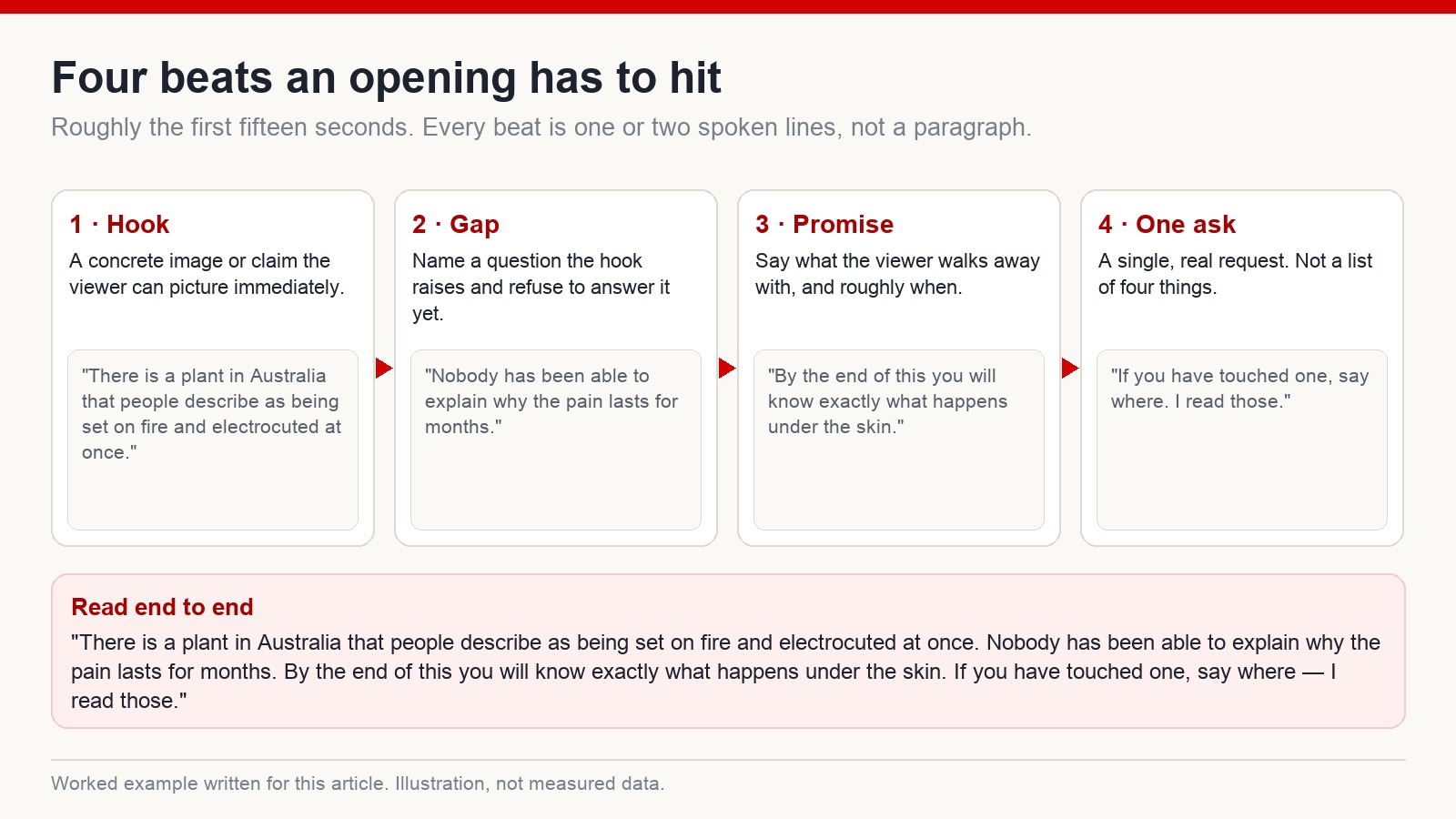
Almost every opening that works, in any niche, is doing these four things inside roughly fifteen seconds. Not fifteen seconds of talking — fifteen seconds of anything happening.
1. The hook: one concrete thing
Not a topic. A thing the viewer can picture. Abstractions (“today we look at dangerous plants”) are invisible; specifics (“a plant that people describe as being set on fire and electrocuted at once”) are not. If your first line could open five other videos in your niche, it is not a hook, it is a category label.
2. The gap: name a question and refuse to answer it
The hook creates a question. The second beat says the question out loud and then does not resolve it. “Nobody has been able to explain why the pain lasts for months.” That sentence adds no information at all. It adds a reason to stay, which is a different currency.
3. The promise: what they leave with
One line, plainly stated. “By the end of this you will know exactly what happens under the skin.” This is the beat most creators skip, and it is the one doing the structural work: it tells the viewer the video has a destination, and it commits you to arriving there.
4. One ask, and only one
If you want a response, ask for a real one, in a way that fits the video. Not four things. One.
The opening writes a cheque the rest of the video has to cash
Here is a check that takes ten minutes and is uncomfortable every single time. Write down every promise your opening makes — stated or implied — then find the timestamp where each one is paid off.
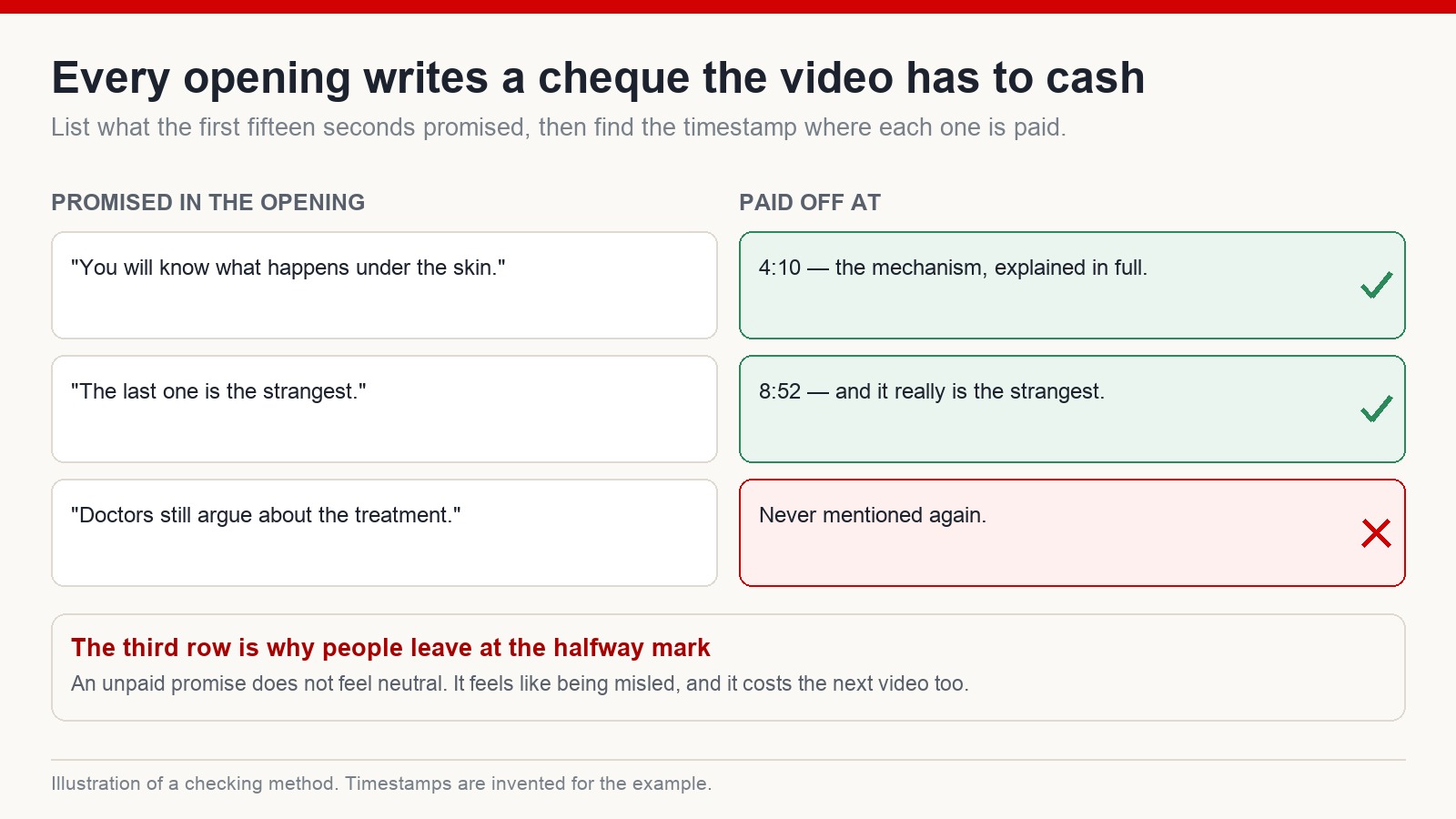
Most videos have at least one line in the left column with nothing on the right. That unpaid promise is not neutral. A viewer who was told the strangest case is coming and then watches the video end without it does not think “well, the rest was good”. They feel slightly conned, and it is a feeling that attaches to the channel rather than to the video.
Two ways to fix it, and both are fine: pay the promise, or delete it from the opening. What you cannot do is leave it there because it sounds good.
Write the opening after the video is finished
This is the single practice I would hand to somebody who only wants one thing from this article. Do not write the opening first. Write and cut the whole body, then go back and build the opening out of what you now know is in it.
The reason is simple. Before you make the video, you are guessing which part is strongest. After you make it, you know. You know which twenty seconds you would show somebody if you had only twenty seconds, and that is your hook. You know which claim is genuinely surprising, and that is your gap. You know what the video actually delivers, so the promise you write is one you can keep by definition.
On a faceless channel this is even easier, because the opening can be assembled from footage and lines that already exist further down the timeline. You are not writing new material. You are choosing the order in which existing material is revealed.
About asking for comments
You will see openings that end with “comment 1 if you are brave enough to watch to the end” or “type 0 if this gave you chills”. They work in the narrow sense that people do it. They are also engagement bait — asking for interaction purely to generate interaction — and YouTube’s spam and deceptive practices policy treats that as a violation, not as a clever tactic. Reach-for-reach and vote-for-a-number prompts sit in the same family.
The fix costs nothing. Ask a real question that a real person would answer, and only when the video has earned it:
“If you have ever touched one of these, I want to know where and what it felt like. I read those.”
“There is one thing I could not find a straight answer on, and it is in the description. If you know it, tell me.”
Both invite a response. Neither is a numbered reflex. The comments you get back are also worth reading, which the number ones never are.
Five openings, written out
The beats are easier to see in finished lines than in theory. These are written for different kinds of channel, and all five are fifteen seconds or under when read at a normal pace.
Nature / wildlife. “This bird has never built a nest in its life. It does not need to — it has worked out how to make somebody else raise its children, and the way it does it is genuinely unsettling. By the end of this you will never look at a garden hedge the same way.”
History. “When the banks closed in the 1930s, American towns started printing their own money. Some of it circulated for months. By the end of this you will understand why that worked, and why Washington was in a hurry to stop it.”
How-to / software. “This took me four hours the first time. It now takes eleven minutes, and the difference is one setting that is off by default. I will show you the finished result first, then how to get there.”
Explainer / science. “You have probably heard that your body replaces itself every seven years. It does not, and the parts that never get replaced are the interesting half of the story.”
Story / documentary. “Three people left the harbour that morning. The boat came back. In the next ten minutes you will hear what the inquiry decided, and why almost nobody who was there believes it.”
Read them out loud. If a line makes you self-conscious to say, rewrite it — a script that embarrasses the person reading it will sound exactly like that in the recording.
Three ways an opening dies
It warms up. Greeting, context, a bit of background, then the actual first interesting sentence at 0:40. Cut everything before the first concrete image and start there. It almost always works, and it is almost always painful to do.
The hook has nothing to do with the video. Borrowed drama that the body never touches. The opening is not a separate creative exercise; it is a preview of the same object.
Nothing is at stake. The information is accurate, the delivery is competent, and there is no tension anywhere — nothing withheld, nothing surprising, nothing the viewer wants resolved. This is the hardest one to see in your own script, because the writer already knows how it ends.
Frequently asked questions
How long should an opening be? Short enough that something has happened before the viewer decides. In practice that means the first concrete image lands almost immediately, and the whole four-beat opening is done in well under half a minute. Longer openings can work when the material is genuinely gripping from the first frame.
Should I introduce the channel at the start? Not at the start. If it belongs anywhere it belongs after the first payoff, when there is a reason to care who is talking.
Does the opening really affect how a video is recommended? What happens early in a video affects how much of it gets watched, and how much gets watched is part of what the platform responds to. That is a general tendency, not a formula, and it varies by niche and by format.
Is it dishonest to withhold the answer? No — as long as you deliver it. Withholding a resolution you intend to give is storytelling. Withholding one you never had is the thing to avoid.
Where to start
Take your last published video and do only this: write down the four beats it currently has, note which ones are missing, and list every promise the first fifteen seconds made. Then find where each promise is paid. You will usually discover that the video is fine and the entrance to it is not.
If you want the rest of this approach — the research, the structure, the production side of building a faceless channel for an international audience — that is what I teach at mmoyoutube.com. Results vary, platform policies change, and nothing here is a guarantee of an outcome.